Tardigrades Genes for Innovation - Science And Technology | UPSC Learning
Topics
0 topics • 0 completed
🔍
No topics match your search
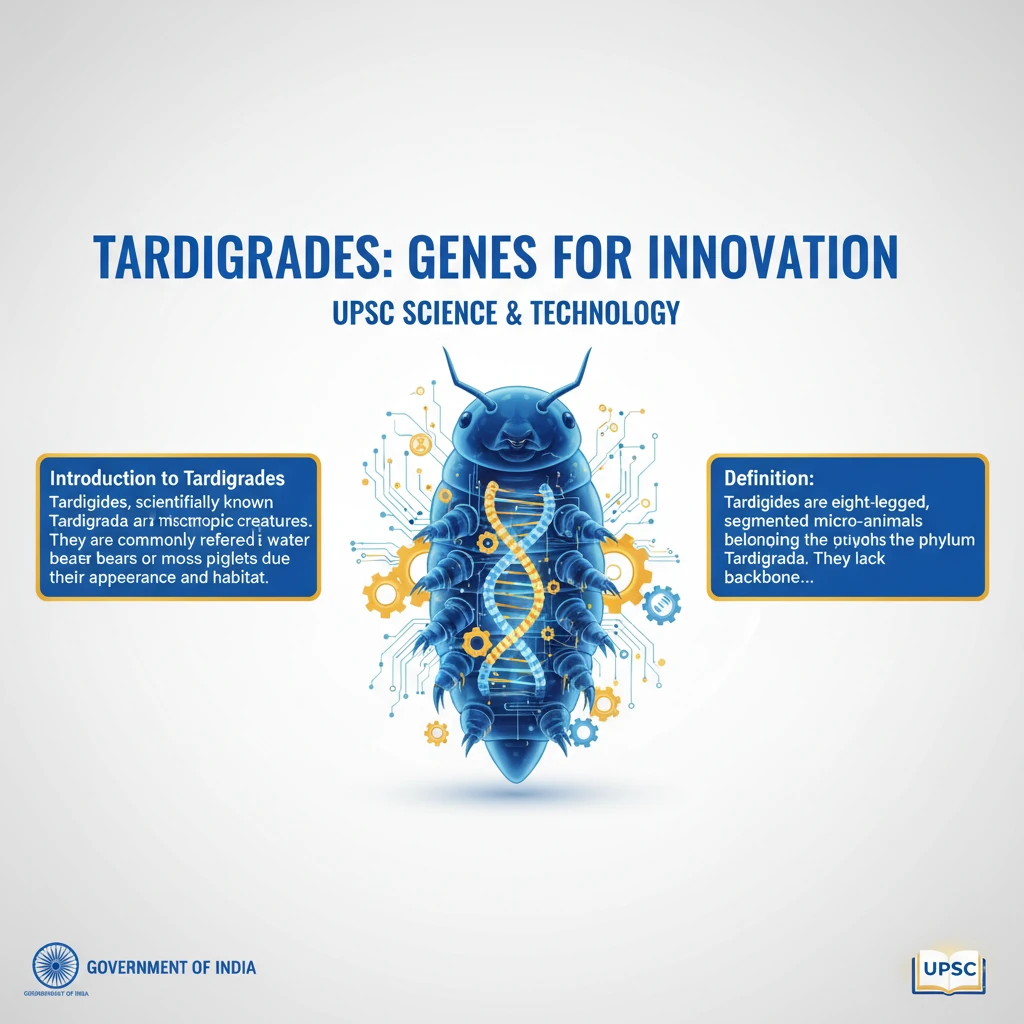
Tardigrades Genes for Innovation
Medium⏱️ 6 min read
science and technology
📖 Introduction
<h4>Introduction to Tardigrades</h4><p><strong>Tardigrades</strong>, scientifically known as <strong>Tardigrada</strong>, are fascinating microscopic creatures. They are commonly referred to as <strong>water bears</strong> or <strong>moss piglets</strong> due to their appearance and habitat.</p><div class='info-box'><p><strong>Definition:</strong> <strong>Tardigrades</strong> are eight-legged, segmented micro-animals belonging to the phylum <strong>Tardigrada</strong>. They lack a backbone, classifying them as invertebrates.</p></div><h4>Why are Tardigrades in the News?</h4><p>Recently, researchers have intensified their study of <strong>tardigrades</strong>. They are exploring a wide array of the creatures' unique features.</p><div class='key-point-box'><p>The primary goal is to draw inspiration from <strong>tardigrade biology</strong> to drive advancements in critical fields such as <strong>medicine, biotechnology</strong>, and <strong>space exploration</strong>.</p></div><h4>Key Characteristics of Tardigrades</h4><h5>Physical Attributes</h5><p>These creatures are truly microscopic, requiring specialized equipment to observe them. They possess <strong>eight legs</strong>, which they use for locomotion.</p><p>A defining characteristic is their lack of a vertebral column, meaning they are <strong>invertebrates</strong>.</p><h5>Classification and Evolution</h5><p><strong>Tardigrades</strong> are classified under their own distinct phylum, <strong>Tardigrada</strong>. This highlights their unique evolutionary path and biological distinctiveness.</p><div class='info-box'><p><strong>Earliest Known Fossils:</strong> The oldest identified <strong>tardigrade fossils</strong> date back approximately <strong>90 million years ago</strong>. These ancient records place their existence firmly within the <strong>Cretaceous Period</strong> (which spanned from <strong>145 to 66 million years ago</strong>).</p></div><div class='exam-tip-box'><p><strong>UPSC Relevance:</strong> Understanding <strong>tardigrades</strong> can be important for questions related to <strong>General Science</strong> (evolution, biology), <strong>Biotechnology</strong> (biomimicry, extremophiles), and <strong>Space Technology</strong> (radiation resistance, life in extreme environments).</p></div>
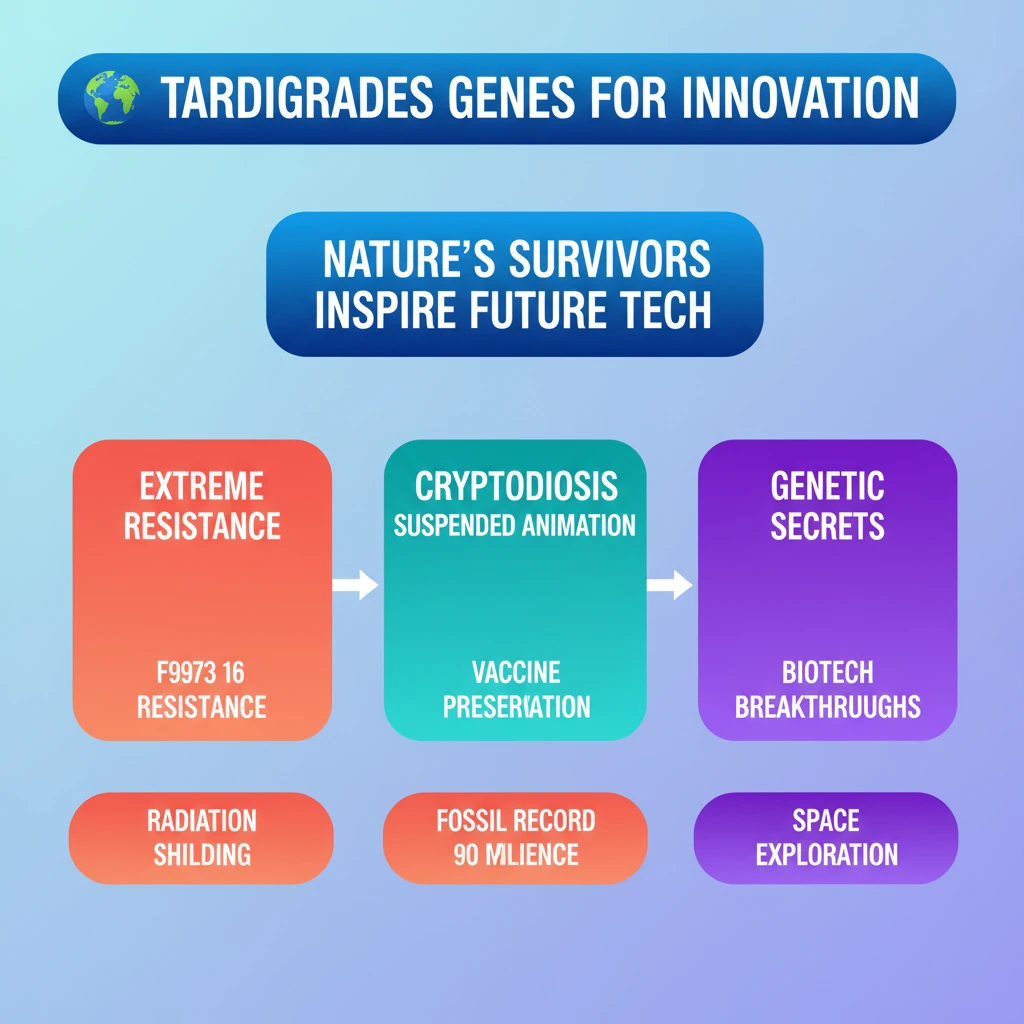
💡 Key Takeaways
- •Tardigrades are microscopic, eight-legged invertebrates, also known as water bears or moss piglets.
- •They are currently being studied for their unique features to inspire advancements in medicine, biotechnology, and space exploration.
- •Their earliest known fossils date back 90 million years to the Cretaceous Period.
- •Key survival mechanisms include cryptobiosis (suspended animation) and extreme resistance to radiation.
- •Research into tardigrade biology offers potential solutions for vaccine preservation, radiation shielding, and crop resilience.
🧠 Memory Techniques

95% Verified Content
📚 Reference Sources
•General scientific knowledge about Tardigrades (cryptobiosis, radiation resistance, Dsup protein)