What are the Contributions of Dr. APJ Abdul Kalam to DRDO? - Science And Technology | UPSC Learning
Topics
0 topics • 0 completed
🔍
No topics match your search
What are the Contributions of Dr. APJ Abdul Kalam to DRDO?
Easy⏱️ 5 min read
science and technology
📖 Introduction
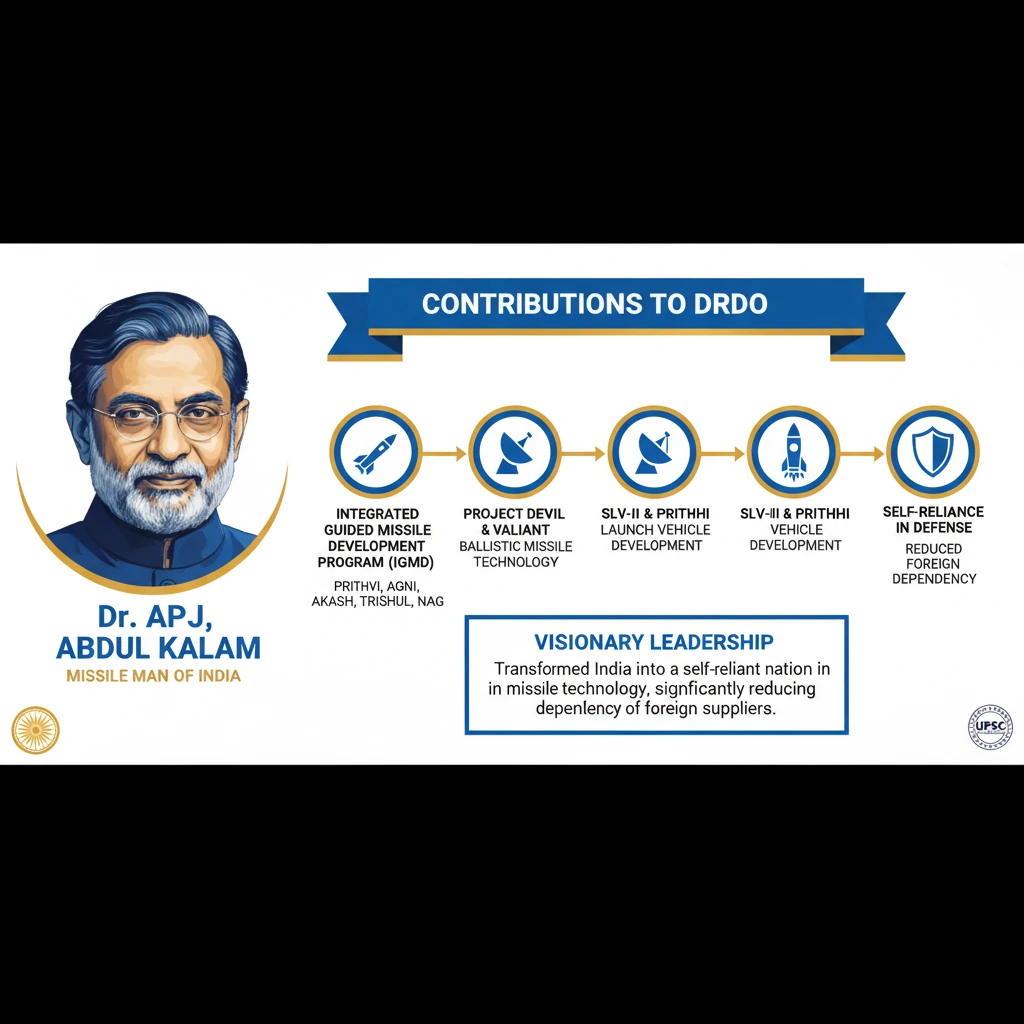
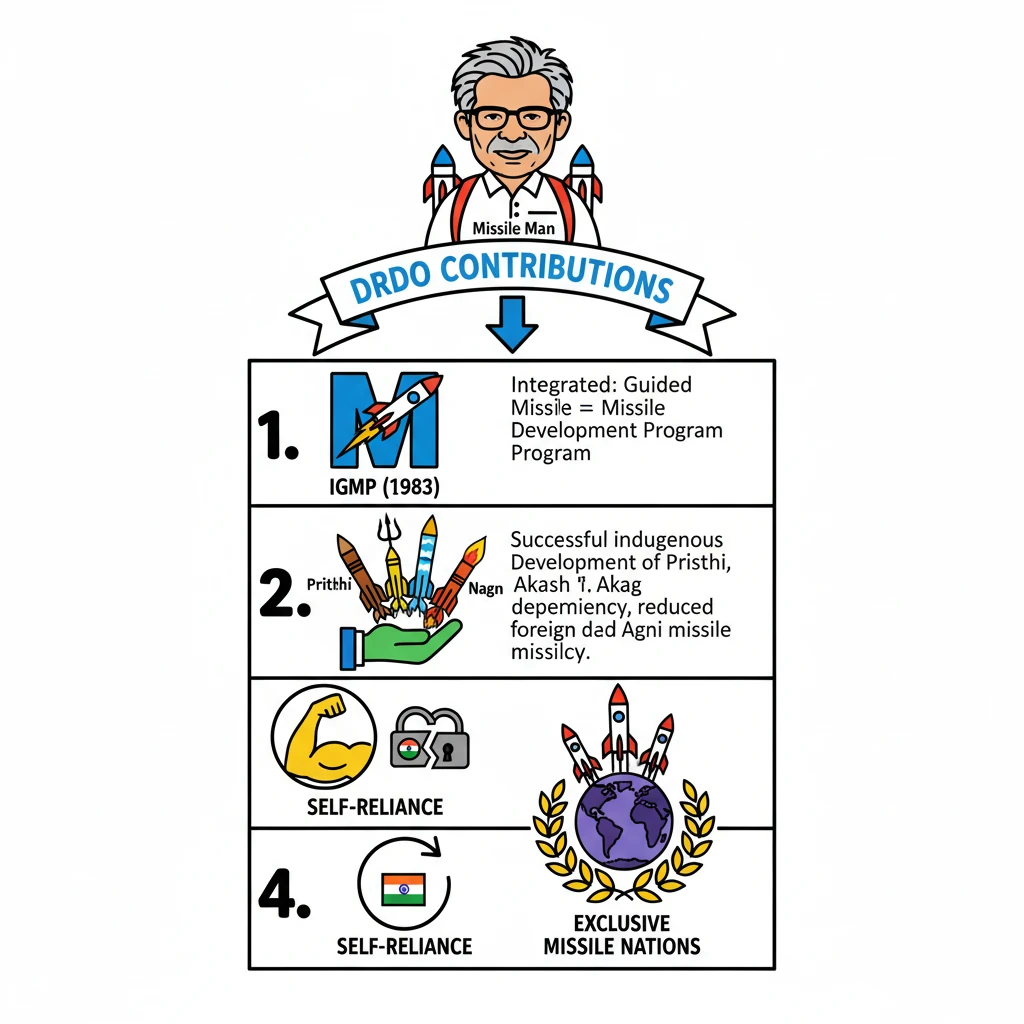
<h4>Introduction to Dr. APJ Abdul Kalam's Contributions to DRDO</h4><p><strong>Dr. APJ Abdul Kalam</strong>, widely revered as the <strong>'Missile Man of India'</strong>, played a pivotal role in strengthening India's defense capabilities through his work at the <strong>Defence Research and Development Organisation (DRDO)</strong>.</p><p>His visionary leadership transformed India into a self-reliant nation in missile technology, significantly reducing dependency on foreign suppliers.</p><h4>Leadership in Integrated Guided Missile Development Program (IGMDP)</h4><p><strong>Dr. Kalam</strong> was the driving force behind the conception and successful execution of the <strong>Integrated Guided Missile Development Program (IGMDP)</strong>.</p><div class='info-box'><p>The <strong>IGMDP</strong> was launched in <strong>1983</strong> with the ambitious goal of achieving self-sufficiency in missile technology.</p></div><p>Under his guidance, the program achieved significant milestones, laying the foundation for India's indigenous missile systems.</p><h4>Key Missile Systems Developed under IGMDP</h4><p>The <strong>IGMDP</strong>, under <strong>Dr. Kalam's</strong> leadership, led to the development of several critical missile systems that became the backbone of India's strategic defense.</p><ul><li><strong>Prithvi</strong>: India's first indigenously developed ballistic missile.</li><li><strong>Trishul</strong>: A short-range surface-to-air missile.</li><li><strong>Akash</strong>: A medium-range surface-to-air missile system.</li><li><strong>Nag</strong>: An anti-tank guided missile, also known as "Prospina".</li><li><strong>Agni</strong>: A family of intermediate-range ballistic missiles, crucial for strategic deterrence.</li></ul><div class='key-point-box'><p>The successful development of these missiles placed <strong>India</strong> in an exclusive group of missile-producing nations globally, earning <strong>Dr. Kalam</strong> the title of <strong>'Missile Man of India'</strong>.</p></div><h4>Technological Breakthroughs and Self-Reliance</h4><p><strong>Dr. Kalam's</strong> tenure at <strong>DRDO</strong> marked a period of intense innovation and technological advancement.</p><p>Breakthroughs were achieved in several critical areas of missile technology, fostering indigenous expertise.</p><ul><li><strong>Propulsion Systems</strong>: Development of advanced rocket engines.</li><li><strong>Navigation Systems</strong>: Precision guidance and control mechanisms.</li><li><strong>Control Systems</strong>: Ensuring accurate trajectory and target engagement.</li><li><strong>Aerodynamics</strong>: Optimized missile designs for enhanced performance.</li></ul><p>These advancements were instrumental in building <strong>indigenous missile systems</strong> and significantly <strong>reducing India's dependency on foreign supplies</strong> for defense hardware.</p><h4>Conclusion of IGMDP and its Enduring Legacy</h4><p>The <strong>Integrated Guided Missile Development Program (IGMDP)</strong> officially concluded in <strong>2008</strong>.</p><p>Its impact extended beyond just missile development, providing significant technological spin-offs and strengthening India's overall defense capabilities.</p><div class='exam-tip-box'><p>The success of <strong>IGMDP</strong> is often cited as a prime example of India's commitment to <strong>strategic deterrence</strong> and its journey towards self-reliance, aligning with initiatives like <strong>'Make in India'</strong> in the defense sector.</p></div>
💡 Key Takeaways
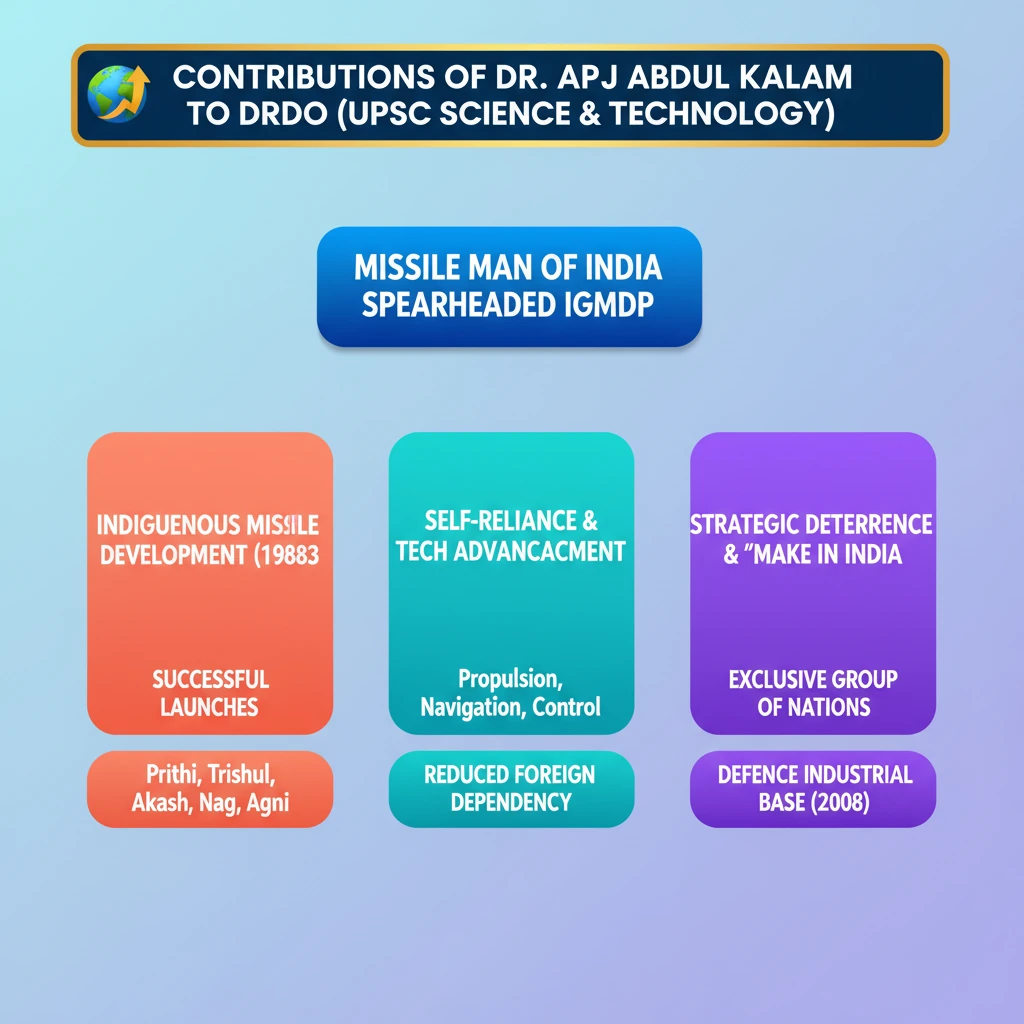
- •Dr. APJ Abdul Kalam, the 'Missile Man of India', spearheaded the Integrated Guided Missile Development Program (IGMDP) at DRDO.
- •IGMDP, launched in 1983, led to the successful indigenous development of Prithvi, Trishul, Akash, Nag, and Agni missiles.
- •The program fostered self-reliance in critical missile technologies like propulsion, navigation, and control systems, reducing foreign dependency.
- •India joined an exclusive group of missile-producing nations due to IGMDP's success.
- •IGMDP, concluded in 2008, strengthened India's strategic deterrence and contributed to the defence industrial base, aligning with 'Make in India'.
🧠 Memory Techniques
98% Verified Content