Moiré Materials and Superconductivity - Science And Technology | UPSC Learning
Topics
0 topics • 0 completed
🔍
No topics match your search
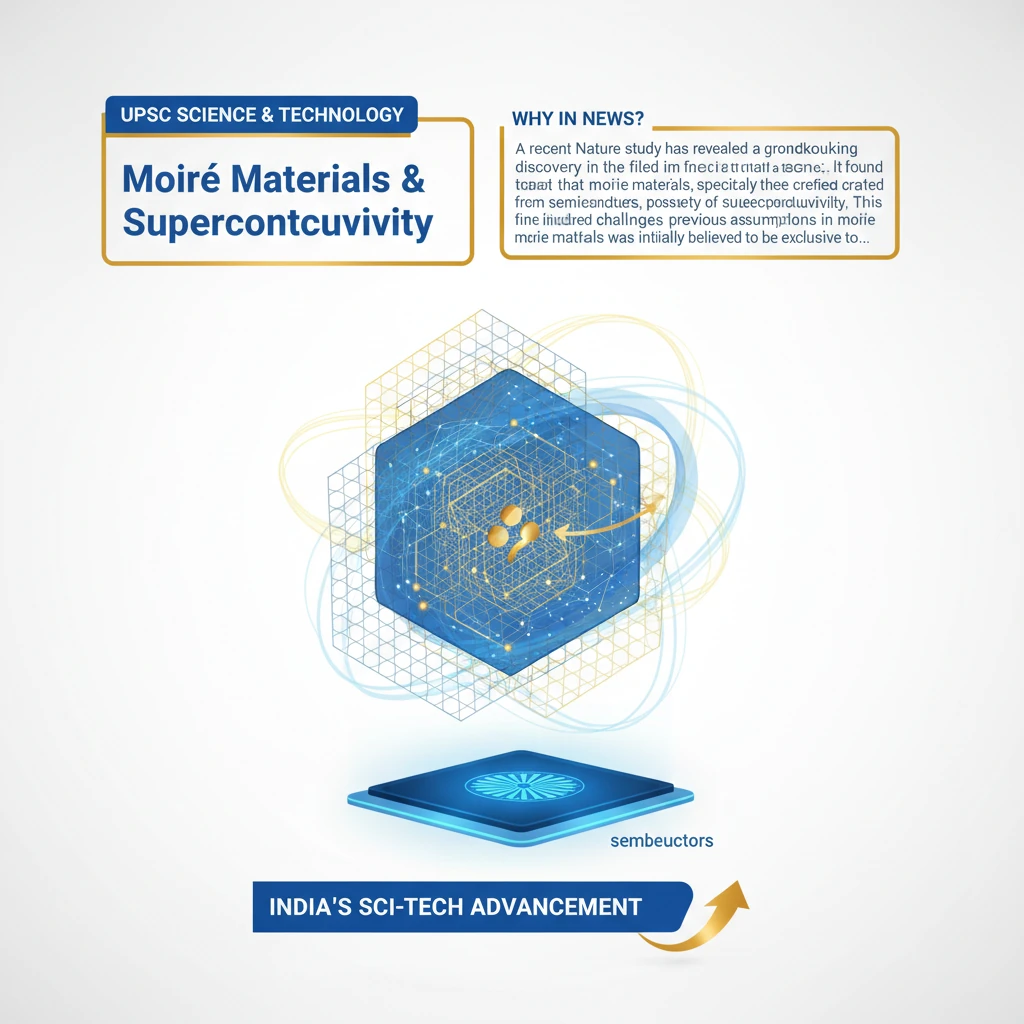
Moiré Materials and Superconductivity
Medium⏱️ 7 min read
science and technology
📖 Introduction
<h4>Why in News?</h4><p>A recent <strong>Nature study</strong> has revealed a groundbreaking discovery in the field of <strong>material science</strong>. It found that <strong>moiré materials</strong>, specifically those crafted from <strong>semiconductors</strong>, possess the property of <strong>superconductivity</strong>.</p><p>This finding challenges previous assumptions, as <strong>superconductivity</strong> in <strong>moiré materials</strong> was initially believed to be exclusive to <strong>graphene-based structures</strong>.</p><h4>What are Moiré Materials?</h4><p><strong>Moiré materials</strong> are advanced engineered materials that exhibit unique properties. These properties arise from an <strong>interference pattern</strong> formed when two highly repetitive structures are precisely overlaid with a slight rotational misalignment.</p><div class='info-box'><p><strong>Definition:</strong> A <strong>Moiré pattern</strong> is a visual interference pattern created, for example, when two sets of parallel lines or grids are superimposed at an angle, or when they have slightly different pitches.</p></div><h4>Creation of Moiré Materials</h4><p>The creation of <strong>moiré materials</strong> typically involves a precise layering technique. Two layers of a <strong>two-dimensional (2-D) material</strong> are stacked upon each other.</p><p>One layer is then subtly twisted at a small, specific angle relative to the other. For instance, in research, an angle of approximately <strong>3.65°</strong> has been used for materials like <strong>tungsten diselenide</strong>.</p><div class='key-point-box'><p>The deliberate <strong>twist</strong> between the material layers is crucial. It generates a distinctive <strong>moiré pattern</strong> that fundamentally alters the material's electronic behavior, leading to properties not present in the individual layers.</p></div><h4>Electronic Properties of Moiré Materials</h4><p>The unique twist in <strong>moiré materials</strong> has a profound effect on their <strong>electronic structure</strong>. It leads to the formation of what are known as <strong>flat bands</strong>.</p><p>In these <strong>flat bands</strong>, electrons move exceptionally slowly and maintain a nearly constant energy level. This sluggish movement is a critical factor.</p><div class='key-point-box'><p>The slow electron movement significantly enhances <strong>electron-electron interactions</strong>. These amplified interactions are fundamentally important and considered crucial for the emergence of <strong>superconductivity</strong> within the material.</p></div><h4>Research on Tungsten Diselenide (WSe2)</h4><p>Recent studies have focused on <strong>Tungsten Diselenide (WSe2)</strong>, which is a prominent example of a <strong>semiconductor moiré material</strong>. This research has yielded significant results regarding its superconducting capabilities.</p><p><strong>WSe2</strong> demonstrated <strong>superconductivity</strong> at a remarkably low transition temperature of approximately <strong>−272.93° C</strong>. This temperature is comparable to those observed in some <strong>high-temperature superconductors</strong>.</p><div class='info-box'><p><strong>Key Finding:</strong> The <strong>superconducting state</strong> observed in <strong>WSe2</strong> was found to be more stable compared to other <strong>moiré materials</strong> investigated, highlighting its potential for practical applications.</p></div><div class='exam-tip-box'><p><strong>UPSC Insight:</strong> Questions on <strong>advanced materials</strong> often focus on their unique properties and potential applications. Understanding the mechanism (<strong>flat bands, electron-electron interactions</strong>) and specific examples like <strong>WSe2</strong> is vital for both Prelims and Mains (<strong>GS Paper 3: Science & Technology</strong>).</p></div>
💡 Key Takeaways
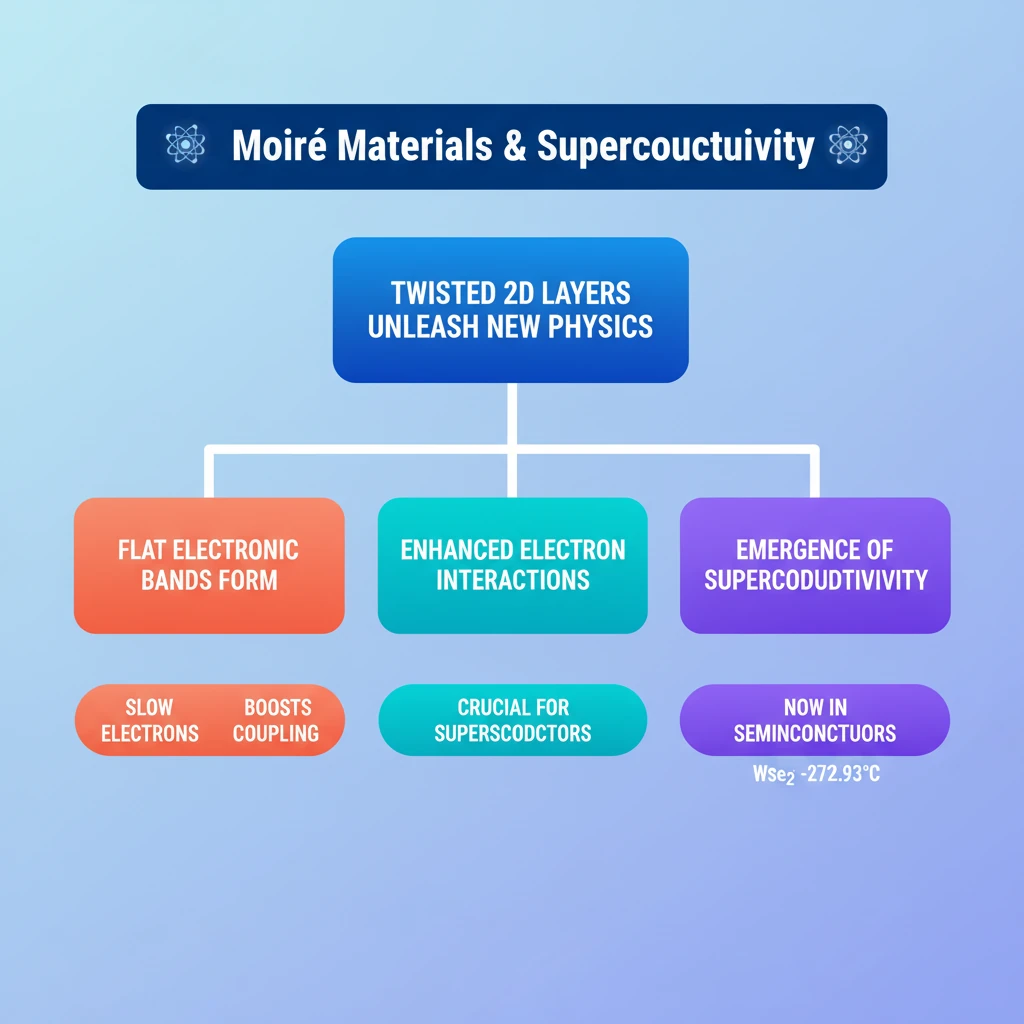
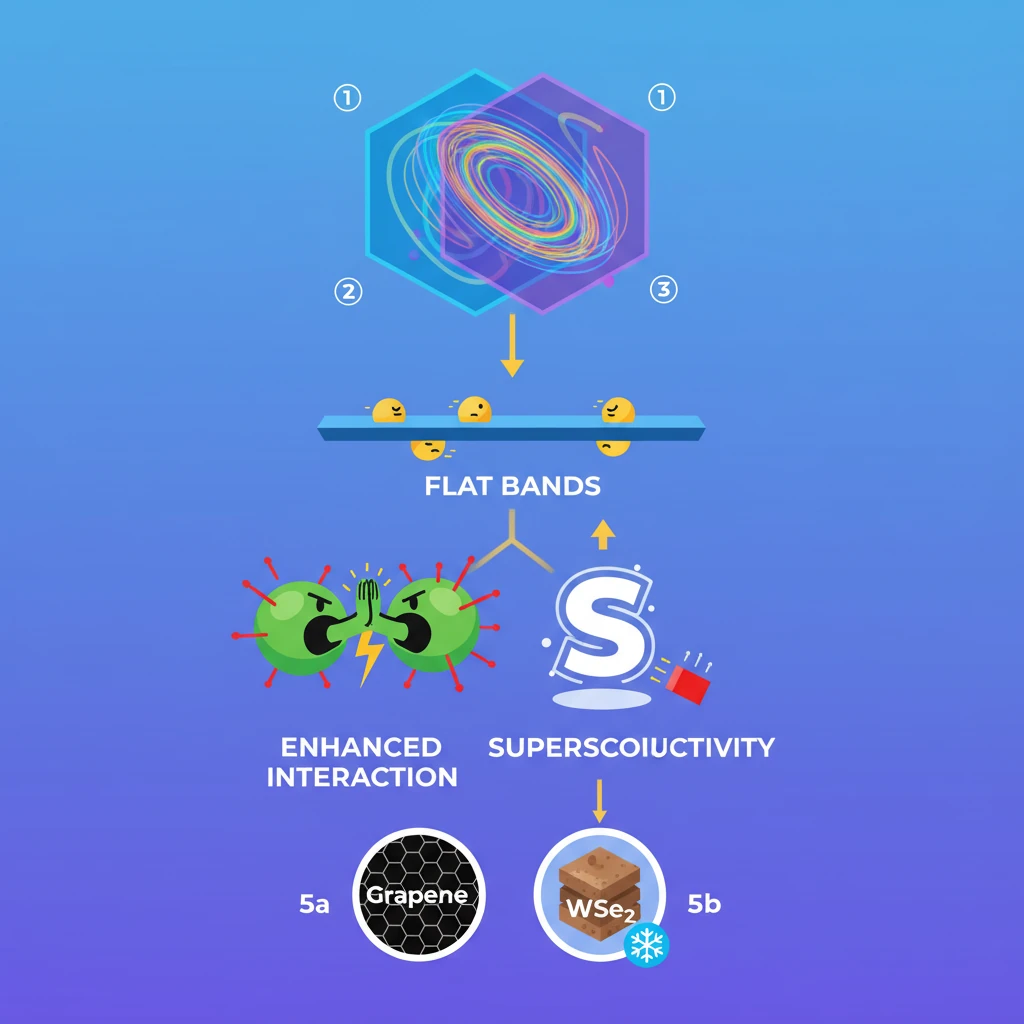
- •Moiré materials are formed by twisting two layers of 2D materials at a slight angle, creating unique interference patterns.
- •This twist induces 'flat bands' in the electronic structure, slowing electrons and boosting electron-electron interactions.
- •Enhanced electron-electron interactions are crucial for the emergence of superconductivity in these materials.
- •Superconductivity, previously thought exclusive to graphene moiré materials, has now been found in semiconductor moiré materials like Tungsten Diselenide (WSe2).
- •WSe2 exhibited stable superconductivity at approximately -272.93° C, comparable to high-temperature superconductors.
- •These materials hold significant promise for quantum computing, lossless energy transmission, and next-generation electronics.
🧠 Memory Techniques
95% Verified Content
📚 Reference Sources
•Nature Journal study (referenced in the source content)
•General scientific literature on Moiré materials, 2D materials, and superconductivity (e.g., academic papers, physics textbooks, reputable science news outlets)