Axiom-4 Mission - Science And Technology | UPSC Learning
Topics
0 topics • 0 completed
🔍
No topics match your search
Axiom-4 Mission
Medium⏱️ 8 min read
science and technology
📖 Introduction
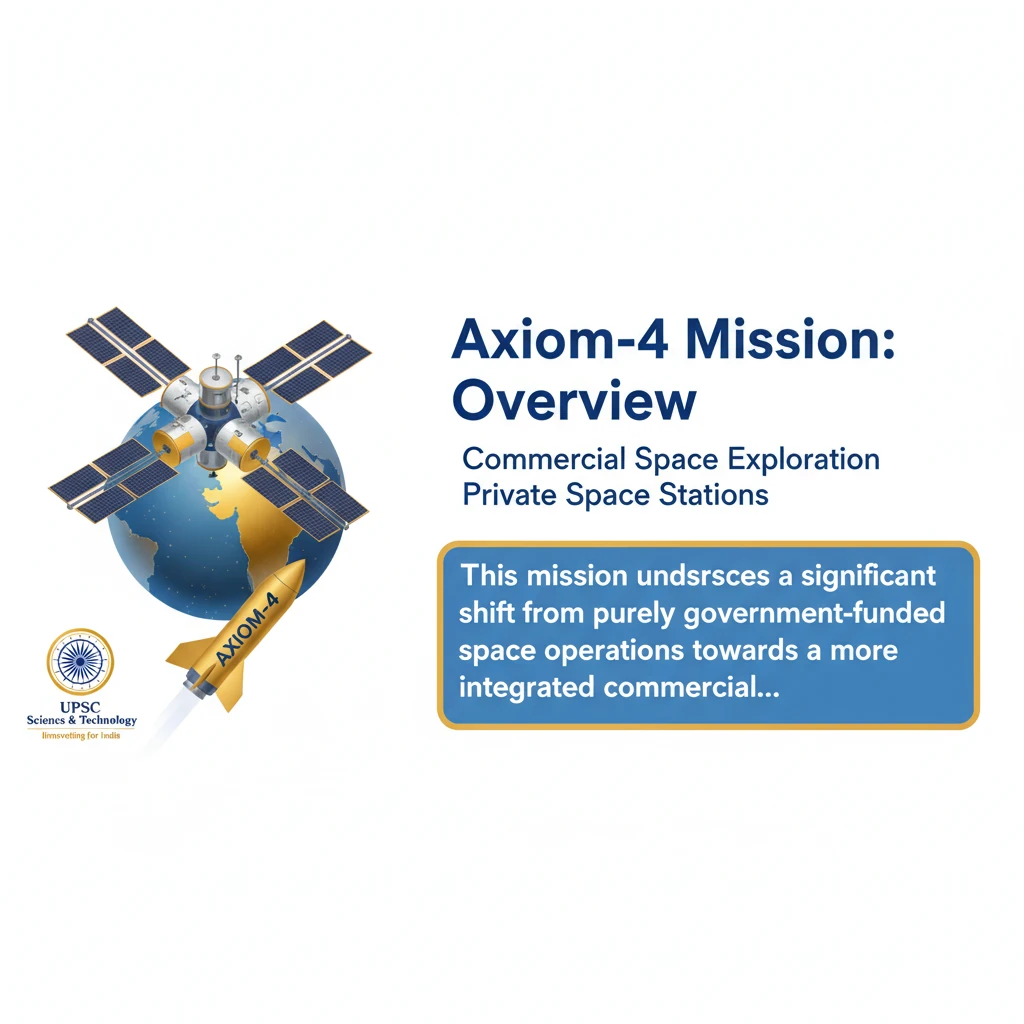
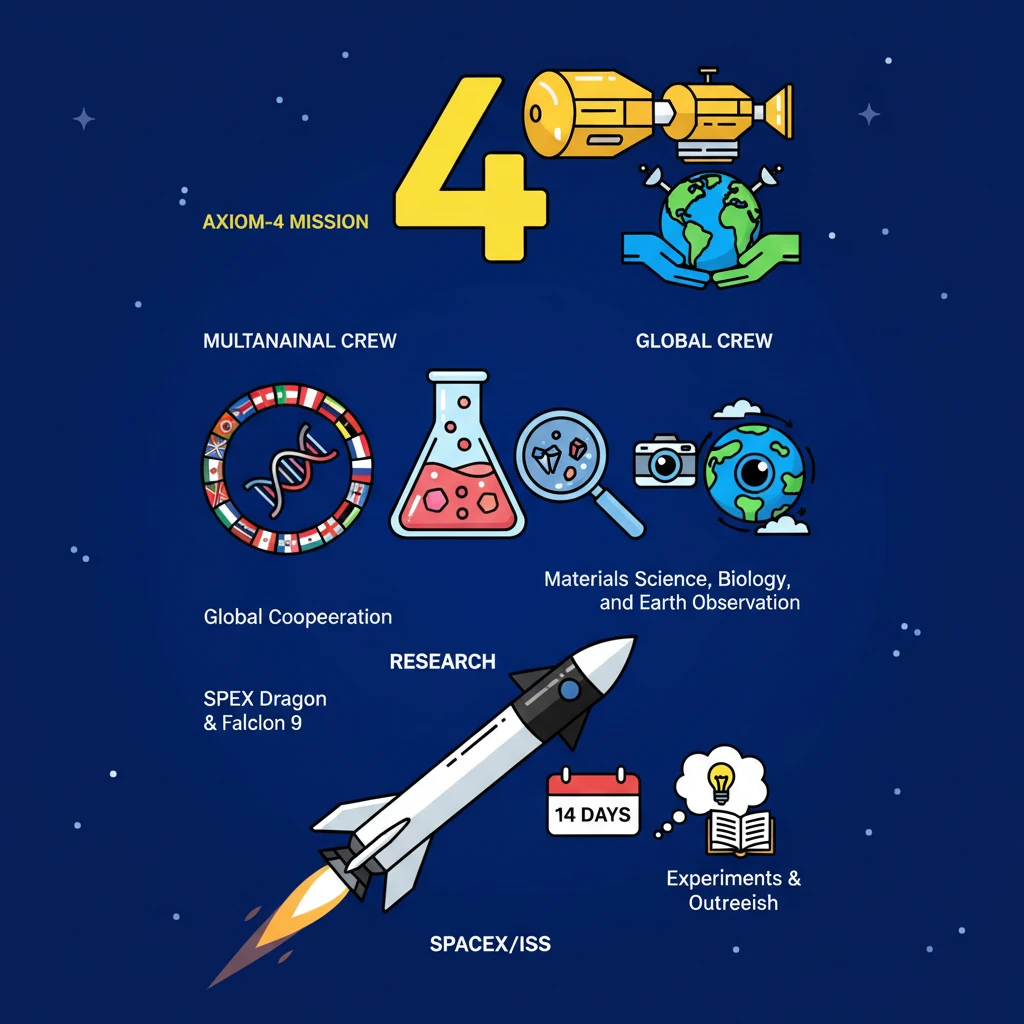
<h4>Axiom-4 Mission: Overview</h4><p>The <strong>Axiom-4 Mission</strong> represents a pivotal step in the burgeoning field of <strong>commercial space exploration</strong>. It is designed to validate the viability of privately-owned <strong>space stations</strong> as platforms for both scientific research and business ventures.</p><div class='key-point-box'><p>This mission underscores a significant shift from purely government-funded space operations towards a more integrated <strong>commercial space economy</strong>.</p></div><h4>Mission Objectives</h4><p>A primary goal of <strong>Axiom-4</strong> is to demonstrate the practical feasibility of operating <strong>commercial space stations</strong>. These platforms are envisioned as future hubs for various business and research activities beyond Earth's atmosphere.</p><h4>International Collaboration</h4><p>The mission features a highly diverse, <strong>multinational crew</strong>, highlighting the growing importance of global cooperation in space. This approach strengthens existing international partnerships and fosters joint efforts in advancing space science and technology.</p><h4>Research and Development</h4><p><strong>Axiom-4</strong> is dedicated to supporting a wide array of scientific experiments and technological advancements. These activities are conducted in a <strong>microgravity environment</strong>, offering unique opportunities for breakthroughs.</p><div class='info-box'><p><strong>Key Research Areas:</strong><ul><li><strong>Materials science</strong>: Investigating new alloys and compounds.</li><li><strong>Biology</strong>: Studying life processes in space.</li><li><strong>Earth observation</strong>: Enhancing understanding of our planet.</li></ul></p></div><h4>Key Features</h4><p>The mission utilizes advanced space technology and involves a varied crew composition.</p><div class='info-box'><p><strong>Spacecraft and Crew:</strong><ul><li><strong>Spacecraft</strong>: A <strong>SpaceX Dragon spacecraft</strong>.</li><li><strong>Launcher</strong>: Propelled by a <strong>Falcon 9 rocket</strong>.</li><li><strong>Crew Composition</strong>: Includes professional astronauts, dedicated researchers, and private individuals.</li></ul></p></div><p>The mission's duration and activities are meticulously planned to maximize scientific output and public engagement.</p><div class='info-box'><p><strong>Mission Duration and Activities:</strong><ul><li><strong>Expected Duration</strong>: Approximately <strong>14 days</strong>.</li><li><strong>Primary Activities</strong>: Conducting experiments, demonstrating new technologies, and engaging in educational outreach programs aboard the <strong>International Space Station (ISS)</strong>.</li></ul></p></div><h4>Commercial Space Station Development</h4><p><strong>Axiom-4</strong> is an integral part of <strong>Axiom Space's</strong> ambitious long-term vision. The company aims to establish the world's <strong>first independent commercial space station</strong>.</p><p>This initiative represents a strategic transition, moving from reliance on the <strong>ISS</strong> to operating a fully autonomous orbital platform, thereby expanding human presence and commercial opportunities in space.</p>
💡 Key Takeaways
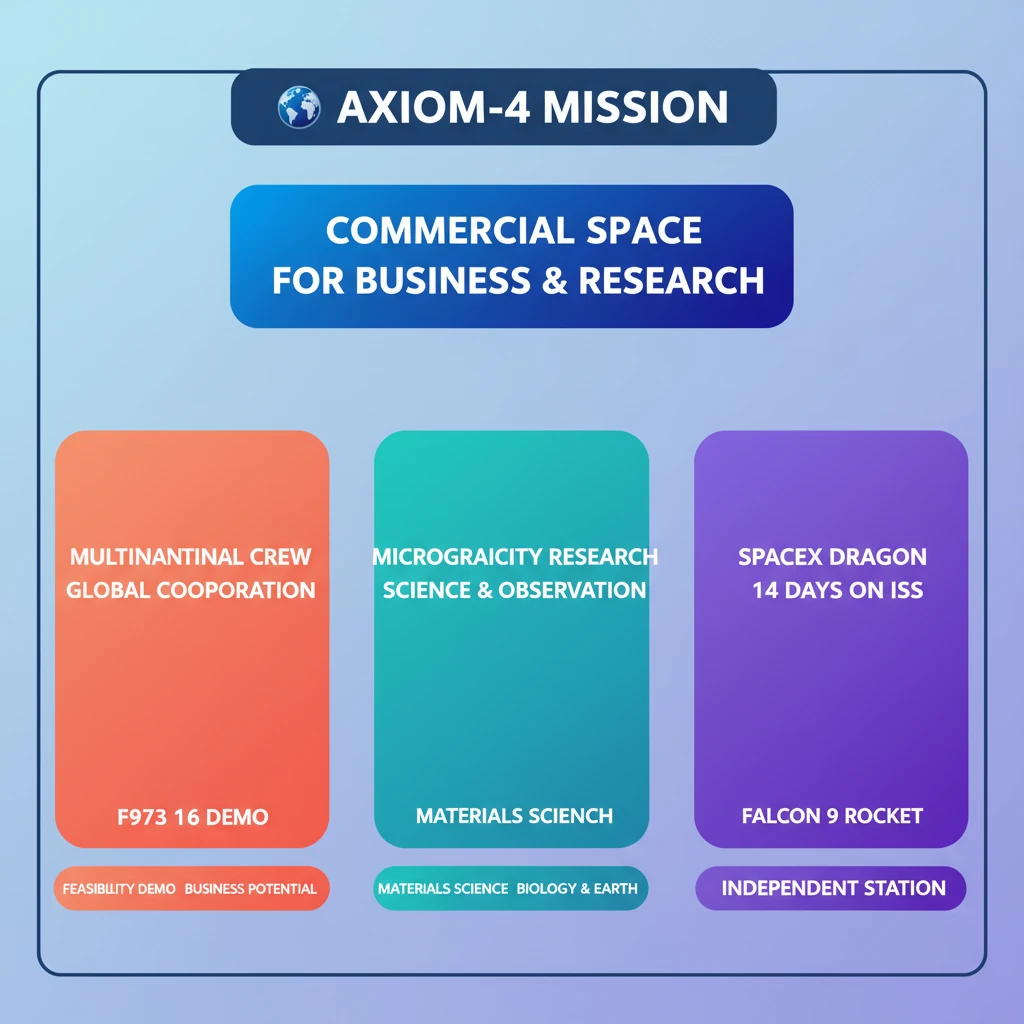
- •Axiom-4 mission demonstrates feasibility of commercial space stations for business and research.
- •It features a multinational crew, emphasizing global cooperation in space exploration.
- •Mission supports microgravity research in materials science, biology, and Earth observation.
- •Utilizes SpaceX Dragon and Falcon 9, lasts 14 days on ISS for experiments and outreach.
- •Part of Axiom Space's vision to establish the first independent commercial space station.
- •India's Gaganyaan mission and Artemis Accords participation highlight its growing role in global human spaceflight.
🧠 Memory Techniques
98% Verified Content
📚 Reference Sources
•Axiom Space official website (axiomspace.com)
•NASA official website (nasa.gov)
•ISRO official website (isro.gov.in)