This property enables phenomena like superconductivity and superfluidity - Science And Technology | UPSC Learning
Topics
0 topics • 0 completed
🔍
No topics match your search
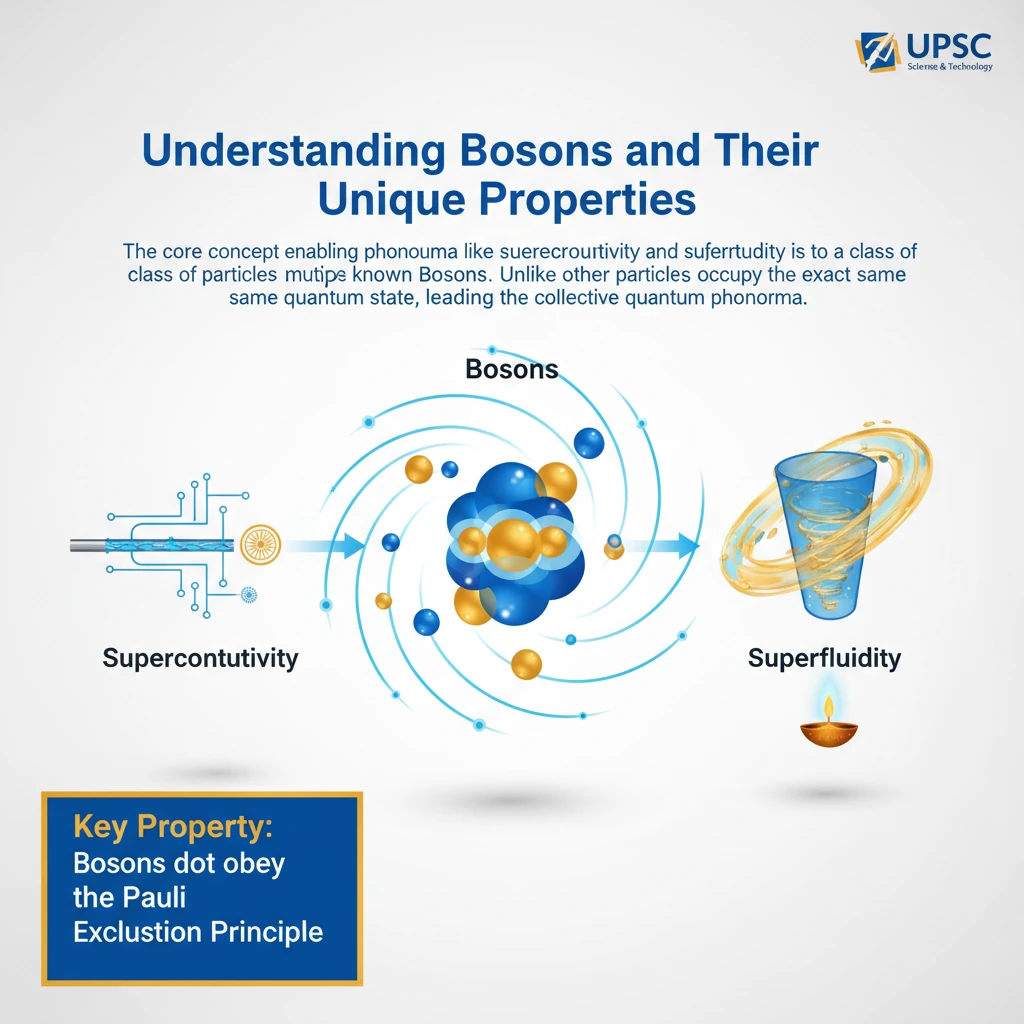
This property enables phenomena like superconductivity and superfluidity
Medium⏱️ 7 min read
science and technology
📖 Introduction
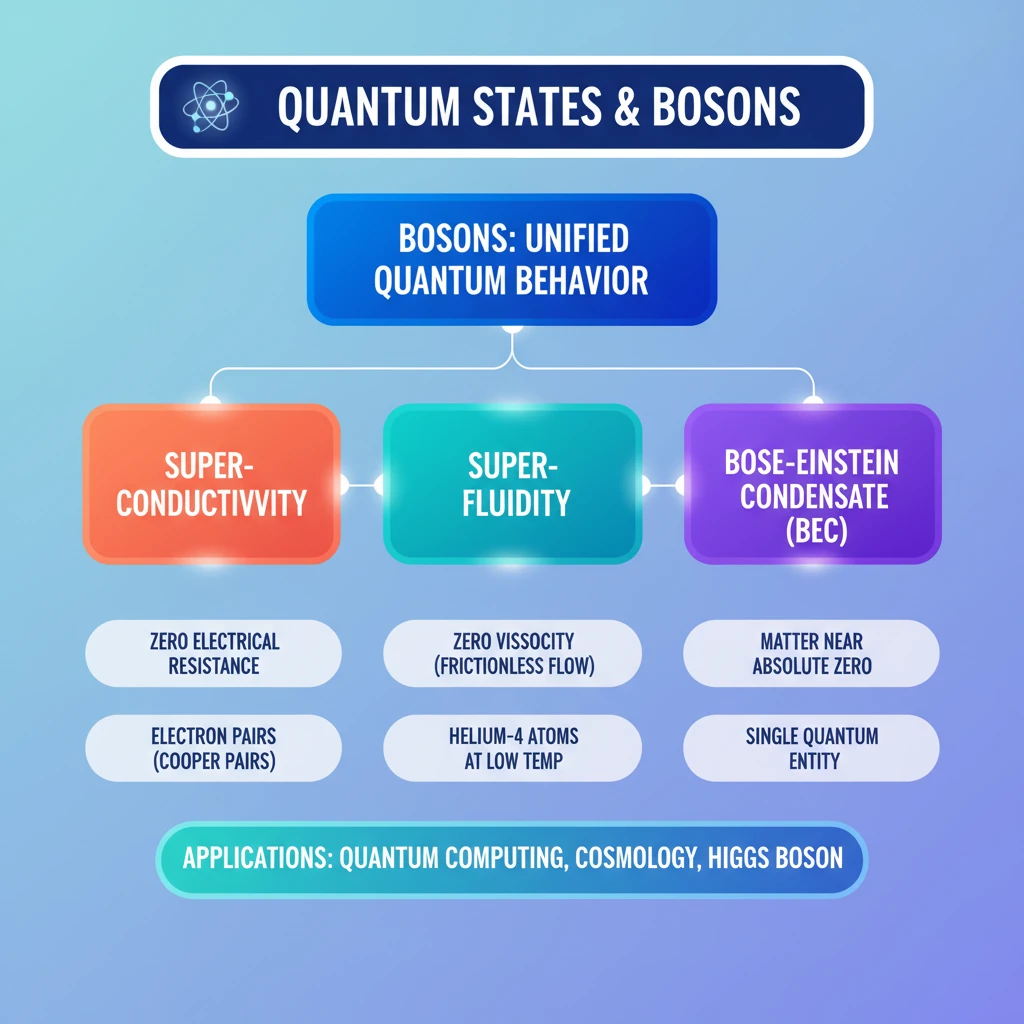
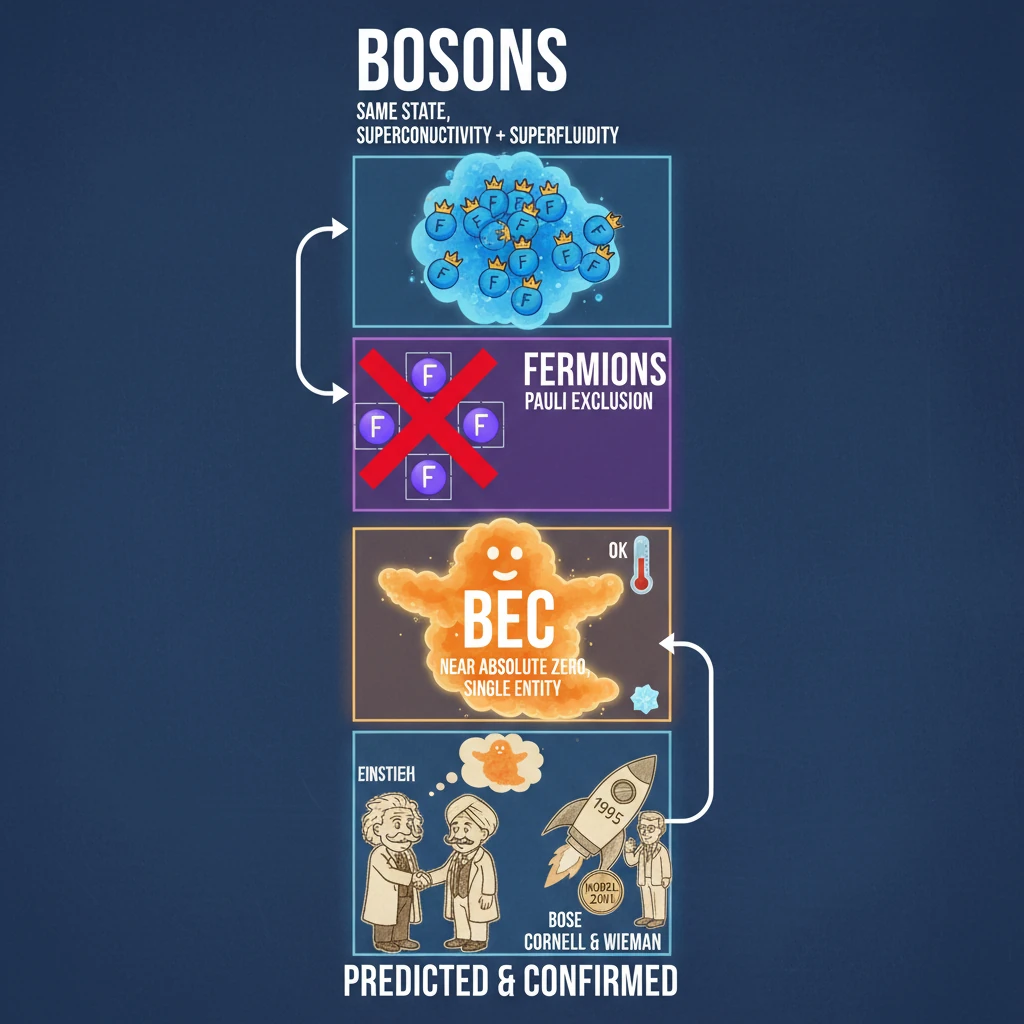
<h4>Understanding Bosons and Their Unique Properties</h4><p>The core concept enabling phenomena like <strong>superconductivity</strong> and <strong>superfluidity</strong> is the behavior of a class of particles known as <strong>Bosons</strong>. Unlike other particles, multiple bosons can occupy the exact same quantum state, leading to collective quantum phenomena.</p><div class='key-point-box'><p><strong>Key Property:</strong> <strong>Bosons</strong> do not obey the <strong>Pauli Exclusion Principle</strong>, allowing them to condense into a single quantum state at very low temperatures. This collective behavior is fundamental to <strong>superconductivity</strong> and <strong>superfluidity</strong>.</p></div><h4>Fermions and the Pauli Exclusion Principle</h4><p>In stark contrast to bosons, <strong>Fermions</strong> are particles that strictly adhere to the <strong>Pauli Exclusion Principle</strong>. This fundamental principle states that no two identical fermions can occupy the same quantum state simultaneously.</p><p>This principle is crucial for understanding the structure of matter, as it governs how electrons arrange themselves in atoms and molecules. Electrons, protons, and neutrons are all examples of <strong>Fermions</strong>.</p><h4>Bose-Einstein Condensate (BEC): A Unique State of Matter</h4><p>The theoretical work of <strong>Satyendra Nath Bose</strong>, later expanded by <strong>Albert Einstein</strong>, predicted the existence of a unique state of matter known as the <strong>Bose-Einstein Condensate (BEC)</strong>. This state forms under extreme conditions.</p><p>A <strong>BEC</strong> is created when a gas of <strong>bosonic atoms</strong> is cooled to temperatures extremely close to <strong>absolute zero</strong> (approximately <strong>-273.15°C</strong> or <strong>0 Kelvin</strong>). At this point, the individual atoms lose their separate identities and merge into a single <strong>quantum entity</strong>.</p><div class='info-box'><p><strong>BEC Formation:</strong> When bosonic atoms are cooled to near <strong>absolute zero</strong>, their wave functions overlap significantly, causing them to behave as a single, coherent <strong>wave-like entity</strong>. This is a macroscopic manifestation of quantum mechanics.</p></div><h4>Experimental Confirmation and Nobel Prize</h4><p>The concept of <strong>Bose-Einstein Condensate</strong> remained a theoretical prediction for many decades. Its experimental confirmation was a monumental achievement in physics.</p><p>In <strong>1995</strong>, physicists <strong>Eric Cornell</strong> and <strong>Carl Wieman</strong> successfully created the first <strong>BEC</strong> using rubidium atoms. This groundbreaking experiment provided empirical evidence for Bose's and Einstein's predictions.</p><div class='info-box'><p><strong>Nobel Recognition:</strong> For their pioneering work in achieving <strong>Bose-Einstein condensation</strong> in dilute alkali gases, <strong>Eric Cornell</strong>, <strong>Carl Wieman</strong>, and <strong>Wolfgang Ketterle</strong> (who achieved it independently shortly after) were awarded the <strong>Nobel Prize in Physics</strong> in <strong>2001</strong>.</p></div><h4>Relevance in Modern Physics</h4><p>The principles laid down by <strong>Satyendra Nath Bose</strong> and the understanding of <strong>Bose-Einstein statistics</strong> continue to have profound relevance across various fields of modern physics.</p><p>Discoveries such as the <strong>Higgs boson</strong>, often referred to as the 'God Particle', are deeply connected to the statistical framework developed by Bose. The <strong>Higgs boson</strong> itself is a boson and plays a crucial role in the Standard Model of particle physics.</p><p>Furthermore, advancements in cutting-edge technologies like <strong>quantum computing</strong> and the study of <strong>condensed matter science</strong> heavily rely on the understanding of bosonic behavior and quantum statistics. These principles also impact theoretical frameworks in <strong>cosmology</strong>.</p><h4>Satyendra Nath Bose: Awards and Honours</h4><p><strong>Satyendra Nath Bose</strong> is widely recognized for his foundational contributions to quantum mechanics, particularly for his work on <strong>Bose-Einstein statistics</strong> and the prediction of the <strong>Bose-Einstein Condensate</strong>.</p><p>He is sometimes referred to as the “<strong>Father of the God Particle</strong>” due to the theoretical connection between his work and the discovery of the <strong>Higgs boson</strong>.</p><div class='info-box'><p><strong>Key Honours:</strong><ul><li><strong>1954:</strong> Awarded the <strong>Padma Vibhushan</strong>, India's second-highest civilian award.</li><li><strong>1959:</strong> Appointed <strong>India’s National Professor</strong>, the highest honour for a scholar in India, a position he held for <strong>15 years</strong>.</li></ul></p></div>
💡 Key Takeaways
- •Bosons are particles that can occupy the same quantum state, enabling phenomena like superconductivity and superfluidity.
- •Fermions, like electrons, obey the Pauli Exclusion Principle, which governs matter's structure.
- •Bose-Einstein Condensate (BEC) is a unique state of matter formed when bosonic atoms are cooled near absolute zero, behaving as a single quantum entity.
- •BEC was theoretically predicted by Bose and Einstein and experimentally confirmed in 1995 by Cornell and Wieman (Nobel Prize 2001).
- •Bose-Einstein principles are crucial for understanding the Higgs boson, quantum computing, cosmology, and condensed matter science.
- •Satyendra Nath Bose received the Padma Vibhushan (1954) and was India's National Professor (1959) for his foundational contributions.
🧠 Memory Techniques
98% Verified Content
📚 Reference Sources
•Nobel Prize official website (for Nobel laureates and their work)
•NCERT Science textbooks (for basic quantum physics concepts)
•Encyclopaedia Britannica (for definitions and historical context)