India's Contribution to the Square Kilometre Array (SKA) Project - Science And Technology | UPSC Learning
Topics
0 topics • 0 completed
🔍
No topics match your search

India's Contribution to the Square Kilometre Array (SKA) Project
Medium⏱️ 6 min read
science and technology
📖 Introduction
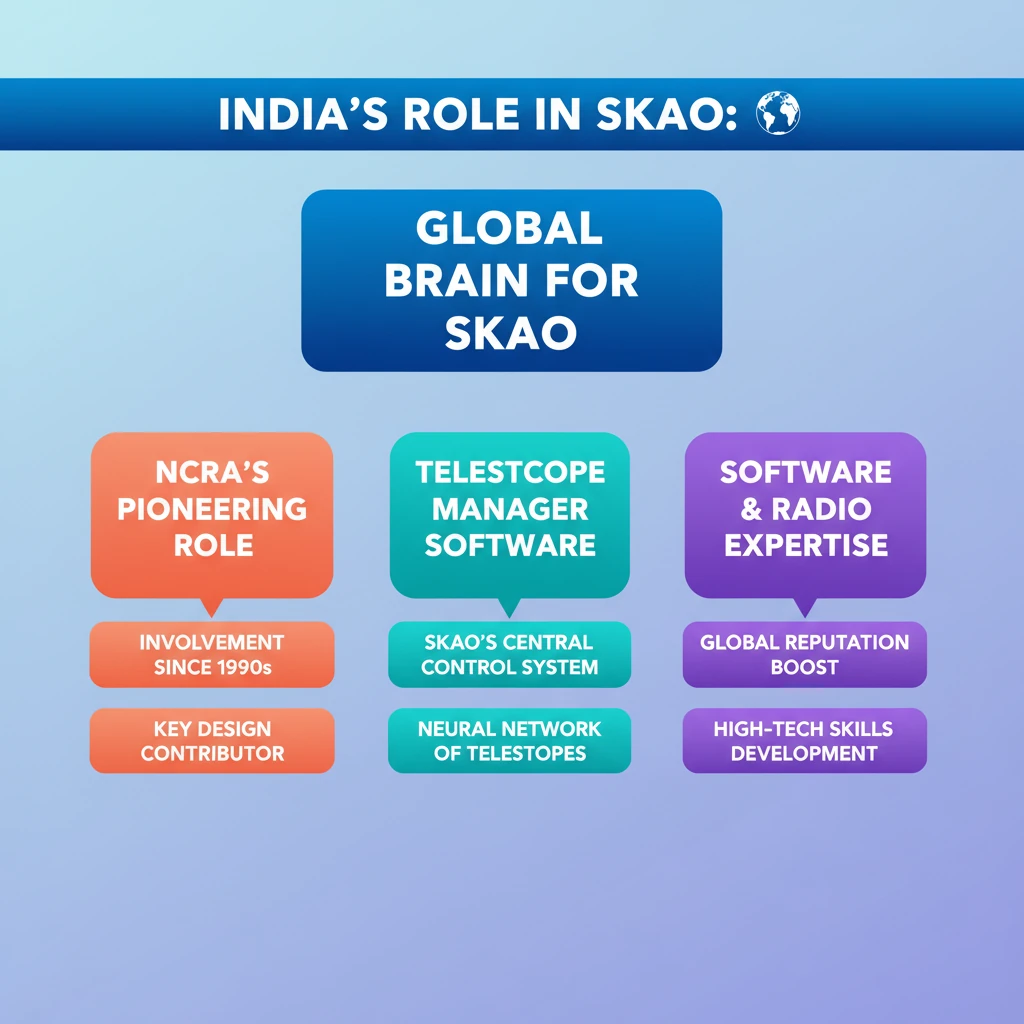
<h4>Introduction to the Square Kilometre Array Observatory (SKAO)</h4><p>The <strong>Square Kilometre Array Observatory (SKAO)</strong> is an ambitious global initiative to build the world's largest <strong>radio telescope</strong>. This monumental project aims to push the boundaries of astronomical research, exploring fundamental questions about the universe.</p><p>It involves a vast network of thousands of radio antennas spread across sites in <strong>South Africa</strong> and <strong>Australia</strong>, designed to observe the universe with unprecedented sensitivity and resolution.</p><h4>India's Foundational Role in SKAO Development</h4><p><strong>India</strong> has been a pivotal partner in the development of the <strong>SKAO project</strong> since its very inception. This involvement dates back to the <strong>1990s</strong>, highlighting India's long-standing commitment to global scientific endeavors.</p><p>India's participation has been primarily channeled through the <strong>Pune-based National Centre for Radio Astrophysics (NCRA)</strong> and a consortium of other esteemed Indian institutions.</p><div class='info-box'><p><strong>National Centre for Radio Astrophysics (NCRA)</strong>: A premier research institution under the <strong>Tata Institute of Fundamental Research (TIFR)</strong>, known for its expertise in <strong>radio astronomy</strong> and operating the <strong>Giant Metrewave Radio Telescope (GMRT)</strong>.</p></div><h4>India's Core Contribution: The Telescope Manager Element</h4><p>A significant and central contribution from <strong>India</strong> to the <strong>SKAO project</strong> is the development and ongoing operation of the <strong>Telescope Manager element</strong>. This component is critical to the entire observatory's functionality.</p><div class='key-point-box'><p>The <strong>Telescope Manager</strong> is often described as the "<strong>neural network</strong>" or the central <strong>software brain</strong> that orchestrates the entire operation of the <strong>SKAO telescope</strong>. It manages data flow, coordinates observations, and ensures seamless functioning of the vast array.</p></div><p>This sophisticated software system is responsible for controlling all aspects of the telescope, from scheduling observations to managing the enormous data streams generated by the array.</p><div class='exam-tip-box'><p><strong>UPSC Insight:</strong> India's contribution to the <strong>Telescope Manager</strong> showcases its advanced capabilities in <strong>software engineering</strong> and <strong>complex system integration</strong> for large-scale scientific projects. This is a crucial point for <strong>GS Paper 3 (Science & Technology)</strong>, highlighting indigenous technological prowess and international collaboration.</p></div>
💡 Key Takeaways
- •India, via NCRA, has been involved in SKAO since the 1990s.
- •India's primary contribution is the development and operation of the 'Telescope Manager'.
- •The Telescope Manager is the SKAO's central 'neural network' or control software.
- •This highlights India's expertise in complex software engineering and radio astronomy.
- •SKAO involvement boosts India's scientific reputation and fosters high-tech skill development.
🧠 Memory Techniques

100% Verified Content
📚 Reference Sources
•SKAO Official Website (www.skao.int)
•National Centre for Radio Astrophysics (NCRA) Website (www.ncra.tifr.res.in)