BioE3 Policy and Biotechnology in India - Science And Technology | UPSC Learning
Topics
0 topics • 0 completed
🔍
No topics match your search
BioE3 Policy and Biotechnology in India
Medium⏱️ 10 min read
science and technology
📖 Introduction
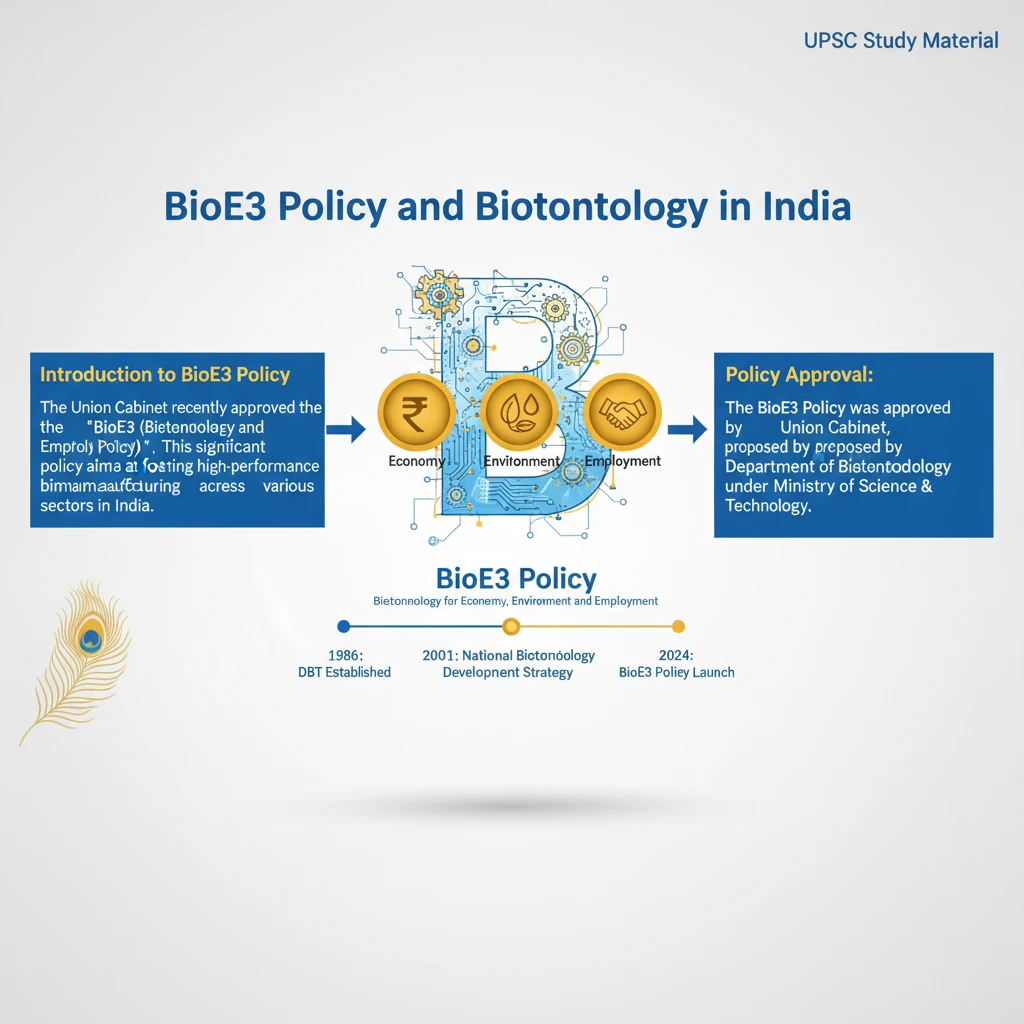
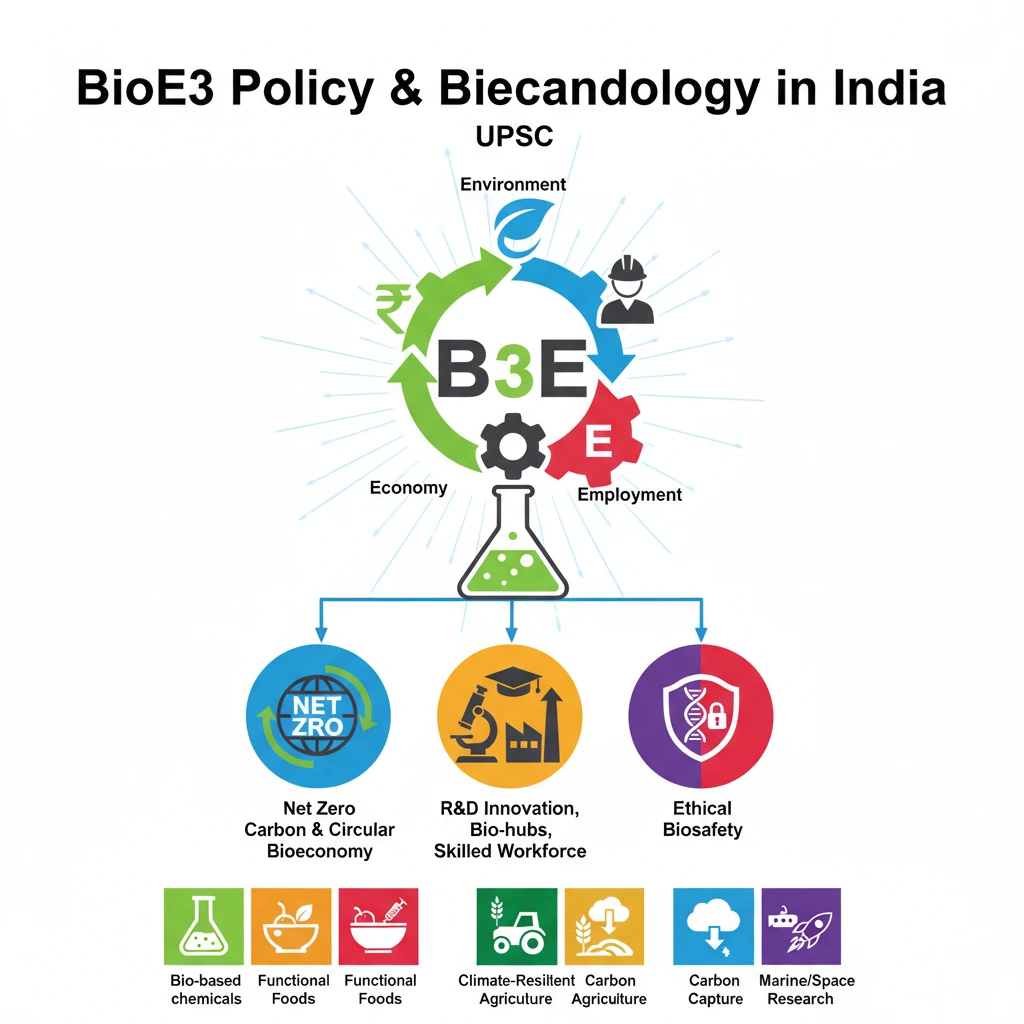
<h4>Introduction to BioE3 Policy and Biotechnology in India</h4><p>The <strong>Union Cabinet</strong> recently approved the '<strong>BioE3 (Biotechnology for Economy, Environment and Employment) Policy</strong>'. This significant policy aims at <strong>fostering high-performance biomanufacturing</strong> across various sectors in India.</p><div class='info-box'><p><strong>Policy Approval:</strong> The <strong>BioE3 Policy</strong> was approved by the <strong>Union Cabinet</strong>, proposed by the <strong>Department of Biotechnology</strong>.</p><p><strong>Simultaneous Merger:</strong> Three existing schemes of the <strong>Science & Technology Ministry</strong> were merged into a single scheme named <strong>Vigyan Dhara</strong>, with an outlay of <strong>Rs 10,579 crore</strong> until <strong>2025-26</strong>.</p></div><h4>Understanding the BioE3 Policy</h4><p>The <strong>BioE3 Policy</strong> is designed to propel India's capabilities in <strong>biomanufacturing</strong>. This involves the sustainable production of <strong>bio-based products</strong> across diverse industrial applications.</p><p>The policy's vision extends beyond economic growth, aiming for a holistic impact on the nation's future.</p><h4>Alignment with National Goals</h4><p>The <strong>BioE3 Policy</strong> is strategically aligned with several other critical national objectives. These include ambitious targets for environmental sustainability and economic resilience.</p><div class='key-point-box'><p><strong>Key National Alignments:</strong></p><ul><li>Achieving a <strong>‘Net Zero’ carbon economy</strong>.</li><li>Promoting <strong>sustainable growth</strong> through a <strong>circular bioeconomy</strong>.</li><li>Contributing to India's overall developmental agenda.</li></ul></div><h4>Key Objectives of BioE3</h4><p>The policy outlines a multi-faceted approach to strengthen India's biotechnology sector. It emphasizes both foundational research and practical implementation.</p><ul><li><strong>Innovation and Entrepreneurship:</strong> Fostering cutting-edge <strong>research and development (R&D)</strong> and supporting new ventures.</li><li><strong>Infrastructure Development:</strong> Establishing dedicated <strong>Biomanufacturing & Bio-hubs</strong> and advanced <strong>Biofoundries</strong>.</li><li><strong>Workforce Expansion:</strong> Expanding India’s highly skilled <strong>biotechnology workforce</strong> to meet industry demands.</li><li><strong>Environmental Harmony:</strong> Aligning with <strong>‘Lifestyle for Environment’ (LiFE)</strong> programs to promote sustainable living.</li><li><strong>Regenerative Models:</strong> Targeting the development of <strong>regenerative bioeconomy models</strong> for long-term sustainability.</li></ul><h4>Employment Generation and Regional Growth</h4><p>A significant objective of the <strong>BioE3 Policy</strong> is to create substantial employment opportunities. This focus is particularly directed towards <strong>tier-II and tier-III cities</strong>.</p><p>The establishment of <strong>biomanufacturing hubs</strong> in these regions will utilize <strong>local biomass</strong>, thereby fostering equitable development and regional economic growth.</p><h4>Ethical and Regulatory Framework</h4><p>The policy places strong emphasis on responsible biotechnology development. It ensures that advancements are made within a robust ethical and regulatory framework.</p><p>This includes adherence to <strong>ethical biosafety standards</strong> and achieving <strong>global regulatory alignment</strong> to enhance India’s international competitiveness.</p><h4>Core Themes of the BioE3 Policy</h4><p>The policy focuses on six key areas that are crucial for advancing India's biomanufacturing capabilities and addressing contemporary challenges.</p><ul><li><strong>Bio-Based Chemicals and Enzymes:</strong> Developing advanced alternatives to reduce environmental impact.</li><li><strong>Functional Foods and Smart Proteins:</strong> Innovating to enhance nutrition and ensure food security.</li><li><strong>Precision Biotherapeutics:</strong> Advancing personalized medicine and improving healthcare outcomes.</li><li><strong>Climate Resilient Agriculture:</strong> Promoting practices that can withstand climate change for food security.</li><li><strong>Carbon Capture and Utilization:</strong> Fostering technologies for efficient carbon management.</li><li><strong>Futuristic Marine and Space Research:</strong> Exploring new frontiers in biomanufacturing through novel research.</li></ul><h4>The Vigyan Dhara Scheme</h4><p>The <strong>Vigyan Dhara Scheme</strong> is a consolidated effort to streamline and enhance science and technology initiatives in India.</p><h4>Background and Purpose</h4><p>The <strong>Department of Science & Technology (DST)</strong> serves as the central nodal department. Its role is to organize, coordinate, and promote all science, technology, and innovation activities nationwide.</p><h4>Scheme Merger and Financial Outlay</h4><p>Three previously separate central sector umbrella schemes implemented by the <strong>DST</strong> have been unified. These schemes focused on <strong>S&T Institutional and Human Capacity Building</strong>, <strong>R&D and Innovation</strong>, and <strong>Technology Development and Deployment</strong>.</p><div class='info-box'><p><strong>Vigyan Dhara Merger:</strong> The three schemes were merged into the single, unified scheme called <strong>‘Vigyan Dhara’</strong>.</p><p><strong>Financial Commitment:</strong> The scheme has a substantial financial outlay of <strong>Rs 10,579 crore</strong>, allocated until the fiscal year <strong>2025-26</strong>.</p></div>

💡 Key Takeaways
- •BioE3 Policy aims to boost India's bioeconomy through high-performance biomanufacturing for Economy, Environment, and Employment.
- •It aligns with national goals like Net Zero carbon economy and a circular bioeconomy.
- •Key objectives include R&D innovation, establishing Bio-hubs, expanding skilled workforce, and ethical biosafety.
- •Core themes cover bio-based chemicals, functional foods, precision biotherapeutics, climate-resilient agriculture, carbon capture, and marine/space research.
- •Vigyan Dhara Scheme, with Rs 10,579 crore outlay, merges three S&T schemes to support holistic scientific development.
- •The policy focuses on generating employment in Tier-II/III cities by utilizing local biomass.
🧠 Memory Techniques
95% Verified Content
📚 Reference Sources
•Press Information Bureau (PIB) releases on Union Cabinet decisions (for policy approval and Vigyan Dhara merger)
•Department of Biotechnology (DBT), Ministry of Science & Technology, Government of India official website
•Reports and documents related to India's National Biotechnology Development Strategy