What is India’s FBR Programme? - Science And Technology | UPSC Learning
Topics
0 topics • 0 completed
🔍
No topics match your search
What is India’s FBR Programme?
Medium⏱️ 6 min read
science and technology
📖 Introduction
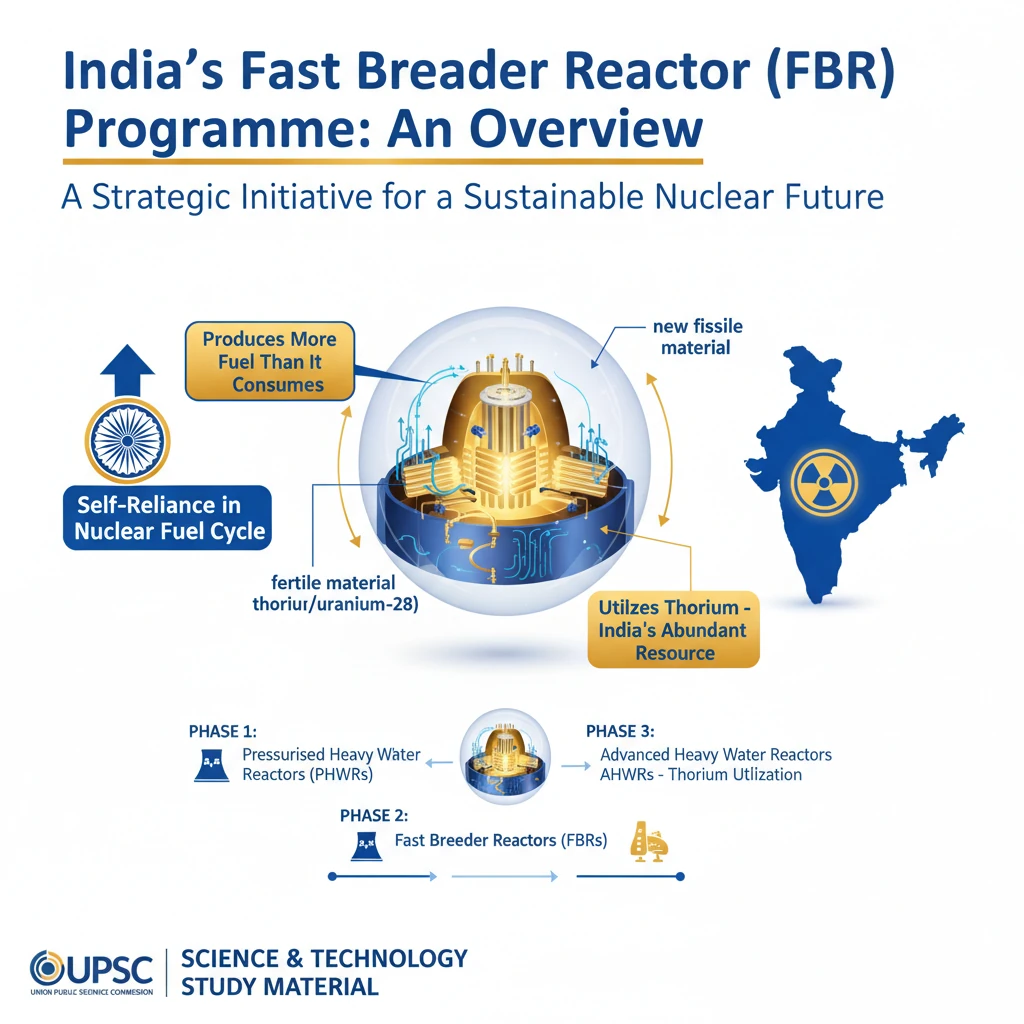
<h4>India's Fast Breeder Reactor (FBR) Programme: An Overview</h4><p>India's <strong>Fast Breeder Reactor (FBR) Programme</strong> is a crucial strategic initiative in the nation's pursuit of comprehensive nuclear energy capabilities. It aims to establish a self-reliant and sustainable nuclear fuel cycle.</p><p>The program involves the development and operation of <strong>Fast Breeder Reactors (FBRs)</strong>, which are advanced nuclear reactors designed to produce more fissile material than they consume.</p><div class='key-point-box'><p>The core objective is to ensure <strong>long-term energy security</strong> for India by efficiently utilizing its vast thorium reserves and optimizing uranium resources.</p></div><h4>Understanding Fast Breeder Reactors (FBRs)</h4><p>Unlike conventional nuclear reactors (like <strong>Pressurised Heavy Water Reactors - PHWRs</strong>), <strong>FBRs</strong> have a unique characteristic: they "breed" fuel.</p><p>This means they generate more new <strong>fissile material</strong> (e.g., Plutonium-239) from <strong>fertile isotopes</strong> (e.g., Uranium-238 or Thorium-232) than the fissile material they initially consume.</p><div class='info-box'><ul><li><strong>Fissile Material:</strong> Can sustain a nuclear chain reaction (e.g., <strong>Uranium-235</strong>, <strong>Plutonium-239</strong>).</li><li><strong>Fertile Material:</strong> Can be converted into fissile material by neutron absorption (e.g., <strong>Uranium-238</strong>, <strong>Thorium-232</strong>).</li></ul></div><div class='exam-tip-box'><p><strong>UPSC Mains (GS-III):</strong> Understanding the difference between <strong>fissile</strong> and <strong>fertile</strong> materials, and the concept of 'breeding' fuel, is vital for questions on nuclear technology.</p></div><h4>Historical Development and Key Institutions</h4><p>Efforts to build an <strong>FBR</strong> in India were initiated over <strong>two decades ago</strong>, marking a significant commitment to advanced nuclear technology.</p><p>A pivotal step was the incorporation of <strong>Bharatiya Nabhikiya Vidyut Nigam Ltd (BHAVINI)</strong> in <strong>2003</strong>.</p><div class='info-box'><p><strong>BHAVINI's Mandate:</strong> To build and operate India’s most advanced nuclear reactor, the <strong>Prototype Fast Breeder Reactor (PFBR)</strong>, located at <strong>Kalpakkam, Tamil Nadu</strong>.</p></div><h4>Strategic Goals and Future Outlook</h4><p>The <strong>Department of Atomic Energy (DAE)</strong> has ambitious targets for India's nuclear power sector. It aims to significantly increase the share of nuclear power in the national energy mix.</p><p>By <strong>2032</strong>, the <strong>DAE</strong> targets producing <strong>22,400 MWe</strong> (Megawatts electric) from its nuclear power plants.</p><p>To achieve this, the <strong>DAE</strong> has approved the construction of <strong>10 new Pressurised Heavy Water Reactors (PHWRs)</strong> in a <strong>‘fleet mode’</strong>.</p><div class='key-point-box'><p><strong>Fleet Mode Construction:</strong> This approach aims to accelerate project timelines, with each plant expected to be built in approximately <strong>five years</strong> from the first pouring of concrete.</p></div><p>Once the <strong>PFBR</strong> is commissioned and commercially operational, India will achieve a significant global milestone. It will become the <strong>second country after Russia</strong> to have a commercial operating <strong>FBR</strong>.</p><div class='exam-tip-box'><p><strong>UPSC Prelims:</strong> Remember the target year (<strong>2032</strong>), the MWe target (<strong>22,400 MWe</strong>), and India's potential global ranking (<strong>second after Russia</strong>) in FBR operation.</p></div>
💡 Key Takeaways
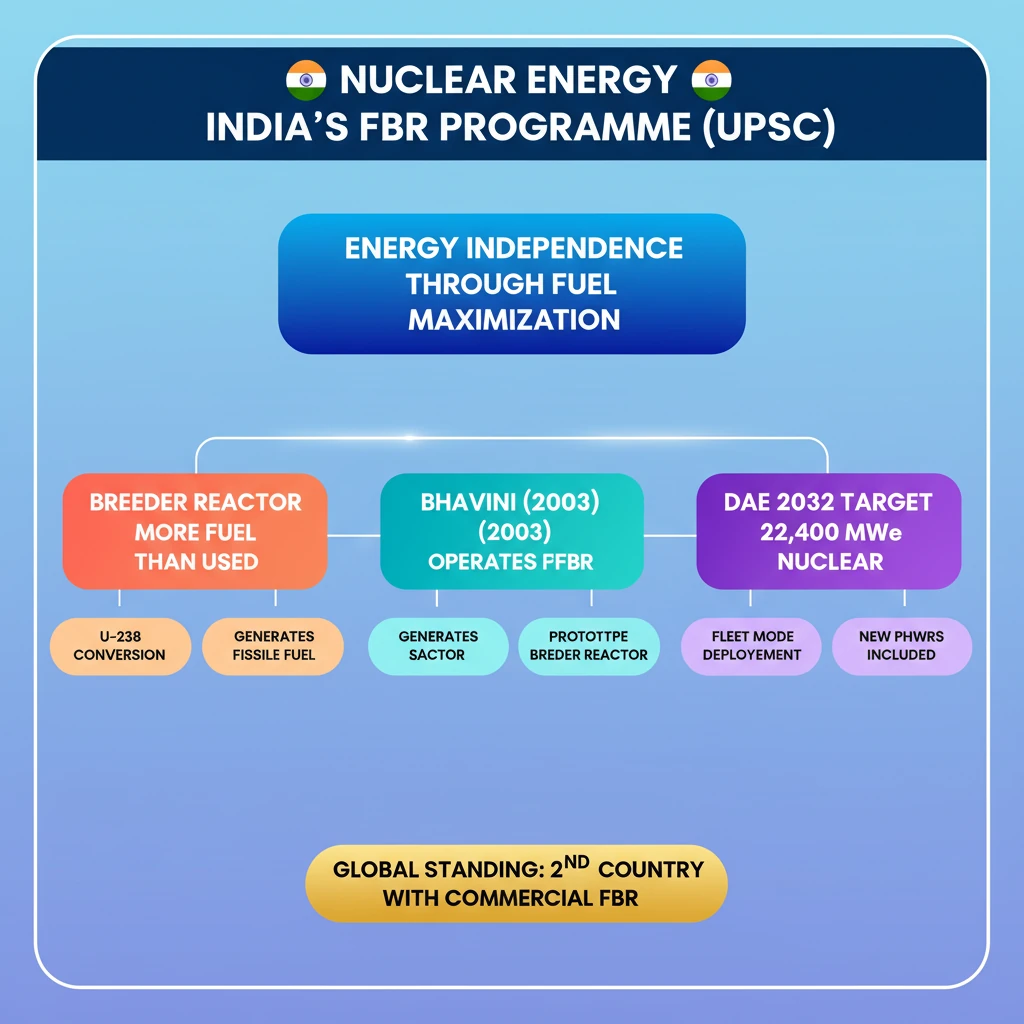
- •India's FBR Programme aims for energy independence by maximizing nuclear fuel utilization.
- •FBRs 'breed' fuel, generating more fissile material than they consume, primarily from Uranium-238.
- •BHAVINI was incorporated in 2003 to build and operate the Prototype Fast Breeder Reactor (PFBR).
- •The DAE targets 22,400 MWe nuclear power by 2032, supported by FBRs and new PHWRs in 'fleet mode'.
- •India is set to become the second country after Russia with a commercial operating FBR, enhancing global standing.
🧠 Memory Techniques
95% Verified Content
📚 Reference Sources
•Department of Atomic Energy (DAE) official reports
•Press Information Bureau (PIB) releases