SC Allows States to Regulate Industrial Alcohol - Polity And Governance | UPSC Learning
Topics
0 topics • 0 completed
🔍
No topics match your search

SC Allows States to Regulate Industrial Alcohol
Medium⏱️ 8 min read
polity and governance
📖 Introduction
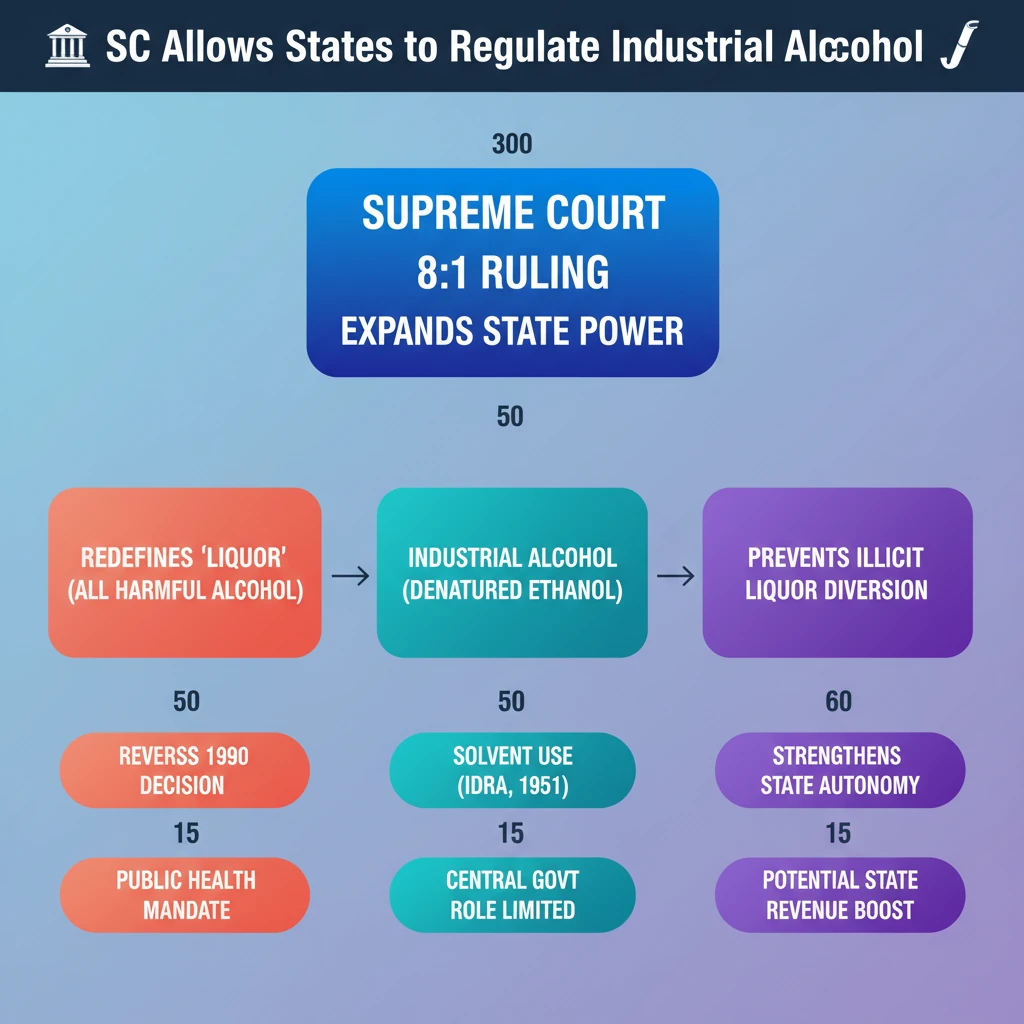
<h4>Context of the Ruling</h4><p>The <strong>Supreme Court</strong> recently delivered a landmark <strong>8:1 ruling</strong>, affirming the <strong>states' authority</strong> to regulate <strong>industrial alcohol</strong>.</p><p>This decision overturns a significant <strong>1990 judgment</strong> in the <strong>Synthetics & Chemicals v. State of Uttar Pradesh case (1989)</strong>, which had previously granted control to the <strong>central government</strong>.</p><div class='exam-tip-box'><p>This ruling is crucial for <strong>UPSC Mains GS-II (Polity & Governance)</strong>, especially topics related to <strong>Centre-State relations</strong> and <strong>judicial interpretation</strong> of legislative lists.</p></div><h4>SC Bench Ruling on Industrial Alcohol</h4><p>The majority <strong>Constitution Bench</strong> expanded the definition of <strong>“intoxicating liquor”</strong> beyond just potable alcohol.</p><p>It clarified that this term encompasses <strong>all types of alcohol</strong> that can potentially impact <strong>public health negatively</strong>, not just alcoholic beverages.</p><div class='key-point-box'><p>The court emphasized that substances like <strong>alcohol, opium, and drugs</strong> are prone to misuse. It ruled that <strong>Parliament cannot override state powers</strong> concerning intoxicating liquors, as “intoxicating” can also mean “<strong>poisonous</strong>,” allowing for a broader classification.</p></div><h4>Dissenting Opinion</h4><p><strong>Justice B.V. Nagarathna</strong> dissented, arguing against stretching <strong>Entry 8 – List II</strong> (State List) to include <strong>industrial alcohol</strong> merely due to its potential misuse.</p><p>She contended that allowing states to regulate industrial alcohol could lead to misinterpretations of the <strong>legislative intent</strong> behind alcohol regulation.</p><h4>Understanding Industrial Alcohol</h4><div class='info-box'><p><strong>Industrial alcohol</strong> is essentially <strong>impure alcohol</strong> primarily used as an <strong>industrial solvent</strong>. It is rendered unfit for human consumption through a process called <strong>denaturation</strong>.</p></div><p><strong>Denaturation</strong> involves mixing chemicals like <strong>benzene, pyridine, or gasoline</strong> with <strong>ethanol</strong>. This process significantly lowers its price and makes it dangerous to consume.</p><p><strong>Applications:</strong></p><ul><li>Used extensively in <strong>pharmaceuticals</strong>.</li><li>A key ingredient in <strong>cosmetics</strong>.</li><li>Found in various <strong>cleaning liquids</strong>.</li></ul><p><strong>Misuse:</strong> Despite denaturation, industrial alcohol is sometimes diverted to make <strong>illicit liquor</strong>, which is cheap, dangerous, and can cause severe health risks, including <strong>blindness and death</strong>.</p><h4>Industries (Development and Regulation) Act, 1951 (IDRA)</h4><p>The <strong>IDRA, 1951</strong>, provides the legal and conceptual framework for <strong>industrial development and regulation</strong> across India.</p><p><strong>Main Goals of the Act:</strong></p><ul><li>To <strong>control and direct</strong> the growth of national industries.</li><li>To promote <strong>fair resource distribution</strong>.</li><li>To prevent the <strong>concentration of economic power</strong>.</li><li>To ensure <strong>balanced and controlled industrial expansion</strong>.</li></ul><p><strong>Central Government Powers under IDRA:</strong></p><ul><li>Regulate the <strong>production, supply, and distribution</strong> of certain industries.</li><li>Impose restrictions on the establishment of <strong>new industries</strong>.</li><li>Grant <strong>licenses</strong> for industrial operations.</li><li>Create and run industries when deemed in the <strong>public interest</strong>.</li><li>Implement measures to prevent the <strong>concentration of economic power</strong>.</li></ul>
💡 Key Takeaways
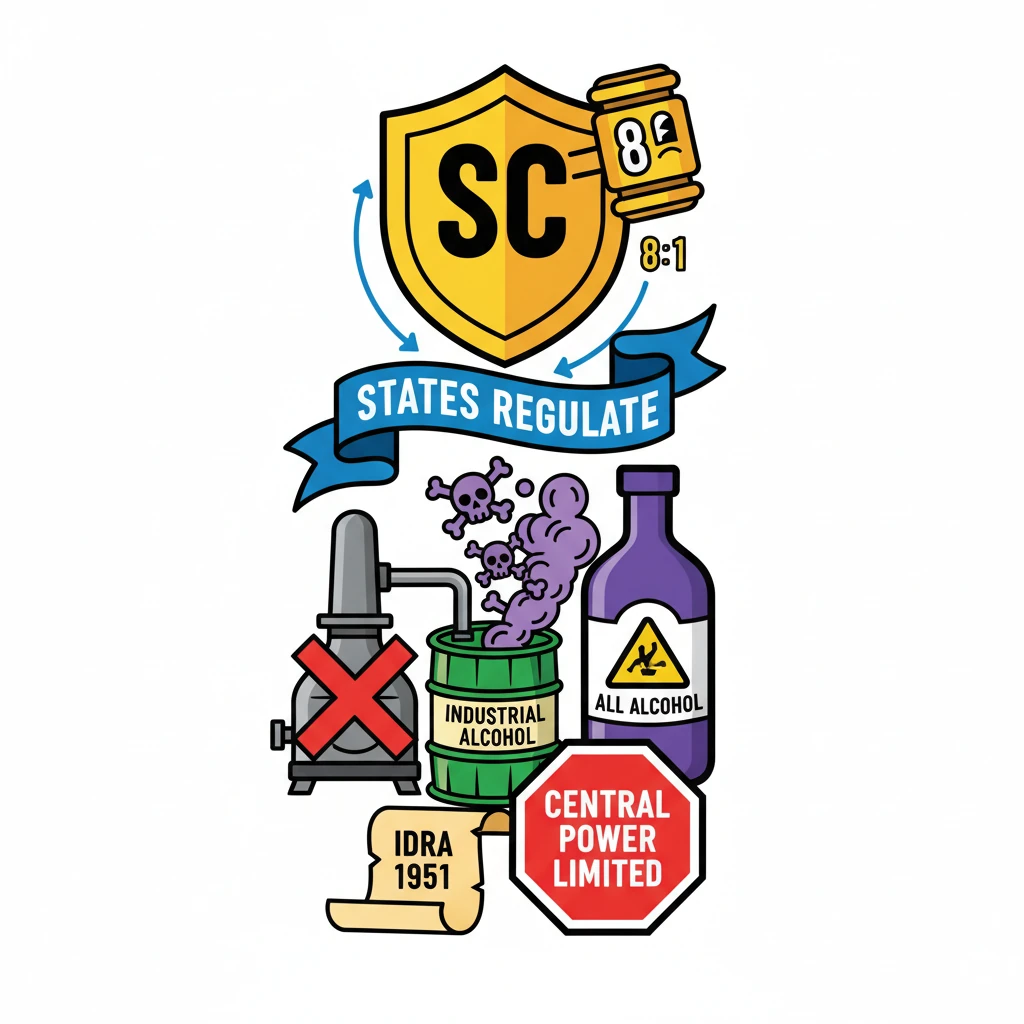
- •SC's 8:1 ruling grants states authority to regulate industrial alcohol, reversing a 1990 decision.
- •The ruling expands 'intoxicating liquor' definition beyond potable alcohol to include all alcohol harmful to public health.
- •Industrial alcohol is denatured ethanol used as a solvent, prone to diversion for illicit liquor.
- •Industries (Development and Regulation) Act, 1951 (IDRA) outlines central government's industrial regulatory powers.
- •The decision strengthens state autonomy, public health measures, and potentially state revenues.
- •Curative petition is the last legal remedy in the Supreme Court, used to correct grave errors.
🧠 Memory Techniques
95% Verified Content
📚 Reference Sources
•Supreme Court of India official pronouncements (implied by ruling details)