Pradhan Mantri Awas Yojana-Gramin - Polity And Governance | UPSC Learning
Topics
0 topics • 0 completed
🔍
No topics match your search
Pradhan Mantri Awas Yojana-Gramin
Medium⏱️ 10 min read
polity and governance
📖 Introduction
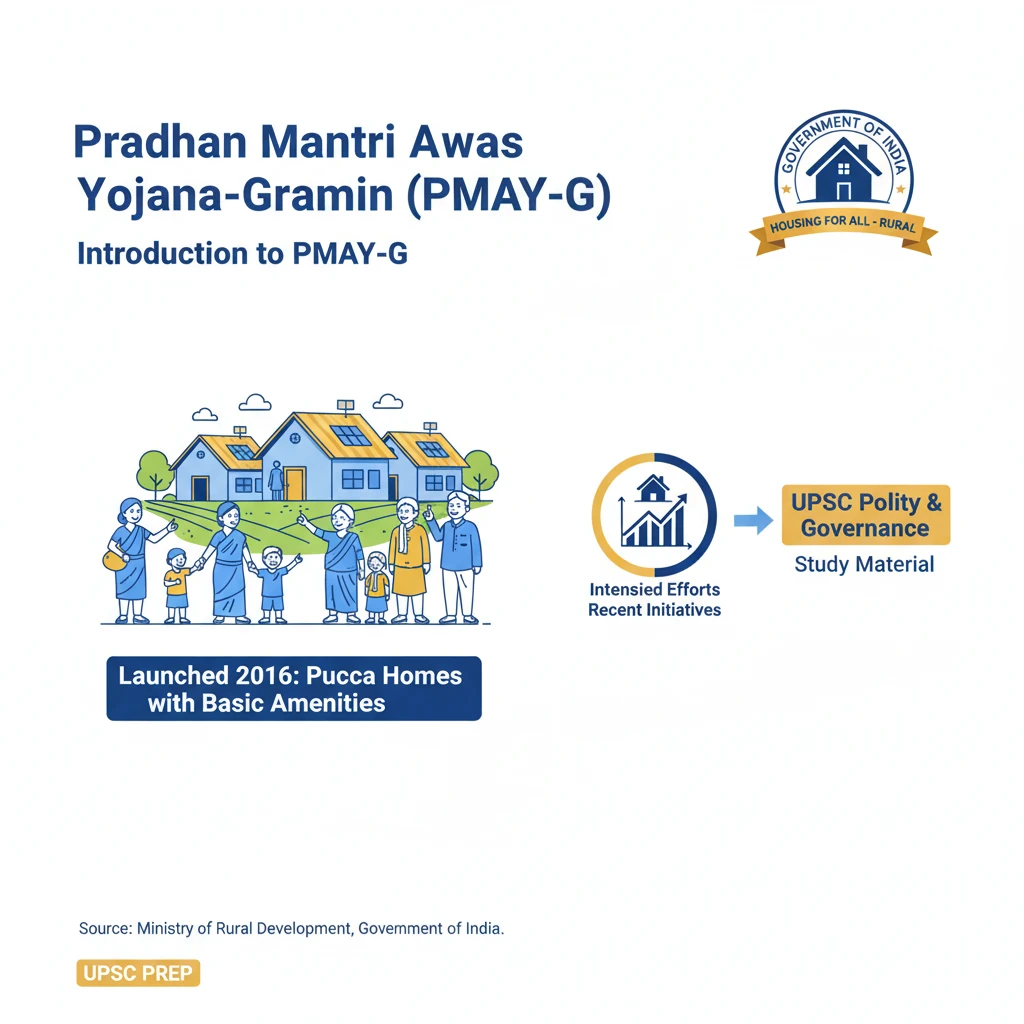
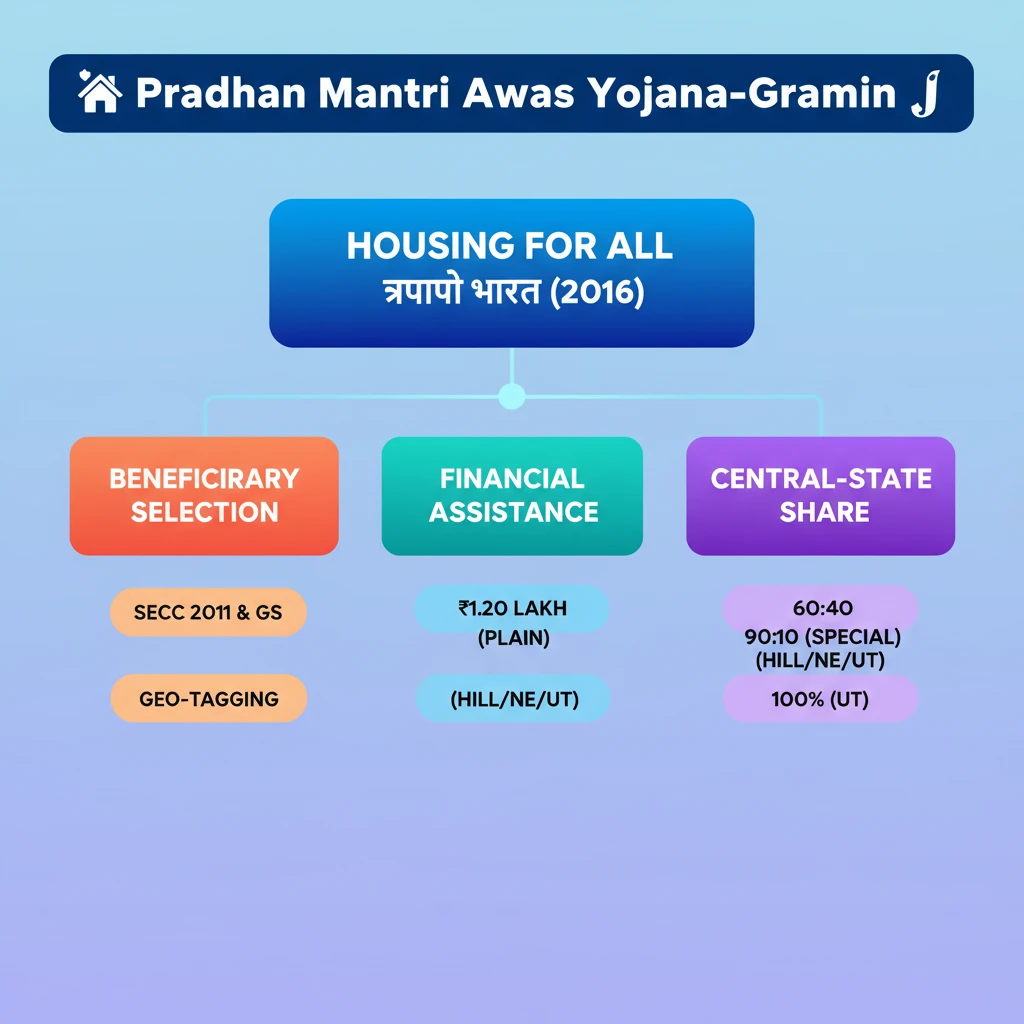
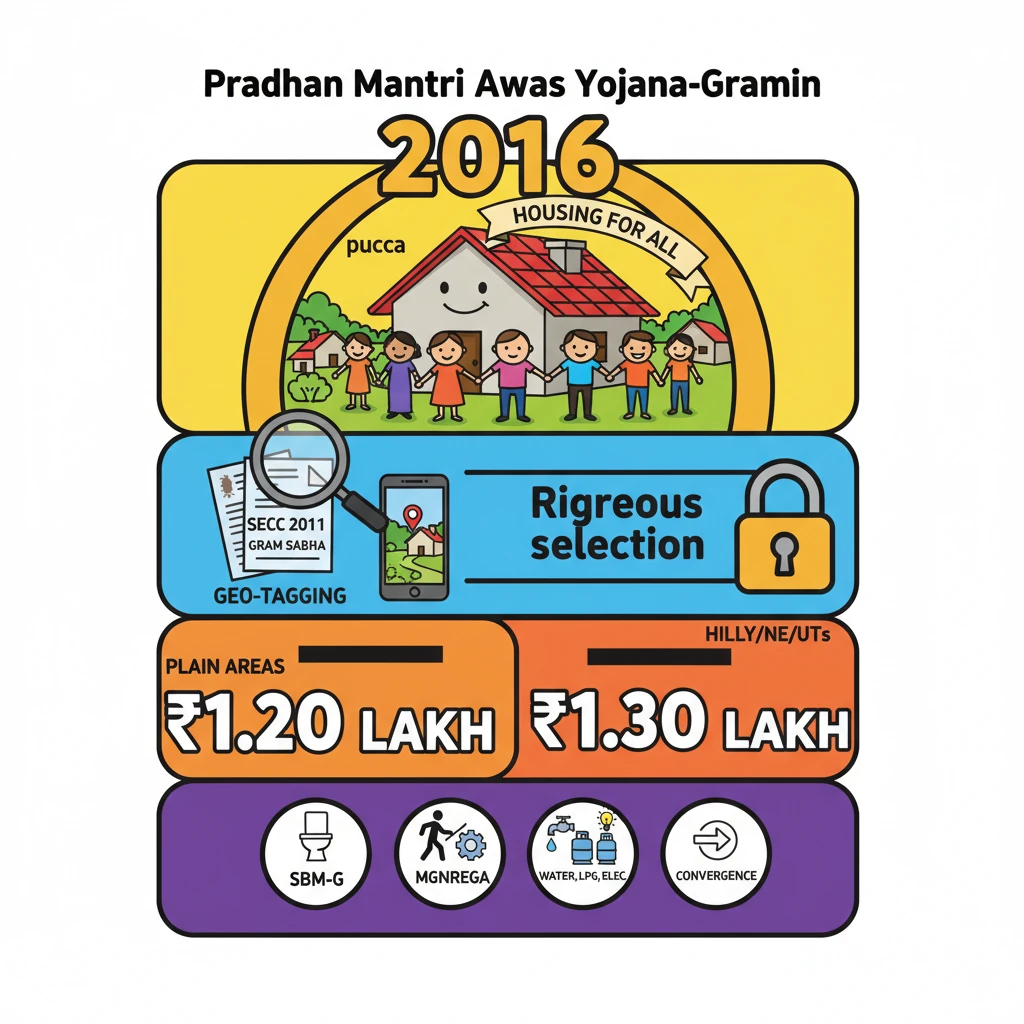
<h4>Introduction to Pradhan Mantri Awas Yojana-Gramin (PMAY-G)</h4><p>The **Pradhan Mantri Awas Yojana-Gramin (PMAY-G)** is a flagship initiative by the **Indian government** aimed at providing housing for the most vulnerable sections of society in rural areas. Launched in **2016**, it seeks to ensure that every rural household has access to a **pucca (all-weather) home** with basic amenities.</p><h4>Recent Initiatives and Context</h4><p>Recently, the government has intensified its efforts under **PMAY-G** by initiating a nationwide **survey of kutcha houses**. This crucial step aims to identify new eligible beneficiaries who currently lack adequate housing.</p><p>Alongside the survey, the **Awas Sakhi mobile app** has been launched. This application is designed to streamline the identification process and enhance the efficiency of the scheme's implementation on the ground.</p><div class='exam-tip-box'><p><strong>UPSC Insight:</strong> Recent developments like the survey and mobile app highlight the government's commitment to achieving its 'Housing for All' objective and are important for current affairs sections in **Prelims** and **Mains GS-II**.</p></div><h4>Core Objective and Launch</h4><p>The primary objective of **PMAY-G**, which commenced in **2016**, is to provide financial assistance for the construction of **pucca houses** to all eligible rural households. This includes those living in **kutcha** or dilapidated houses.</p><p>The scheme specifically targets the **poorest segments of society**, ensuring that aid reaches those who are most in need of safe and dignified shelter.</p><h4>Beneficiary Selection Process</h4><p>Beneficiary selection under **PMAY-G** follows a rigorous **three-stage validation process** to ensure transparency and prevent leakages. This multi-layered approach helps identify the most deserving individuals.</p><ul><li><strong>Stage 1:</strong> Utilizes data from the **Socio-Economic Caste Census (SECC) 2011** to identify potential beneficiaries based on deprivation criteria.</li><li><strong>Stage 2:</strong> Requires **Gram Sabha approvals**, where the provisional list of beneficiaries is publicly displayed and verified by the community.</li><li><strong>Stage 3:</strong> Involves **geo-tagging** of the houses, which helps in monitoring construction progress and ensures that assistance is provided for actual construction.</li></ul><h4>Key Provisions and Support</h4><p>Under **PMAY-G**, beneficiaries receive comprehensive support to construct their homes. This includes direct financial aid and convergence with other government schemes for essential facilities.</p><div class='info-box'><strong>Financial Assistance:</strong><ul><li><strong>Plain Areas:</strong> Beneficiaries receive <strong>Rs 1.20 lakh</strong>.</li><li><strong>Hilly States, Northeastern States, and Union Territories:</strong> Beneficiaries receive <strong>Rs 1.30 lakh</strong> due to higher construction costs.</li></ul></div><div class='info-box'><strong>Additional Support for Toilets:</strong><ul><li>An additional <strong>Rs 12,000</strong> is provided for the construction of toilets.</li><li>This support is facilitated through convergence with schemes like **Swachh Bharat Mission - Gramin (SBM-G)** or **Mahatma Gandhi National Rural Employment Guarantee Scheme (MGNREGS)**, or other dedicated funding sources.</li></ul></div><div class='info-box'><strong>Employment Support:</strong><ul><li>Beneficiaries are mandatorily provided with **90/95/100-person-days** of **unskilled wage employment**.</li><li>This employment is channeled through the **Mahatma Gandhi National Rural Employment Guarantee Act (MGNREGA)** for the construction of their houses, providing both income and labor.</li></ul></div><div class='info-box'><strong>Basic Amenities:</strong><ul><li>Access to essential amenities such as **water**, **liquefied petroleum gas (LPG)**, and **electricity connections** is ensured.</li><li>This is achieved through convergence with relevant schemes of other ministries and departments, promoting holistic development.</li></ul></div><h4>Funding and Cost Sharing Mechanism</h4><p>The financial burden of **PMAY-G** is shared between the **Central** and **State governments**, with varying ratios depending on the geographical region to account for diverse economic conditions.</p><div class='info-box'><strong>Cost Sharing Ratios:</strong><ul><li><strong>Plain Areas:</strong> The Centre and State share expenses in a **60:40 ratio**.</li><li><strong>Northeastern States, Two Himalayan States (Himachal Pradesh and Uttarakhand), and the Union Territory (UT) of J&K:</strong> The sharing ratio is **90:10** (Centre:State).</li><li><strong>Other Union Territories (including Ladakh):</strong> The **Centre bears 100% of the cost**.</li></ul></div><h4>Progress and Achievements</h4><p>The **PMAY-G** scheme has demonstrated significant progress towards its ambitious goals, positively impacting millions of rural families across India.</p><div class='key-point-box'><p>The government had set an ambitious target to build **2.95 crore houses** under the scheme.</p><p>As of **August 2023**, **2.94 crore houses** have been sanctioned, indicating nearly full sanctioning of the target.</p><p>A total of **2.54 crore houses** have been successfully completed, significantly improving the living conditions of millions.</p></div><h4>Future Outlook and Eligibility Revisions</h4><p>The government continues to expand the scope and reach of **PMAY-G** to address ongoing housing needs and ensure wider coverage.</p><p>In **August 2024**, the **Union Cabinet** approved financial assistance for the construction of **two crore additional houses**. These will be built at the existing unit assistance rates.</p><p>Significantly, the **PMAY-G eligibility criteria have been relaxed**. Individuals owning **bikes or scooters** can now be included in the beneficiary list, expanding the pool of eligible households.</p><p>The income limit for eligibility has also been increased. People earning up to **Rs 15,000 a month** are now eligible, up from the earlier limit of **Rs 10,000**.</p><p>This amendment, spanning from **FY 2024-2029**, aims to benefit nearly **10 crore individuals** by ensuring safe, hygienic, and socially inclusive housing for those without proper shelter or living in dilapidated conditions.</p>
💡 Key Takeaways
- •PMAY-G (launched 2016) aims to provide 'Housing for All' in rural areas by building pucca houses.
- •Beneficiary selection is rigorous, involving SECC 2011 data, Gram Sabha approval, and geo-tagging.
- •Financial assistance varies: Rs 1.20 lakh (plain areas) and Rs 1.30 lakh (hilly/NE/UTs).
- •Scheme relies on convergence for toilets (SBM-G), employment (MGNREGA), and basic amenities (water, LPG, electricity).
- •Cost sharing is 60:40 (Centre:State) for plain areas, 90:10 for special category states, and 100% for other UTs.
- •Recent updates (Aug 2024) include 2 crore additional houses and relaxed eligibility (income up to Rs 15,000, bike/scooter owners now eligible).
🧠 Memory Techniques
98% Verified Content
📚 Reference Sources
•Official PMAY-G website (for cross-referencing figures and dates if available outside summary)