Legal and Social Issues - Polity And Governance | UPSC Learning
Topics
0 topics • 0 completed
🔍
No topics match your search

Legal and Social Issues
Medium⏱️ 8 min read
polity and governance
📖 Introduction
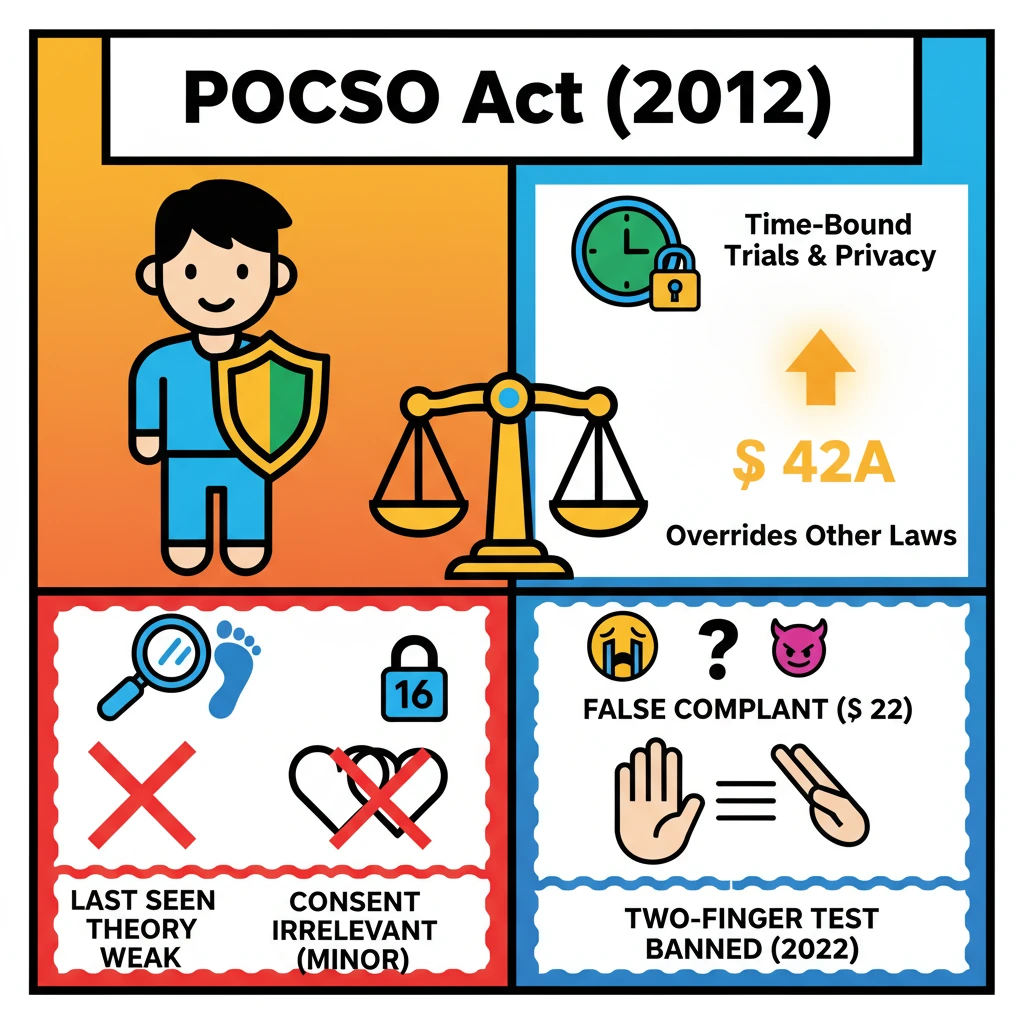
<h4>Introduction to POCSO Act, 2012</h4><p>The <strong>Protection of Children from Sexual Offences (POCSO) Act, 2012</strong>, is a landmark legislation in India. It aims to protect children from various forms of sexual abuse and exploitation, ensuring their well-being and dignity.</p><p>The Act provides a child-friendly legal framework for reporting, recording evidence, investigation, and speedy trial of offences.</p><h4>Key Rights of the Child under POCSO</h4><div class='key-point-box'><p>The <strong>POCSO Act</strong> enshrines several crucial rights for child victims during legal proceedings.</p></div><p><strong>Right to be Informed:</strong> Children must be kept informed about the progress and details of legal proceedings concerning them. This ensures transparency and reduces anxiety.</p><p><strong>Right to Privacy:</strong> The Act mandates maintaining strict confidentiality of proceedings. This is vital to protect the child's identity and privacy, preventing further trauma or stigmatization.</p><h4>Procedural Aspects and Safeguards</h4><p>The <strong>POCSO Act</strong> outlines specific procedures for the trial of offenders to ensure swift justice and protection for the child.</p><ul><li><strong>Special Courts:</strong> The Act mandates the establishment of <strong>Special Courts</strong> which can take cognizance of offences without the accused being committed to trial.</li><li><strong>Child Protection:</strong> Efforts must be made to prevent the child from being exposed to the accused during proceedings, safeguarding their emotional well-being.</li><li><strong>Time-bound Justice:</strong> Evidence must be recorded within <strong>30 days</strong> of cognizance, and trials are mandated to be completed within <strong>one year</strong>.</li></ul><div class='info-box'><p><strong>Medical Examination:</strong> The Act emphasizes the importance of a medical examination. However, it acknowledges that <strong>physical injuries may not always be present</strong> in cases of sexual abuse, which should not deter prosecution.</p></div><h4>Overriding Effect of POCSO Provisions</h4><p><strong>Section 42A</strong> of the <strong>POCSO Act</strong> is a critical provision. It explicitly states that the provisions of POCSO will <strong>override any conflicting laws</strong> currently in force.</p><div class='key-point-box'><p>This ensures that the protective measures and child-centric approach of <strong>POCSO</strong> take precedence over other statutes, strengthening its implementation.</p></div><h4>Critical Shortcomings and Challenges of the POCSO Act</h4><p>Despite its progressive intent, the implementation of the <strong>POCSO Act</strong> has faced several challenges and highlighted certain shortcomings.</p><h5>1. Application of the 'Last Seen Theory'</h5><p>The <strong>'Last Seen Theory'</strong> posits that if someone was the last person seen with a victim before a crime and cannot provide a credible explanation, they are strongly presumed responsible.</p><div class='exam-tip-box'><p>In <strong>Anjan Kumar Sarma v. State of Assam, 2017</strong>, the <strong>Supreme Court</strong> ruled that this theory is <strong>weak without corroborative evidence</strong>. Over-reliance on it risks <strong>wrongful convictions</strong>, a critical concern for justice.</p></div><h5>2. Issues with Consensual Sexual Activities</h5><p>A significant debate surrounds cases of <strong>consensual sexual activities</strong> involving a minor and a non-minor partner. The Act currently prosecutes the non-minor partner.</p><div class='key-point-box'><p>This is because a minor's <strong>consent is deemed irrelevant</strong> under the <strong>POCSO Act</strong>, regardless of the perceived voluntariness of the act. This has led to complex legal and social dilemmas, particularly for adolescents.</p></div><h5>3. Problem of False Complaints by Children</h5><p><strong>Section 22</strong> of the <strong>POCSO Act</strong> provides an exemption for children from punishment for making <strong>false complaints</strong>. While intended to encourage reporting, this provision has raised concerns.</p><p>There is a potential for <strong>misuse</strong> of this exemption, leading to false accusations and subsequent legal complications for innocent individuals.</p><h5>4. Continued Practice of the 'Two-Finger Test'</h5><p>The invasive <strong>'two-finger' or 'three-finger' vaginal test</strong> for rape or sexual assault survivors was <strong>banned in 2012</strong>. However, reports indicate its continued practice.</p><div class='info-box'><p>In <strong>Lillu @ Rakesh v. State of Haryana, 2013</strong>, the <strong>Supreme Court</strong> highlighted that this test violates the victim’s <strong>privacy and dignity</strong>. The Court <strong>reaffirmed this ban in 2022</strong>, categorizing its conduct as <strong>misconduct</strong>.</p></div><p>These tests are considered <strong>regressive</strong> and are used erroneously to determine if the survivor was <strong>"habituated" to sexual intercourse</strong>, which is medically and legally irrelevant to proving rape.</p><h5>5. Unprepared Investigation Machinery</h5><p>The effectiveness of the <strong>POCSO Act</strong> is often hampered by deficiencies in the <strong>investigation machinery</strong>.</p><div class='exam-tip-box'><p>The <strong>Bombay High Court</strong>, in <strong>Addl. Sessions Judge, Hoingoli and Ors. v. Bhawat and Ors., 2017</strong>, acquitted an accused due to <strong>unsealed evidence</strong>. This case underscores the critical need for improved and standardized <strong>investigation procedures</strong> to prevent faulty evidence collection.</p></div>

💡 Key Takeaways
- •POCSO Act (2012) is India's key law for protecting children from sexual offenses.
- •It grants children rights to information and privacy during legal proceedings, mandating special courts and time-bound trials.
- •Section 42A ensures POCSO provisions override any conflicting laws, strengthening its implementation.
- •Key shortcomings include issues with the 'Last Seen Theory' (weak without corroboration), treatment of consensual activities (minor's consent irrelevant), potential misuse of false complaint exemption (Section 22), and the banned 'Two-Finger Test' (reaffirmed as misconduct in 2022).
- •Investigation machinery often faces challenges, with procedural errors (e.g., unsealed evidence) leading to acquittals, highlighting the need for capacity building.
- •Judicial pronouncements (e.g., Anjan Kumar Sarma, Lillu @ Rakesh, Addl. Sessions Judge, Hoingoli) are crucial for interpreting and improving POCSO implementation.
🧠 Memory Techniques
95% Verified Content
📚 Reference Sources
•Protection of Children from Sexual Offences (POCSO) Act, 2012
•Anjan Kumar Sarma v. State of Assam, 2017 (Supreme Court)
•Lillu @ Rakesh v. State of Haryana, 2013 (Supreme Court)
•Supreme Court of India's 2022 ruling on Two-Finger Test
•Addl. Sessions Judge, Hoingoli and Ors. v. Bhawat and Ors., 2017 (Bombay High Court)
•POCSO Amendment Act, 2019