What is the Death Penalty? - Polity And Governance | UPSC Learning
Topics
0 topics • 0 completed
🔍
No topics match your search
What is the Death Penalty?
Medium⏱️ 10 min read
polity and governance
📖 Introduction
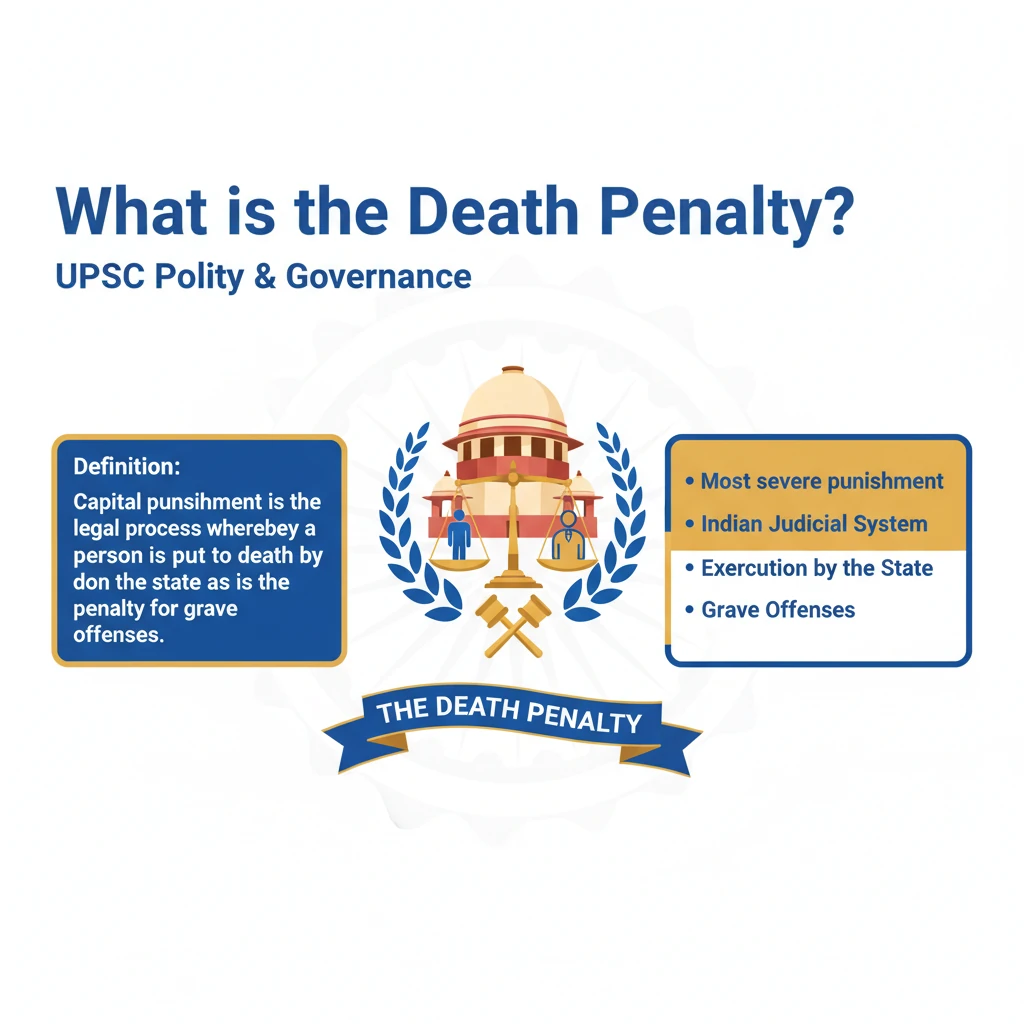
<h4>What is the Death Penalty?</h4><p>The <strong>Death Penalty</strong>, also known as <strong>capital punishment</strong>, represents the most severe form of punishment within the <strong>Indian judicial system</strong>. It involves the execution of an individual by the <strong>state</strong> as a penalty for certain grave offenses.</p><div class='info-box'><p><strong>Definition:</strong> <strong>Capital punishment</strong> is the legal process whereby a person is put to death by the state as a punishment for a crime.</p></div><h4>Legal Framework for Death Sentence</h4><p>In India, the imposition of the <strong>death penalty</strong> is governed by specific provisions outlined in the <strong>Bharatiya Nyay Sanhita (BNS, 2023)</strong>, the <strong>Bharatiya Nagarik Suraksha Sanhita (BNSS, 2023)</strong>, and other special laws.</p><p>The <strong>BNS (2023)</strong>, which replaced the <strong>Indian Penal Code (IPC)</strong>, mandates the <strong>death penalty</strong> for several heinous crimes. These include offenses such as <strong>rape causing death (Section 66)</strong>, <strong>gang rape of minors (Section 70(2))</strong>, and <strong>serial rape (Section 71)</strong>.</p><p><strong>Section 33</strong> of the <strong>BNS</strong> specifically provides for the punishment of death, alongside other forms like <strong>life imprisonment</strong> and general imprisonment. Beyond these, other specific offenses punishable by death include <strong>murder (Section 302)</strong>, acts of <strong>terrorism</strong> under the <strong>Unlawful Activities (Prevention) Act (UAPA)</strong>, and certain offenses related to <strong>drug trafficking</strong> under the <strong>Narcotic Drugs and Psychotropic Substances Act (NDPS)</strong>.</p><h4>Constitutional Stance on Death Penalty</h4><p>The <strong>Constitution of India</strong> does not explicitly declare <strong>capital punishment</strong> as unconstitutional. Its legality is affirmed through judicial interpretation.</p><p>The <strong>Supreme Court</strong>, particularly in the landmark case of <strong>Bachan Singh vs. State of Punjab (1980)</strong>, identified five categories of cases where capital punishment could be awarded. These categories often involve crimes of extreme brutality, depraved motives, and significant magnitude.</p><div class='key-point-box'><p><strong>Key Principle:</strong> The <strong>Indian Constitution</strong> allows for deprivation of life if done according to <strong>procedure established by law</strong>, as interpreted by the <strong>Supreme Court</strong>.</p></div><h4>Key Supreme Court Rulings</h4><p>The <strong>Supreme Court of India</strong> has delivered several pivotal judgments shaping the application of the <strong>death penalty</strong>:</p><ul><li><strong>Jagmohan Singh v. State of UP (1973):</strong> The SC held that deprivation of life is constitutionally permissible under <strong>Article 21</strong> if it is done according to the <strong>procedure established by law</strong>. Thus, a death sentence imposed after a fair trial, in accordance with legal procedures under the <strong>CrPC</strong> and <strong>Indian Evidence Act</strong>, is not unconstitutional under <strong>Article 21</strong>.</li><li><strong>Rajendra Prasad v. State of UP (1979):</strong> The SC opined that if a criminal's murderous actions persistently, planned, and perilously jeopardize <strong>social security</strong>, their enjoyment of fundamental rights, including life, may be justifiably annihilated.</li><li><strong>Bachan Singh v. State of Punjab (1980):</strong> This landmark case established the principle of awarding the <strong>death penalty</strong> only in the <strong>“rarest of rare” cases</strong>. This dictum signifies that capital punishment should be imposed only when the alternative sentence of <strong>life imprisonment</strong> is deemed inadequate due to the extreme nature and brutality of the crime.</li><li><strong>Machhi Singh v. State of Punjab (1983):</strong> The SC laid down specific considerations and guidelines for determining whether a particular case falls under the category of <strong>“rarest of rare”</strong>, providing a framework for lower courts.</li></ul><div class='exam-tip-box'><p>⚡️<strong>UPSC Insight:</strong> Understanding the evolution of the <strong>'rarest of rare' doctrine</strong> through these judgments is crucial for Mains answers, especially in <strong>GS-II Polity</strong> and <strong>GS-IV Ethics</strong>.</p></div>
💡 Key Takeaways
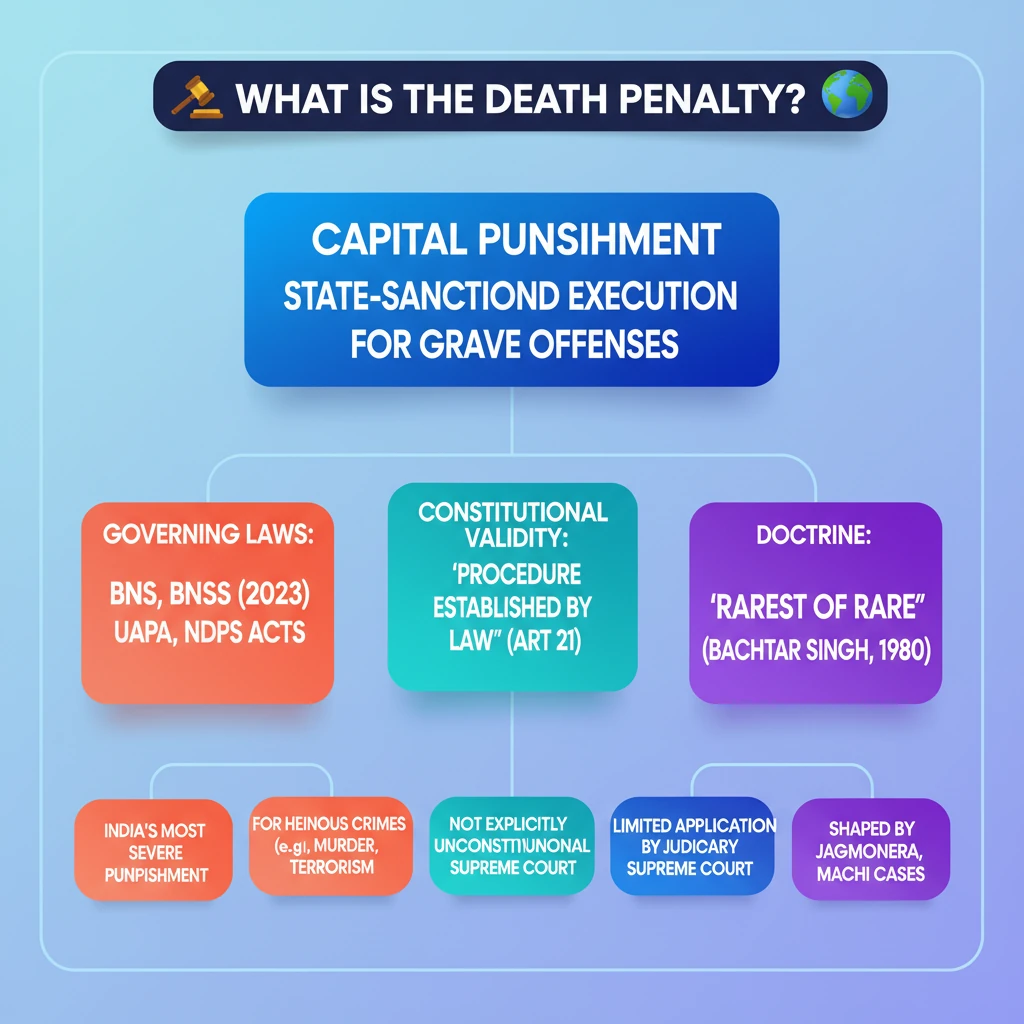
- •The Death Penalty (capital punishment) is the most severe punishment in India, involving execution by the state for grave offenses.
- •It is governed by the Bharatiya Nyay Sanhita (BNS, 2023), Bharatiya Nagarik Suraksha Sanhita (BNSS, 2023), and special laws like UAPA and NDPS Act.
- •The Constitution of India does not explicitly declare it unconstitutional; its validity rests on 'procedure established by law' (Article 21).
- •The Supreme Court, in Bachan Singh v. State of Punjab (1980), established the 'rarest of rare' doctrine, limiting its application.
- •Key judgments like Jagmohan Singh (1973), Rajendra Prasad (1979), and Machhi Singh (1983) have shaped its interpretation and application.
🧠 Memory Techniques

98% Verified Content
📚 Reference Sources
•The Constitution of India (Article 21)
•Bharatiya Nyay Sanhita (BNS, 2023)
•Bharatiya Nagarik Suraksha Sanhita (BNSS, 2023)
•Supreme Court judgments: Bachan Singh v. State of Punjab (1980)
•Supreme Court judgments: Jagmohan Singh v. State of UP (1973)
•Supreme Court judgments: Rajendra Prasad v. State of UP (1979)
•Supreme Court judgments: Machhi Singh v. State of Punjab (1983)
•Unlawful Activities (Prevention) Act (UAPA)
•Narcotic Drugs and Psychotropic Substances Act (NDPS)