Railway Accidents and Kavach System - Polity And Governance | UPSC Learning
Topics
0 topics • 0 completed
🔍
No topics match your search
Railway Accidents and Kavach System
Medium⏱️ 8 min read
polity and governance
📖 Introduction
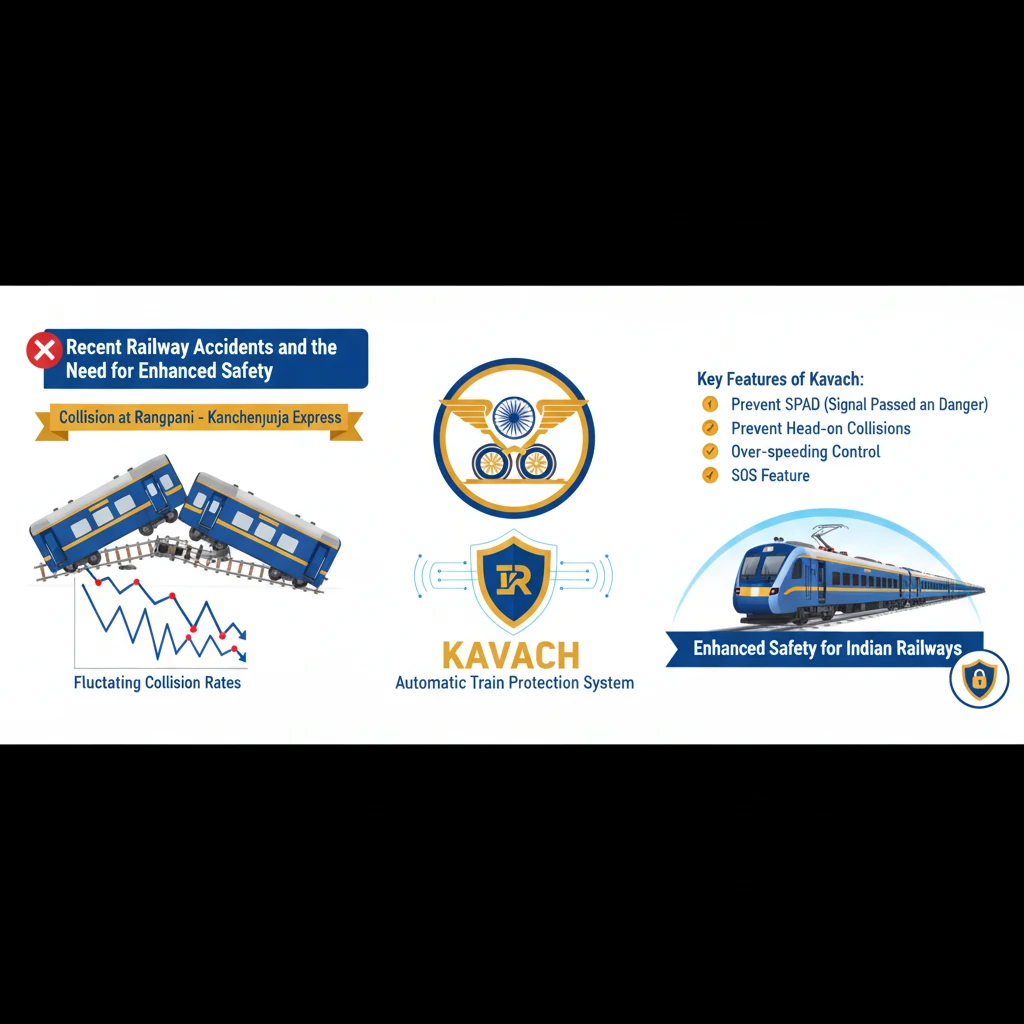
<h4>Recent Railway Accidents and the Need for Enhanced Safety</h4><p>The recent <strong>collision at Rangapani</strong> involving the <strong>Kanchenjunga Express</strong> has brought critical attention to the urgent need for enhanced safety measures within the Indian Railways system. This incident underscores the persistent challenges in ensuring complete operational safety.</p><p>Despite continuous safety enhancements, <strong>Indian Railways</strong> has experienced fluctuating rates of collisions. Data indicates <strong>six incidents</strong> in the fiscal year <strong>2022-23</strong> and <strong>four incidents</strong> in <strong>2023-24</strong>, highlighting the ongoing imperative to prevent such occurrences and safeguard passenger lives.</p><h4>Understanding the Kavach System</h4><p><strong>Kavach</strong>, an advanced <strong>cab signalling train control system</strong>, was officially launched in <strong>2020</strong>. It incorporates crucial <strong>anti-collision features</strong> designed to significantly improve railway safety across the network.</p><p>The system was indigenously developed by the <strong>Research Design and Standards Organisation (RDSO)</strong> in collaboration with three Indian vendors. It has been officially adopted as the <strong>National Automatic Train Protection (ATP) System</strong> for Indian Railways.</p><div class='key-point-box'><p><strong>Kavach</strong> adheres to <strong>Safety Integrity Level-4 (SIL-4)</strong> standards, representing the highest level of safety integrity. It functions as a vigilant watchdog, overseeing the existing signalling system and providing critical alerts.</p></div><p>When a loco pilot approaches a <strong>'red signal'</strong>, <strong>Kavach</strong> provides immediate alerts. If necessary, it automatically applies brakes to prevent the train from overshooting the signal, thereby averting potential collisions.</p><div class='info-box'><p><strong>Safety Integrity Level (SIL):</strong> This is a crucial measure in functional safety standards. It quantifies the level of risk reduction provided by a safety function. SILs range from <strong>SIL 1</strong> (lowest safety integrity) to <strong>SIL 4</strong> (highest safety integrity).</p></div><p>Beyond collision prevention, <strong>Kavach</strong> is equipped to relay <strong>SoS messages</strong> during emergency situations, ensuring prompt communication and response. It also facilitates <strong>centralised live monitoring</strong> of train movements through a dedicated <strong>Network Monitor System</strong>.</p><h4>Key Components of Kavach</h4><p>The successful deployment and operation of the <strong>Kavach system</strong> depend on the integration of several critical components. These components work in tandem to create a robust safety network.</p><p>One fundamental component involves the integration of <strong>Radio Frequency Identification (RFID) technology</strong> directly into the railway tracks. This technology forms the backbone for accurate train positioning and communication.</p><div class='info-box'><p><strong>Radio Frequency Identification (RFID):</strong> This technology uses <strong>electromagnetic fields</strong> to automatically identify and read information from a wireless device, known as an <strong>RFID tag</strong>. It operates from a distance, eliminating the need for physical contact or a direct line of sight.</p></div>
💡 Key Takeaways
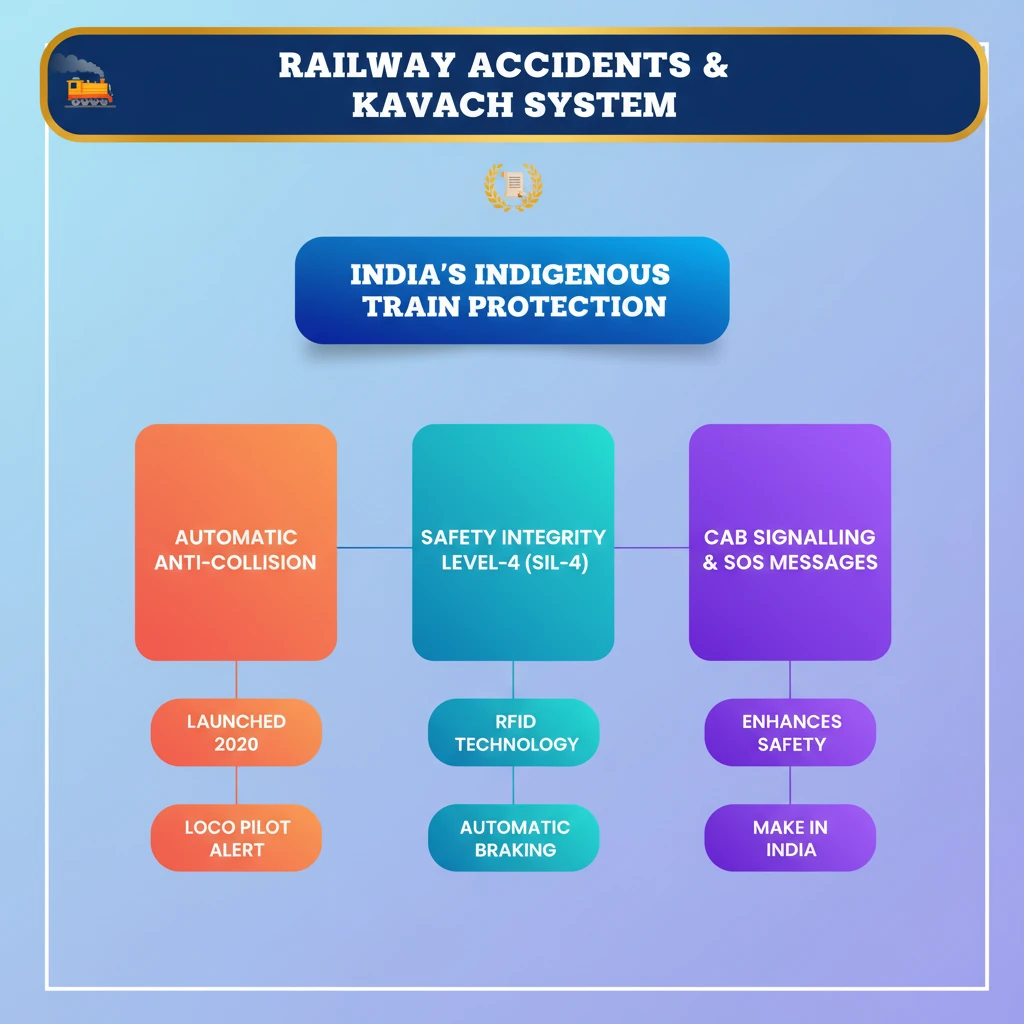
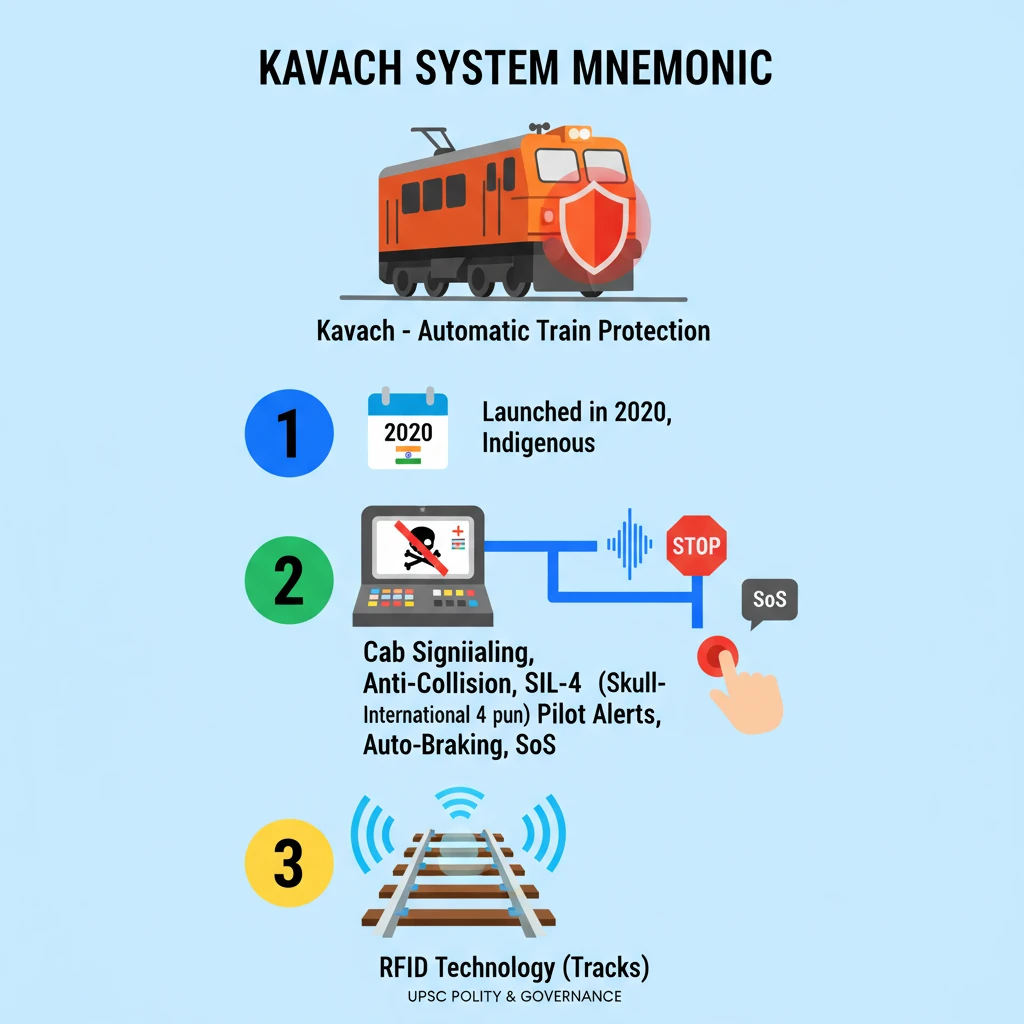
- •Kavach is India's indigenous Automatic Train Protection (ATP) system, launched in 2020.
- •It is a cab signalling system with anti-collision features, adhering to Safety Integrity Level-4 (SIL-4).
- •Key functions include alerting loco pilots, automatic braking to prevent signal overshooting, and sending SoS messages.
- •Components include Radio Frequency Identification (RFID) technology integrated into tracks.
- •Aims to enhance railway safety, reduce accidents, and support the 'Make in India' initiative.
- •Recent incidents like the Rangapani collision highlight its urgent need for widespread deployment.
🧠 Memory Techniques
98% Verified Content
📚 Reference Sources
•Press Information Bureau (PIB) releases on Indian Railways and Kavach
•Official documents from the Ministry of Railways, Government of India
•Research Design and Standards Organisation (RDSO) publications