SC Limits ED's Arrest Powers in PMLA Cases - Polity And Governance | UPSC Learning
Topics
0 topics • 0 completed
🔍
No topics match your search
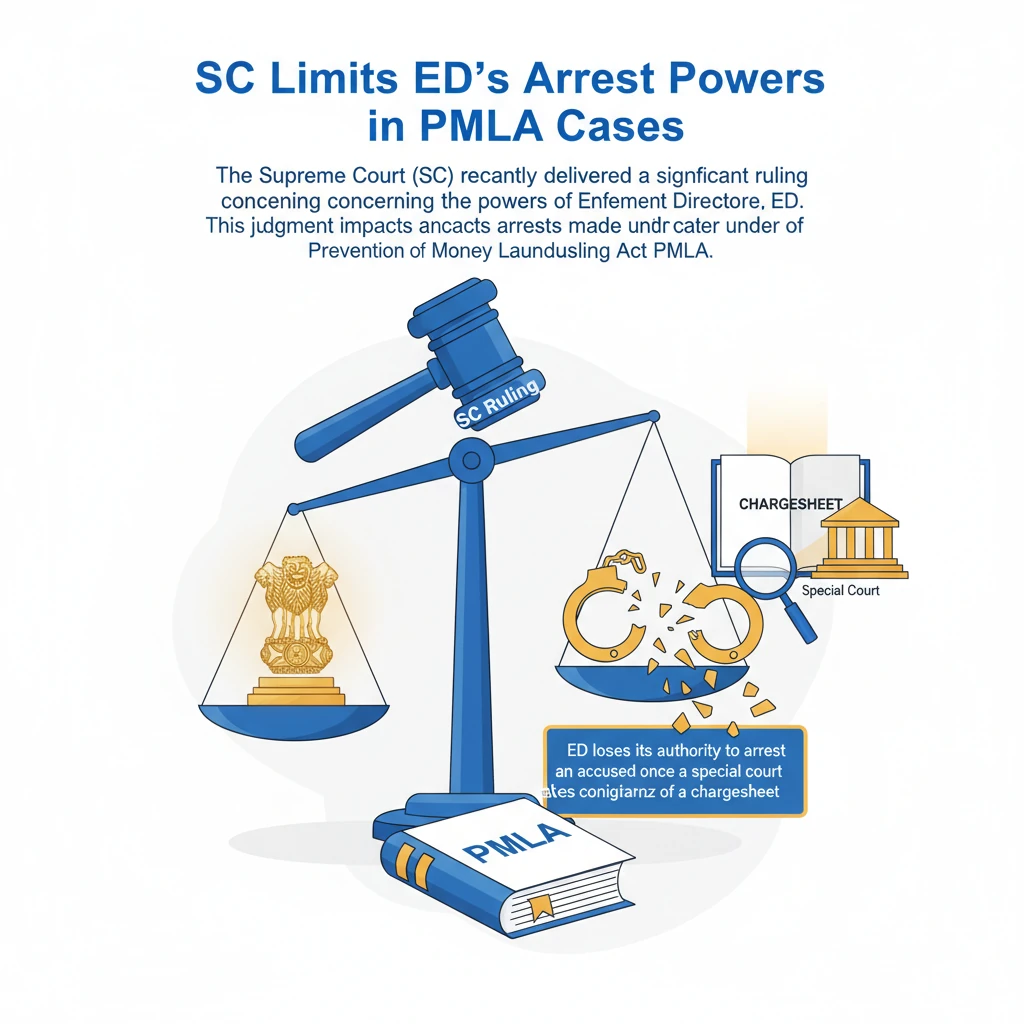
SC Limits ED's Arrest Powers in PMLA Cases
Medium⏱️ 7 min read
polity and governance
📖 Introduction
<h4>SC Limits ED's Arrest Powers in PMLA Cases</h4><p>The <strong>Supreme Court (SC)</strong> recently delivered a significant ruling concerning the powers of the <strong>Enforcement Directorate (ED)</strong>. This judgement impacts arrests made under the <strong>Prevention of Money Laundering Act (PMLA)</strong>.</p><div class='key-point-box'><p>The SC ruled that the <strong>ED loses its authority to arrest an accused</strong> once a <strong>special court takes cognizance of a chargesheet</strong> filed under the PMLA. This decision significantly limits the ED's power to execute arrests.</p></div><p>The ruling underscores the paramount importance of <strong>personal liberty</strong>, ensuring it is not arbitrarily infringed upon by investigative agencies.</p><h4>Twin Conditions of Bail Under PMLA (Section 45)</h4><p><strong>Section 45</strong> of the <strong>PMLA</strong> imposes extremely stringent conditions for granting bail to an accused. These are often referred to as the <strong>"twin conditions"</strong>.</p><ul><li><strong>Burden of Proving Innocence:</strong> The accused is required to satisfy the court that there are reasonable grounds for believing they are <strong>not guilty</strong> of the alleged offence.</li><li><strong>Ensuring No Offences While on Bail:</strong> The accused must also convince the judge that they are <strong>unlikely to commit any offence</strong> while out on bail.</li></ul><div class='info-box'><p>The <strong>burden of proof</strong> in PMLA bail cases rests entirely on the <strong>incarcerated accused</strong>. This reversal of the usual 'innocent until proven guilty' principle makes obtaining bail exceptionally difficult.</p></div><p>These rigorous twin conditions make it almost impossible for an accused to secure bail in PMLA cases, leading to prolonged incarceration during trial.</p><h4>What is PMLA?</h4><p>The <strong>Prevention of Money Laundering Act, 2002 (PMLA)</strong> was enacted by the Indian Parliament to combat the serious issue of <strong>money laundering</strong>. It came into force on <strong>July 1, 2005</strong>.</p><div class='info-box'><p><strong>Definition:</strong> <strong>Money laundering</strong> is the process of converting illegally earned money (<strong>"black money"</strong>) into seemingly legitimate money (<strong>"white money"</strong>) to conceal its illicit origin.</p></div><p>The primary objectives of PMLA are to <strong>prevent money laundering</strong> and to provide for the <strong>confiscation of property</strong> derived from or involved in money laundering activities.</p><p>It specifically targets money laundering related to various illegal activities, including <strong>drug trafficking</strong>, <strong>smuggling</strong>, and <strong>terrorism financing</strong>.</p><h4>Key Provisions of PMLA</h4><p>The PMLA includes several crucial provisions to achieve its objectives:</p><ul><li><strong>Offences and Penalties:</strong> The Act clearly defines what constitutes a <strong>money laundering offence</strong>. It prescribes severe penalties, including <strong>rigorous imprisonment</strong> for a term ranging from 3 to 7 years (extendable to 10 years in certain cases) and substantial <strong>fines</strong>.</li><li><strong>Attachment and Confiscation of Property:</strong> PMLA empowers authorities to provisionally <strong>attach</strong> and subsequently <strong>confiscate</strong> properties involved in or derived from money laundering. An <strong>Adjudicating Authority</strong> is established to oversee these proceedings.</li><li><strong>Reporting Requirements:</strong> The Act mandates certain entities, known as <strong>"reporting entities"</strong> (e.g., banks, financial institutions, intermediaries), to maintain records of transactions and report <strong>suspicious transactions</strong> to the <strong>Financial Intelligence Unit - India (FIU-IND)</strong>.</li><li><strong>Appellate Tribunal:</strong> <strong>Section 25</strong> of PMLA provides for the establishment of an <strong>Appellate Tribunal</strong>. This tribunal hears appeals against orders passed by the Adjudicating Authority, ensuring a mechanism for review.</li></ul><h4>Recent Amendments Related to PMLA</h4><p>The PMLA has undergone several amendments to strengthen its framework and align with international standards:</p><ol><li><strong>Prevention of Money-laundering (Restoration of Confiscated Property) Amendment Rules, 2019:</strong><ul><li>This amendment introduced a <strong>New Rule 8A</strong>.</li><li>Under <strong>Rule 8A</strong>, after charges are framed, the <strong>Special Court</strong> may publish notices in newspapers. These notices invite claimants with legitimate interest in attached, seized, or frozen property to establish their claims for restoration.</li></ul></li><li><strong>Prevention of Money Laundering (Maintenance of Records) Amendment Rules, 2023:</strong><ul><li>The <strong>Finance Ministry</strong> revised these rules to expand <strong>disclosure requirements for NGOs</strong> by reporting entities. This aims to prevent misuse of funds by non-profit organizations.</li><li>It also clarified the definition of <strong>"Politically Exposed Persons" (PEPs)</strong> under PMLA, aligning it with recommendations from the <strong>Financial Action Task Force (FATF)</strong>.</li></ul></li></ol><div class='info-box'><p><strong>Definition of PEPs:</strong> As per the new PMLA compliance rules, <strong>Politically Exposed Persons (PEPs)</strong> are individuals entrusted with prominent public functions by a foreign country. This includes heads of state, senior politicians, high-ranking government, judicial or military officers, senior executives of state-owned corporations, and important political party officials.</p></div><h4>Bailable and Non-Bailable Offences in India</h4><p>Understanding the distinction between bailable and non-bailable offences is crucial in the context of legal proceedings, including those under PMLA.</p><table class='info-table'><tr><th>Offence Type</th><th>Description</th><th>Example</th></tr><tr><td><strong>Bailable Offences</strong></td><td>These are generally <strong>less serious offences</strong> where the accused is presumed innocent and has a <strong>right to be released on bail</strong>, usually upon furnishing a bail bond.</td><td><strong>Petty theft</strong>, <strong>Traffic violations</strong>, <strong>Simple assault</strong></td></tr><tr><td><strong>Non-Bailable Offences</strong></td><td>These are <strong>more serious offences</strong>. Granting bail is at the <strong>discretion of the court</strong>, based on specific criteria such as the nature of the crime, evidence, and potential flight risk.</td><td><strong>Murder</strong>, <strong>Rape</strong>, <strong>Kidnapping</strong>, <strong>Arson</strong></td></tr></table><div class='exam-tip-box'><p>The twin conditions of <strong>Section 45 PMLA</strong> effectively make money laundering a <strong>non-bailable offence</strong>, placing a heavy burden on the accused to prove innocence for bail.</p></div>
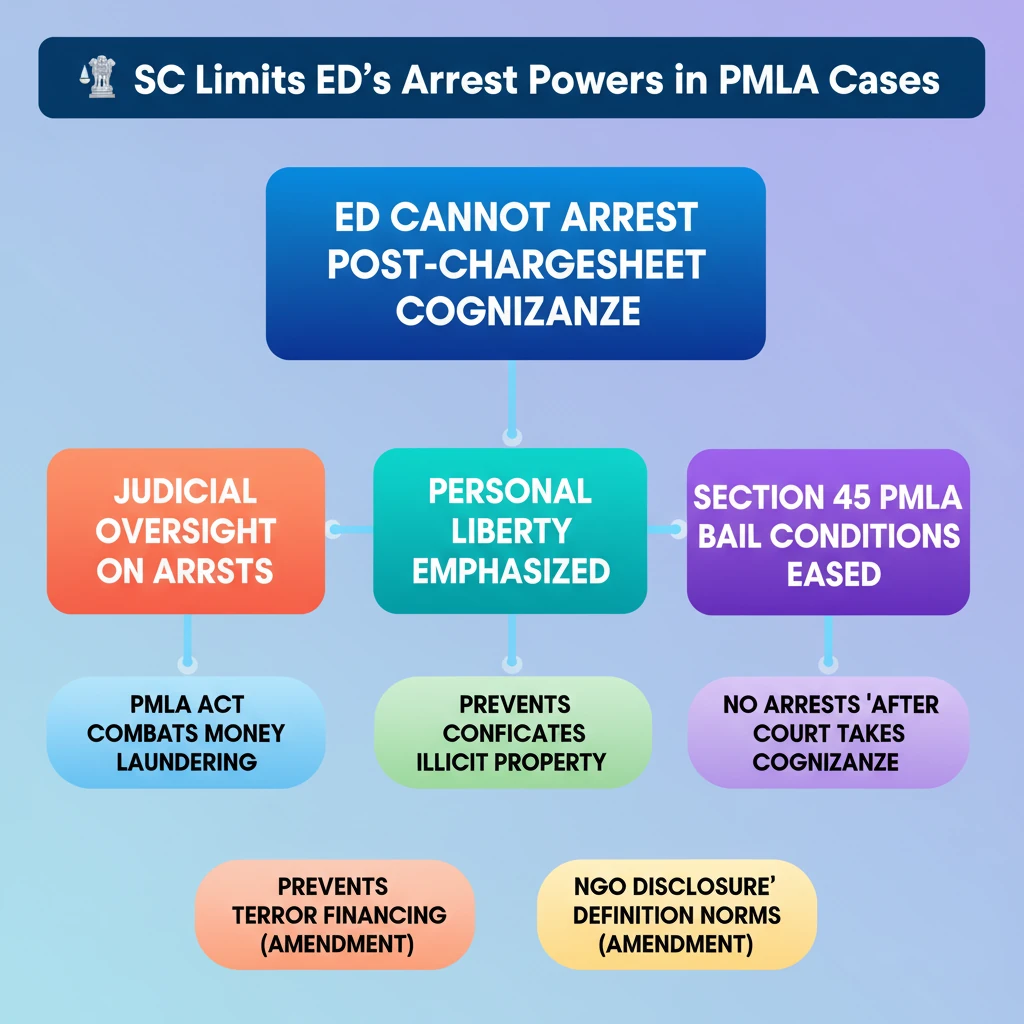
💡 Key Takeaways
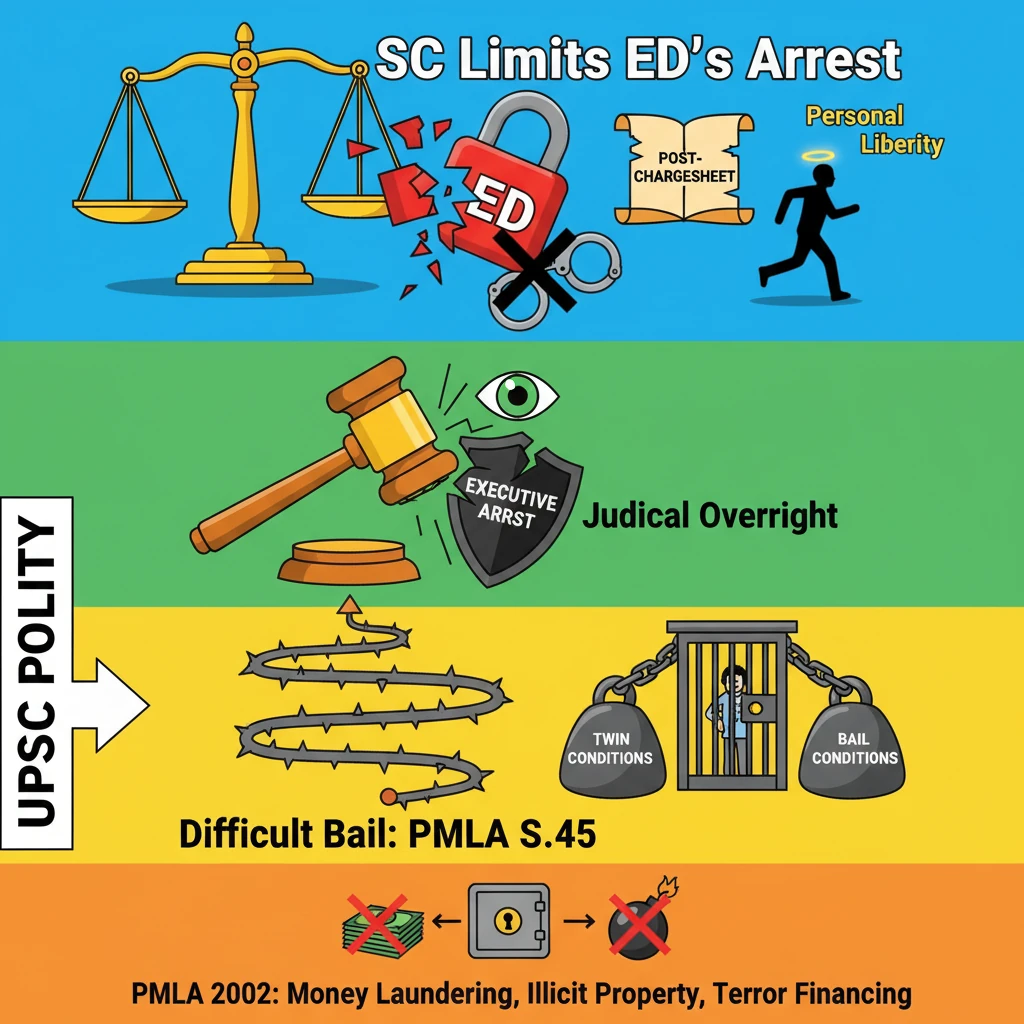
- •Supreme Court ruled ED loses arrest power post-cognizance of chargesheet in PMLA cases.
- •Judgement emphasizes personal liberty and judicial oversight over executive arrests.
- •PMLA's Section 45 imposes stringent 'twin conditions' for bail, making it difficult for accused.
- •PMLA (2002) aims to combat money laundering, confiscate illicit property, and prevent terror financing.
- •Recent amendments to PMLA include NGO disclosure norms and clarified 'Politically Exposed Persons' (PEPs) definition.
🧠 Memory Techniques
98% Verified Content
📚 Reference Sources
•The Prevention of Money Laundering Act, 2002 (PMLA)
•Supreme Court of India Judgments (specifically the ruling mentioned)
•Ministry of Finance Notifications regarding PMLA amendments