Motion of Thanks - Polity And Governance | UPSC Learning
Topics
0 topics • 0 completed
🔍
No topics match your search
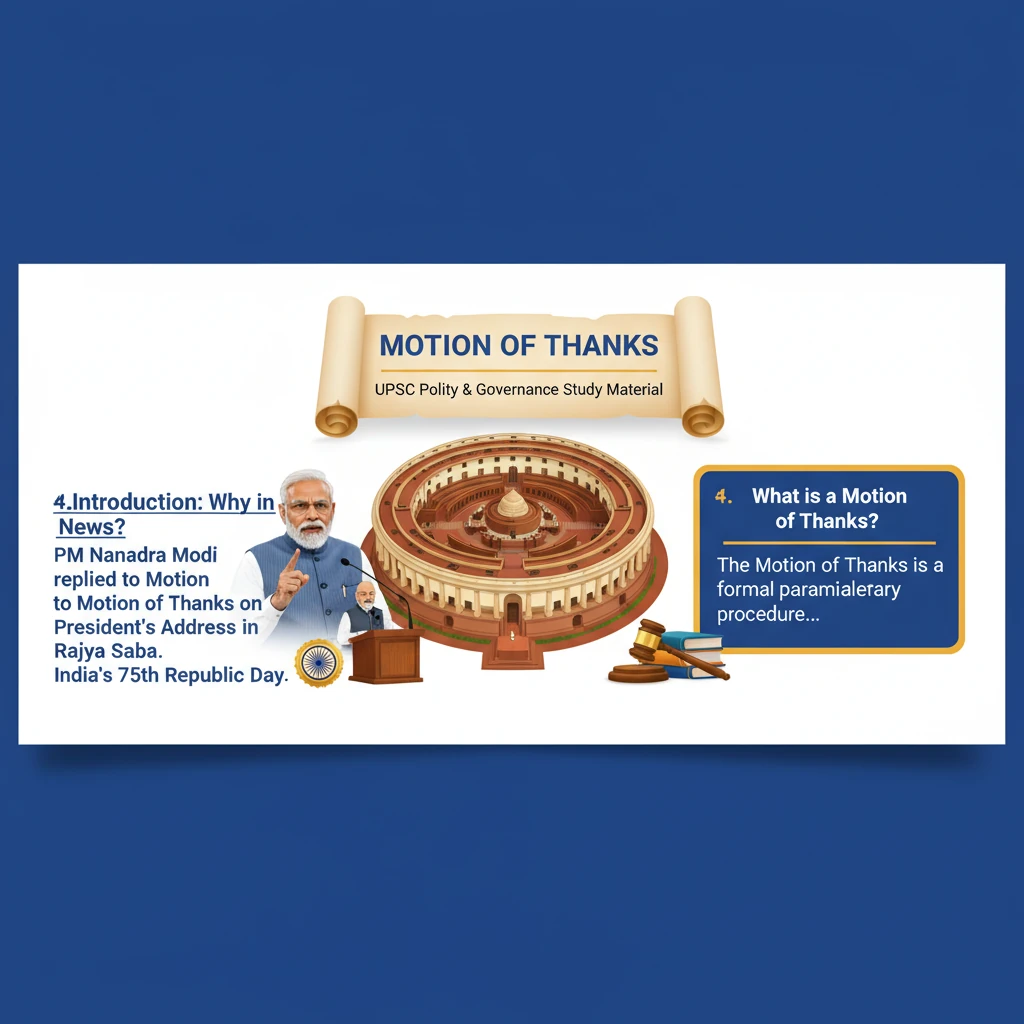
Motion of Thanks
Medium⏱️ 8 min read
polity and governance
📖 Introduction
<h4>Introduction: Why in News?</h4><p>Recently, <strong>Prime Minister Narendra Modi</strong> replied to the <strong>Motion of Thanks</strong> on the <strong>President’s Address</strong> to Parliament in the <strong>Rajya Sabha</strong>. This event highlighted significant milestones in India’s journey towards the <strong>75th Republic Day</strong>.</p><h4>What is a Motion of Thanks?</h4><div class='info-box'><p>The <strong>Motion of Thanks</strong> is a formal <strong>parliamentary procedure</strong> used to express gratitude or appreciation for the <strong>President’s Address</strong> to both Houses of Parliament. It is a crucial part of India's parliamentary tradition.</p></div><p>This motion serves as a mechanism for Parliament to discuss and respond to the government's policy statement.</p><h4>The President's Address: A Government Policy Statement</h4><p>The <strong>President’s Address</strong> is essentially a statement of policy of the incumbent <strong>Government</strong>. As such, it is drafted by the <strong>Government</strong> itself, reflecting its agenda and achievements.</p><p>It provides a comprehensive review of various activities and achievements of the <strong>Government</strong> during the preceding year. Furthermore, it outlines the policy, projects, and programmes that the <strong>Government</strong> intends to pursue concerning important national and international issues.</p><h4>Constitutional Basis: Article 87</h4><div class='info-box'><p><strong>Article 87</strong> of the <strong>Constitution of India</strong> mandates that the <strong>President</strong> must address both Houses of Parliament at two specific junctures:</p><ul><li>At the beginning of the <strong>first session</strong> after each <strong>general election</strong>.</li><li>At the beginning of the <strong>first session of each year</strong>.</li></ul><p>The <strong>President</strong> also informs Parliament of the reasons for its summons during this address.</p></div><p>This address is often referred to as a <strong>‘special address’</strong> and is an annual feature of the parliamentary calendar.</p><h4>Discussion and Amendments</h4><p>The <strong>President's Address</strong> is discussed in both Houses of Parliament through the <strong>Motion of Thanks</strong>. This procedure is akin to the <strong>‘speech from the Throne’</strong> in <strong>Britain</strong>, signifying its historical roots and parliamentary significance.</p><p>During the discussion, members of Parliament can propose <strong>amendments</strong> to the <strong>Motion of Thanks</strong>. These amendments can refer to matters contained within the Address itself.</p><p>Alternatively, amendments can highlight matters which, in the opinion of a member, the Address has failed to mention, thus allowing for a broader critique of government policy.</p><h4>Voting and Adoption</h4><p>At the conclusion of the discussion, the <strong>Motion of Thanks</strong> is put to a vote. The debate is typically concluded by a reply from the <strong>Prime Minister</strong> or another designated Minister, addressing the points raised by members.</p><p>Immediately after the ministerial reply, any proposed amendments are disposed of, either by being passed or rejected. Following this, the main <strong>Motion of Thanks</strong> is put to vote and adopted.</p><h4>Consequences of Defeat</h4><div class='key-point-box'><p>It is imperative that the <strong>Motion of Thanks</strong> is passed in the House. If it fails to pass, it amounts to the <strong>defeat of the government</strong> on the floor of the House.</p><p>This outcome is considered a significant blow and can be interpreted as an expression of <strong>lack of confidence</strong> in the government, particularly in the <strong>Lok Sabha</strong>.</p></div><div class='exam-tip-box'><p><strong>UPSC Insight:</strong> The defeat of the <strong>Motion of Thanks</strong> is a rare but potent tool for the opposition to demonstrate a lack of confidence. It's crucial to understand its implications, similar to a no-confidence motion.</p></div><h4>Limitations of the Motion of Thanks</h4><div class='info-box'><p>There are specific limitations governing the debate on the <strong>Motion of Thanks</strong>:</p><ul><li>Members cannot refer to matters that are not under the <strong>direct responsibility of the Central Government</strong>. This ensures the debate focuses on the Union government's policies.</li><li>Members are also prohibited from mentioning the <strong>name of the President</strong> in the debate. This upholds the constitutional position of the President as the head of state, above political debate.</li></ul></div>
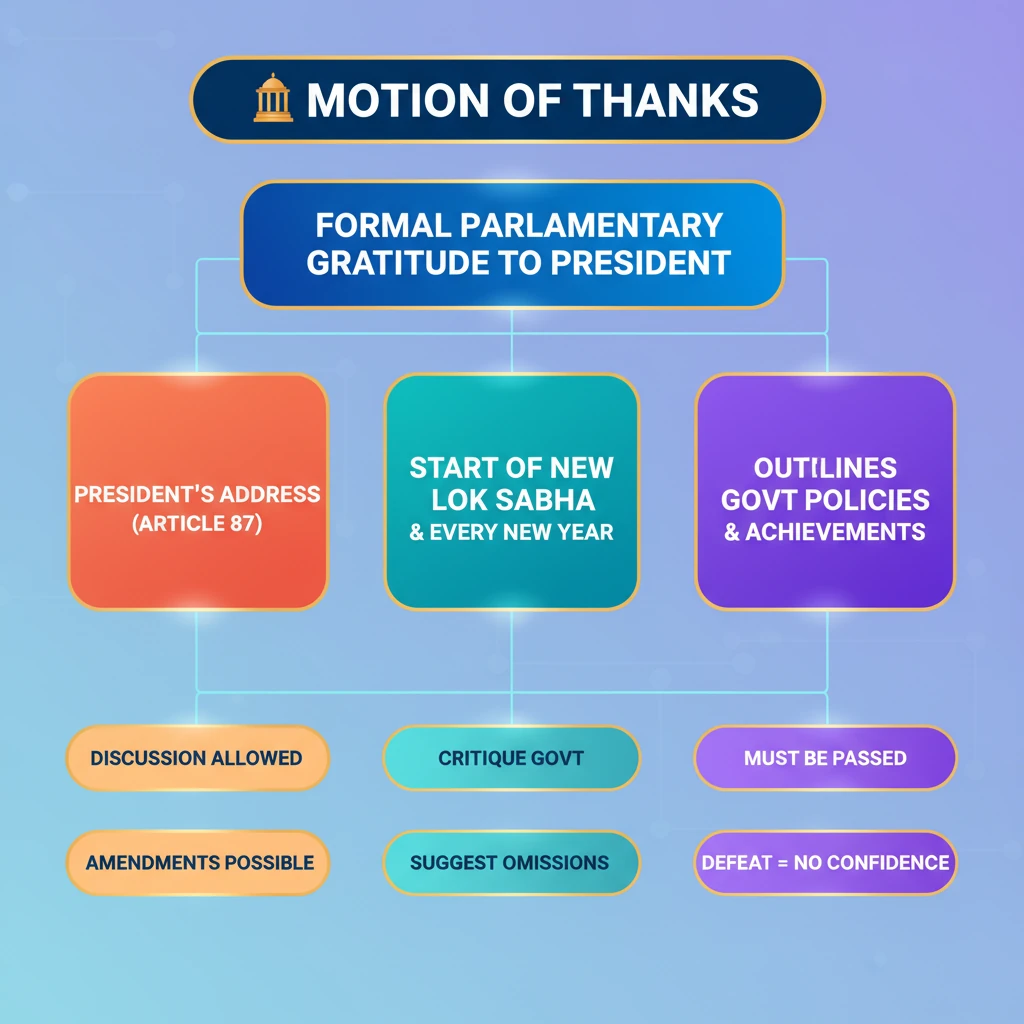
💡 Key Takeaways
- •Motion of Thanks is a formal parliamentary procedure to express gratitude for the President's Address.
- •The President's Address (under Article 87) outlines the government's past achievements and future policies.
- •It is delivered at the start of the first session after general elections and the first session of each year.
- •Discussion allows for amendments, which can critique government policies or omissions.
- •The Motion of Thanks MUST be passed; its defeat implies a lack of confidence in the government.
- •Limitations include not referring to state matters or mentioning the President's name in debate.
🧠 Memory Techniques
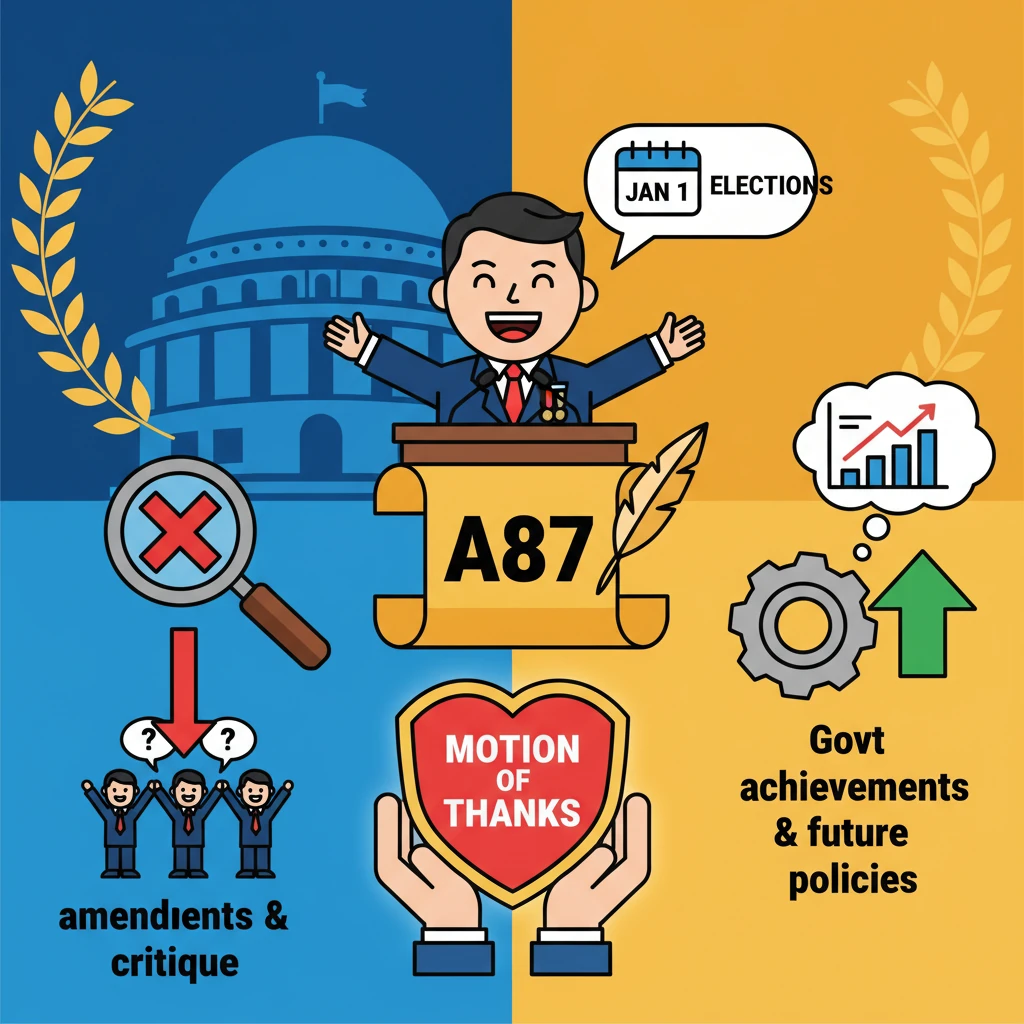
95% Verified Content
📚 Reference Sources
•The Constitution of India (Article 87)
•Parliament of India website (Lok Sabha and Rajya Sabha procedures)