Other Motions in India Parliament - Polity And Governance | UPSC Learning
Topics
0 topics • 0 completed
🔍
No topics match your search

Other Motions in India Parliament
Medium⏱️ 9 min read
polity and governance
📖 Introduction
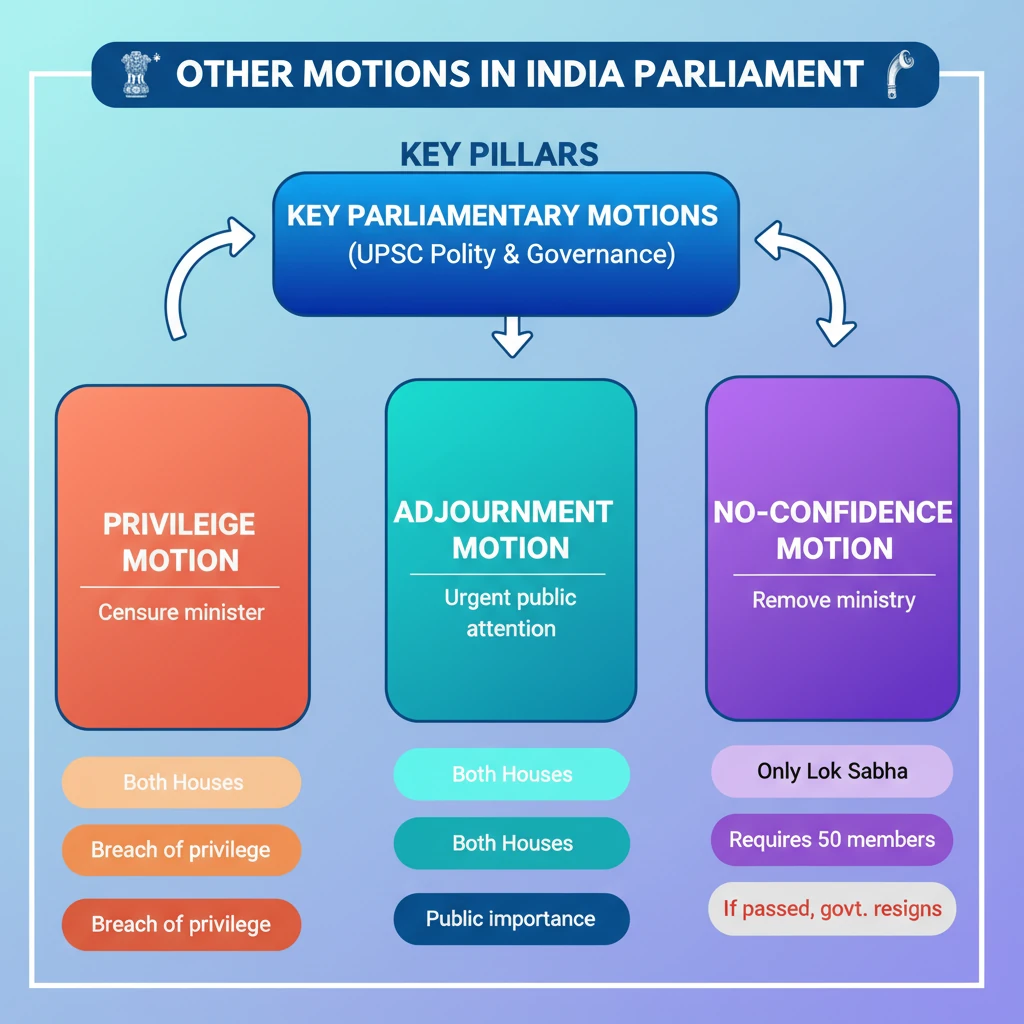
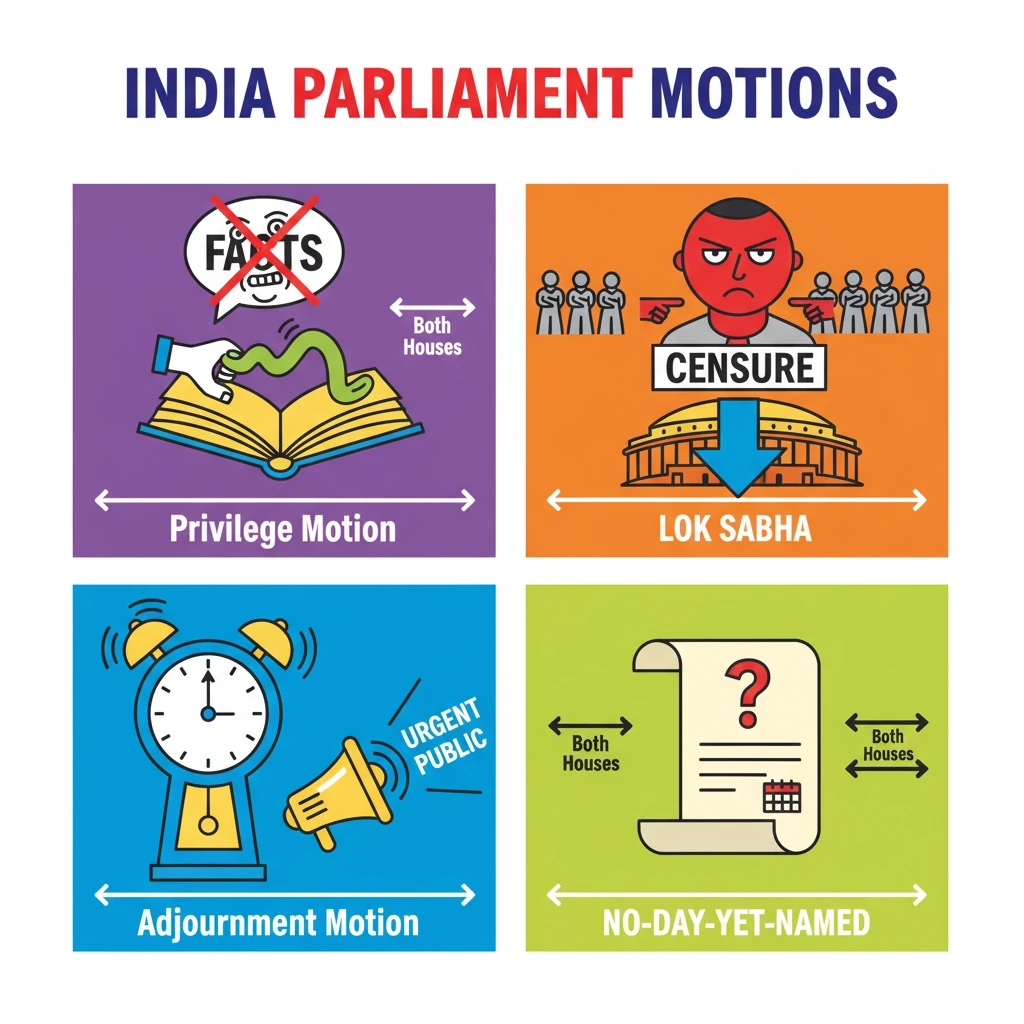
<h4>Understanding Other Motions in Indian Parliament</h4><p>The Indian Parliament utilizes various <strong>motions</strong> to conduct its business, discuss matters of public importance, and hold the executive accountable. Beyond routine legislative processes, these motions serve specific purposes, ranging from expressing disapproval to calling attention to urgent issues.</p><div class='key-point-box'><p><strong>Motions</strong> are formal proposals made by a member of Parliament, which, if adopted, become decisions or expressions of the House's opinion. They are crucial tools for parliamentary oversight and deliberation.</p></div><h4>Privilege Motion</h4><p>A <strong>Privilege Motion</strong> is moved by a member when they believe a <strong>minister</strong> has committed a <strong>breach of privilege</strong> of the House or its members. This breach typically occurs by <strong>withholding facts</strong> or providing <strong>wrong or distorted information</strong>.</p><div class='info-box'><ul><li><strong>Purpose:</strong> To <strong>censure</strong> the concerned minister.</li><li><strong>Applicability:</strong> Can be moved in both <strong>Rajya Sabha</strong> and <strong>Lok Sabha</strong>.</li><li><strong>Requirement:</strong> In the <strong>Lok Sabha</strong>, it must clearly state the <strong>reasons</strong> for its adoption.</li></ul></div><div class='exam-tip-box'><p>Understanding the concept of <strong>parliamentary privileges</strong> is vital for UPSC. A <strong>Privilege Motion</strong> directly relates to safeguarding these privileges against executive overreach or misinformation.</p></div><h4>Censure Motion</h4><p>A <strong>Censure Motion</strong> is specifically moved to express strong disapproval or <strong>censure</strong> against an <strong>individual minister</strong>, a <strong>group of ministers</strong>, or the <strong>entire Council of Ministers</strong>. It targets specific <strong>policies and actions</strong> of the government.</p><div class='info-box'><ul><li><strong>Purpose:</strong> To express <strong>disapproval</strong> of specific government policies or actions.</li><li><strong>Applicability:</strong> Can be moved <strong>only in Lok Sabha</strong>.</li><li><strong>Distinction:</strong> Unlike a No-Confidence Motion, it doesn't necessarily lead to the government's resignation but signals a lack of confidence in specific areas.</li></ul></div><h4>Adjournment Motion</h4><p>An <strong>Adjournment Motion</strong> is a critical parliamentary device introduced to draw the attention of a <strong>minister</strong> to a <strong>matter of urgent public importance</strong>. It seeks an <strong>authoritative statement</strong> from the minister on that particular issue.</p><div class='info-box'><ul><li><strong>Purpose:</strong> To discuss a <strong>definite matter of urgent public importance</strong>, often suspending regular business.</li><li><strong>Applicability:</strong> Can be moved in both <strong>Rajya Sabha</strong> and <strong>Lok Sabha</strong>.</li><li><strong>Impact:</strong> If admitted, it leads to a debate on the specified urgent matter, highlighting its significance.</li></ul></div><h4>No-Day-Yet-Named Motion</h4><p>A <strong>No-Day-Yet-Named Motion</strong> refers to a motion that has been <strong>admitted by the Speaker</strong> (or Chairman in Rajya Sabha) but for which <strong>no specific date has been fixed for its discussion</strong> in the House.</p><div class='info-box'><ul><li><strong>Status:</strong> Admitted but awaiting scheduling for debate.</li><li><strong>Applicability:</strong> Can be moved in both <strong>Rajya Sabha</strong> and <strong>Lok Sabha</strong>.</li><li><strong>Flexibility:</strong> Allows for important issues to be formally recognized, with discussion pending the House's agenda.</li></ul></div><h4>No-Confidence Motion</h4><p>The <strong>No-Confidence Motion</strong> is a powerful tool for parliamentary accountability, rooted in <strong>Article 75</strong> of the Constitution. This article states that the <strong>Council of Ministers shall be collectively responsible to the Lok Sabha</strong>.</p><p>By passing a <strong>No-Confidence Motion</strong>, the <strong>Lok Sabha</strong> can effectively <strong>remove the ministry from office</strong>. It is a direct challenge to the government's majority and its ability to govern.</p><div class='info-box'><ul><li><strong>Constitutional Basis:</strong> <strong>Article 75</strong>, establishing collective responsibility.</li><li><strong>Requirement for Admission:</strong> Needs the support of at least <strong>50 members</strong> to be admitted.</li><li><strong>Applicability:</strong> Can be moved <strong>only in Lok Sabha</strong>.</li><li><strong>Consequence:</strong> If adopted, the entire <strong>Council of Ministers must resign</strong>.</li></ul></div><div class='exam-tip-box'><p>The <strong>No-Confidence Motion</strong> is a cornerstone of India's parliamentary democracy. UPSC often tests its constitutional basis, procedure, and implications for government stability.</p></div><h4>Cut Motions</h4><p><strong>Cut Motions</strong> are a special power available to members of the <strong>Lok Sabha</strong> during the discussion of <strong>Demands for Grants</strong>, which are part of the <strong>Finance Bill</strong>. These motions propose a reduction in the amount of a demand being discussed.</p><p>If a <strong>Cut Motion</strong> is adopted by the <strong>Lok Sabha</strong>, it amounts to a <strong>no-confidence vote</strong> against the government. In such a scenario, the government is obliged to <strong>resign</strong>, according to parliamentary norms.</p><div class='info-box'><ul><li><strong>Purpose:</strong> To scrutinize and reduce government expenditure proposals.</li><li><strong>Applicability:</strong> Can be moved <strong>only in Lok Sabha</strong>.</li><li><strong>Types of Cut Motions:</strong><ul><li><strong>Policy Cut Motion:</strong> Proposes to reduce the demand to <strong>Re. 1</strong>, expressing <strong>disapproval of the underlying policy</strong>.</li><li><strong>Economy Cut Motion:</strong> Proposes to reduce the demand by a <strong>specified amount</strong>, suggesting specific economies.</li><li><strong>Token Cut Motion:</strong> Proposes to reduce the demand by <strong>Rs. 100</strong>, expressing a <strong>specific grievance</strong>.</li></ul></li></ul></div><div class='exam-tip-box'><p><strong>Cut Motions</strong> are crucial for understanding parliamentary control over public finance. Their adoption has serious implications, making them a potent tool for the opposition.</p></div>
💡 Key Takeaways
- •Privilege Motion: Censure minister for breach of privilege by withholding/distorting facts. Movable in both Houses.
- •Censure Motion: Censure minister(s) or Council of Ministers for specific policies/actions. Movable only in Lok Sabha.
- •Adjournment Motion: Call attention to urgent public importance. Movable in both Houses.
- •No-Day-Yet-Named Motion: Admitted but unscheduled for discussion. Movable in both Houses.
- •No-Confidence Motion: Remove ministry from office (Article 75). Requires 50 members. Movable only in Lok Sabha. If passed, government resigns.
- •Cut Motions: Reduce demands for grants. Policy (Re.1), Economy (specified amount), Token (Rs.100). Movable only in Lok Sabha. If passed, government resigns.
🧠 Memory Techniques
98% Verified Content
📚 Reference Sources
•Indian Constitution (Article 75)
•Rules of Procedure and Conduct of Business in Lok Sabha and Rajya Sabha