Ordinary Private Members in the P.V Narasimha Rao and Related Cases - Polity And Governance | UPSC Learning
Topics
0 topics • 0 completed
🔍
No topics match your search
Ordinary Private Members in the P.V Narasimha Rao and Related Cases
Medium⏱️ 10 min read
polity and governance
📖 Introduction
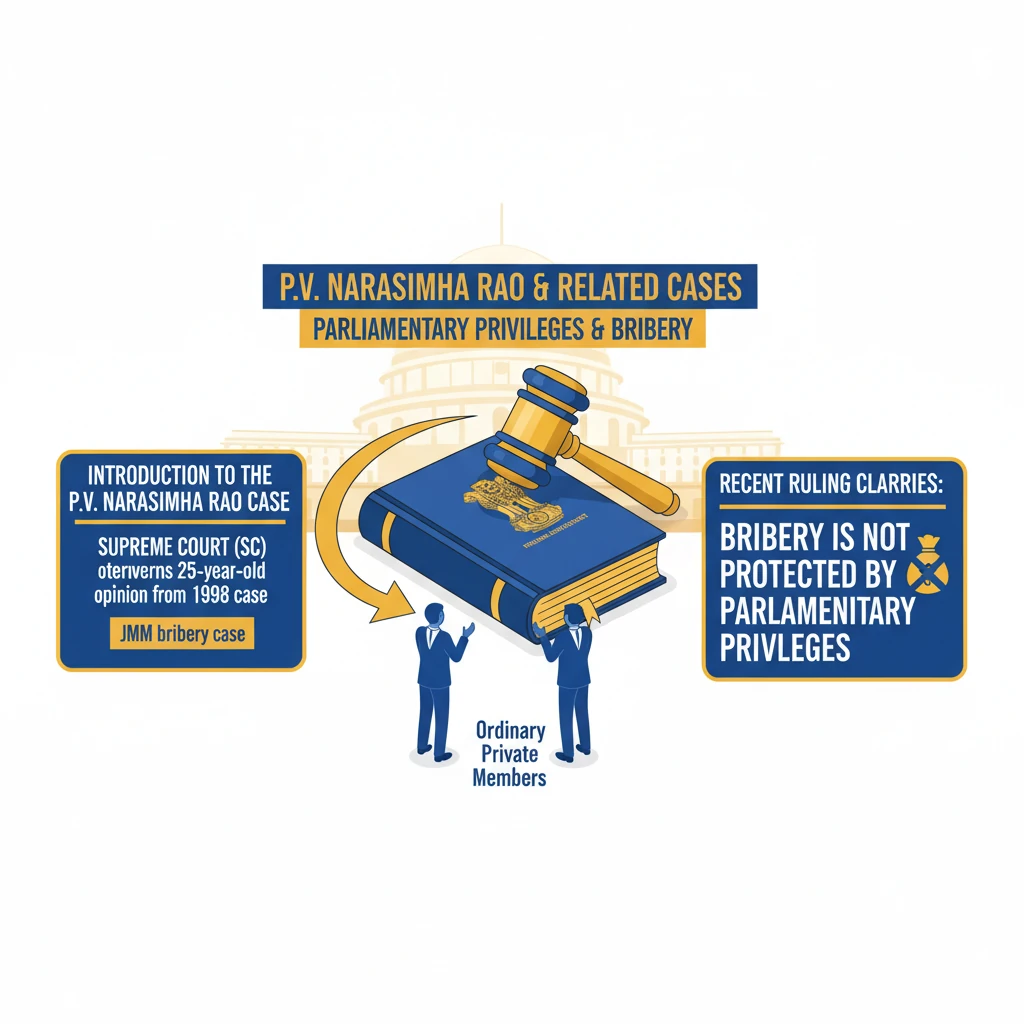
<h4>Introduction to the P.V. Narasimha Rao Case</h4><p>The <strong>Supreme Court (SC)</strong> recently delivered a landmark judgment, overturning a <strong>25-year-old majority opinion</strong> from the <strong>P.V. Narasimha Rao v. State (CBI/Spe) Case, 1998</strong>. This case, also known as the <strong>JMM bribery case</strong>, dealt with parliamentary privileges concerning bribery.</p><p>The recent ruling clarifies that <strong>bribery is not protected by parliamentary privileges</strong>. This decision marks a significant shift in the interpretation of legislative immunity in India.</p><h4>The 1998 P.V. Narasimha Rao Case: Background and Ruling</h4><p>The <strong>1993 P.V. Narasimha Rao case</strong> involved serious allegations of corruption. Several <strong>Members of Parliament (MPs)</strong> from the <strong>Jharkhand Mukti Morcha (JMM)</strong> were accused of accepting bribes.</p><p>These bribes were allegedly taken in exchange for voting against a <strong>no-confidence motion</strong> in the Lok Sabha. The case raised profound concerns about the integrity of India's legislative processes and the accountability of elected representatives.</p><div class='info-box'><p><strong>Case Specifics (1998)</strong></p><ul><li><strong>Accused:</strong> Certain JMM MPs.</li><li><strong>Allegation:</strong> Accepting bribes to vote against a <strong>no-confidence motion</strong>.</li><li><strong>Key Issue:</strong> Whether parliamentary privilege protected lawmakers from prosecution for bribery.</li></ul></div><p>The <strong>Supreme Court's 1998 ruling</strong> established a controversial precedent. It granted immunity to <strong>MPs</strong> and <strong>Members of Legislative Assembly (MLAs)</strong> from criminal prosecution in bribery cases.</p><p>This immunity applied specifically if the lawmakers fulfilled their part of the agreement, i.e., casting their vote or speaking in the House as promised after taking the bribe.</p><div class='key-point-box'><p><strong>1998 Ruling's Core Point:</strong> The bribe-takers who cast their vote against the <strong>no-confidence motion</strong> were deemed immune from criminal prosecution under <strong>Parliamentary Privilege (Article 105(2))</strong>.</p></div><p>The 1998 decision prioritized the <strong>stability of governance</strong> and the smooth functioning of parliamentary democracy. It suggested that prosecuting lawmakers for bribery could potentially disrupt governmental stability.</p><h4>The 2024 Supreme Court Ruling: A Paradigm Shift</h4><p>A <strong>7-Judge Constitution Bench</strong> of the Supreme Court recently overturned the earlier <strong>5-Judge Bench verdict</strong> of the <strong>P.V. Narasimha Rao v. State Case, 1998</strong>.</p><p>This new ruling directly contradicts the previous stance that <strong>MPs</strong> and <strong>MLAs</strong> enjoyed immunity if they cast a vote in the House after taking bribes.</p><div class='info-box'><p><strong>Key Aspects of the 2024 Ruling</strong></p><ul><li><strong>Bench:</strong> 7-Judge Constitution Bench.</li><li><strong>Outcome:</strong> Overturned the 1998 verdict.</li><li><strong>Central Tenet:</strong> Bribery is a criminal act and not covered by parliamentary privilege.</li></ul></div><p>The <strong>Supreme Court</strong> strongly emphasized the <strong>detrimental impact of bribery</strong> on democratic principles and the overall governance structure of the nation.</p><p>The court clarified that <strong>accepting a bribe is a separate criminal act</strong>. It is distinct and unrelated to the core duties of lawmakers within the Parliament or legislative assembly.</p><div class='key-point-box'><p><strong>Legal Basis for Bribery Prosecution:</strong> <strong>Section 7 of the Prevention of Corruption Act</strong> specifically deals with 'offence relating to public servants being bribed'.</p></div><p>Therefore, the immunity provided under <strong>Articles 105</strong> (for MPs) and <strong>194</strong> (for MLAs) of the Constitution <strong>does not extend to cases of bribery</strong>. This is a crucial distinction made by the court.</p><div class='exam-tip-box'><p>This decision signifies a major shift towards prioritizing <strong>accountability</strong> and <strong>integrity in governance</strong> over stability alone. It aims to uphold the ideals of a <strong>responsible, responsive, and representative democracy</strong> in India, a key topic for <strong>GS Paper II (Polity & Governance)</strong>.</p></div><h4>Understanding Parliamentary Privileges</h4><p><strong>Parliamentary privileges</strong> are special rights, immunities, and exemptions. They are enjoyed by the members of the Parliament and their committees to ensure their effective functioning.</p><p>These privileges are explicitly defined in <strong>Article 105 of the Indian Constitution</strong> for Members of Parliament. <strong>Article 194</strong> guarantees the same privileges to the <strong>Members of Legislative Assemblies</strong> of states.</p><div class='info-box'><p><strong>Scope of Privileges</strong></p><ul><li>Members are exempted from <strong>civil liability</strong> for any statement made or act done in the course of their duties.</li><li>Crucially, these privileges <strong>do not extend to criminal liability</strong>, a point reinforced by the 2024 SC ruling.</li></ul></div><p>The Indian Parliament has not enacted a comprehensive law to exhaustively codify all these privileges. Instead, they are derived from multiple sources, ensuring flexibility and evolution.</p><ul><li><strong>Constitutional provisions:</strong> Primarily <strong>Articles 105 and 194</strong>.</li><li><strong>Various laws made by Parliament:</strong> Specific statutes related to parliamentary functioning.</li><li><strong>Rules of both the Houses:</strong> Procedural rules established by Lok Sabha and Rajya Sabha.</li><li><strong>Conventions:</strong> Unwritten practices and precedents.</li><li><strong>Judicial interpretations:</strong> Rulings by courts, such as the recent 2024 verdict.</li></ul>
💡 Key Takeaways
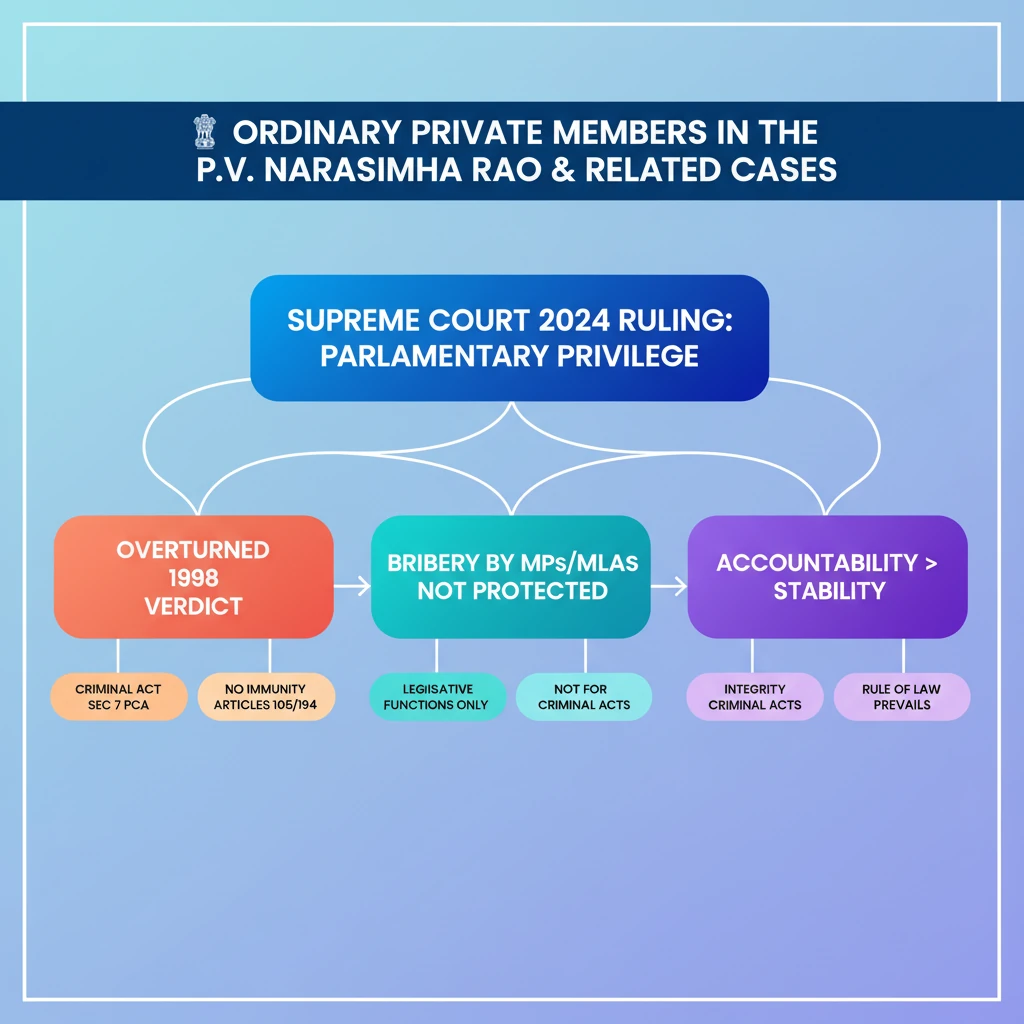
- •The Supreme Court's 2024 ruling overturned the 1998 P.V. Narasimha Rao verdict.
- •Bribery by MPs/MLAs is no longer protected by parliamentary privileges (Articles 105 & 194).
- •Accepting a bribe is a criminal act under Section 7 of the Prevention of Corruption Act.
- •The 2024 decision prioritizes accountability and integrity over legislative stability alone.
- •Parliamentary privileges protect legislative functions, not criminal acts like bribery.
🧠 Memory Techniques

98% Verified Content
📚 Reference Sources
•Supreme Court of India judgment: P.V. Narasimha Rao v. State (CBI/Spe), 1998
•Supreme Court of India judgment: Sita Soren v. Union of India, 2024
•The Constitution of India (Articles 105, 194)
•The Prevention of Corruption Act, 1988 (Section 7)