SC Upholds EVM and VVPAT System - Polity And Governance | UPSC Learning
Topics
0 topics • 0 completed
🔍
No topics match your search
SC Upholds EVM and VVPAT System
Medium⏱️ 5 min read
polity and governance
📖 Introduction
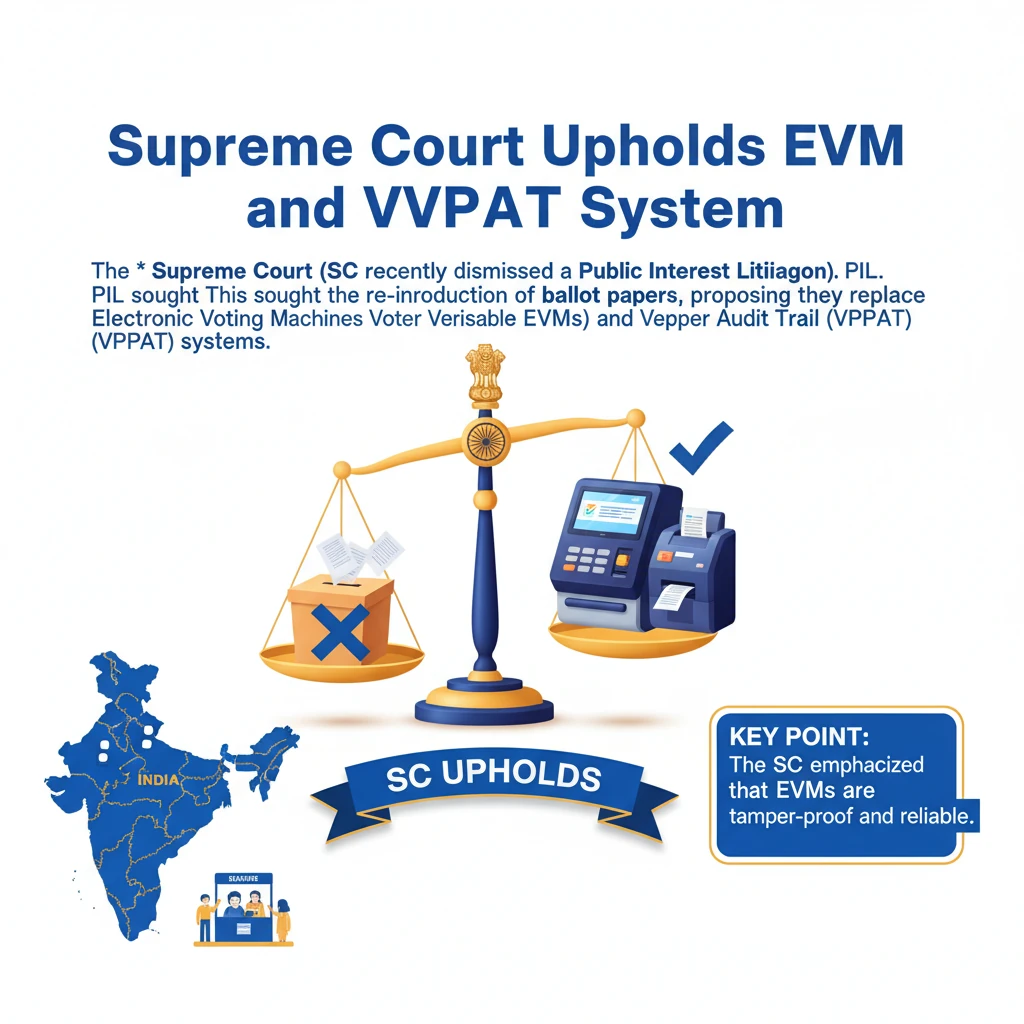
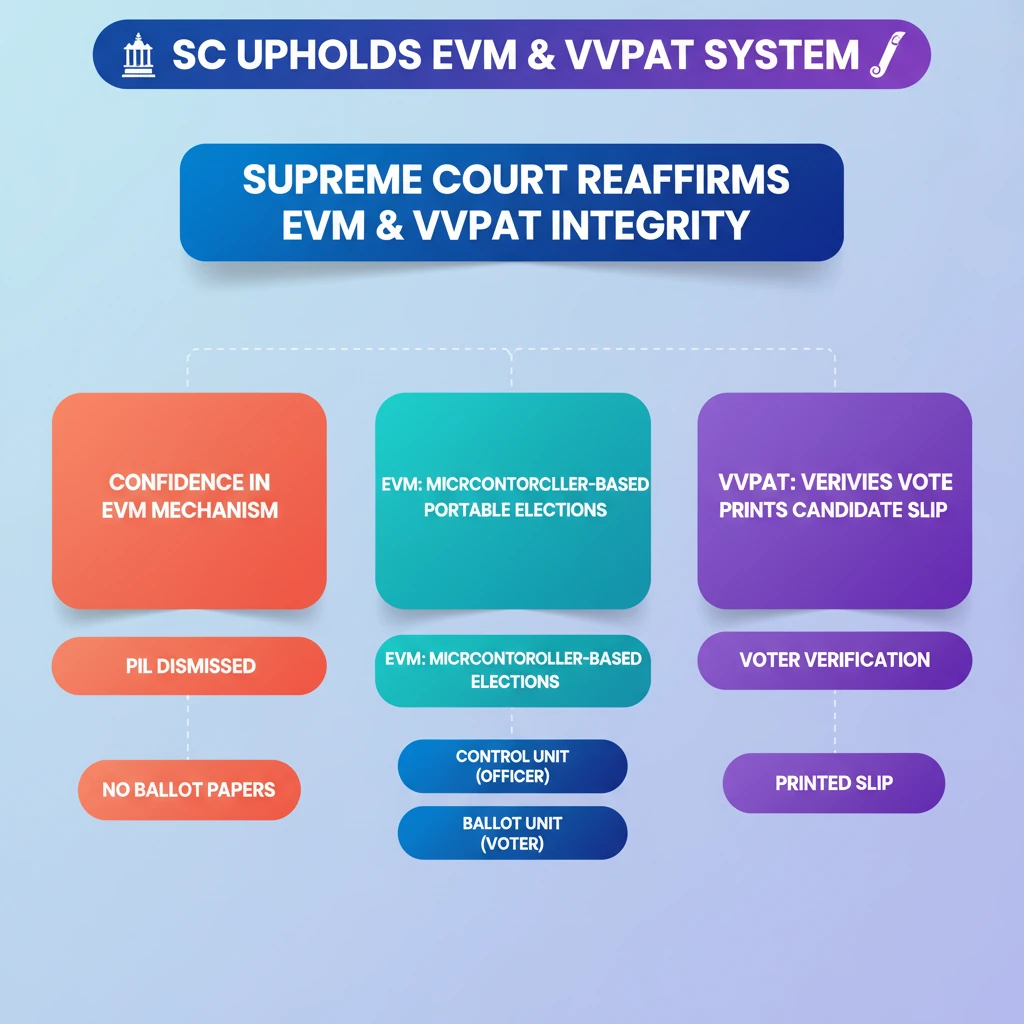
<h4>Supreme Court Upholds EVM and VVPAT System</h4><p>The <strong>Supreme Court (SC)</strong> recently dismissed a <strong>Public Interest Litigation (PIL)</strong>. This <strong>PIL</strong> sought the re-introduction of <strong>ballot papers</strong>, proposing they replace <strong>Electronic Voting Machines (EVMs)</strong> and <strong>Voter Verifiable Paper Audit Trail (VVPAT)</strong> systems.</p><div class='key-point-box'><p>The <strong>SC</strong> emphasized that <strong>EVMs</strong> are frequently questioned only after electoral losses. It reaffirmed its confidence in the <strong>EVM mechanism</strong> and the robust safeguards in place.</p></div><h4>Understanding Electronic Voting Machines (EVMs)</h4><div class='info-box'><p><strong>EVMs</strong> are <strong>portable instruments</strong> specifically designed for conducting elections.</p><p>They are utilized for elections to the <strong>parliament</strong>, <strong>state legislatures</strong>, and various <strong>local bodies</strong> such as <strong>panchayats</strong> and <strong>municipalities</strong>.</p></div><p>An <strong>EVM</strong> is a <strong>microcontroller-based instrument</strong>. It is engineered to facilitate a <strong>single poll</strong> and record a <strong>single vote</strong> per elector.</p><h4>Components of an EVM</h4><p>An <strong>EVM</strong> system comprises two primary units, which are interconnected by a cable:</p><ul><li><strong>Control Unit</strong></li><li><strong>Ballot Unit</strong></li></ul><p>This design ensures that the <strong>polling officer</strong> can effectively verify the identity of the user before voting.</p><h5>Control Unit</h5><p>The <strong>Control Unit</strong> of the <strong>EVM</strong> is typically kept under the charge of the <strong>presiding officer</strong> or the <strong>polling officer</strong> at the polling station.</p><h5>Ballot Unit</h5><p>The <strong>Ballot Unit</strong> is placed inside the <strong>voting compartment</strong>. This allows electors to cast their votes privately and securely.</p><h4>Understanding Voter Verifiable Paper Audit Trail (VVPAT)</h4><div class='info-box'><p>The <strong>VVPAT</strong> system is an independent verification mechanism. It enables <strong>voters</strong> to visually confirm that their vote has been recorded accurately, as intended.</p></div><h4>How VVPAT Works</h4><ol><li>When a voter casts their vote, a slip is printed by the <strong>VVPAT machine</strong>.</li><li>This slip displays the <strong>serial number</strong>, the <strong>candidate's name</strong>, and their corresponding <strong>symbol</strong>.</li><li>The printed slip is visible through a <strong>transparent window</strong> for approximately <strong>7 seconds</strong>.</li><li>After this duration, the slip is automatically cut and securely stored in a <strong>sealed box</strong>, ensuring auditability.</li></ol>
💡 Key Takeaways
- •Supreme Court dismissed a PIL seeking re-introduction of ballot papers, upholding EVM and VVPAT systems.
- •SC reaffirmed confidence in EVM mechanism, noting challenges often follow electoral losses.
- •EVMs are microcontroller-based, portable instruments for conducting elections across all levels.
- •An EVM comprises two units: a Control Unit (with polling officer) and a Ballot Unit (for voters).
- •VVPAT enables voters to verify their vote via a printed slip showing candidate details.
- •VVPAT slips are visible for 7 seconds, then automatically cut and stored in a sealed box for audit.
- •The system aims for enhanced transparency, efficiency, and voter confidence in elections.
🧠 Memory Techniques
98% Verified Content
📚 Reference Sources
•Election Commission of India (ECI) official website
•Supreme Court of India judgments related to EVMs and VVPATs
•Press Information Bureau (PIB) releases on electoral reforms