What are the Constitutional Provisions that Mandate the Provision of Legal Services in India? - Polity And Governance | UPSC Learning
Topics
0 topics • 0 completed
🔍
No topics match your search

What are the Constitutional Provisions that Mandate the Provision of Legal Services in India?
Medium⏱️ 4 min read
polity and governance
📖 Introduction
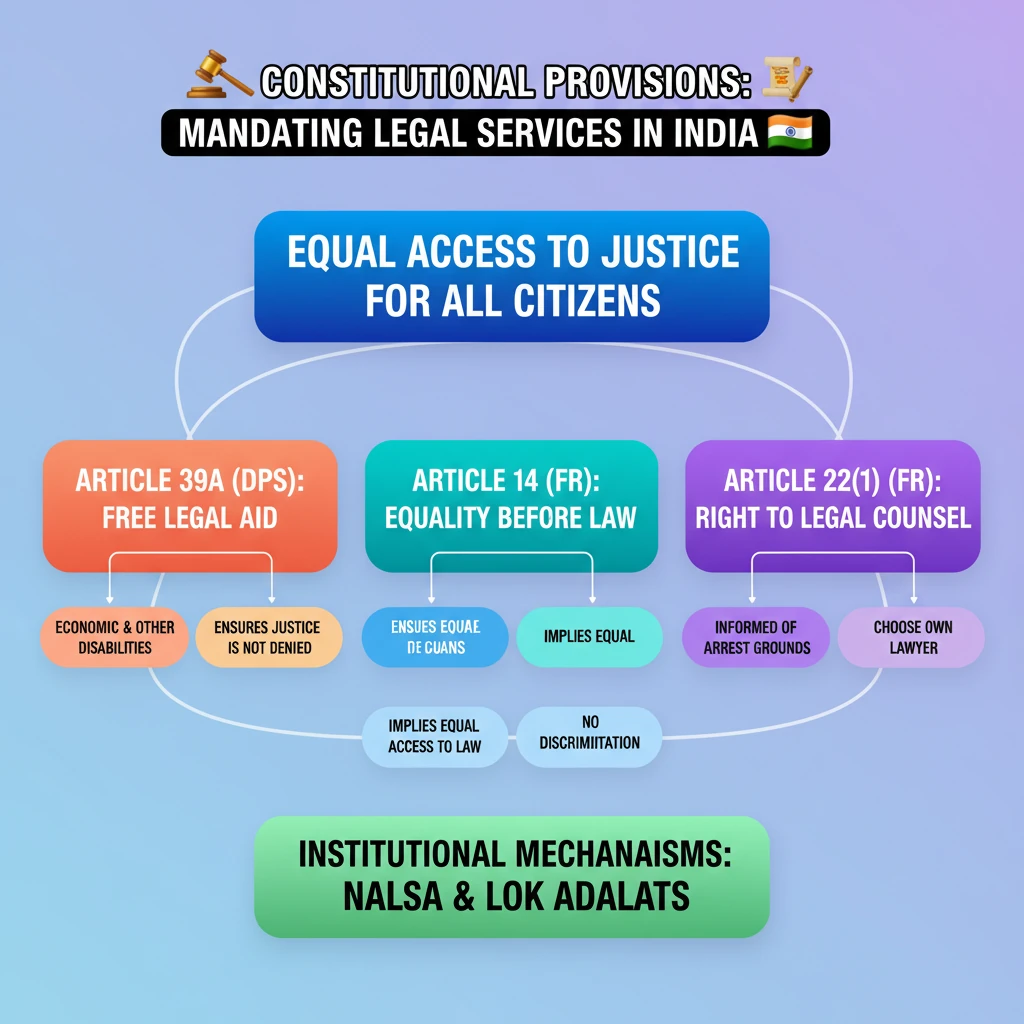
<h4>Introduction to Legal Services Mandate</h4><p>The <strong>Indian Constitution</strong> lays down a strong foundation for ensuring <strong>justice</strong> and <strong>equal opportunity</strong> for all citizens. Various provisions underscore the State's responsibility to provide accessible legal services.</p><p>This mandate is crucial for upholding the principles of a just and equitable society, ensuring that economic or other disabilities do not hinder access to the legal system.</p><h4>Article 39A: Free Legal Aid</h4><p><strong>Article 39A</strong> is a Directive Principle of State Policy (DPSP) that specifically mandates the provision of free legal aid. It was inserted into the Constitution by the <strong>42nd Amendment Act of 1976</strong>.</p><div class='info-box'><p><strong>Article 39A states:</strong> "The State shall secure that the operation of the legal system promotes justice, on a basis of equal opportunity, and shall, in particular, provide <strong>free legal aid</strong>, by suitable legislation or schemes or in any other way, to ensure that opportunities for securing justice are not denied to any citizen by reason of <strong>economic or other disabilities</strong>."</p></div><div class='key-point-box'><p>This article transforms the ideal of justice into a constitutional obligation, requiring the State to take proactive steps to bridge the gap in legal access.</p></div><h4>Article 14: Right to Equality</h4><p><strong>Article 14</strong>, a Fundamental Right, guarantees <strong>equality before the law</strong> and <strong>equal protection of the laws</strong> within the territory of India. This principle inherently requires that all individuals, irrespective of their socio-economic status, have equal access to legal remedies.</p><p>Denying legal assistance to the poor would violate the spirit of equality, as it would create an unequal playing field in the pursuit of justice.</p><h4>Article 22(1): Rights of Arrested Persons</h4><p><strong>Article 22(1)</strong> is another fundamental right that reinforces the need for legal services, particularly for those arrested or detained. It provides crucial safeguards for individuals facing legal proceedings.</p><div class='info-box'><p><strong>Article 22(1) states:</strong> "No person who is arrested shall be detained in custody without being informed, as soon as may be, of the <strong>grounds for such arrest</strong> nor shall he be denied the right to consult, and to be defended by, a <strong>legal practitioner of his choice</strong>."</p></div><div class='exam-tip-box'><p>While <strong>Article 39A</strong> is a DPSP, <strong>Articles 14</strong> and <strong>22(1)</strong> are Fundamental Rights. This distinction is important for understanding their enforceability and the State's direct obligation.</p></div>
💡 Key Takeaways
- •Article 39A (DPSP) mandates free legal aid for economic/other disabilities.
- •Article 14 (FR) ensures equality before law, implying equal access to justice.
- •Article 22(1) (FR) guarantees right to be informed of arrest grounds and legal counsel.
- •These provisions collectively obligate the State to ensure justice is not denied due to socio-economic barriers.
- •NALSA and Lok Adalats are key institutional mechanisms implementing these mandates.
🧠 Memory Techniques

98% Verified Content
📚 Reference Sources
•Drishti IAS Summary on Constitutional Provisions for Legal Services
•Legal Services Authorities Act, 1987