Impeachment Process and Judicial Accountability in India - Polity And Governance | UPSC Learning
Topics
0 topics • 0 completed
🔍
No topics match your search
Impeachment Process and Judicial Accountability in India
Medium⏱️ 12 min read
polity and governance
📖 Introduction
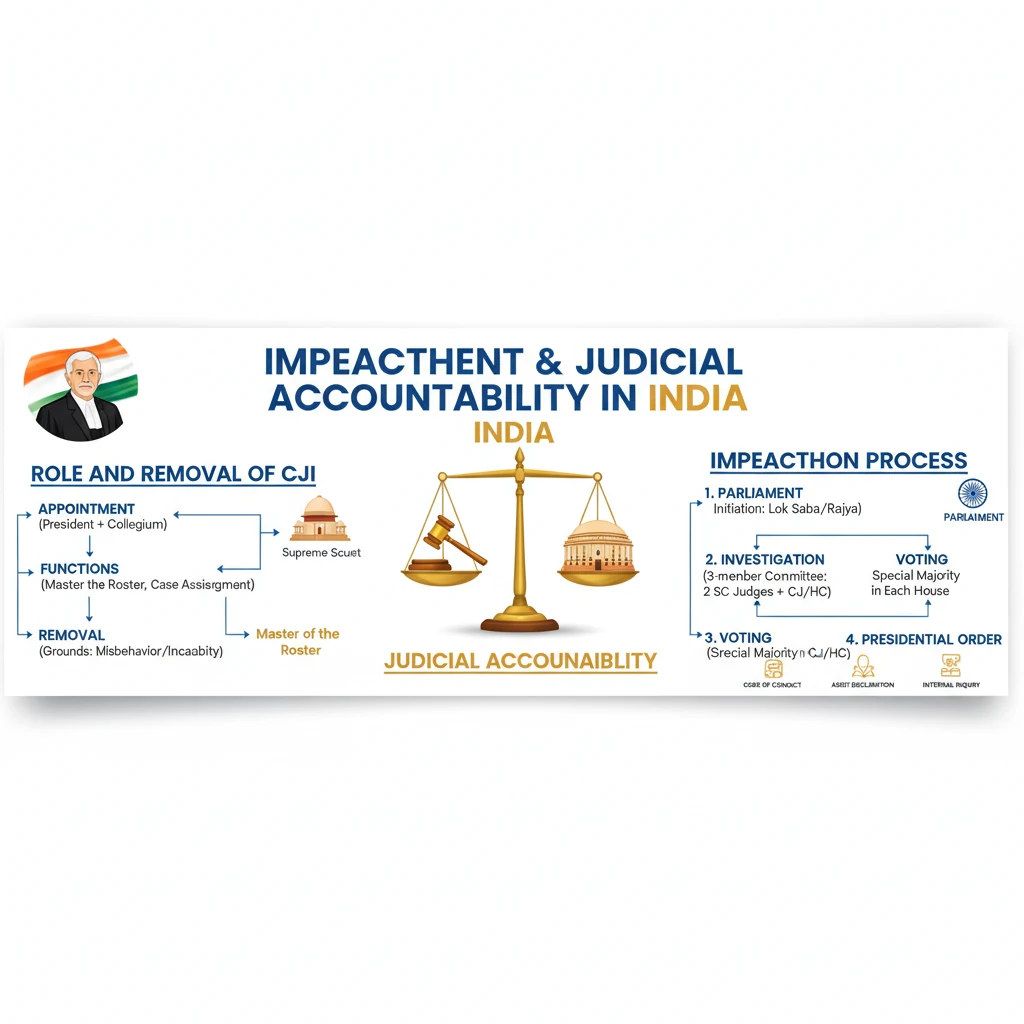
<h4>Role and Removal of the Chief Justice of India (CJI)</h4><h5>Appointment and Functions of the CJI</h5><p>The <strong>Chief Justice of India (CJI)</strong> holds significant responsibilities within the Indian judiciary. As the <strong>"Master of the Roster"</strong>, the CJI holds the authority to assign specific cases to particular benches and determine the schedule for their hearings in the <strong>Supreme Court</strong>.</p><p>The CJI, along with a collegium of four senior-most judges of the Supreme Court, is consulted by the <strong>President of India</strong> for the appointment of judges in both the <strong>Supreme Court</strong> and the <strong>High Courts</strong>.</p><div class='info-box'><p>The CJI also possesses the power to appoint <strong>ad-hoc Supreme Court judges</strong>, a provision outlined under <strong>Article 127</strong> of the Constitution.</p></div><p>Furthermore, with the approval of the <strong>President</strong>, the CJI can change the seat of the Supreme Court from <strong>Delhi</strong> to any other place in India.</p><h5>Removal Process of the CJI</h5><p>The <strong>CJI</strong> can only be removed from office by the <strong>President</strong> following a specific parliamentary procedure. This involves Parliament presenting an address, which must be supported by a <strong>special majority</strong> in both Houses.</p><div class='info-box'><p>A <strong>special majority</strong> implies a majority of the total membership of each House and at least <strong>two-thirds</strong> of the members present and voting.</p></div><h4>Understanding Judicial Impeachment in India</h4><p>The term <strong>"impeachment"</strong>, though not explicitly mentioned in the <strong>Constitution</strong> for judges, colloquially refers to the process by which a judge can be removed from office by <strong>Parliament</strong>.</p><p>This impeachment process for judges in India serves as a crucial mechanism. It aims to uphold <strong>judicial accountability</strong> while simultaneously preserving the fundamental <strong>independence of the judiciary</strong>.</p><div class='key-point-box'><p>The process ensures that judges can be held responsible for serious misconduct without undue political interference, thereby maintaining public trust.</p></div><h4>Constitutional Basis and Grounds for Impeachment</h4><p>The <strong>Indian Constitution</strong> provides specific safeguards and clearly defined grounds for the removal of judges.</p><div class='info-box'><p><strong>Article 124(4)</strong> outlines the removal process for <strong>Supreme Court judges</strong>. This procedure is also applicable to <strong>High Court judges</strong> as per <strong>Article 218</strong> of the Constitution.</p></div><p>The grounds for impeachment are explicitly and strictly limited to two conditions: <strong>"proved misbehaviour"</strong> and <strong>"incapacity"</strong>.</p><ul><li><strong>Proved Misbehaviour:</strong> This refers to actions or conduct by a judge that definitively breaches the ethical and professional standards expected of the judiciary.</li><li><strong>Incapacity:</strong> This denotes a judge's inability to perform their judicial duties effectively due to physical or mental infirmity.</li></ul><h4>Detailed Steps in the Impeachment Process</h4><h5>1. Initiation of Motion</h5><p>A motion for impeachment must be supported by a significant number of members in Parliament to be considered. It requires at least <strong>100 members</strong> in the <strong>Lok Sabha</strong> or <strong>50 members</strong> in the <strong>Rajya Sabha</strong>.</p><p>The <strong>Speaker</strong> of the Lok Sabha or the <strong>Chairman</strong> of the Rajya Sabha has the authority to review relevant materials and consult individuals before deciding whether to admit or reject the motion.</p><div class='exam-tip-box'><p>This stringent requirement ensures that the process cannot be initiated casually or without substantial support from elected representatives, acting as a crucial filter.</p></div><p>For example, in <strong>2018</strong>, a motion against then <strong>Chief Justice Dipak Misra</strong> was rejected by the Chairman of the Rajya Sabha after due consideration.</p><h5>2. Formation of an Inquiry Committee</h5><p>Upon the admission of the motion, the presiding officer of the House (Speaker or Chairman) constitutes a <strong>three-member committee</strong>. This committee is tasked with conducting a thorough inquiry.</p><p>The committee typically comprises:</p><ul><li>The <strong>Chief Justice of India</strong> or a <strong>Supreme Court judge</strong>.</li><li>The <strong>Chief Justice of a High Court</strong>.</li><li>A <strong>distinguished jurist</strong>.</li></ul><p>This expert committee conducts a thorough inquiry into the allegations, gathering evidence and examining witnesses to determine the validity of the charges.</p><h5>3. Committee Report and Parliamentary Debate</h5><p>The inquiry committee submits its findings to the presiding officer of the House where the motion was introduced. If the judge is found guilty of the alleged misconduct or incapacity, the report is then debated in Parliament.</p><p>Both Houses of Parliament must approve the motion with a <strong>special majority</strong>.</p><div class='info-box'><p>This <strong>special majority</strong> requires: (1) A majority of the <strong>total membership</strong> of the House, AND (2) At least <strong>two-thirds</strong> of the members present and voting.</p></div><h5>4. Final Removal by the President</h5><p>Once the impeachment motion is adopted in both Houses of Parliament in the same session, it is then presented to the <strong>President of India</strong>.</p><p>The <strong>President</strong> then issues an order for the removal of the judge from office, thereby completing the impeachment process.</p><h4>Checks and Balances in the Impeachment Process</h4><p>The impeachment process incorporates several critical checks and balances, meticulously designed to ensure fairness and prevent any potential misuse.</p><ul><li><strong>High Thresholds for Impeachment:</strong> The stringent requirements for initiating and approving an impeachment motion provide significant protection against frivolous or politically motivated accusations.</li><li><strong>Objective Inquiry by Experts:</strong> The inclusion of experienced judicial and legal experts in the inquiry committee ensures a fair, impartial, and expert-led investigation into the allegations.</li><li><strong>Parliamentary Oversight:</strong> By involving both Houses of Parliament, the process ensures accountability through democratic scrutiny and requires broad political consensus for removal.</li></ul><h4>Guidelines Regulating Judges' Public Statements</h4><p>Judges, like all citizens, are entitled to <strong>freedom of speech and expression</strong>, as guaranteed under <strong>Article 19(1)(a)</strong> of the Constitution.</p><p>However, this right is not absolute and is subject to <strong>reasonable restrictions</strong>. These restrictions are crucial to maintain <strong>public order</strong>, uphold <strong>morality</strong>, and preserve the essential <strong>integrity and impartiality</strong> of their judicial office.</p><div class='key-point-box'><p>Judges must exercise their freedom of speech responsibly to avoid any perception that could undermine the dignity or neutrality of the judiciary.</p></div>
💡 Key Takeaways
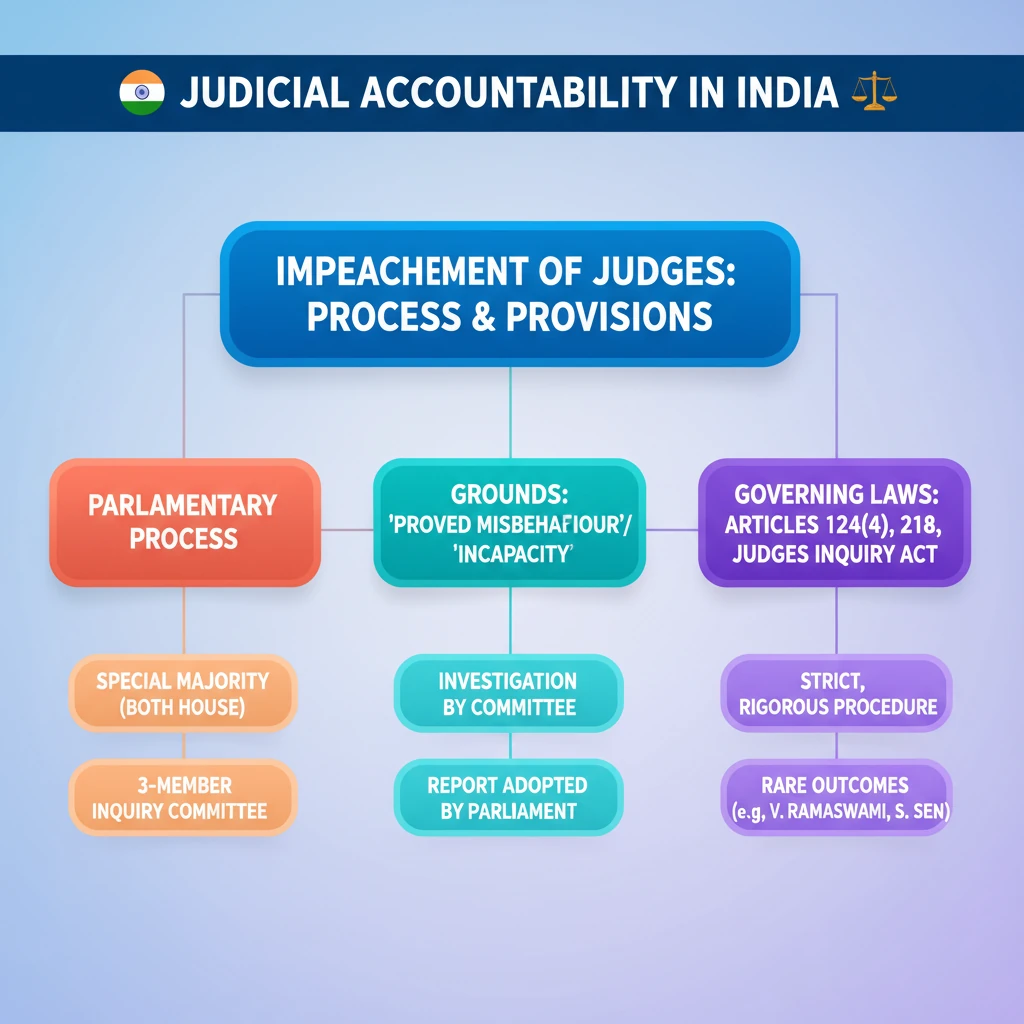
- •Judicial impeachment in India is a parliamentary process for removing judges based on "proved misbehaviour" or "incapacity".
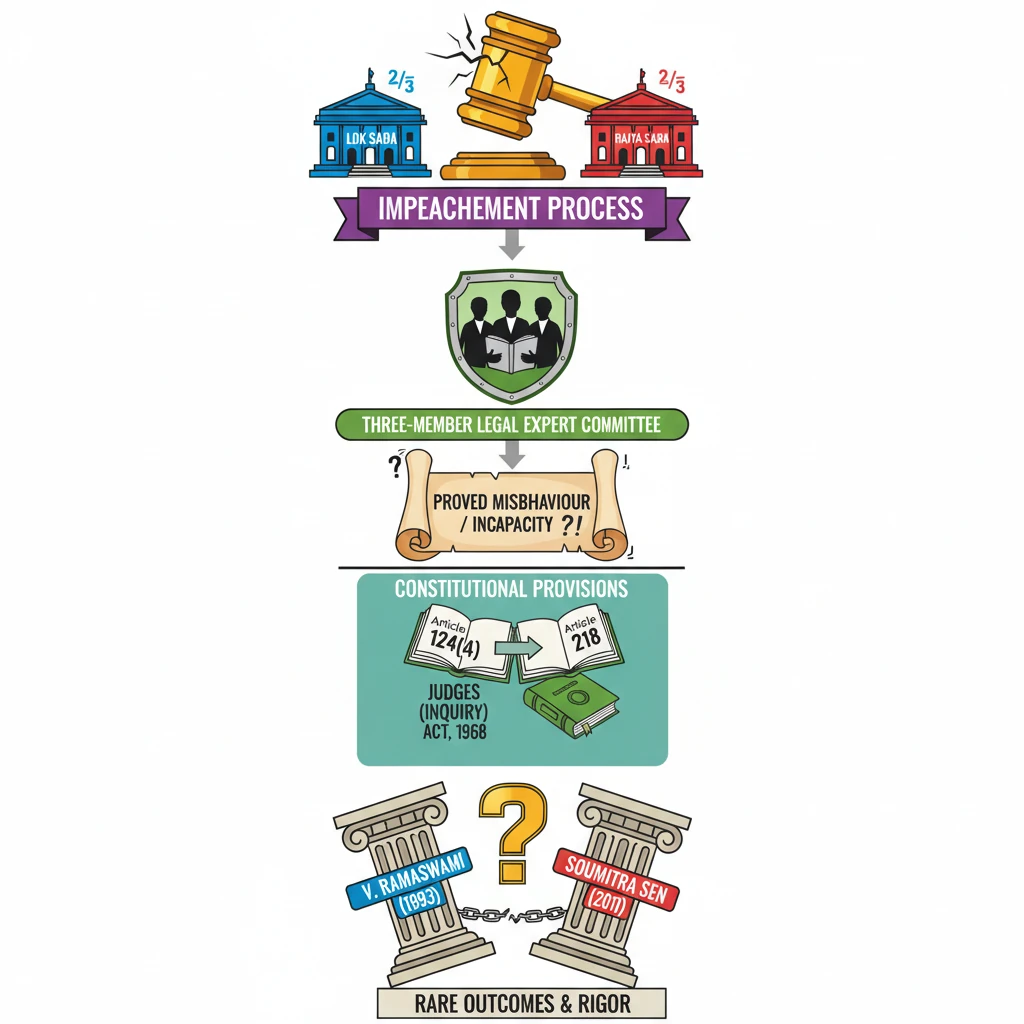
- •The process is stringent, requiring a special majority in both Houses of Parliament and an inquiry by a three-member committee of legal experts.
- •Constitutional provisions (Article 124(4), 218) and the Judges (Inquiry) Act, 1968, govern the detailed procedure for judicial removal.
- •Notable cases like Justice V. Ramaswami (1993) and Justice Soumitra Sen (2011) highlight the rigor, complexities, and rare outcomes of the process.
- •Judges' freedom of expression, while guaranteed, is subject to reasonable restrictions to maintain judicial integrity, impartiality, and public trust.
- •The impeachment mechanism serves as a crucial check on judicial power, balancing the judiciary's independence with its essential accountability.
🧠 Memory Techniques
95% Verified Content
📚 Reference Sources
•The Constitution of India (Articles 124, 127, 218)
•The Judges (Inquiry) Act, 1968