Diplomatic Passport - Polity And Governance | UPSC Learning
Topics
0 topics • 0 completed
🔍
No topics match your search
Diplomatic Passport
Medium⏱️ 5 min read
polity and governance
📖 Introduction
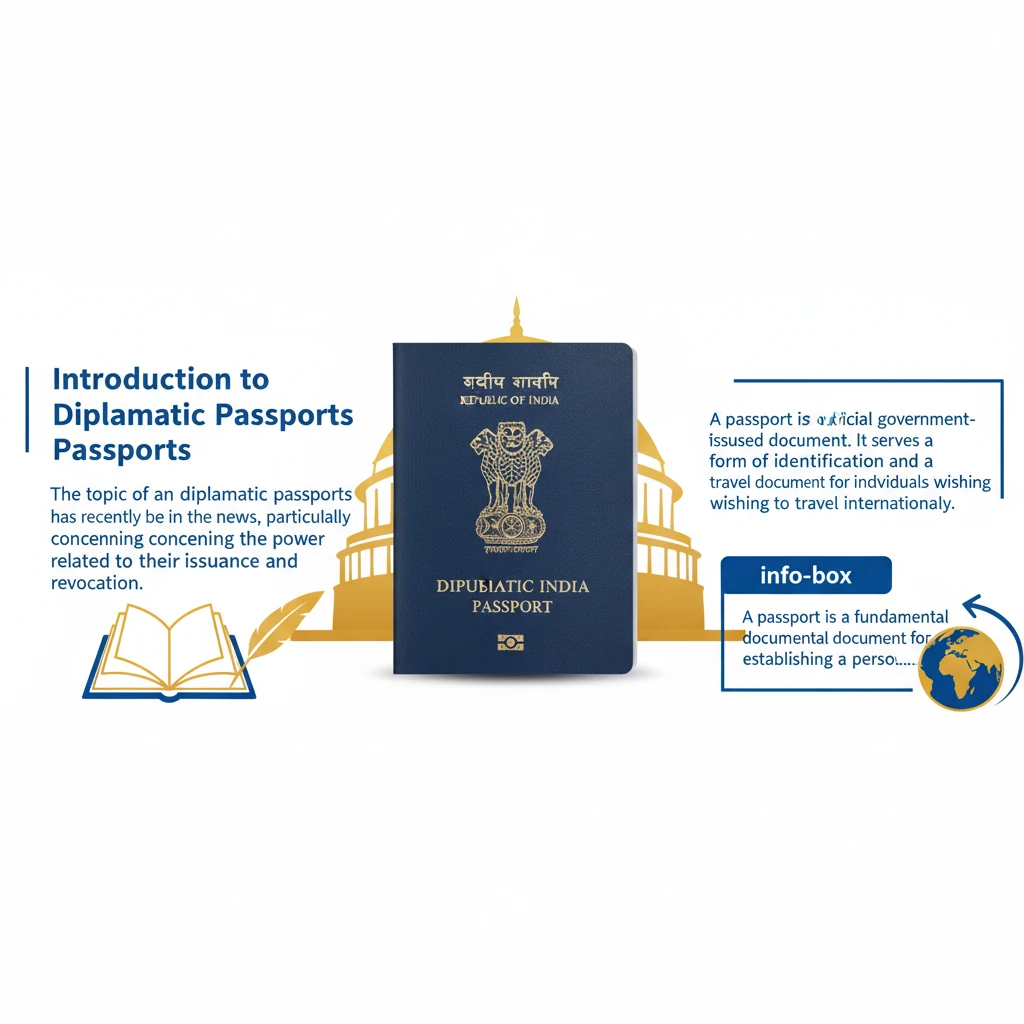
<h4>Introduction to Diplomatic Passports</h4><p>The topic of <strong>diplomatic passports</strong> has recently been in the news, particularly concerning the power related to their issuance and revocation.</p><p>A <strong>passport</strong> is an official government-issued document. It serves as a form of identification and a travel document for individuals wishing to travel internationally.</p><div class='info-box'><p>A <strong>passport</strong> is a fundamental document for establishing a person's <strong>identity</strong> and <strong>nationality</strong> for international travel purposes.</p></div><h4>Understanding Diplomatic Passports (Type D)</h4><p><strong>Diplomatic passports</strong> are specifically issued to individuals representing a country on official <strong>diplomatic missions</strong> or for <strong>government business</strong>.</p><p>These passports are utilized by <strong>diplomats, government officials</strong>, and in some cases, their immediate family members.</p><div class='key-point-box'><p><strong>Diplomatic passports</strong> are a form of identification that carries specific <strong>legal privileges and immunities</strong> under international law.</p></div><p>These privileges include <strong>immunity from arrest, detention</strong>, and certain <strong>legal proceedings</strong> in the host country, facilitating unhindered diplomatic functions.</p><h4>Eligibility for Diplomatic Passports in India</h4><p>In India, the <strong>Ministry of External Affairs’ Consular, Passport & Visa Division</strong> is responsible for issuing <strong>diplomatic passports</strong>.</p><div class='info-box'><p><strong>Diplomatic passports</strong> are also commonly known as <strong>Type D passports</strong>.</p></div><p>Eligibility extends to individuals falling into several specific categories:</p><ul><li><strong>Government-appointed individuals and officers</strong> working under <strong>Branches A and B of the Indian Foreign Service (IFS)</strong> who are traveling abroad for official business.</li><li><strong>Selected individuals on official travel</strong>, which includes <strong>Union Ministers</strong> and <strong>Members of Parliament (MPs)</strong>.</li></ul><h4>Revocation of Diplomatic Passports</h4><p>The authority to revoke a <strong>diplomatic passport</strong> lies with the designated <strong>passport authority</strong>.</p><p>Crucially, the government can only revoke a <strong>diplomatic passport</strong> after a <strong>court order</strong> to that effect has been issued.</p><div class='exam-tip-box'><p>Understanding the <strong>checks and balances</strong> on government power, especially concerning diplomatic instruments, is vital for <strong>UPSC Mains GS-II (Polity)</strong>.</p></div><p>Under the provisions of the <strong>Passport Act of 1967</strong>, a <strong>diplomatic passport</strong> may be revoked under several circumstances:</p><ul><li>If the holder is found to be in <strong>wrongful possession</strong> of the passport.</li><li>If it was obtained through the <strong>suppression of material information</strong>.</li><li>If the <strong>passport authority deems it necessary for India’s interests</strong>.</li><li>If the holder has been <strong>convicted or is facing criminal proceedings</strong> in India.</li></ul><h4>Key Differences: Passport vs. Visa</h4><table class='info-table'><tr><th>Feature</th><th>Passport</th><th>Visa</th></tr><tr><td><strong>Issuing Authority</strong></td><td><strong>Ministry of External Affairs of India</strong></td><td><strong>Embassy or Consulate</strong> of the foreign country</td></tr><tr><td><strong>Purpose</strong></td><td><strong>Proof of Indian citizenship</strong> and identity for international travel</td><td><strong>Permission to enter</strong> a specific foreign country</td></tr><tr><td><strong>Validity</strong></td><td>Typically <strong>10 years</strong></td><td>Varies depending on type, country, and purpose</td></tr><tr><td><strong>Requirement</strong></td><td><strong>Mandatory</strong> for all Indian citizens traveling abroad (with exceptions)</td><td>Varies depending on the country (<strong>visa-free agreements</strong> exist)</td></tr></table>
💡 Key Takeaways
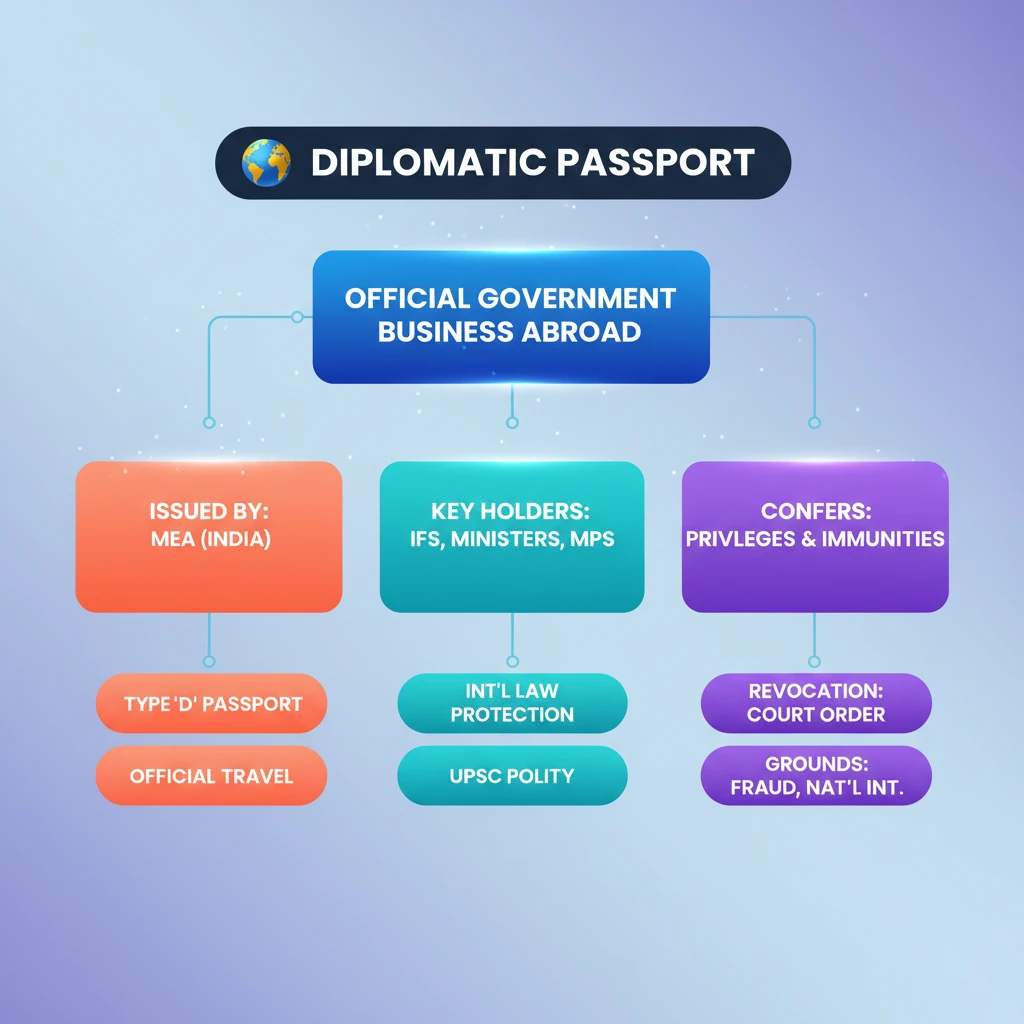
- •Diplomatic passports (Type D) are issued for official government business abroad.
- •They are issued by the Ministry of External Affairs to IFS officers, Union Ministers, and MPs.
- •These passports confer specific legal privileges and immunities under international law.
- •Revocation authority lies with the passport authority but requires a court order.
- •Grounds for revocation include wrongful possession, fraud, national interest, or criminal proceedings.
- •Diplomatic passports differ from regular passports and visas in purpose, issuing authority, and associated privileges.
🧠 Memory Techniques

90% Verified Content