Hindi Diwas 2024 - Polity And Governance | UPSC Learning
Topics
0 topics • 0 completed
🔍
No topics match your search
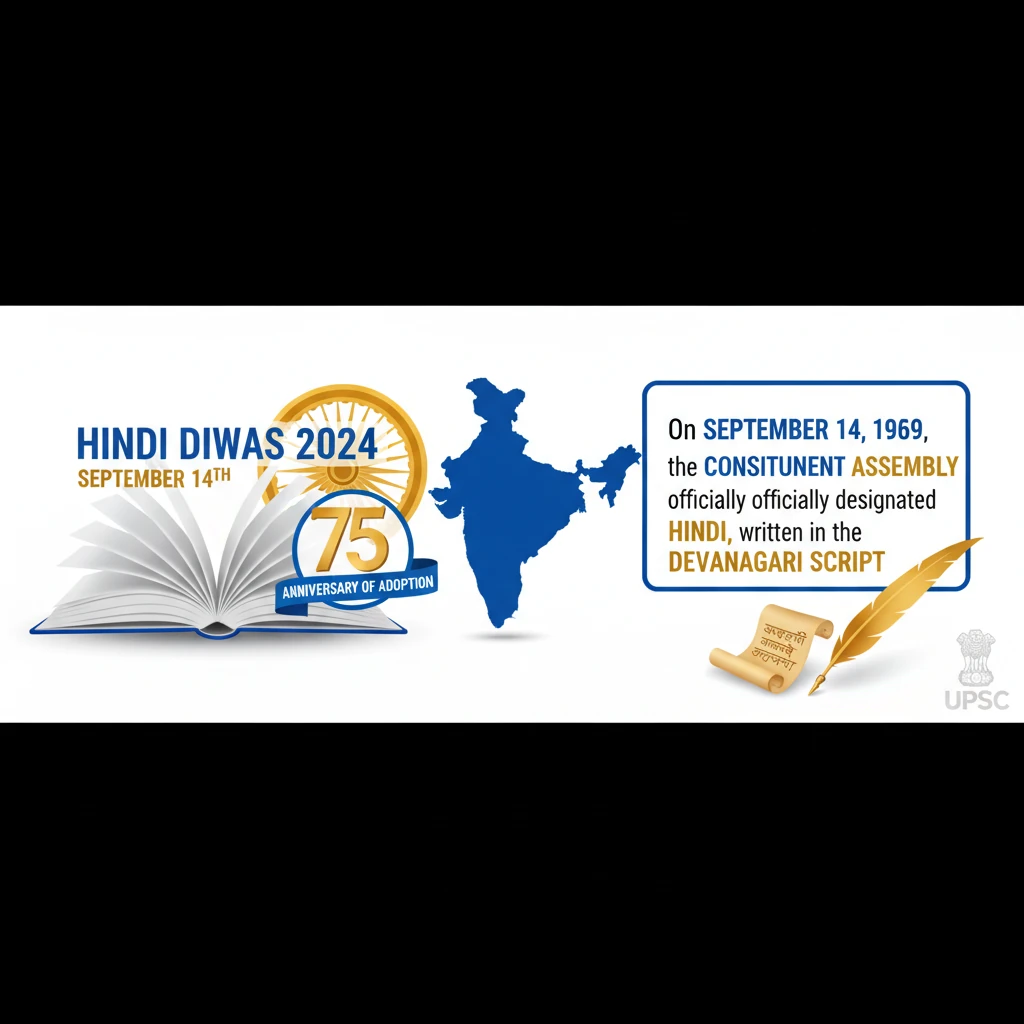
Hindi Diwas 2024
Medium⏱️ 7 min read
polity and governance
📖 Introduction
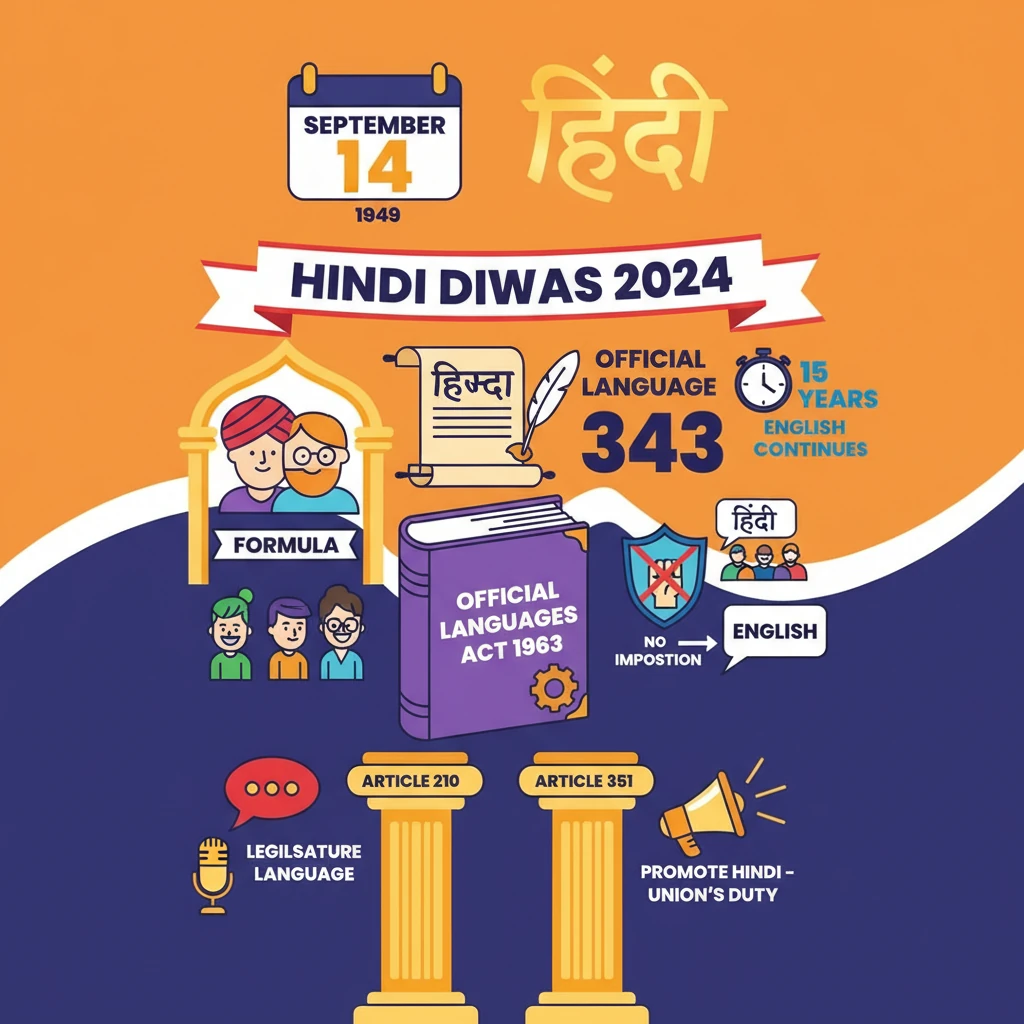
<h4>Introduction to Hindi Diwas 2024</h4><p><strong>Hindi Diwas 2024</strong> was celebrated on <strong>September 14th</strong>, marking a significant milestone. This year commemorated the <strong>75th anniversary</strong> of <strong>Hindi's adoption</strong> as the official language of the country.</p><div class='info-box'><p>On <strong>September 14, 1949</strong>, the <strong>Constituent Assembly</strong> officially designated <strong>Hindi</strong>, written in the <strong>Devanagari script</strong>, as the <strong>official language of the Union of India</strong>.</p></div><h4>Constitutional Mentions (from Source Context)</h4><p>The provided source material also briefly touched upon other constitutional provisions. It stated that <strong>Article 44</strong> permits the government to strive for a <strong>Uniform Civil Code (UCC)</strong>.</p><p>This pursuit of a <strong>UCC</strong> is not restricted by the term <strong>'Secular'</strong> as mentioned in the <strong>Preamble</strong> of the Constitution.</p><p>Furthermore, the <strong>Socialism</strong> practiced in India aims for the <strong>economic and social upliftment of citizens</strong>. This form of socialism does not restrict <strong>private entrepreneurship</strong> or the <strong>right to do business</strong>, which is guaranteed as a <strong>fundamental right</strong> under <strong>Article 19(1)(g)</strong>.</p><h4>The Munshi-Ayyangar Formula</h4><p>The decision to adopt <strong>Hindi</strong> as the official language was a result of the <strong>Munshi-Ayyangar formula</strong>. This was a crucial compromise reached between <strong>K.M. Munshi</strong> and <strong>N. Gopalaswamy Ayyangar</strong> during the Constituent Assembly debates.</p><div class='key-point-box'><p>This formula led to the inclusion of <strong>Article 343</strong> in the Constitution. It adopted <strong>Hindi in the Devanagari script</strong> as the official language of the Union, while also allowing <strong>English</strong> to continue for official purposes for an initial period of <strong>fifteen years</strong>.</p></div><h4>Official Languages Act 1963</h4><p>As the initial <strong>15-year period</strong> for the use of <strong>English</strong> was nearing its end, significant protests erupted. These protests were driven by the fear of <strong>Hindi imposition</strong> on non-Hindi speaking regions.</p><p>In response to these concerns, the <strong>Official Languages Act 1963</strong> was enacted. This Act played a pivotal role in upholding <strong>English</strong> as an official language alongside <strong>Hindi</strong>, ensuring continuity and addressing regional sentiments.</p><h4>Key Articles Related to Hindi</h4><ul><li><p><strong>Article 210:</strong> This article states that the language to be used in the <strong>legislature</strong> of a state can be the <strong>official language of that state</strong>, <strong>Hindi</strong>, or <strong>English</strong>.</p></li><li><p><strong>Article 351:</strong> This article mandates that it shall be the <strong>duty of the Union</strong> to promote the spread of the <strong>Hindi language</strong>. The goal is to develop it so that it may serve as a medium of expression for all elements of India's <strong>composite culture</strong>.</p></li></ul><h4>Status and Origin of Hindi</h4><p><strong>Hindi</strong> is one of the <strong>22 languages</strong> officially recognized and listed in the <strong>Eighth Schedule</strong> of the <strong>Constitution of India</strong>.</p><div class='info-box'><p>It is important to note that <strong>Hindi is not a classical language</strong>, distinguishing it from languages like Sanskrit, Tamil, Telugu, Kannada, Malayalam, and Odia.</p></div><p>The name <strong>'Hindi'</strong> itself has historical roots. It is derived from the <strong>Persian word 'Hind'</strong>, which means <strong>'land of the Indus River'</strong>. Linguistically, <strong>Hindi</strong> is a direct descendant of <strong>Sanskrit</strong>.</p><div class='exam-tip-box'><p>Understanding the constitutional provisions (<strong>Articles 343, 210, 351</strong>) and the historical context (<strong>Munshi-Ayyangar formula, Official Languages Act 1963</strong>) is crucial for UPSC Mains questions on language policy and federalism.</p></div>
💡 Key Takeaways
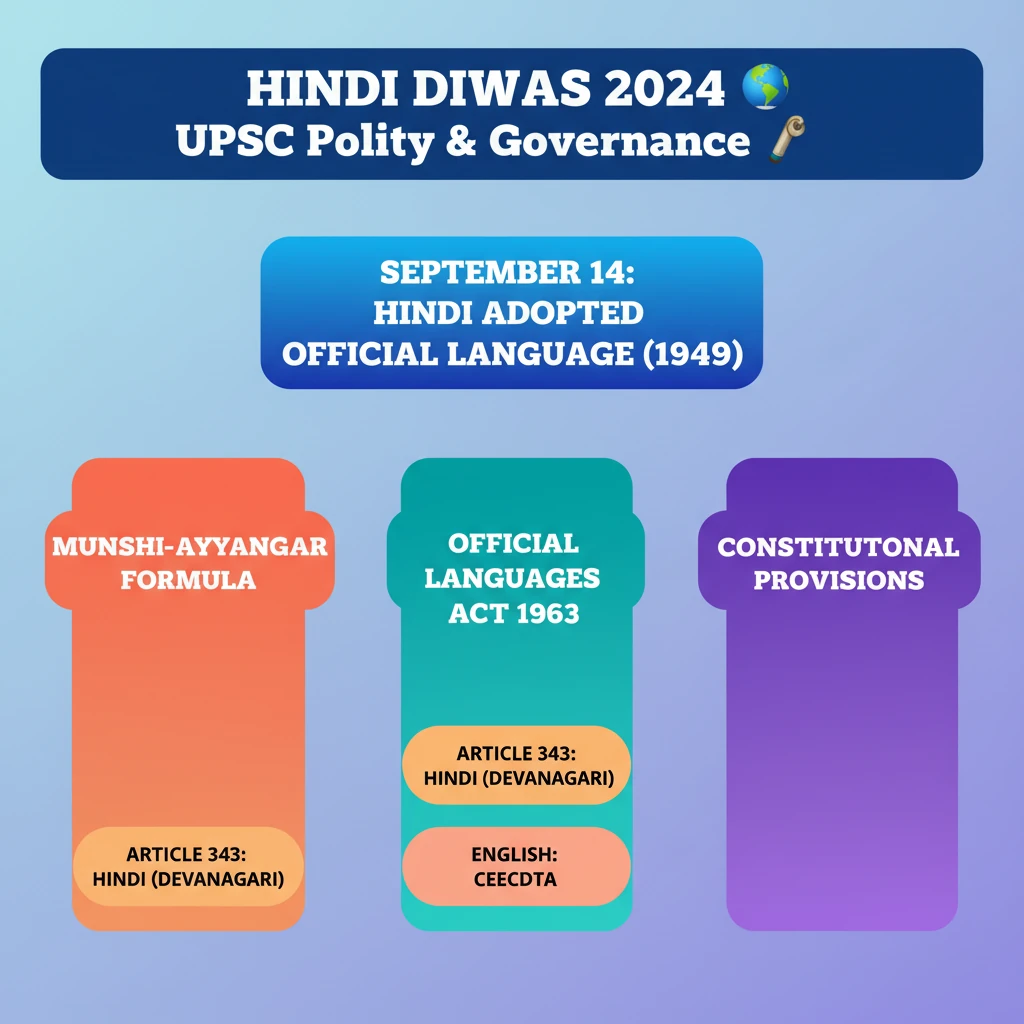
- •Hindi Diwas is celebrated on September 14th, commemorating Hindi's adoption as the official language in 1949.
- •The Munshi-Ayyangar formula led to Article 343, making Hindi (Devanagari script) the official language, with English continuing for 15 years.
- •The Official Languages Act 1963 ensured English's continued use alongside Hindi due to protests against imposition.
- •Articles 210 (language in legislature) and 351 (Union's duty to promote Hindi) are key constitutional provisions.
- •Hindi is one of 22 languages in the Eighth Schedule but is not a classical language.
- •The source material also briefly mentioned Article 44 (UCC) and the nature of Indian Socialism (Article 19(1)(g)).
🧠 Memory Techniques
95% Verified Content
📚 Reference Sources
•The Constitution of India (Articles 44, 19(1)(g), 210, 343, 351, Preamble, Eighth Schedule)
•Official Languages Act, 1963