Appointment of Chief Justice of India - Polity And Governance | UPSC Learning
Topics
0 topics • 0 completed
🔍
No topics match your search

Appointment of Chief Justice of India
Medium⏱️ 8 min read
polity and governance
📖 Introduction
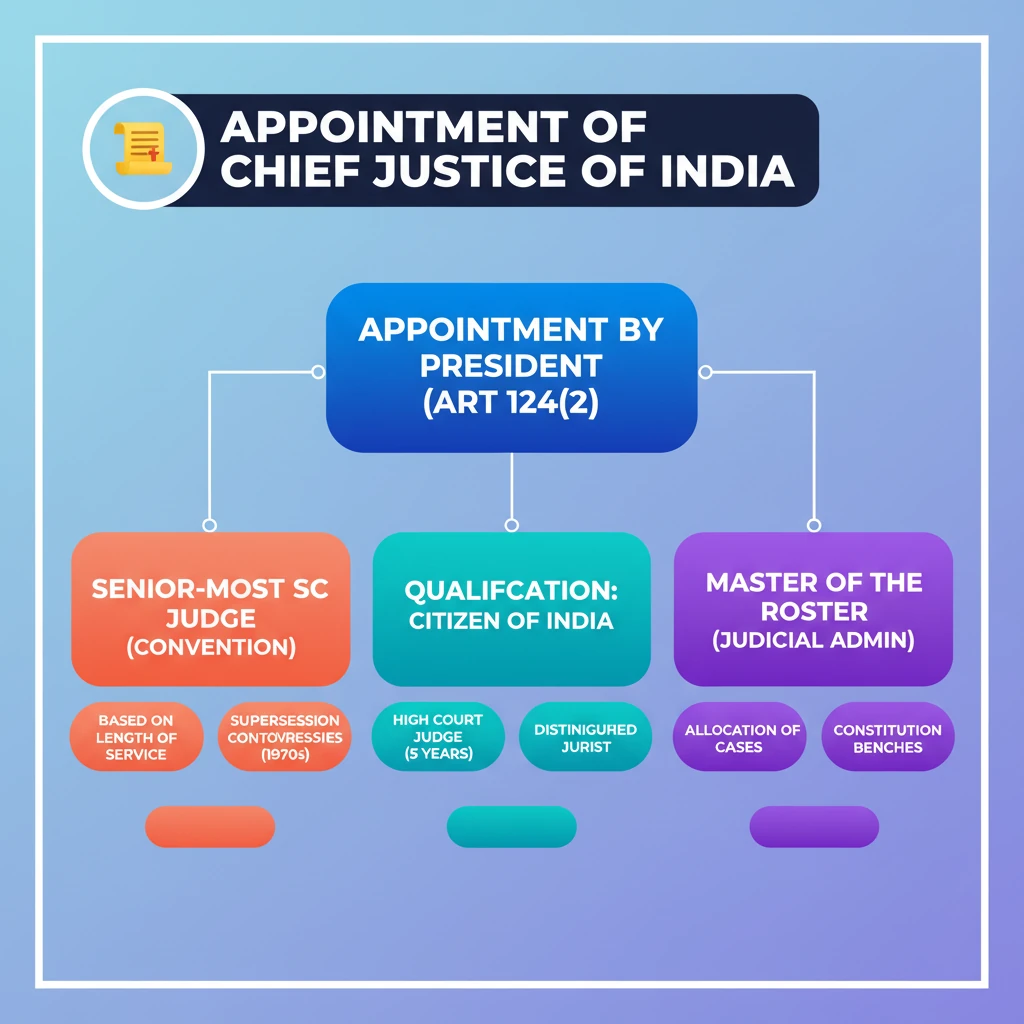
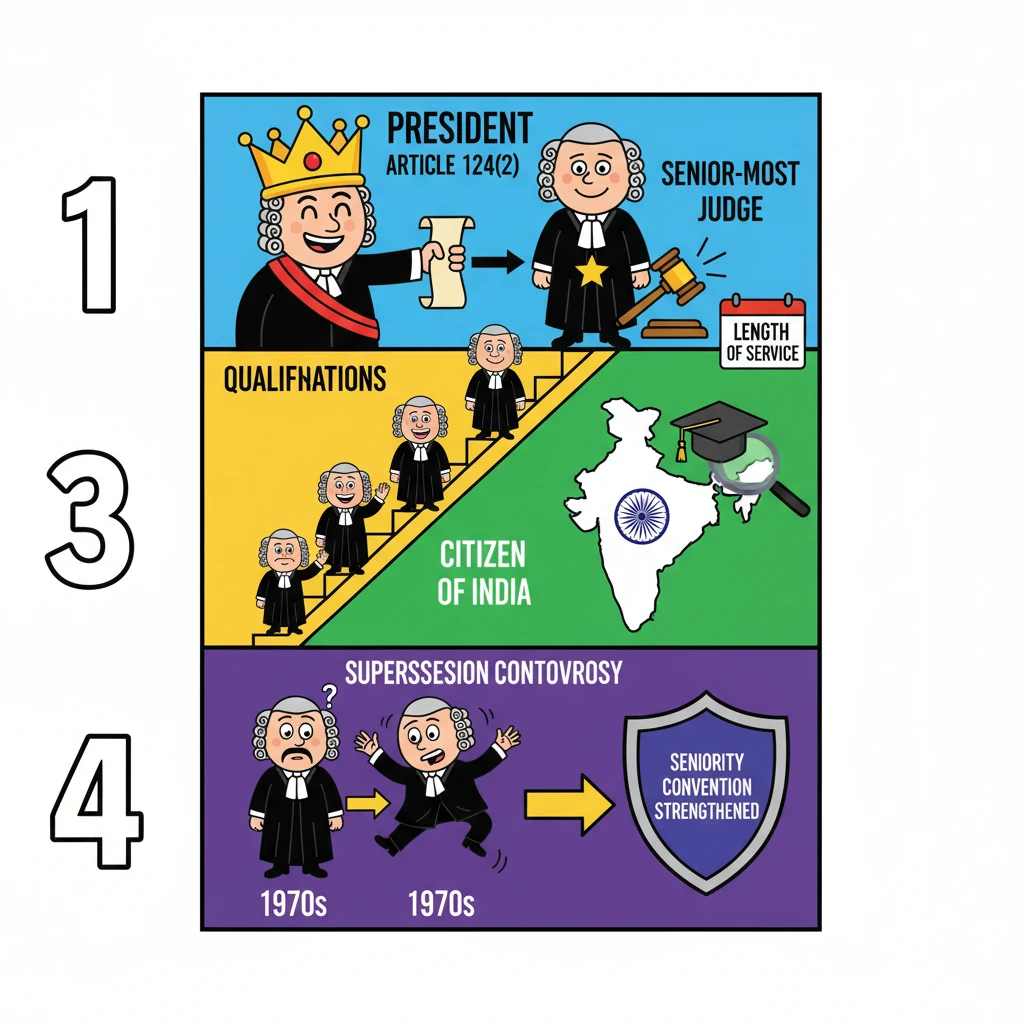
<h4>Recent Context: 51st CJI Appointment</h4><p>Recently, the <strong>President of India</strong> administered the <strong>oath of office</strong> to <strong>Justice Sanjiv Khanna</strong> as the <strong>Chief Justice of India (CJI)</strong>.</p><p>He succeeded <strong>Justice D.Y. Chandrachud</strong>, becoming the <strong>51st CJI</strong> of India. This appointment adheres to the established conventions for judicial leadership.</p><div class='info-box'><p><strong>Key Fact:</strong> <strong>Justice Sanjiv Khanna</strong> is the <strong>51st Chief Justice of India</strong>, following <strong>Justice D.Y. Chandrachud</strong>.</p></div><h4>Constitutional Provisions for CJI Appointment</h4><p>A <strong>Supreme Court judge</strong>, including the <strong>Chief Justice of India</strong>, is appointed by the <strong>President of India</strong>. This power is derived from <strong>Article 124 (2)</strong> of the <strong>Constitution of India</strong>.</p><p>As per a long-standing <strong>convention</strong>, the <strong>senior-most judge</strong> of the <strong>Supreme Court</strong> is designated as the <strong>Chief Justice of India</strong>. This convention ensures predictability and upholds the independence of the judiciary.</p><div class='key-point-box'><p><strong>Convention of Seniority:</strong> The <strong>seniority</strong> of a judge is measured by their <strong>length of service</strong> on the <strong>Supreme Court</strong>. This is the primary criterion for becoming the CJI.</p></div><h4>Qualifications for a Supreme Court Judge</h4><p>To be appointed as a <strong>Supreme Court judge</strong>, a person must meet specific constitutional qualifications. The foundational requirement is citizenship.</p><ul><li>He should be a <strong>citizen of India</strong>.</li></ul><div class='exam-tip-box'><p><strong>UPSC Insight:</strong> While the source mentions only <strong>citizenship</strong>, recall other qualifications like judicial experience (High Court judge for 5 years) or advocate experience (High Court for 10 years), or being a distinguished jurist, as per <strong>Article 124(3)</strong>. For CJI, these apply first, then seniority.</p></div>
💡 Key Takeaways
- •CJI is appointed by the President under Article 124(2) of the Constitution.
- •The senior-most Supreme Court judge, based on length of service, is conventionally designated as CJI.
- •Qualifications for a Supreme Court judge include being a citizen of India.
- •The 1970s witnessed supersession controversies, leading to strengthening of the seniority convention.
- •The CJI is the 'master of the roster' and plays a crucial role in judicial administration.
- •Debates around the Collegium System for judicial appointments remain a contemporary issue.
🧠 Memory Techniques
95% Verified Content
📚 Reference Sources
•Supreme Court of India Official Website
•Press Information Bureau (PIB) releases on CJI appointments
•Drishti IAS Study Material (provided source)