Speaker and Deputy Speaker: Powers, Removal, and Roles - Polity And Governance | UPSC Learning
Topics
0 topics • 0 completed
🔍
No topics match your search
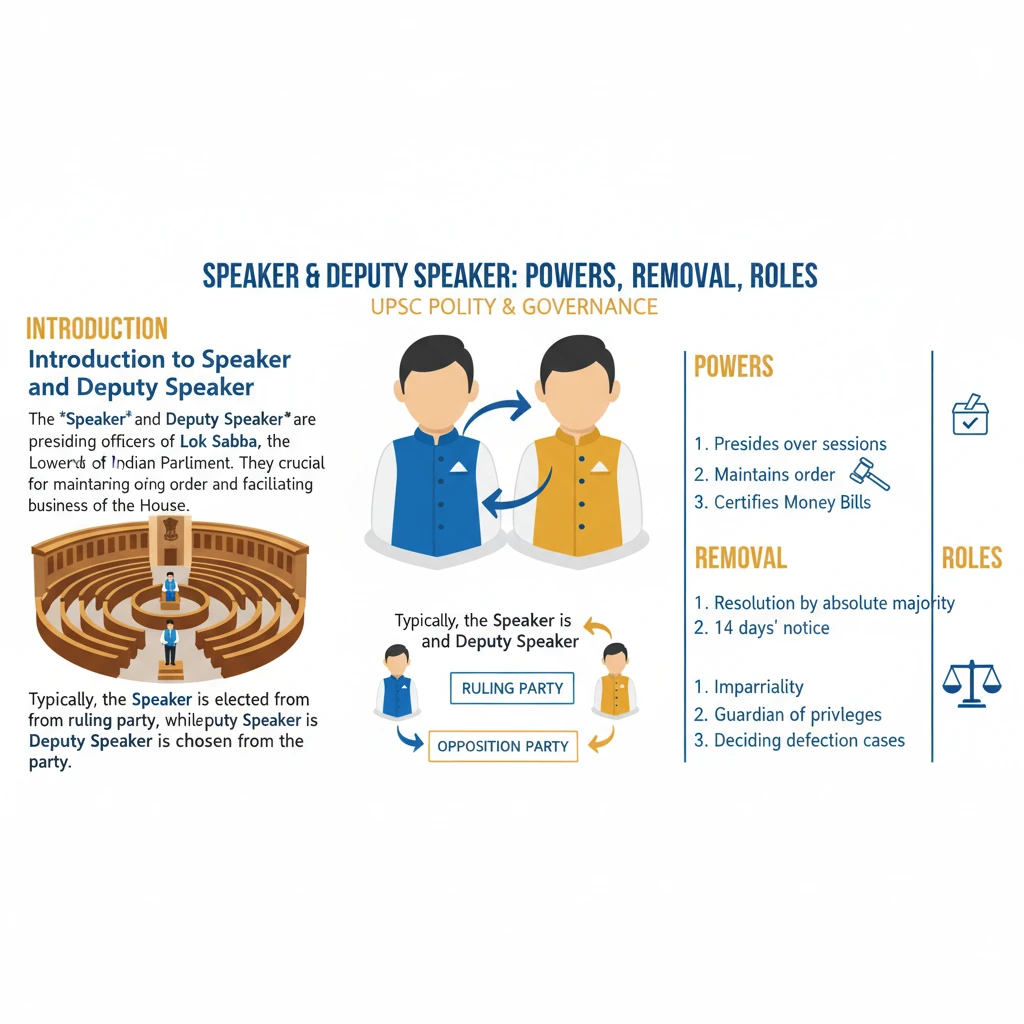
Speaker and Deputy Speaker: Powers, Removal, and Roles
Medium⏱️ 15 min read
polity and governance
📖 Introduction
<h4>Introduction to Speaker and Deputy Speaker</h4><p>The <strong>Speaker</strong> and <strong>Deputy Speaker</strong> are the presiding officers of the <strong>Lok Sabha</strong>, the Lower House of the Indian Parliament. They are crucial for maintaining order and facilitating the business of the House.</p><p>Typically, the <strong>Speaker</strong> is elected from the <strong>ruling party</strong>, while the <strong>Deputy Speaker</strong> is chosen from the <strong>opposition party</strong>. This convention aims to ensure a balance and impartiality in the functioning of the House.</p><div class='info-box'><p><strong>Notable Exceptions:</strong></p><ul><li><strong>GMC Balayogi</strong> (12th Lok Sabha)</li><li><strong>Manohar Joshi</strong> (13th Lok Sabha)</li></ul><p>Both served as Speaker while belonging to <strong>non-ruling parties</strong>, demonstrating instances where this convention was not strictly followed.</p></div><p>Upon the <strong>dissolution of the Lok Sabha</strong>, the <strong>Speaker</strong> continues in office until the first meeting of the new assembly, when a new Speaker is elected. This ensures continuity in the legislative process.</p><h4>Election and Appointment</h4><p>The <strong>Speaker</strong> and <strong>Deputy Speaker</strong> are elected by the <strong>Lok Sabha</strong> from amongst its members. The process is governed by the <strong>Rules of Procedure and Conduct of Business of Lok Sabha</strong>.</p><div class='info-box'><p><strong>Constitutional Provision:</strong></p><ul><li><strong>Article 93</strong> of the <strong>Indian Constitution</strong> mandates the election of the <strong>Speaker</strong> and <strong>Deputy Speaker</strong> for the <strong>Lok Sabha</strong>.</li><li><strong>Article 178</strong> makes similar provisions for <strong>State Legislative Assemblies</strong>.</li></ul></div><h4>Removal of the Speaker and Deputy Speaker</h4><p>The <strong>Constitution of India</strong> empowers the <strong>Lok Sabha</strong> to remove its presiding officers. This process is a significant check on their authority and ensures accountability.</p><div class='key-point-box'><p><strong>Removal Process:</strong></p><ul><li>A <strong>resolution for removal</strong> can be initiated with a <strong>14-day prior notice</strong>.</li><li>The resolution must be passed by an <strong>effective majority</strong> of the House.</li><li>An <strong>effective majority</strong> means more than <strong>50% of the effective strength</strong> of the House (total strength minus vacancies).</li><li>This procedure is outlined in <strong>Article 94</strong> of the <strong>Indian Constitution</strong>.</li></ul></div><p>Beyond a resolution, a <strong>Speaker</strong> can also be removed if they are <strong>disqualified from being a Lok Sabha member</strong> under <strong>Sections 7 and 8</strong> of the <strong>Representation of the People Act, 1951</strong>.</p><p>The <strong>Speaker</strong> also has the option to <strong>resign</strong> from office by submitting their resignation to the <strong>Deputy Speaker</strong>.</p><div class='info-box'><p><strong>Constitutional Provisions on Removal:</strong></p><ul><li><strong>Article 94</strong> (Lok Sabha) and <strong>Article 179</strong> (Legislative Assembly) detail the vacation, resignation, and removal from office.</li><li><strong>Article 96</strong> (Lok Sabha) and <strong>Article 181</strong> (Legislative Assembly) state that the <strong>Speaker</strong> or <strong>Deputy Speaker</strong> shall not preside while a resolution for their removal is under consideration.</li></ul></div><h4>Sources of Speaker's Powers and Duties</h4><p>The authority of the <strong>Speaker of the Lok Sabha</strong> is derived from a combination of constitutional provisions, established rules, and parliamentary traditions.</p><ul><li><strong>Constitution of India:</strong> Provides the foundational framework and specific articles defining the office.</li><li><strong>Rules of Procedure and Conduct of Business of Lok Sabha:</strong> Detailed regulations governing the day-to-day functioning of the House.</li><li><strong>Parliamentary Conventions:</strong> Unwritten rules and practices that have evolved over time, filling gaps not explicitly covered by the Constitution or rules (often referred to as <strong>residuary powers</strong>).</li></ul><h4>Roles and Responsibilities of the Speaker</h4><p>The <strong>Speaker</strong> performs a multifaceted role, acting as the principal representative of the House, its guardian, and its chief administrator.</p><ul><li><strong>Presiding Officer:</strong> Oversees the sessions of the <strong>Lower House</strong>, ensuring <strong>discipline</strong> and <strong>decorum</strong> among members.</li><li><strong>Disciplinary Authority:</strong> Has the power to punish unruly behaviour and can even <strong>disqualify members</strong> on grounds of <strong>defection</strong> under the <strong>Tenth Schedule</strong> of the Constitution.</li><li><strong>Committee Formation:</strong> Constitutes the <strong>Committees of the House</strong> and directs their overall functioning.</li><li><strong>Guardian of Rights:</strong> Acts as the guardian of the <strong>rights and privileges</strong> of the House, its Committees, and individual members.</li><li><strong>Administrative Head:</strong> Heads the <strong>Lok Sabha Secretariat</strong>, managing administrative affairs and security arrangements within the <strong>Parliament Estate</strong>.</li><li><strong>Inter-Parliamentary Relations:</strong> Serves as the <strong>ex-officio President</strong> of the <strong>Indian Parliamentary Group</strong>, facilitating relations with other parliaments globally. Chairs the <strong>Conference of Presiding Officers of Legislative Bodies in India</strong>.</li></ul><h4>Provisions Ensuring Independence and Impartiality</h4><p>Several constitutional and procedural safeguards are in place to ensure the <strong>independence</strong> and <strong>impartiality</strong> of the <strong>Speaker's office</strong>, vital for the fair conduct of parliamentary business.</p><div class='key-point-box'><p><strong>Key Safeguards:</strong></p><ul><li><strong>Security of Tenure:</strong> The Speaker can only be removed by a resolution passed by an <strong>effective majority</strong> of the <strong>Lok Sabha</strong>, making arbitrary removal difficult.</li><li><strong>Salaries and Allowances:</strong> These are <strong>charged on the Consolidated Fund of India</strong>, meaning they are not subject to the annual vote of Parliament, insulating the Speaker from political pressure regarding remuneration. (<strong>Article 97</strong> and <strong>Article 186</strong>)</li><li><strong>Conduct Discussion:</strong> The Speaker's work and conduct cannot be discussed or criticised in the <strong>Lok Sabha</strong> except through a <strong>substantive motion</strong>, ensuring protection from frivolous accusations.</li><li><strong>Judicial Immunity:</strong> The Speaker's powers in regulating procedure, conducting business, or maintaining order within the House are generally <strong>not subject to the jurisdiction of any court</strong>.</li><li><strong>Casting Vote:</strong> The Speaker <strong>cannot vote in the first instance</strong>. They can only exercise a <strong>casting vote</strong> in the event of a tie, underscoring their impartial role.</li><li><strong>High Precedence:</strong> The Speaker is placed at the <strong>sixth rank</strong> in the <strong>order of precedence</strong>, alongside the <strong>Chief Justice of India</strong>, reflecting the high regard and importance of the office.</li></ul></div><h4>Speaker Pro Tem</h4><p>The office of the <strong>Speaker Pro Tem</strong> is a temporary arrangement made to facilitate the transition between one <strong>Lok Sabha</strong> and the next.</p><div class='info-box'><p><strong>Role and Appointment:</strong></p><ul><li>When the <strong>Speaker</strong> of the outgoing <strong>Lok Sabha</strong> vacates office before the first meeting of the newly-elected House, the <strong>President</strong> appoints a <strong>Speaker Pro Tem</strong>.</li><li>Traditionally, the <strong>senior most member</strong> of the <strong>Lok Sabha</strong> is chosen for this role.</li><li>The <strong>President</strong> himself administers the <strong>oath</strong> to the <strong>Speaker Pro Tem</strong>.</li></ul></div><p>The <strong>Speaker Pro Tem</strong> presides over the <strong>first sitting</strong> of the newly-elected <strong>Lok Sabha</strong> and possesses all the powers of the Speaker during this interim period.</p><p>Their primary responsibilities include <strong>administering oaths</strong> to the new members and overseeing the election of the new, permanent <strong>Speaker</strong>.</p><p>Once the new <strong>Speaker</strong> is elected by the House, the office of the <strong>Speaker Pro Tem</strong> automatically ceases to exist.</p>
💡 Key Takeaways
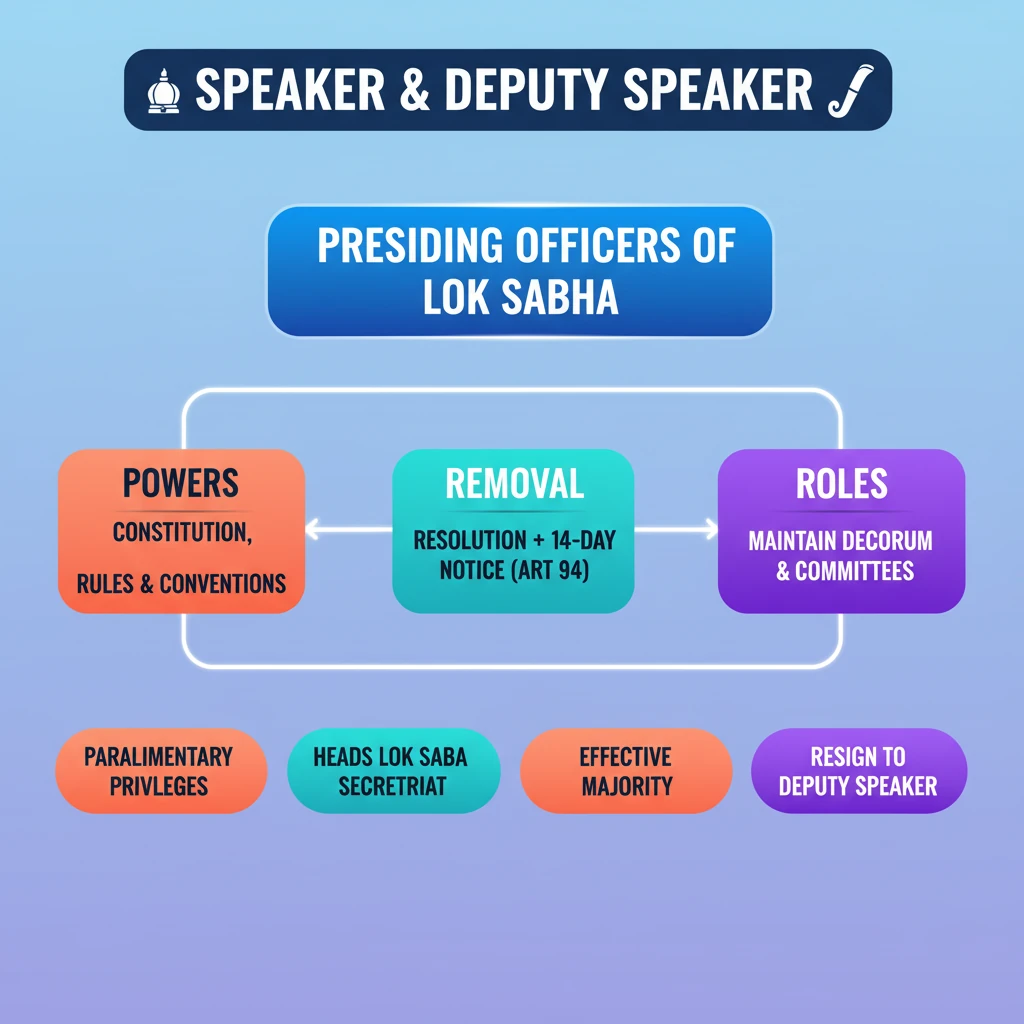
- •Speaker and Deputy Speaker are presiding officers of Lok Sabha, usually from ruling and opposition parties respectively.
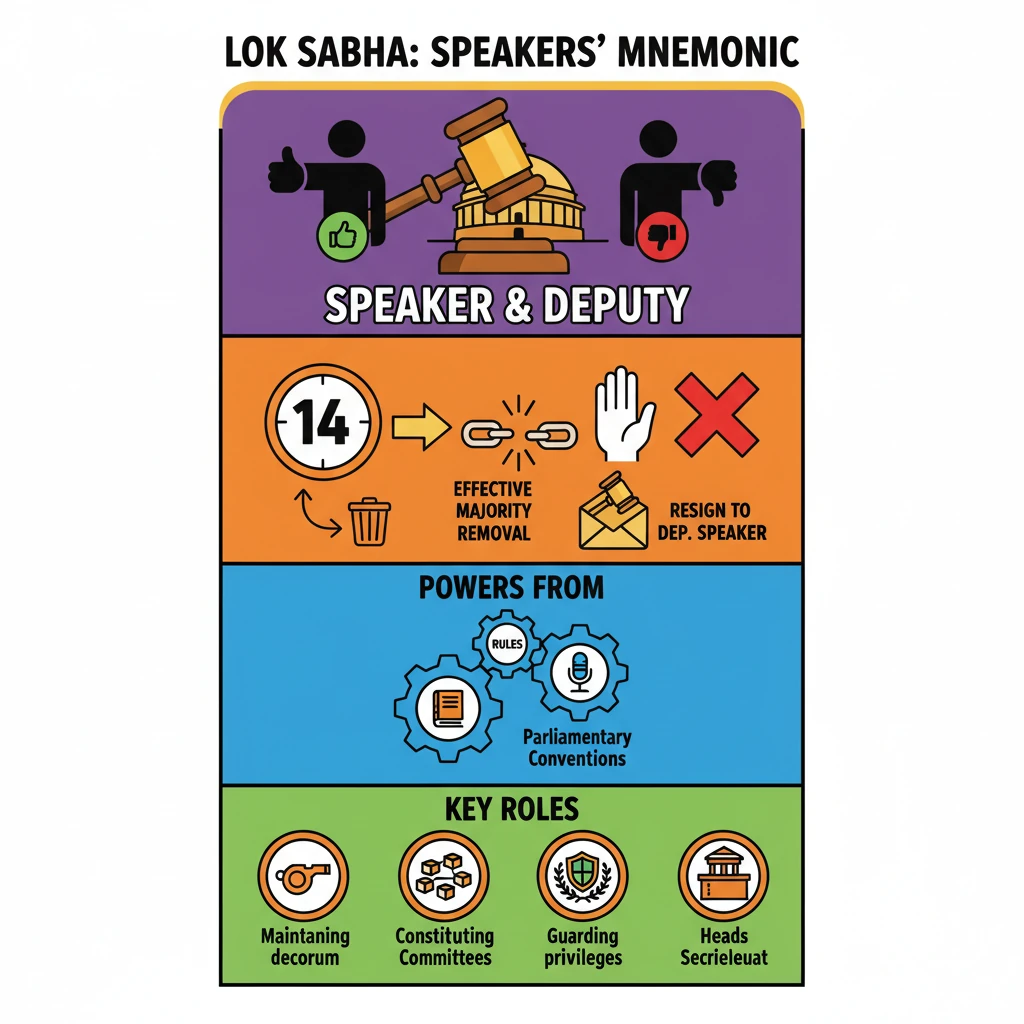
- •Removal requires a 14-day notice and an effective majority resolution (Article 94); resignation to Deputy Speaker.
- •Powers derive from Constitution, Rules of Procedure, and Parliamentary Conventions.
- •Key roles include maintaining decorum, constituting committees, guarding privileges, and heading Lok Sabha Secretariat.
- •Independence ensured by security of tenure, salaries charged on Consolidated Fund, limited judicial scrutiny of internal proceedings, and casting vote only.
- •Speaker Pro Tem is a temporary appointee by the President to administer oaths and oversee new Speaker's election.
- •Supreme Court rulings (e.g., Kihoto Hollohan, Nabam Rebia, Keisham Meghachandra Singh) have made Speaker's anti-defection decisions subject to judicial review and imposed timelines.
🧠 Memory Techniques
98% Verified Content
📚 Reference Sources
•Representation of the People Act, 1951 (Sections 7 and 8)
•Rules of Procedure and Conduct of Business of Lok Sabha
•Kihoto Hollohan vs. Zachillhu Case, 1993, AIR 1993 SC 412
•Keisham Meghachandra Singh vs. The Hon'ble Speaker Manipur Legislative Assembly & Ors Case, 2020, (2020) 1 SCC 808
•Nabam Rebia vs. Deputy Speaker Case, 2016, (2017) 1 SCC 1
•Subhash Desai v. Principal Secretary, Governor of Maharashtra Case, 2023, (2023) SCC OnLine SC 607