Right to Education - Polity And Governance | UPSC Learning
Topics
0 topics • 0 completed
🔍
No topics match your search
Right to Education
Medium⏱️ 6 min read
polity and governance
📖 Introduction
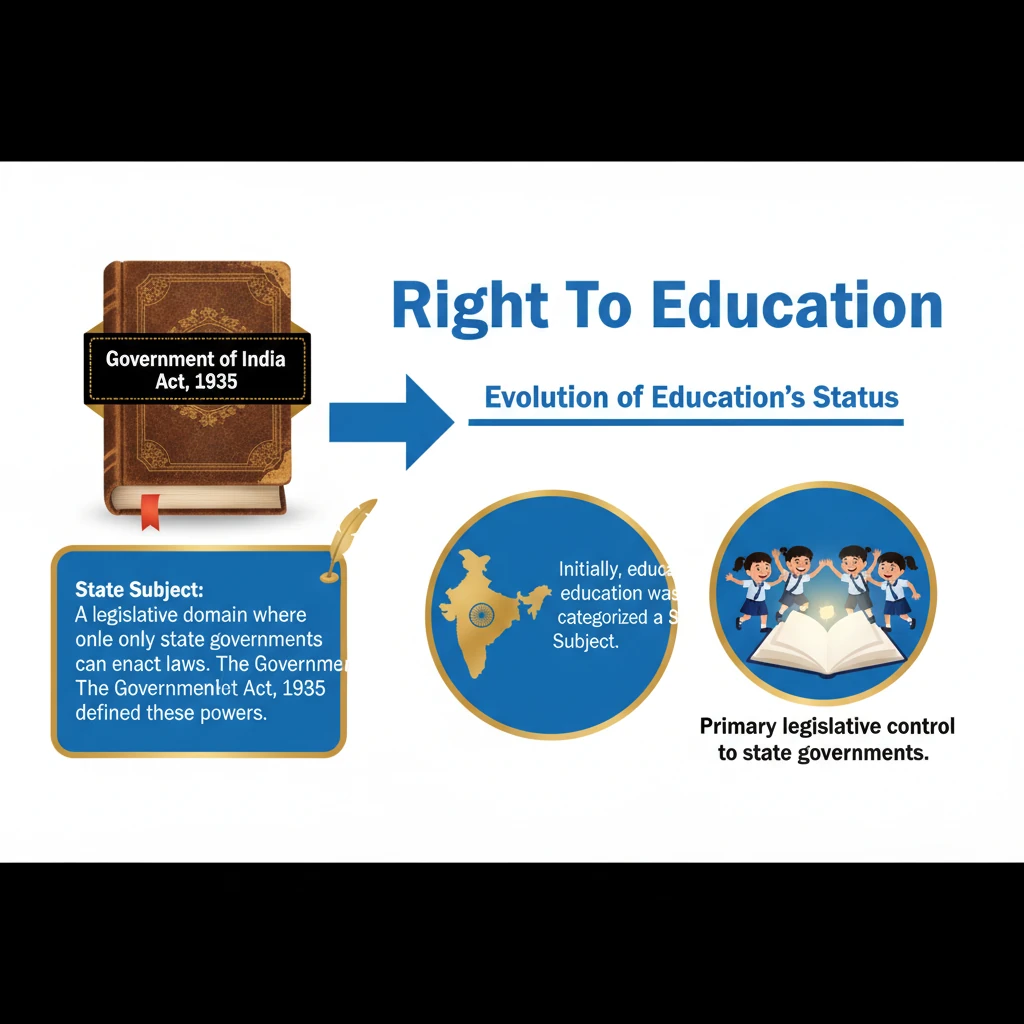
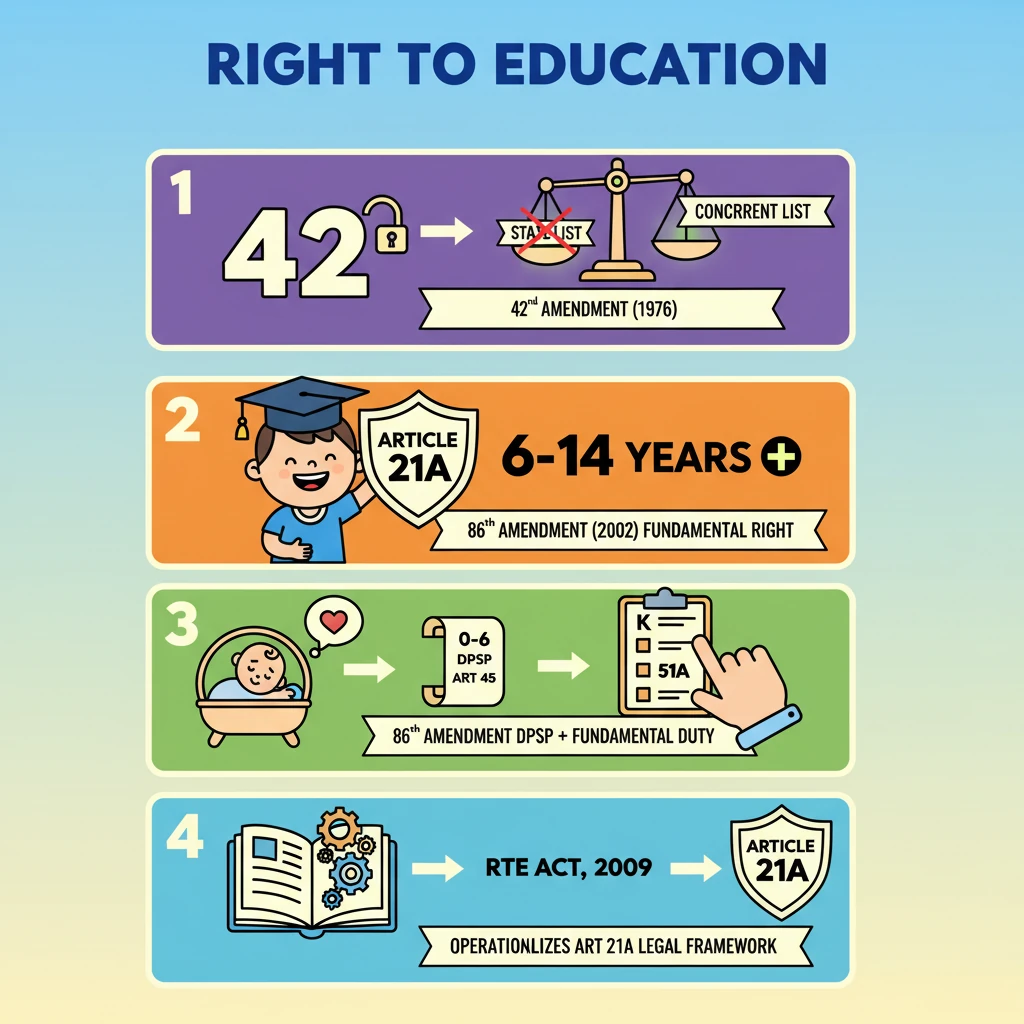
<h4>Evolution of Education as a Legislative Subject</h4><p>Initially, <strong>education</strong> was classified as a <strong>State Subject</strong> in India. This classification was established under the provisions of the <strong>Government of India Act 1935</strong>.</p><p>A significant change occurred with the <strong>42nd Constitutional Amendment Act of 1976</strong>. Through this amendment, education was shifted from the State List to the <strong>Concurrent List</strong>.</p><div class='info-box'><p>Inclusion in the <strong>Concurrent List</strong> means that both the <strong>Central Government</strong> and <strong>State Governments</strong> now possess the authority to legislate on matters pertaining to education.</p></div><h4>The 86th Constitutional Amendment Act, 2002</h4><div class='key-point-box'><p>The <strong>Eighty-sixth Amendment Constitution Act, 2002</strong> marked a landmark change. It elevated the <strong>Right to Education</strong> to the status of a <strong>Fundamental Right</strong> in India.</p></div><p>This amendment specifically inserted <strong>Article 21A</strong> into Part III (Fundamental Rights) of the Indian Constitution. It guarantees <strong>free and compulsory education</strong> for all children between the ages of <strong>six and fourteen years</strong>.</p><h4>Impact on Directive Principles and Fundamental Duties</h4><p>The <strong>86th Amendment</strong> also brought changes to the <strong>Directive Principles of State Policy (DPSP)</strong>. <strong>Article 45</strong> was substituted to reflect the state's enhanced responsibility.</p><div class='info-box'><p>The revised <strong>Article 45</strong> now directs the State to endeavor to provide <strong>early childhood care and education</strong> for all children until they complete the age of <strong>six years</strong>.</p></div><p>Furthermore, the amendment impacted <strong>Fundamental Duties</strong>. <strong>Article 51A</strong> was amended to include a new duty for citizens.</p><div class='info-box'><p>Under <strong>Article 51A(k)</strong>, it became the duty of every <strong>parent or guardian</strong> to provide opportunities for education to his child or, as the case may be, ward between the age of <strong>six and fourteen years</strong>.</p></div><h4>The Right to Education (RTE) Act, 2009</h4><p>To operationalize the constitutional mandate of <strong>Article 21A</strong>, the Parliament enacted the <strong>Right to Education Act, 2009</strong>.</p><div class='key-point-box'><p>This Act provides the legal framework for the implementation of <strong>free and compulsory education</strong>, ensuring its enforcement as a <strong>fundamental right</strong> across the country.</p></div>

💡 Key Takeaways
- •Education moved from State List to Concurrent List by 42nd Amendment, 1976.
- •86th Amendment, 2002, inserted Article 21A, making RTE a Fundamental Right for 6-14 years.
- •86th Amendment also modified Article 45 (DPSP) for ECCE (0-6 years) and added Article 51A(k) (Fundamental Duty) for parents.
- •RTE Act, 2009, operationalized Article 21A, mandating free and compulsory education.
- •RTE aims for universal access, quality standards, and equity in education across India.
🧠 Memory Techniques
100% Verified Content
📚 Reference Sources
•The Constitution of India (as amended)
•The Right of Children to Free and Compulsory Education Act, 2009