Right To Education - Polity And Governance | UPSC Learning
Topics
0 topics • 0 completed
🔍
No topics match your search
Right To Education
Medium⏱️ 7 min read
polity and governance
📖 Introduction
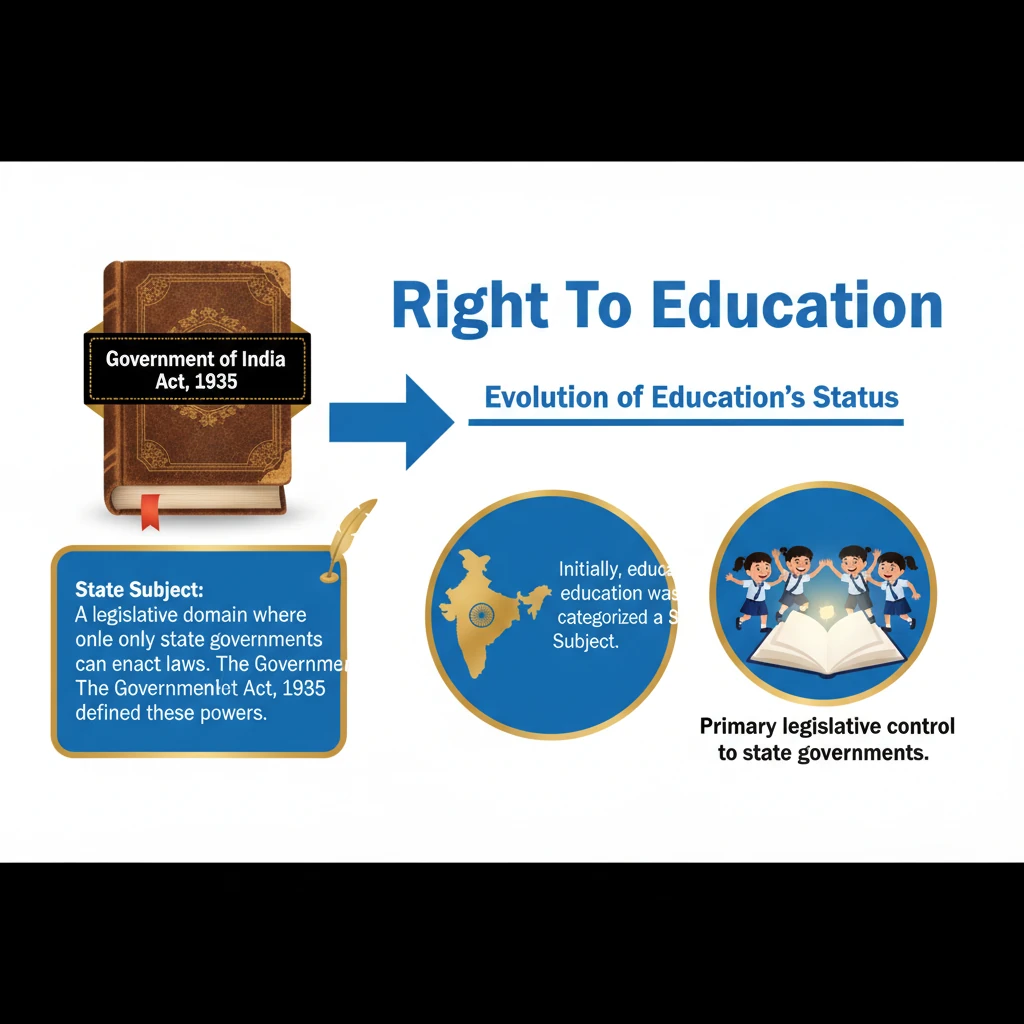
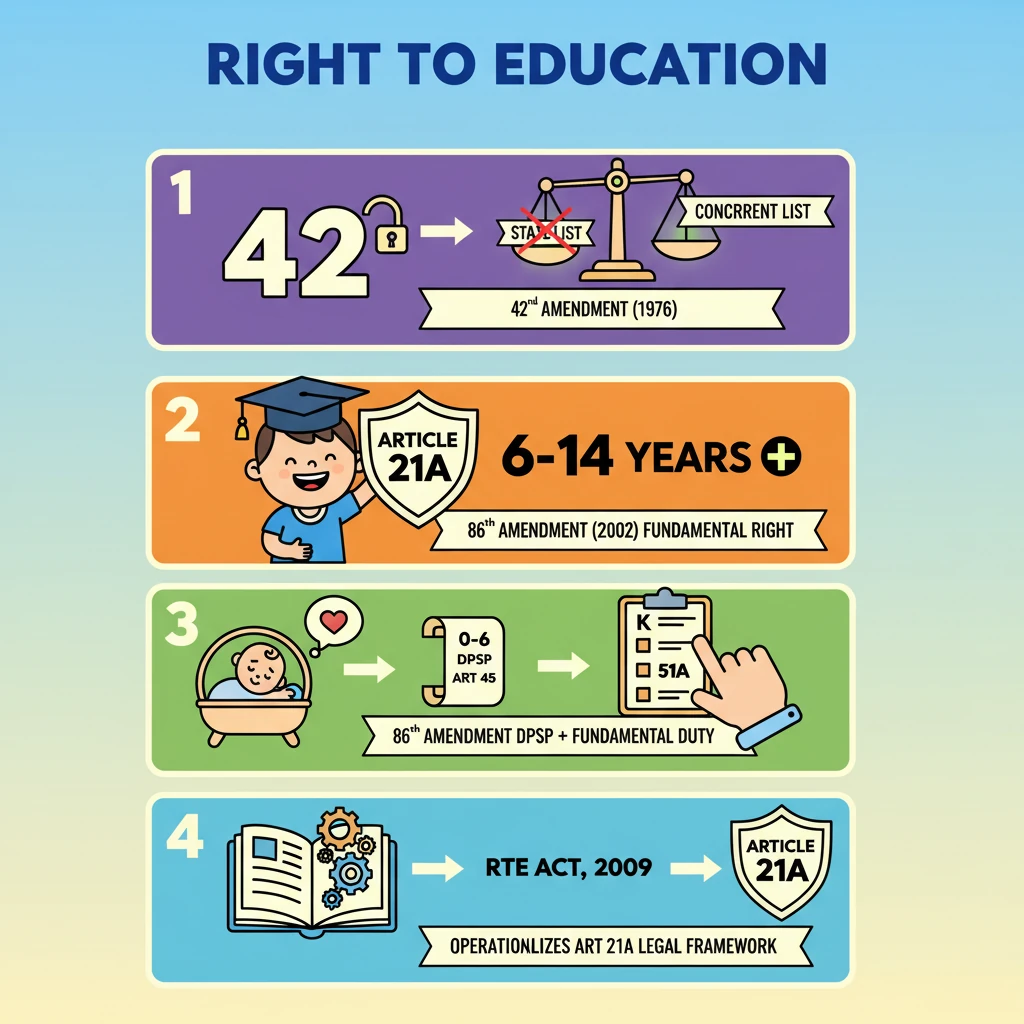
<h4>Evolution of Education's Status</h4><p>Initially, <strong>education</strong> was categorized as a <strong>State Subject</strong> in India. This classification was established under the <strong>Government of India Act, 1935</strong>, granting primary legislative control to state governments.</p><div class='info-box'><p><strong>State Subject:</strong> A legislative domain where only state governments can enact laws. The <strong>Government of India Act, 1935</strong> defined these powers.</p></div><p>A significant change occurred with the <strong>42nd Constitutional Amendment Act of 1976</strong>. This amendment shifted <strong>education</strong> from the <strong>State List</strong> to the <strong>Concurrent List</strong>.</p><div class='key-point-box'><p>The move to the <strong>Concurrent List</strong> implies that both the <strong>Central Government</strong> and <strong>State Governments</strong> now possess the authority to legislate on matters pertaining to <strong>education</strong>.</p></div><h4>The 86th Constitutional Amendment Act, 2002</h4><p>The landmark <strong>Eighty-sixth Constitutional Amendment Act</strong>, enacted in <strong>2002</strong>, introduced profound changes to the status of education in India.</p><p>Crucially, this amendment enshrined the <strong>Right to Education (RTE)</strong> as a <strong>Fundamental Right</strong>. It did so by inserting a new article, <strong>Article 21A</strong>, into <strong>Part III</strong> of the Constitution.</p><div class='info-box'><p><strong>Article 21A:</strong> Mandates that the State shall provide <strong>free and compulsory education</strong> to all children between the ages of <strong>six and fourteen years</strong> in such manner as the State may, by law, determine.</p></div><div class='key-point-box'><p>This made <strong>education</strong> not merely a policy goal, but an enforceable right for a specific age group, emphasizing its importance for national development.</p></div><h4>Impact on Directive Principles of State Policy (DPSP)</h4><p>Concurrently with the introduction of <strong>Article 21A</strong>, the <strong>86th Amendment Act, 2002</strong> also modified <strong>Article 45</strong> under the <strong>Directive Principles of State Policy (DPSP)</strong>.</p><p>The original provision of <strong>Article 45</strong>, which dealt with free and compulsory education for all children until they complete fourteen years, was substituted.</p><div class='info-box'><p><strong>New Article 45:</strong> Now directs the State to endeavor to provide <strong>early childhood care and education</strong> for all children until they complete the age of <strong>six years</strong>.</p></div><div class='exam-tip-box'><p>This modification clearly delineates the State's responsibility: <strong>Fundamental Right</strong> for <strong>6-14 years</strong> and <strong>DPSP</strong> for <strong>0-6 years</strong>, highlighting a comprehensive approach to child development.</p></div><h4>Introduction of a Fundamental Duty</h4><p>To further strengthen the commitment to education, the <strong>86th Amendment Act, 2002</strong> also introduced a new <strong>Fundamental Duty</strong> under <strong>Article 51A</strong> of the Constitution.</p><p>This addition placed a direct responsibility on parents and guardians regarding their children's education.</p><div class='info-box'><p><strong>Article 51A(k):</strong> States that it shall be the duty of every citizen who is a parent or guardian to provide opportunities for education to his child or, as the case may be, ward between the age of <strong>six and fourteen years</strong>.</p></div><div class='key-point-box'><p>This amendment created a holistic framework, addressing education through <strong>Fundamental Rights</strong>, <strong>DPSPs</strong>, and <strong>Fundamental Duties</strong>.</p></div><h4>The Right to Education Act, 2009</h4><p>Following the constitutional mandate of <strong>Article 21A</strong>, the <strong>Parliament</strong> enacted the <strong>Right of Children to Free and Compulsory Education Act, 2009</strong>, commonly known as the <strong>RTE Act, 2009</strong>.</p><p>This act operationalized the provisions of <strong>Article 21A</strong>, providing the legal framework and mechanisms for its implementation across the country.</p><div class='info-box'><p>The <strong>RTE Act, 2009</strong>, details aspects such as norms for schools, pupil-teacher ratios, curriculum, and the prohibition of physical punishment and mental harassment.</p></div><div class='exam-tip-box'><p>Understanding the interplay between the <strong>86th Amendment (2002)</strong> and the <strong>RTE Act (2009)</strong> is crucial for UPSC. The amendment provided the constitutional basis, while the Act provided the statutory framework.</p></div>

💡 Key Takeaways
- •Education moved from State List to Concurrent List by 42nd Amendment (1976).
- •86th Amendment (2002) made education a Fundamental Right (Article 21A) for 6-14 years.
- •86th Amendment also changed DPSP Article 45 (0-6 years) and added Fundamental Duty Article 51A(k).
- •RTE Act, 2009, operationalized Article 21A, providing the legal framework.
- •RTE is crucial for inclusive growth, social justice, and achieving SDG 4.
🧠 Memory Techniques
95% Verified Content
📚 Reference Sources
•The Constitution of India (Articles 21A, 45, 51A)
•The Right of Children to Free and Compulsory Education Act, 2009