Supreme Court Ruling on the SC and ST Act 1989 - Polity And Governance | UPSC Learning
Topics
0 topics • 0 completed
🔍
No topics match your search
Supreme Court Ruling on the SC and ST Act 1989
Medium⏱️ 8 min read
polity and governance
📖 Introduction
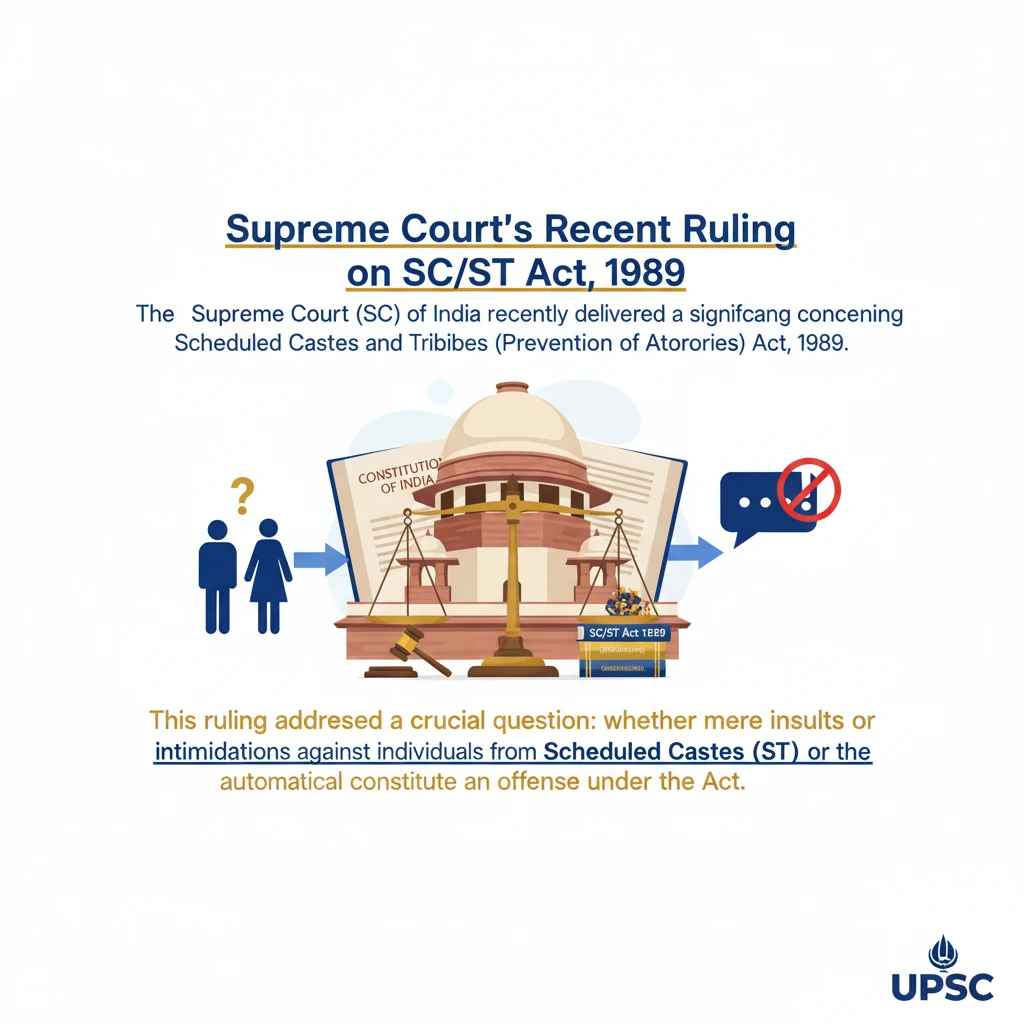
<h4>Supreme Court's Recent Ruling on SC/ST Act, 1989</h4><p>The <strong>Supreme Court (SC) of India</strong> recently delivered a significant ruling concerning the <strong>Scheduled Castes and Scheduled Tribes (Prevention of Atrocities) Act, 1989</strong>.</p><p>This ruling addressed a crucial question: whether mere insults or intimidations against individuals from <strong>Scheduled Castes (SC)</strong> or <strong>Scheduled Tribes (ST)</strong> automatically constitute an offense under the Act.</p><p>The decision was made in the context of granting <strong>anticipatory bail</strong> to a <strong>YouTube channel editor</strong> accused under the Act.</p><div class='info-box'><p><strong>Case Background:</strong> The allegations against the editor involved derogatory remarks made about a <strong>Member of the Legislative Assembly (MLA)</strong> belonging to the <strong>SC community</strong>.</p></div><h4>Scope of the SC/ST Act on Insults and Intimidations</h4><p>The <strong>Supreme Court</strong> clarified that not all insults or intimidations directed at <strong>SC/ST members</strong> automatically qualify as offenses under the <strong>SC/ST (Prevention of Atrocities) Act, 1989</strong>.</p><p>For the Act to be applicable, the insult or intimidation must be explicitly linked to the <strong>caste identity</strong> of the victim.</p><p>Under <strong>Section 3(1)(r)</strong> of the Act, the Court emphasized that the <strong>'intent to humiliate'</strong> must be clearly associated with the victim's caste.</p><div class='key-point-box'><p><strong>Key Interpretation:</strong> Simply knowing the victim's <strong>SC/ST status</strong> is insufficient. The insult must be specifically intended to humiliate based on their <strong>caste identity</strong>.</p></div><h4>Anticipatory Bail under SC/ST Act: A Clarification</h4><p>The Court provided an important clarification regarding <strong>Section 18</strong> of the Act, which traditionally bars <strong>anticipatory bail</strong>.</p><p>It ruled that <strong>Section 18</strong> does not completely prevent the granting of such bail in all circumstances.</p><p>Courts are mandated to conduct a <strong>preliminary inquiry</strong> to ascertain if the allegations genuinely meet the criteria for an offense under the Act before applying <strong>Section 18</strong>.</p><div class='exam-tip-box'><p>This ruling highlights the judiciary's role in preventing potential misuse of stringent laws while upholding their protective intent. It's crucial for understanding the balance between <strong>victim protection</strong> and <strong>accused rights</strong> for <strong>UPSC Mains Paper 2</strong>.</p></div><p>In the specific case, the <strong>Supreme Court</strong> granted <strong>anticipatory bail</strong> to the editor, concluding that there was no <em>prima facie</em> evidence of intent to humiliate the MLA due to his <strong>caste identity</strong>.</p><h4>About the Scheduled Castes and Scheduled Tribes (Prevention of Atrocities) Act, 1989</h4><p>The <strong>SC/ST (Prevention of Atrocities) Act, 1989</strong>, commonly known as the <strong>SC/ST Act</strong>, was enacted to protect members of <strong>Scheduled Castes</strong> and <strong>Scheduled Tribes</strong> from <strong>caste-based discrimination and violence</strong>.</p><p>Its foundation lies in <strong>Articles 15</strong> and <strong>17</strong> of the <strong>Indian Constitution</strong>, aiming to ensure the protection of these marginalized communities.</p><div class='info-box'><p><strong>Purpose:</strong> To address the inadequacies of previous laws and provide a stronger legal framework against atrocities.</p></div><h4>Historical Context and Evolution of the Act</h4><p>The <strong>SC/ST Act, 1989</strong>, builds upon earlier legislative efforts to combat caste discrimination.</p><ol><li>The <strong>Untouchability (Offences) Act, 1955</strong>, was the first major step to abolish untouchability.</li><li>This was later renamed and strengthened as the <strong>Protection of Civil Rights Act, 1955</strong>.</li><li>The <strong>SC/ST Act, 1989</strong>, further expanded the scope of protection by defining specific "atrocities" and prescribing stringent penalties.</li></ol><h4>Implementation and Administration of the Act</h4><p>The <strong>Central Government</strong> holds the authority to frame rules for the Act's effective implementation.</p><p><strong>State Governments</strong> and <strong>Union Territories</strong> are responsible for administering the Act, often with financial and logistical assistance from the central government.</p><h4>Key Provisions of the SC/ST Act, 1989</h4><p>The Act outlines specific offenses considered "atrocities" against <strong>SC/ST members</strong>.</p><ul><li><strong>Definition of Offenses:</strong> Includes physical violence, harassment, and various forms of social discrimination.</li><li><strong>Stringent Penalties:</strong> Prescribes higher penalties for perpetrators compared to those under the <strong>Indian Penal Code (IPC)</strong>.</li><li><strong>Exclusion of Anticipatory Bail (Section 18):</strong> Traditionally bars the application of <strong>Section 438 of the Code of Criminal Procedure</strong> for anticipatory bail, though recent SC rulings have clarified this.</li><li><strong>Special Courts:</strong> Mandates the establishment of special courts for speedy trials.</li><li><strong>SC/ST Protection Cells:</strong> Requires state-level cells led by senior police officers to oversee implementation.</li><li><strong>Investigation Protocol:</strong> Investigations must be conducted by officers not below the rank of <strong>Deputy Superintendent of Police (DSP)</strong> and completed within a stipulated timeframe.</li><li><strong>Victim Relief and Rehabilitation:</strong> Provides for financial compensation, legal aid, and support services for victims.</li></ul><div class='info-box'><p><strong>Exclusions:</strong> The Act does not cover offenses committed between members of <strong>SCs</strong> and <strong>STs</strong>; neither community can invoke the Act against the other.</p></div><h4>Recent Amendments: The Scheduled Castes and Scheduled Tribes (Prevention of Atrocities) Amendment Act, 2018</h4><p>The <strong>2018 Amendment Act</strong> significantly strengthened the protections offered to <strong>SCs</strong> and <strong>STs</strong> by introducing more stringent provisions and broadening the Act's scope.</p><p><strong>New Categories of Offenses:</strong></p><ul><li><strong>Garlanding with footwear</strong>, forcing <strong>manual scavenging</strong>.</li><li>Imposing <strong>social or economic boycotts</strong> and any form of <strong>social ostracism</strong>.</li><li><strong>Sexual exploitation</strong> and intentional touching of <strong>SC/ST women</strong> without consent.</li><li>Explicitly outlawing practices like dedicating <strong>SC/ST women as devadasis</strong>.</li></ul><p><strong>Accountability of Public Servants:</strong> Public servants who neglect their duties related to <strong>SC/ST protection</strong> now face imprisonment.</p><p><strong>Arrest Procedures:</strong> The amendment removed the requirement for <strong>Senior Superintendent of Police (SSP) approval</strong> before arresting an accused, permitting <strong>immediate arrests</strong> without prior approval.</p><div class='key-point-box'><p>The <strong>2018 Amendment</strong> aimed to restore the original spirit of the Act, which had been diluted by earlier judicial interpretations regarding immediate arrests and anticipatory bail.</p></div>
💡 Key Takeaways
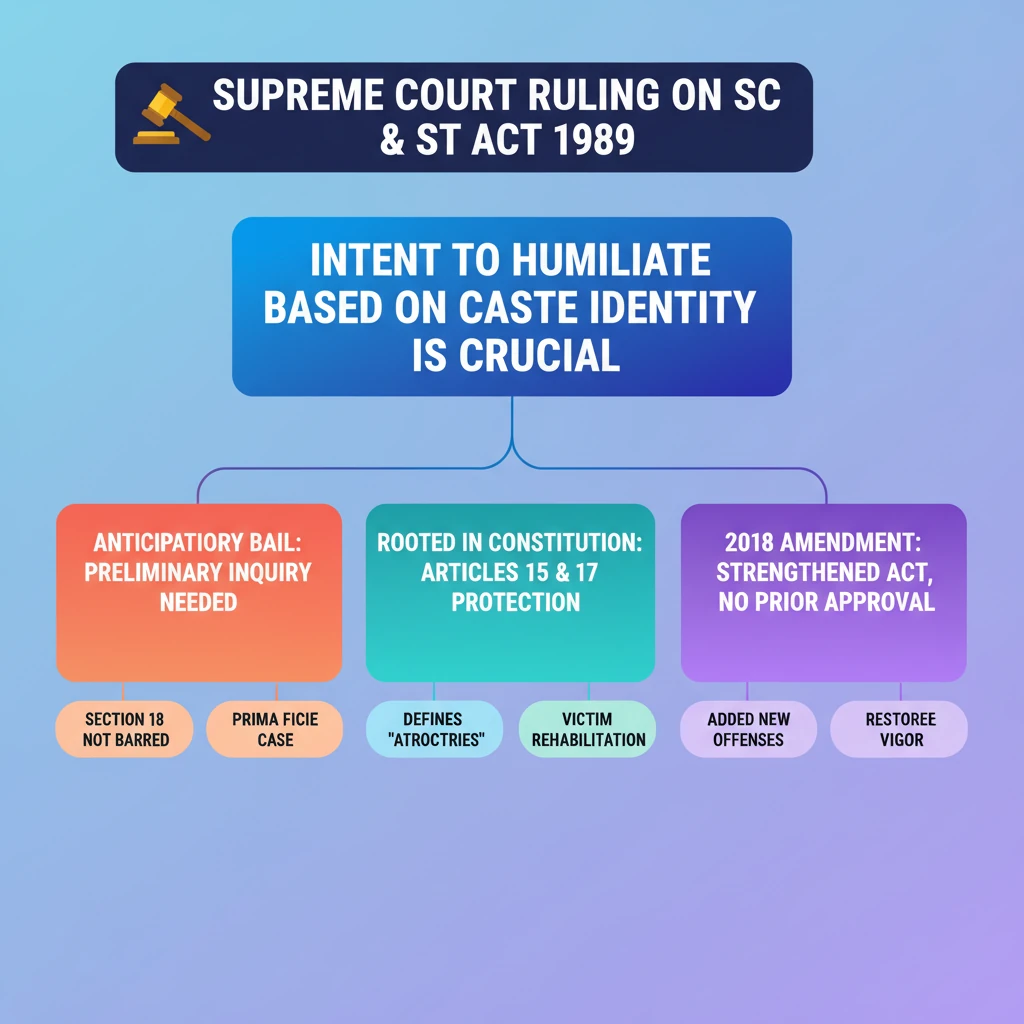
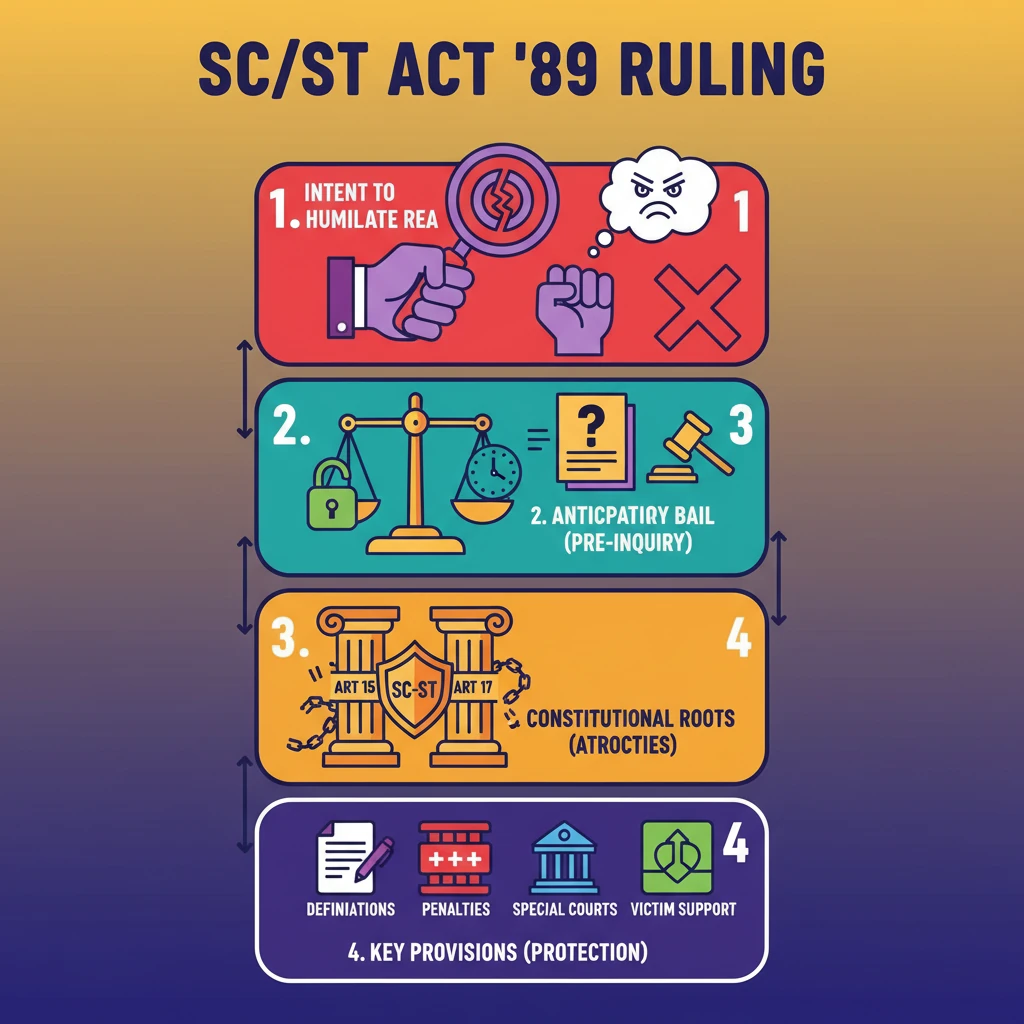
- •SC ruled that insults/intimidation against SC/ST members require 'intent to humiliate based on caste identity' to be an offense under the SC/ST Act, 1989.
- •Anticipatory bail is not completely barred by Section 18; preliminary inquiry is needed to establish prima facie case.
- •The SC/ST Act, 1989, protects SCs/STs from caste-based atrocities, rooted in Articles 15 & 17 of the Constitution.
- •Key provisions include defining 'atrocities,' stringent penalties, special courts, and victim rehabilitation.
- •The 2018 Amendment strengthened the Act by adding new offenses and removing prior approval for arrests, restoring its original rigor.
🧠 Memory Techniques
95% Verified Content