Nazol Land: Definition, Usage, and Recent Haldwani Demolition Drive - Polity And Governance | UPSC Learning
Topics
0 topics • 0 completed
🔍
No topics match your search
Nazol Land: Definition, Usage, and Recent Haldwani Demolition Drive
Medium⏱️ 7 min read
polity and governance
📖 Introduction
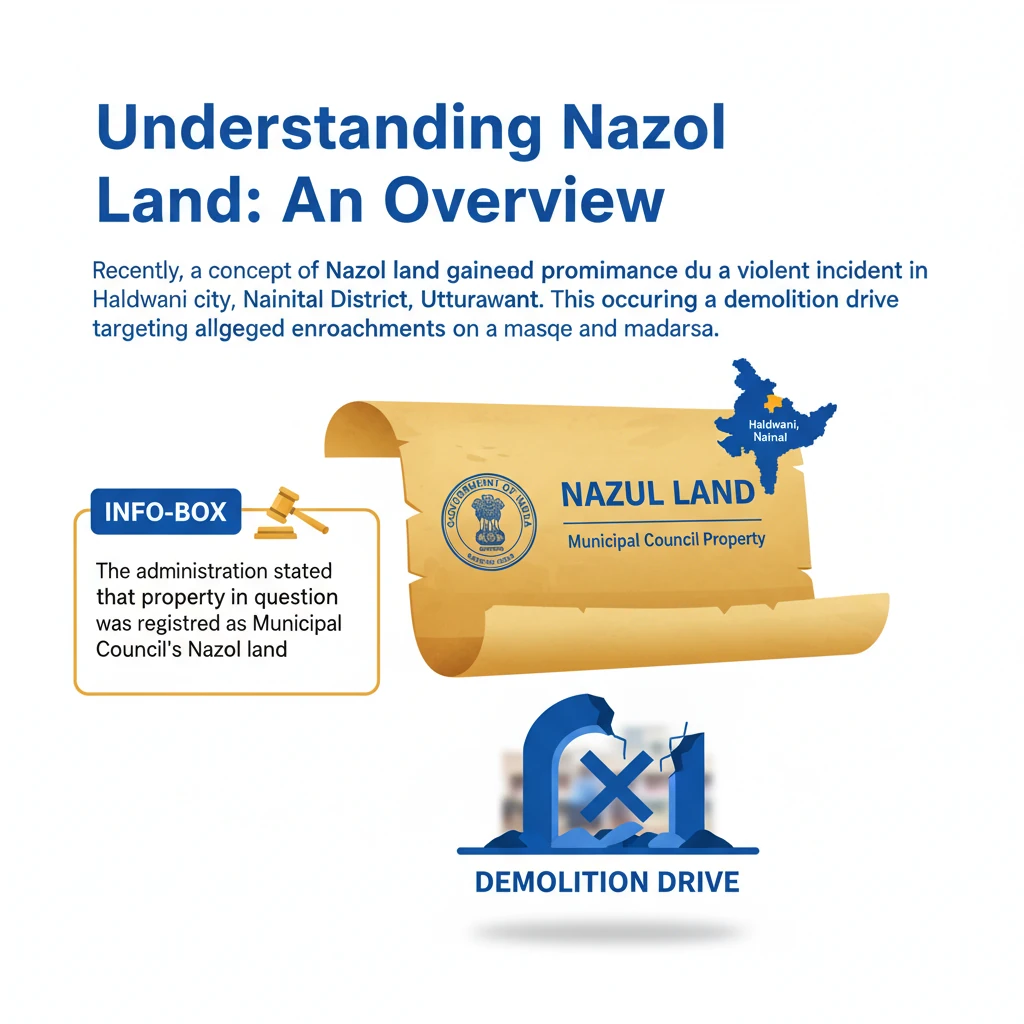
<h4>Understanding Nazol Land: An Overview</h4><p>Recently, the concept of <strong>Nazol land</strong> gained prominence due to a violent incident in <strong>Haldwani city</strong>, <strong>Nainital District</strong>, <strong>Uttarakhand</strong>. This occurred during a <strong>demolition drive</strong> targeting alleged encroachments on a mosque and madrasa.</p><div class='info-box'><p>The administration stated that the property in question was registered as <strong>Municipal Council's Nazol land</strong>, leading to the enforcement action.</p></div><h4>What is Nazol Land?</h4><p><strong>Nazol land</strong> refers to land that is officially owned by the <strong>government</strong>. However, it is typically not directly administered as general state property.</p><div class='key-point-box'><p>Instead, the state usually allots such land to various entities on a <strong>lease basis</strong>. These leases are granted for a fixed period, commonly ranging between <strong>15 and 99 years</strong>.</p></div><h4>Emergence of Nazol Land in India</h4><p>The origin of <strong>Nazol land</strong> dates back to the <strong>British colonial rule</strong> in India. During this period, numerous <strong>kings and kingdoms</strong> frequently revolted against British authority.</p><p>Upon defeating these rulers in battles, the British often confiscated their territories and lands. These lands then came under British control.</p><div class='info-box'><p>After <strong>India gained Independence</strong> in <strong>1947</strong>, the British vacated these acquired lands. Many former kings and royals, however, lacked proper documentation to establish their prior ownership.</p></div><p>Consequently, these lands were officially designated as <strong>Nazol land</strong>, signifying ownership by the respective <strong>state governments</strong>.</p><h4>Purpose and Utilisation of Nazol Land</h4><p>The government primarily uses <strong>Nazol land</strong> for various <strong>public purposes</strong>. This includes the development of essential infrastructure and community facilities.</p><ul><li>Construction of <strong>schools</strong> and <strong>hospitals</strong>.</li><li>Building <strong>Gram Panchayat offices</strong> and other administrative structures.</li></ul><p>Beyond public utilities, large tracts of <strong>Nazol land</strong> have also been allocated for <strong>housing societies</strong> in several Indian cities, typically under long-term leases.</p><h4>Legal Framework and Lease Management</h4><p>While many states have formulated their own <strong>government orders</strong> and rules for managing <strong>Nazol land</strong>, the primary legal instrument for its adjudication is the <strong>Nazol Land (Transfer) Rules, 1956</strong>.</p><div class='exam-tip-box'><p>Understanding the <strong>Nazol Land (Transfer) Rules, 1956</strong> is crucial for questions related to land administration and historical land tenure systems in UPSC exams (<strong>GS Paper II, III</strong>).</p></div><p>When a <strong>lease term expires</strong>, the lessee can submit a written application to the <strong>Revenue Department</strong> of the local development authority to request a renewal.</p><p>The government retains the discretion to either <strong>renew the lease</strong> or <strong>cancel it</strong>, thereby repossessing the <strong>Nazol land</strong>.</p><p>Across almost all major cities in India, <strong>Nazol land</strong> has been extensively allotted for a diverse range of purposes, reflecting its significant role in urban and rural development.</p>
💡 Key Takeaways
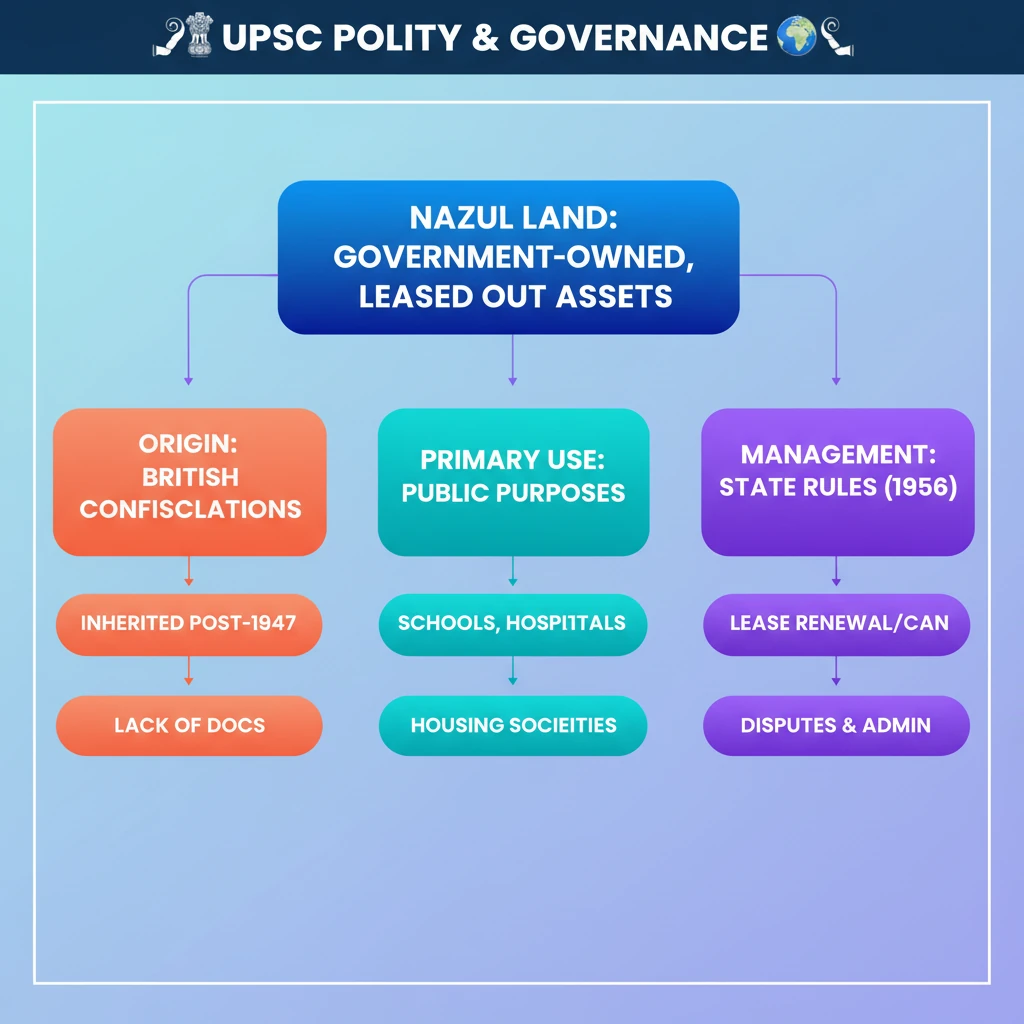
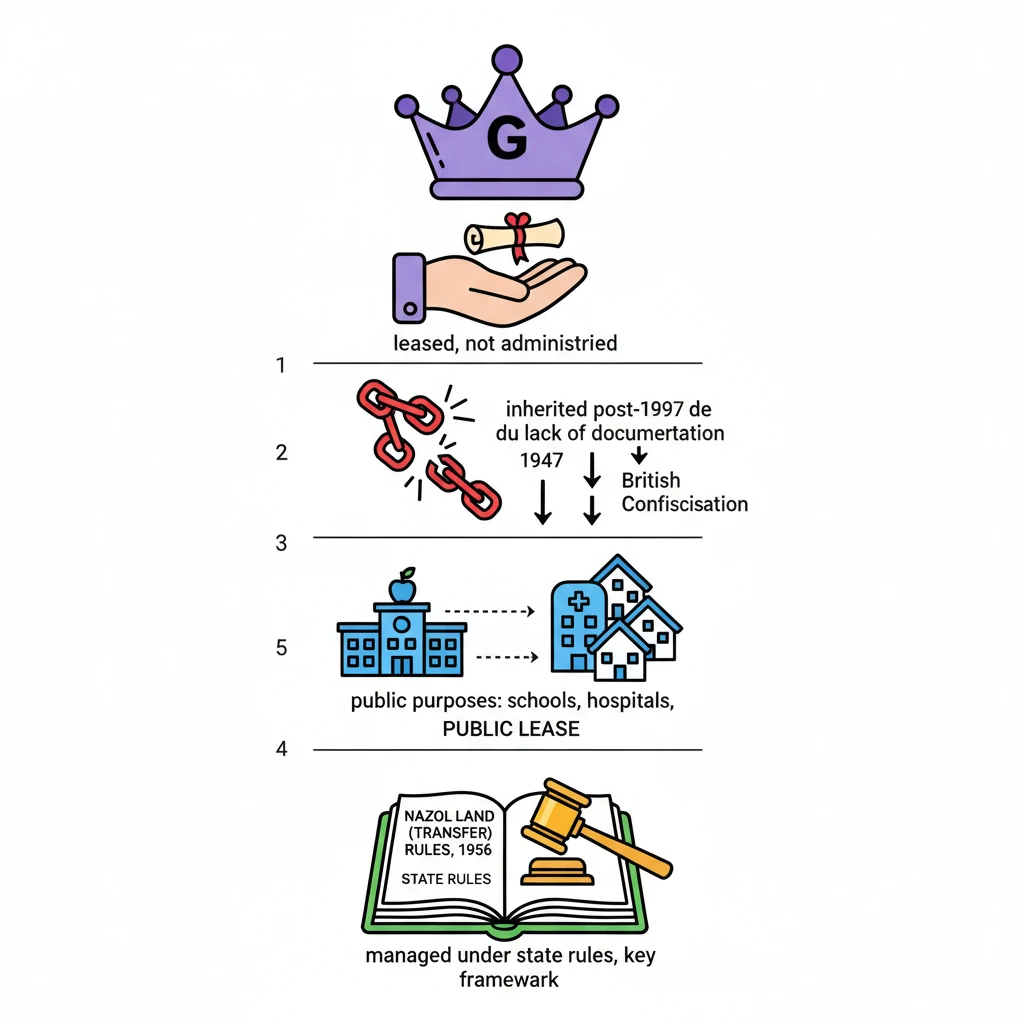
- •Nazol land is government-owned but typically leased out, not directly administered.
- •It originated from lands confiscated by the British, inherited by states post-1947 due to lack of prior documentation.
- •Primarily used for public purposes like schools, hospitals, and housing societies on lease.
- •Managed under state rules, with the Nazol Land (Transfer) Rules, 1956, being a key framework.
- •Leases can be renewed or cancelled by the government, often leading to disputes and administrative challenges.
🧠 Memory Techniques
95% Verified Content
📚 Reference Sources
•General knowledge of Indian land laws and history