Anna Chakra and SCAN for Reforming PDS System - Polity And Governance | UPSC Learning
Topics
0 topics • 0 completed
🔍
No topics match your search
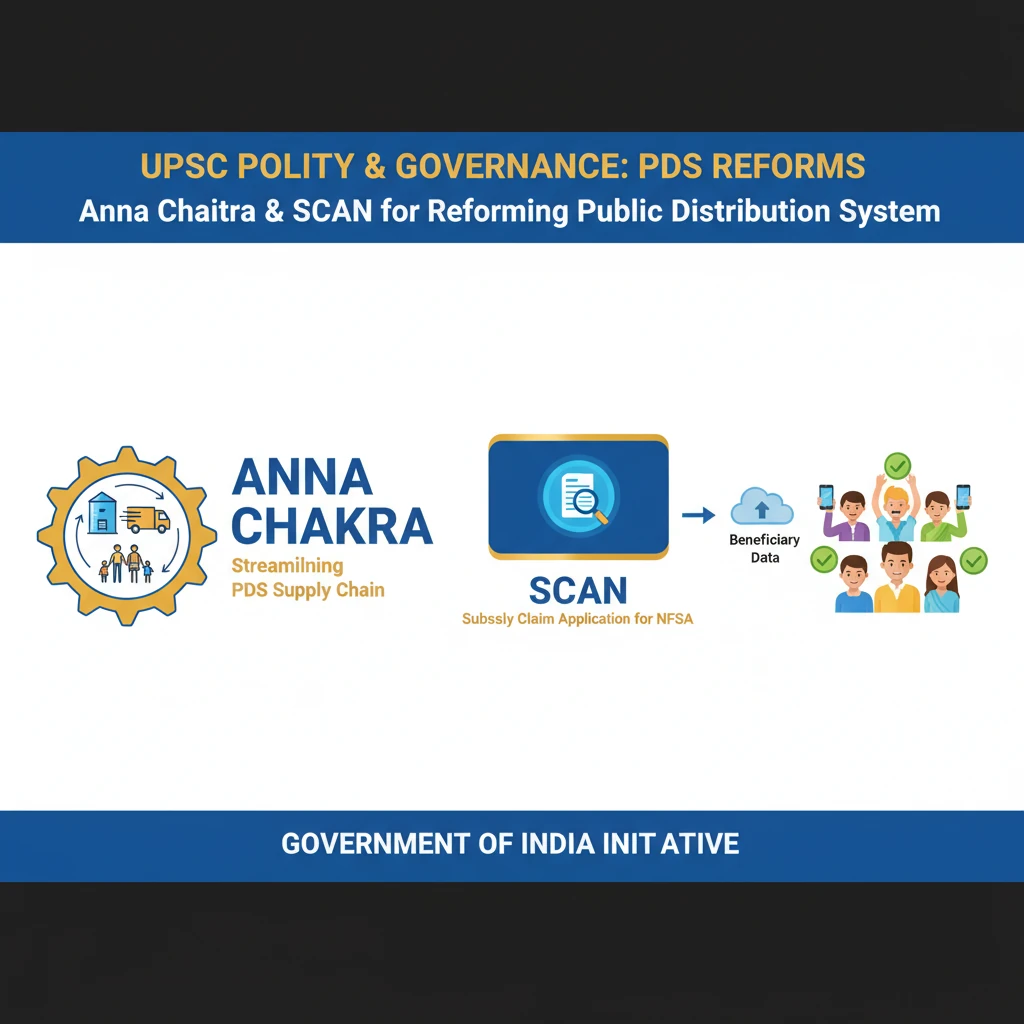
Anna Chakra and SCAN for Reforming PDS System
Medium⏱️ 8 min read
polity and governance
📖 Introduction
<h4>Introduction to PDS Reforms</h4><p>The government, through an entity referred to as <strong>Energy</strong> in the source material, has launched significant initiatives: <strong>Anna Chakra</strong> and the <strong>SCAN (Subsidy Claim Application for NFSA) portal</strong>. These initiatives aim to modernize India’s <strong>Public Distribution System (PDS)</strong>.</p><p>The primary goal is to enhance the <strong>efficiency</strong> of the PDS supply chain. It also seeks to streamline the <strong>subsidy claim process</strong>, ultimately benefiting millions of citizens who rely on these vital food security programs.</p><div class='key-point-box'><p><strong>Key Objective:</strong> Modernize <strong>PDS</strong> by improving <strong>supply chain efficiency</strong> and streamlining <strong>subsidy claims</strong>.</p></div><h4>About Anna Chakra</h4><p><strong>Anna Chakra</strong> is a groundbreaking tool designed to optimize the <strong>supply chain</strong> of the <strong>PDS</strong> across India. It represents a significant step towards leveraging technology for better food distribution.</p><div class='info-box'><p><strong>Development Collaboration:</strong> <strong>Anna Chakra</strong> was developed in collaboration with the <strong>World Food Programme (WFP)</strong> and the <strong>Foundation for Innovation and Technology Transfer (FITT)</strong> at <strong>IIT-Delhi</strong>.</p></div><p>This initiative utilizes <strong>advanced algorithms</strong>. These algorithms are crucial for identifying the most <strong>optimal routes</strong> for the transportation of <strong>food grains</strong>, reducing wastage and improving delivery times.</p><h4>About SCAN System</h4><p>The <strong>SCAN portal</strong> is specifically designed to streamline the <strong>subsidy claim process</strong> for states. This process operates under the framework of the <strong>National Food Security Act (NFSA) 2013</strong>.</p><p>It plays a vital role in modernizing <strong>PDS operations</strong>, leading to better utilization of funds. This aligns with broader government technology initiatives aimed at reducing <strong>leakages</strong> in the system.</p><div class='exam-tip-box'><p>The <strong>SCAN system</strong> enhances <strong>food security</strong> for an estimated <strong>80 crore people</strong>. It also offers significant <strong>environmental and economic benefits</strong> by making the subsidy process more transparent and efficient.</p></div><h4>What is PDS?</h4><p>The <strong>Public Distribution System (PDS)</strong> is a cornerstone of India's food security architecture. It was established to combat <strong>food scarcity</strong> and ensure access to essential foodgrains.</p><div class='info-box'><p><strong>Core Function:</strong> The <strong>PDS</strong> provides <strong>foodgrains</strong> at <strong>affordable prices</strong> to eligible beneficiaries across the country.</p></div><p>It operates primarily under the provisions of the <strong>National Food Security Act (NFSA) 2013</strong>. This act ensures food security for nearly <strong>two-thirds of India’s population</strong>, based on <strong>Census 2011 data</strong>.</p><div class='info-box'><p><strong>Nodal Ministry:</strong> The <strong>Ministry of Consumer Affairs, Food, and Public Distribution</strong> is the nodal ministry responsible for the <strong>PDS</strong>.</p></div><h4>Evolution of PDS</h4><p>The <strong>Public Distribution System (PDS)</strong> in India has a rich history, originating during <strong>World War II</strong> as a wartime rationing measure. It has undergone several transformative phases.</p><ol><li><strong>1960s Expansion:</strong> PDS expanded significantly in the <strong>1960s</strong> due to widespread food shortages. This period saw the establishment of the <strong>Agriculture Prices Commission</strong> and the <strong>Food Corporation of India (FCI)</strong> to ensure domestic procurement and storage.</li><li><strong>1970s Universalization:</strong> By the <strong>1970s</strong>, PDS transitioned into a <strong>universal scheme</strong>, aiming to cover all citizens.</li><li><strong>1992 RPDS:</strong> In <strong>1992</strong>, the <strong>Revamped Public Distribution System (RPDS)</strong> was launched. Its objective was to strengthen and expand the PDS reach, particularly in <strong>remote, hilly, and inaccessible areas</strong>.</li><li><strong>1997 TPDS:</strong> The <strong>Targeted Public Distribution System (TPDS)</strong> was introduced in <strong>1997</strong>. This marked a shift towards focusing on the poor by categorizing beneficiaries into <strong>Below Poverty Line (BPL)</strong> and <strong>Above Poverty Line (APL)</strong> households.</li><li><strong>2000 AAY:</strong> The <strong>Antyodaya Anna Yojana (AAY)</strong>, launched in <strong>2000</strong>, further refined targeting. It specifically aimed to provide highly subsidized foodgrains to the <strong>poorest among the poor families</strong>.</li></ol><h4>Management of PDS</h4><p>The management of the <strong>PDS</strong> is a joint responsibility, shared between the <strong>Central Government</strong> and the <strong>State/Union Territory (UT) Governments</strong>. Each level has distinct, crucial responsibilities.</p><div class='info-box'><p><strong>Central Government's Role (via FCI):</strong> Handles <strong>procurement</strong>, <strong>storage</strong>, <strong>transportation</strong>, and <strong>bulk allocation</strong> of foodgrains.</p></div><p><strong>State Governments</strong> are responsible for the local administration and implementation of the system. This includes identifying eligible households and issuing ration cards.</p><div class='info-box'><p><strong>State Government's Role:</strong> Manages <strong>local distribution</strong>, identifies <strong>eligible households</strong>, issues <strong>ration cards</strong>, and supervises <strong>Fair Price Shops (FPSs)</strong>.</p></div><h4>Commodities Distributed</h4><p>The <strong>PDS</strong> primarily distributes a range of essential commodities to ensure food security. These staples form the core of the food basket provided.</p><ul><li><strong>Primary Commodities:</strong> <strong>Wheat</strong>, <strong>rice</strong>, <strong>sugar</strong>, and <strong>kerosene</strong> are the main items distributed through PDS.</li><li><strong>Additional Commodities:</strong> Some states also distribute supplementary items. These can include <strong>pulses</strong>, <strong>edible oils</strong>, and <strong>salt</strong>, depending on local needs and state policies.</li></ul>
💡 Key Takeaways
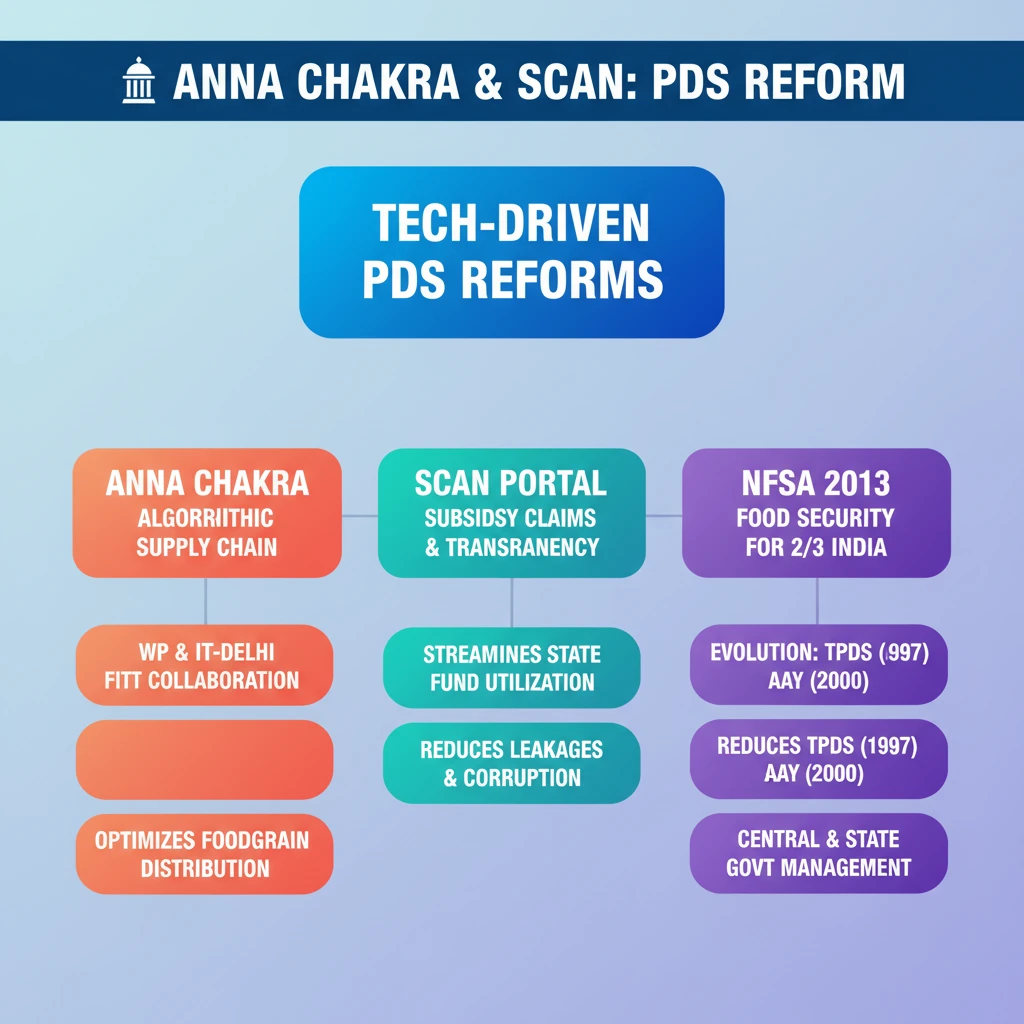
- •Anna Chakra and SCAN are tech-driven reforms for India's PDS.
- •Anna Chakra optimizes foodgrain supply chain using algorithms, developed with WFP and IIT-Delhi FITT.
- •SCAN portal streamlines state subsidy claims under NFSA 2013, enhancing fund utilization and reducing leakages.
- •PDS, under NFSA 2013, ensures food security for two-thirds of India, managed by Central and State Govts.
- •PDS evolved from WWII rationing to Targeted PDS (1997) and Antyodaya Anna Yojana (2000), now focused on efficiency and transparency.
🧠 Memory Techniques

95% Verified Content
📚 Reference Sources
•National Food Security Act (NFSA) 2013
•Ministry of Consumer Affairs, Food, and Public Distribution official documents (implied)