Supreme Court Unveils New Justice Statue - Polity And Governance | UPSC Learning
Topics
0 topics • 0 completed
🔍
No topics match your search
Supreme Court Unveils New Justice Statue
Medium⏱️ 5 min read
polity and governance
📖 Introduction
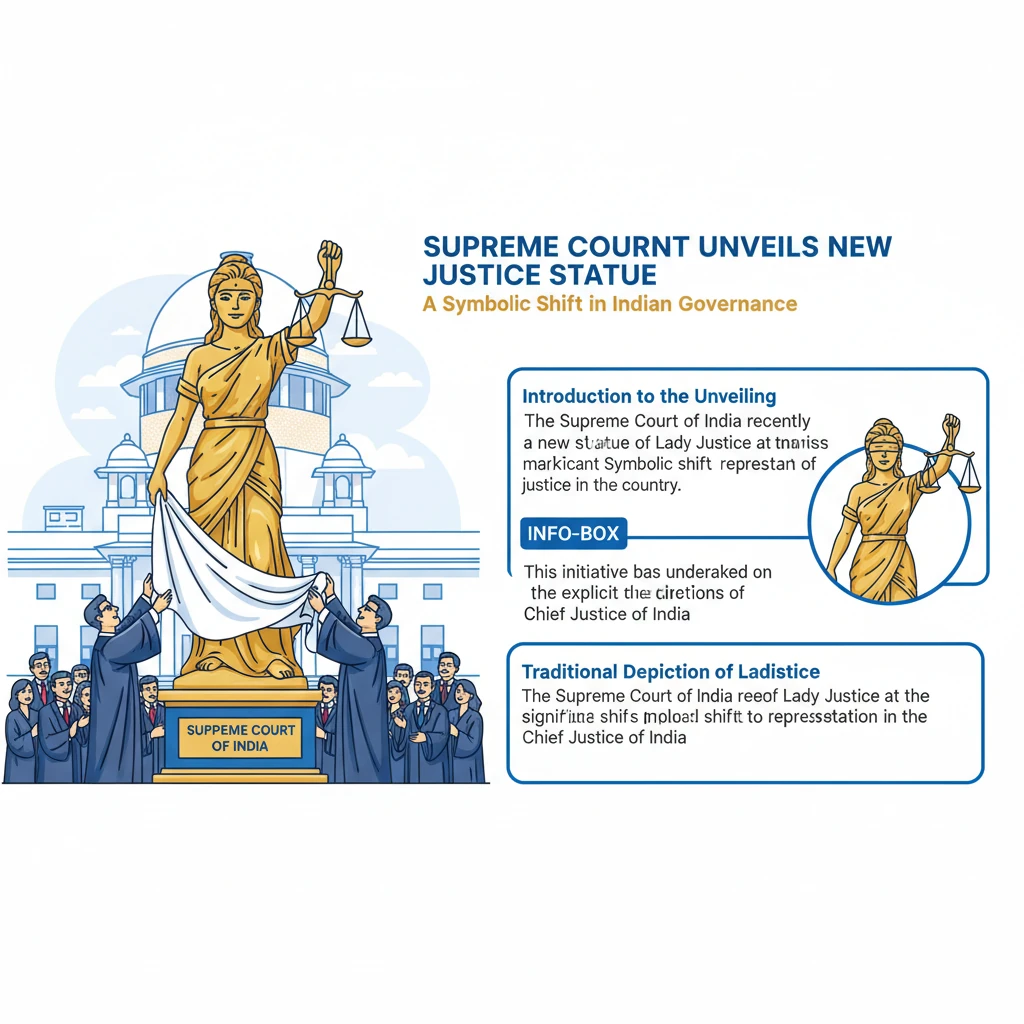
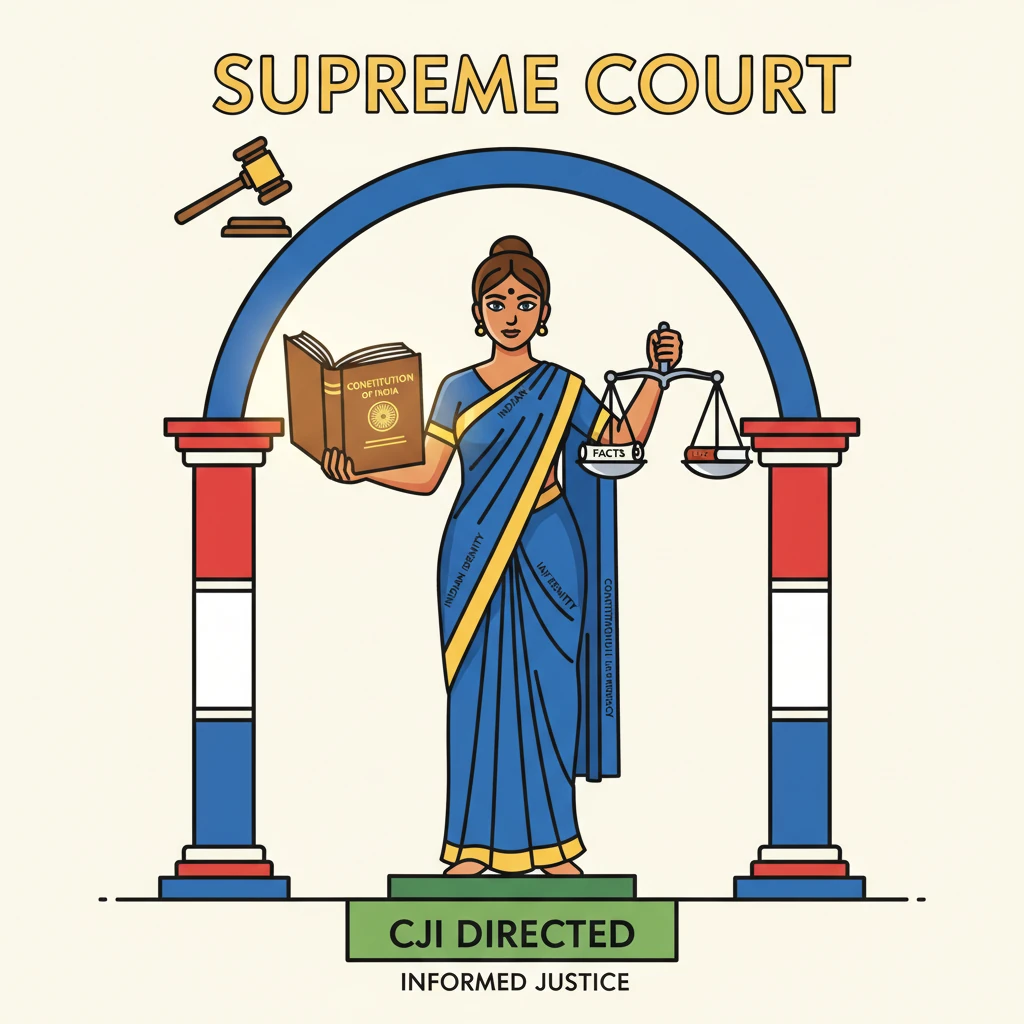
<h4>Introduction to the Unveiling</h4><p>The <strong>Supreme Court of India</strong> recently unveiled a new statue of <strong>Lady Justice</strong> at its premises, marking a significant symbolic shift in the representation of justice in the country.</p><div class="info-box"><p>This initiative was undertaken on the explicit <strong>directions of the Chief Justice of India</strong>, highlighting its institutional importance.</p></div><h4>Traditional Depiction of Lady Justice</h4><p><strong>Lady Justice</strong> is an internationally recognized <strong>allegorical figure</strong> representing the <strong>moral authority</strong> within judicial systems.</p><p>She is often depicted alongside <strong>Prudentia</strong>, another allegorical figure embodying <strong>wisdom</strong> and <strong>prudence</strong>, signifying the thoughtful application of law.</p><ul><li><strong>Blindfold:</strong> Traditionally, the blindfold symbolized <strong>equality before the law</strong>, ensuring justice is delivered impartially, irrespective of wealth, power, or status.</li><li><strong>Sword:</strong> Historically, the sword represented the <strong>authority of the law</strong> and its inherent power to punish wrongdoing and enforce decisions.</li></ul><h4>Key Changes in the New Statue</h4><p>The newly unveiled statue at the <strong>Supreme Court</strong> introduces several profound departures from the conventional portrayal of Lady Justice.</p><ul><li><strong>Absence of Blindfold:</strong> This significant change signifies that <strong>law in India is informed</strong>. It implies that justice should consider context and not be applied blindly, emphasizing a nuanced understanding.</li><li><strong>Constitution in Place of Sword:</strong> Instead of a sword, the statue holds the <strong>Constitution of India</strong>. This symbolizes that justice is guided by the nation's foundational legal document and is <strong>not driven by retribution</strong> alone.</li><li><strong>Dressed in a Saree:</strong> The statue is draped in a <strong>saree</strong>, reflecting a conscious departure from colonial influences and embracing an indigenous cultural identity.</li></ul><h4>Retained Symbolism: The Scales of Justice</h4><p>Despite the notable modifications, one crucial element of the traditional depiction has been retained: the <strong>scales of justice</strong>.</p><div class="key-point-box"><p>The scales, held in <strong>Lady Justice's right hand</strong>, continue to represent <strong>societal balance</strong> and the critical importance of carefully weighing all facts and arguments from opposing sides before reaching a verdict.</p></div><h4>Symbolic Significance and Decolonization</h4><p>The changes in the statue are deeply symbolic of a broader national effort to decolonize India's legal and institutional framework.</p><div class="exam-tip-box"><p>This move parallels the recent replacement of <strong>colonial-era laws</strong> such as the <strong>Indian Penal Code (IPC)</strong> and the <strong>Code of Criminal Procedure (CrPC)</strong> with new, indigenously named criminal laws. It highlights a shift towards a legal identity rooted in Indian values. <strong>(UPSC GS Paper II: Polity & Governance)</strong></p></div>
💡 Key Takeaways
- •Supreme Court unveiled a new Lady Justice statue, directed by the CJI.
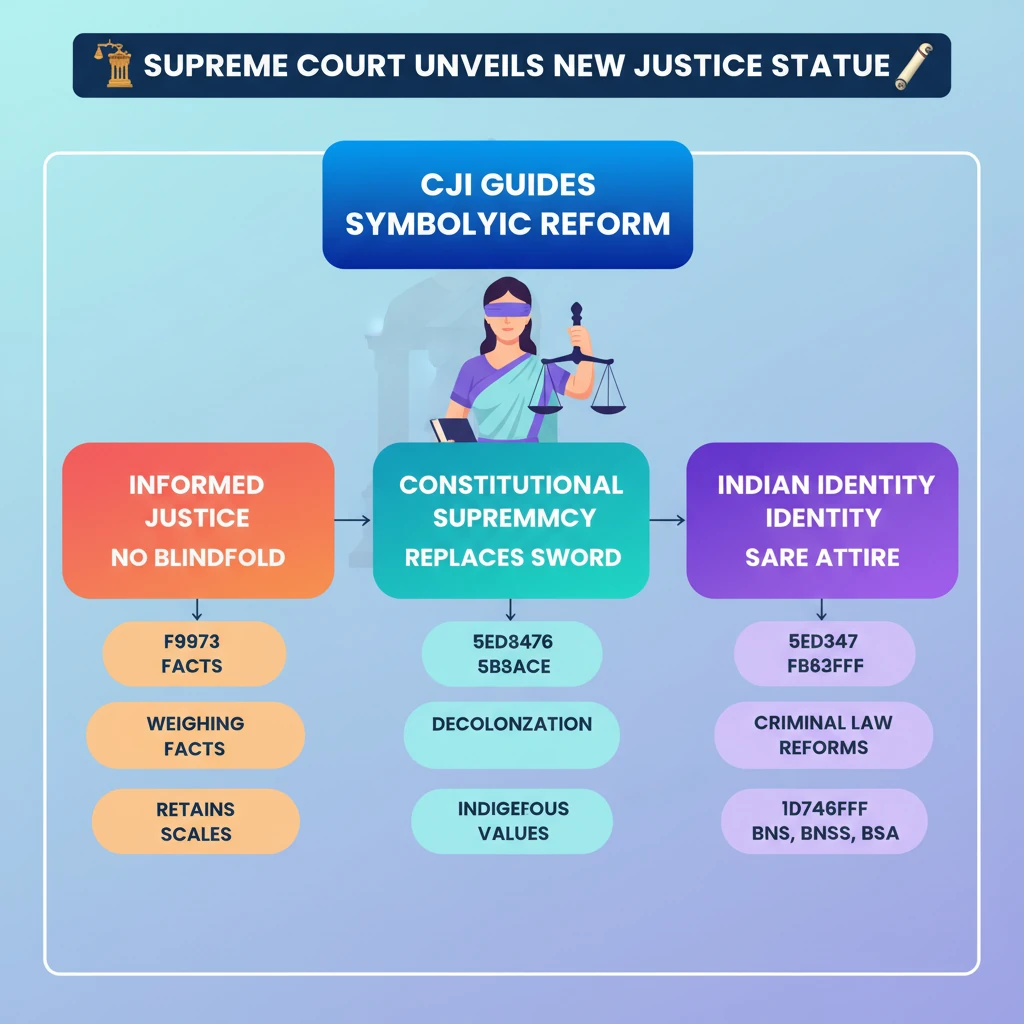
- •Key changes: No blindfold (informed justice), Constitution replaces sword (constitutional supremacy), saree attire (Indian identity).
- •Scales of justice retained, symbolizing balance and weighing facts.
- •The changes reflect a move away from colonial influences towards indigenous, constitutional values.
- •This symbolic reform aligns with broader legislative changes like the new criminal laws (BNS, BNSS, BSA).
🧠 Memory Techniques
95% Verified Content
📚 Reference Sources
•Reports from leading Indian news agencies on the unveiling (e.g., PTI, The Hindu, Indian Express)
•Official notifications/press releases from the Ministry of Law and Justice regarding new criminal laws (BNS, BNSS, BSA)