Role of the Speaker - Polity And Governance | UPSC Learning
Topics
0 topics • 0 completed
🔍
No topics match your search
Role of the Speaker
Medium⏱️ 7 min read
polity and governance
📖 Introduction
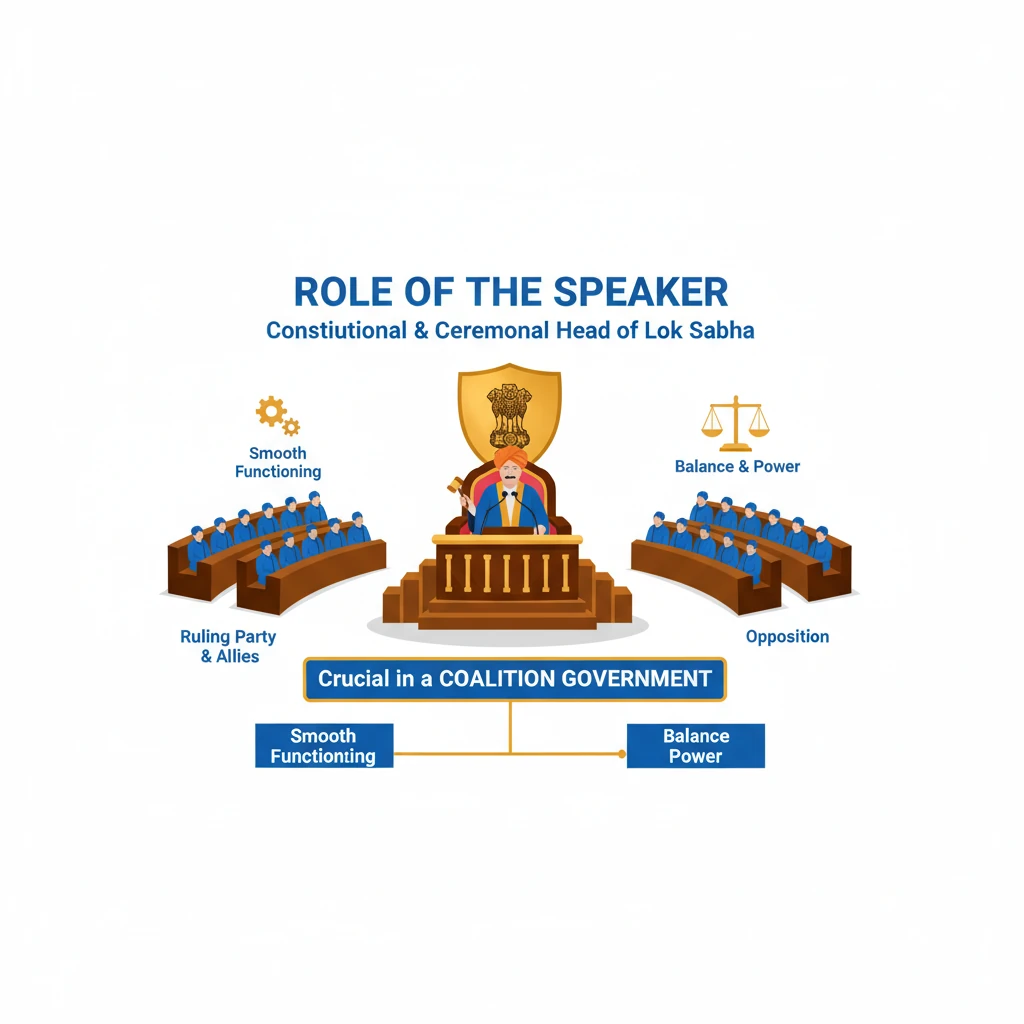
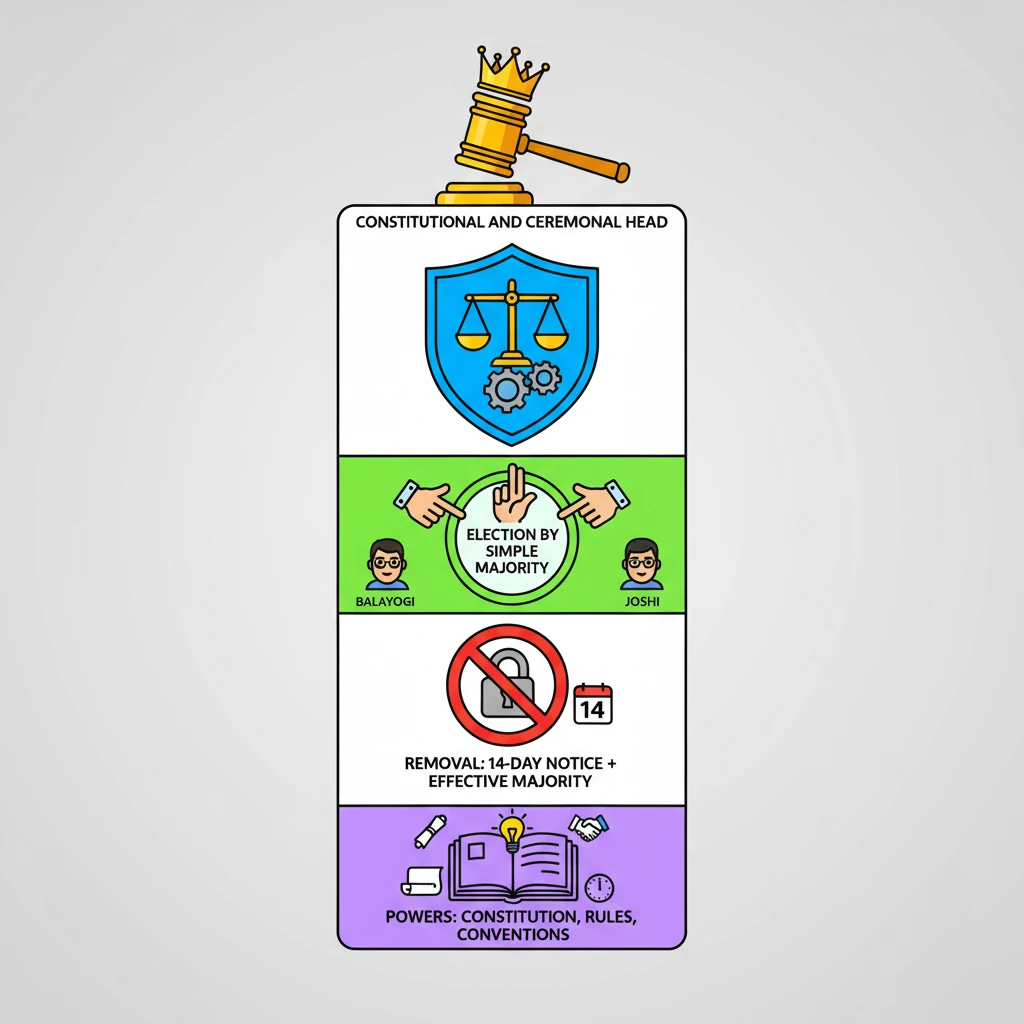
<h4>Introduction to the Speaker's Role</h4><p>The <strong>Speaker</strong> is the <strong>constitutional and ceremonial head</strong> of the <strong>Lok Sabha</strong>, the Lower House of the Indian Parliament. This role becomes particularly crucial in a <strong>coalition government</strong> scenario.</p><p>The Speaker ensures the <strong>smooth functioning</strong> of the House and helps maintain the <strong>balance of power</strong> between the ruling party, its allies, and the opposition.</p><div class='info-box'><p>Each House of Parliament has its own presiding officer:</p><ul><li><strong>Lok Sabha</strong>: Speaker and Deputy Speaker</li><li><strong>Rajya Sabha</strong>: Chairman (Vice-President of India) and Deputy Chairman</li></ul></div><h4>Assistance and Succession</h4><p>The Speaker is assisted by the <strong>Secretary General of the Lok Sabha</strong> and senior officers of the Secretariat in parliamentary activities, practice, and procedure.</p><p>In the absence of the Speaker, the <strong>Deputy Speaker</strong> discharges the functions. If both are absent, a member from the <strong>panel of Chairmen</strong> presides over the House.</p><div class='key-point-box'><p>A member from the panel of Chairmen <strong>cannot preside</strong> when the office of the Speaker or Deputy Speaker is <strong>vacant</strong>, only when they are absent.</p></div><h4>Election of the Speaker</h4><p>The House elects its presiding officer by a <strong>simple majority</strong> of members present and voting. This process typically involves a consensus candidate or a contest if no agreement is reached.</p><p>Traditionally, a member belonging to the <strong>ruling party</strong> is elected as Speaker, while the <strong>Deputy Speaker</strong> is often elected from the <strong>opposition party</strong> to ensure impartiality and consensus.</p><div class='exam-tip-box'><p>UPSC often asks about the convention of Speaker/Deputy Speaker election. Note the exceptions like <strong>GMC Balayogi</strong> and <strong>Manohar Joshi</strong> who were from non-ruling parties.</p></div><h4>Removal of the Speaker</h4><p>The <strong>Constitution</strong> grants the Lok Sabha the authority to remove the Speaker. This is a significant power ensuring accountability.</p><p>The Speaker can be removed through a <strong>resolution</strong>, which requires a <strong>14-day prior notice</strong>. This resolution must be passed by an <strong>effective majority</strong> of the House, as per <strong>Article 94</strong> of the Indian Constitution.</p><div class='info-box'><p><strong>Effective Majority</strong>: More than 50% of the effective strength of the house (total strength minus vacancies) present and voting.</p></div><p>Additionally, a Speaker can be removed if disqualified from being a Lok Sabha member under <strong>Sections 7 and 8 of the Representation of the People Act, 1951</strong>.</p><p>The Speaker can also tender their <strong>resignation</strong> to the <strong>Deputy Speaker</strong>.</p><h4>Sources of Power and Duties</h4><p>The Speaker of the Lok Sabha derives powers and duties from three primary sources:</p><ul><li><strong>Constitution of India</strong>: Lays down fundamental provisions regarding the Speaker's role and functions.</li><li><strong>Rules of Procedure and Conduct of Business of Lok Sabha</strong>: Detailed rules governing parliamentary proceedings.</li><li><strong>Parliamentary Conventions</strong>: Unwritten or unspecified residuary powers that have evolved over time through practice.</li></ul><h4>Roles and Responsibilities of the Speaker</h4><p>The Speaker performs a multitude of critical functions:</p><ul><li><strong>Oversees Sessions</strong>: Ensures <strong>discipline and decorum</strong> among members during House proceedings.</li><li><strong>Punishment for Unruly Behaviour</strong>: Has the power to penalize members for unruly conduct.</li><li><strong>Disqualification of Members</strong>: Can disqualify members on grounds of defection under the <strong>Tenth Schedule</strong> of the Constitution.</li><li><strong>Committee Formation</strong>: Constitutes the <strong>Committees of the House</strong> and provides overall direction for their functioning.</li><li><strong>Guardian of Rights</strong>: Acts as the <strong>guardian of the rights and privileges</strong> of the House, its Committees, and individual members.</li><li><strong>Administrative Head</strong>: Manages administrative affairs and security arrangements within the Parliament estate as head of the <strong>Lok Sabha Secretariat</strong>.</li><li><strong>Inter-Parliamentary Relations</strong>: Serves as the <strong>ex-officio President of the Indian Parliamentary Group</strong>, fostering relations with other parliaments.</li><li><strong>International Representation</strong>: Leads delegations abroad and chairs the <strong>Conference of Presiding Officers of Legislative Bodies in India</strong>.</li></ul><h4>Provisions Ensuring Independence and Impartiality</h4><p>Several constitutional and procedural provisions safeguard the Speaker's independence:</p><ul><li><strong>Security of Tenure</strong>: The Speaker can only be removed by a resolution passed by an effective majority, providing stability.</li><li><strong>Salaries and Allowances</strong>: Charged on the <strong>Consolidated Fund of India</strong>, meaning they are not subject to the annual vote of Parliament, ensuring financial independence.</li><li><strong>Conduct Discussion</strong>: The Speaker's work and conduct cannot be discussed or criticised in the Lok Sabha except on a <strong>substantive motion</strong>.</li><li><strong>Judicial Immunity</strong>: Powers of regulating procedure, conducting business, or maintaining order in the House are <strong>not subject to the jurisdiction of any court</strong>.</li><li><strong>Casting Vote Only</strong>: The Speaker cannot vote in the first instance. They can only exercise a <strong>casting vote</strong> in the event of a tie, reinforcing impartiality.</li><li><strong>Order of Precedence</strong>: The Speaker is placed at the <strong>sixth rank</strong> in the order of precedence, along with the <strong>Chief Justice of India</strong>, highlighting the significance of the office.</li></ul><h4>Pro Tem Speaker</h4><p>When the office of the Speaker of the last Lok Sabha becomes vacant immediately before the first meeting of the newly-elected Lok Sabha, a <strong>Speaker Pro Tem</strong> is appointed.</p><div class='info-box'><p>The <strong>President</strong> appoints a member of the Lok Sabha as the <strong>Speaker Pro Tem</strong>, usually the <strong>senior-most member</strong>.</p></div><p>The President himself administers the <strong>oath</strong> to the Speaker Pro Tem. This temporary Speaker presides over the <strong>first sitting</strong> of the newly-elected Lok Sabha and possesses all the powers of a regular Speaker.</p><p>The main responsibilities of the Speaker Pro Tem include administering oaths to the new members and enabling the House to elect the new Speaker. Once the new Speaker is elected, the office of the <strong>Speaker Pro Tem ceases to exist</strong>.</p>

💡 Key Takeaways
- •The Speaker is the constitutional and ceremonial head of the Lok Sabha, crucial for smooth functioning and balance of power.
- •Elected by simple majority; usually from ruling party, but exceptions exist (e.g., GMC Balayogi, Manohar Joshi).
- •Removal requires a 14-day notice and an effective majority resolution (Article 94).
- •Powers derived from Constitution, Rules of Procedure, and Parliamentary Conventions.
- •Key responsibilities include maintaining decorum, disqualifying members (10th Schedule), constituting committees, and guarding privileges.
- •Independence ensured by security of tenure, salary charged on CFI, limited judicial scrutiny, and casting vote only.
- •Pro Tem Speaker is a temporary appointee by the President to administer oaths and facilitate election of new Speaker.
🧠 Memory Techniques
98% Verified Content
📚 Reference Sources
•The Constitution of India (Articles 93-96, Tenth Schedule)
•M. Laxmikanth's Indian Polity