Indirect Election System - Polity And Governance | UPSC Learning
Topics
0 topics • 0 completed
🔍
No topics match your search
Indirect Election System
Medium⏱️ 9 min read
polity and governance
📖 Introduction
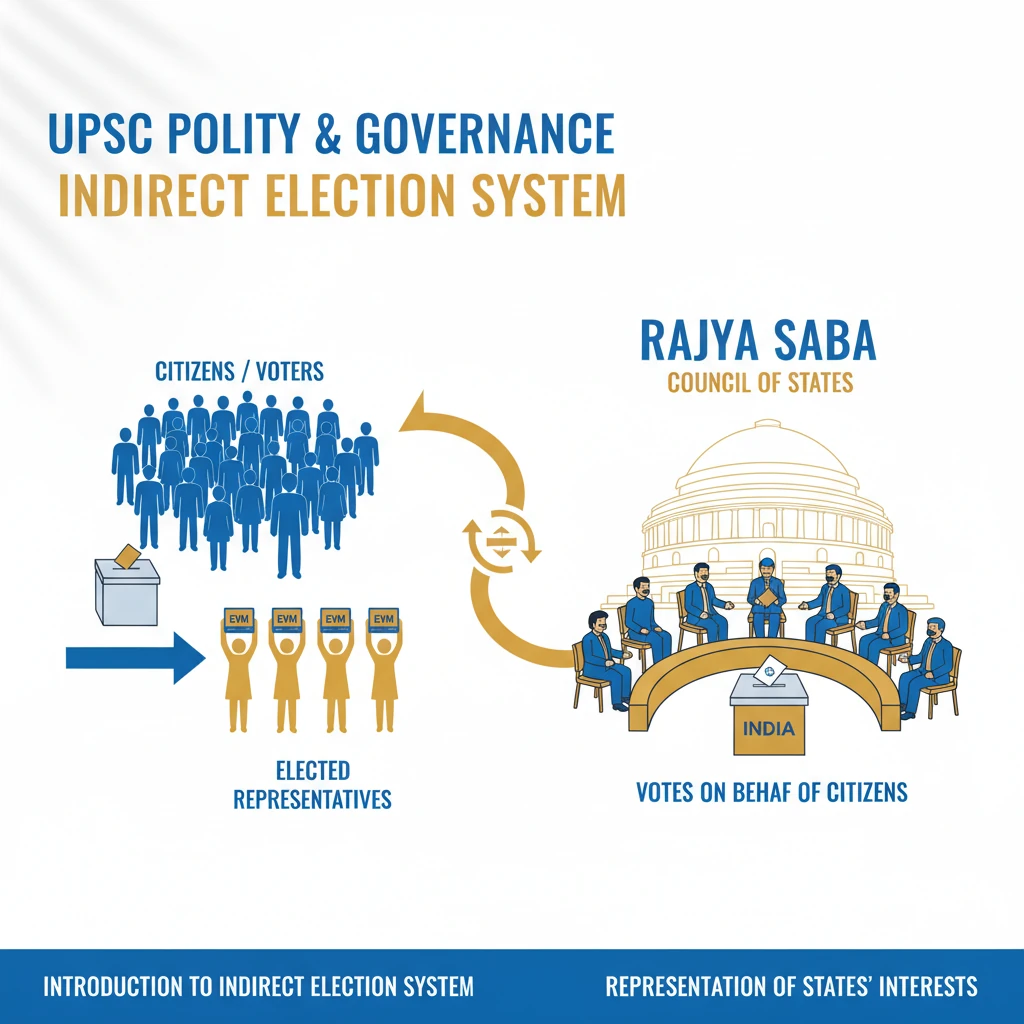
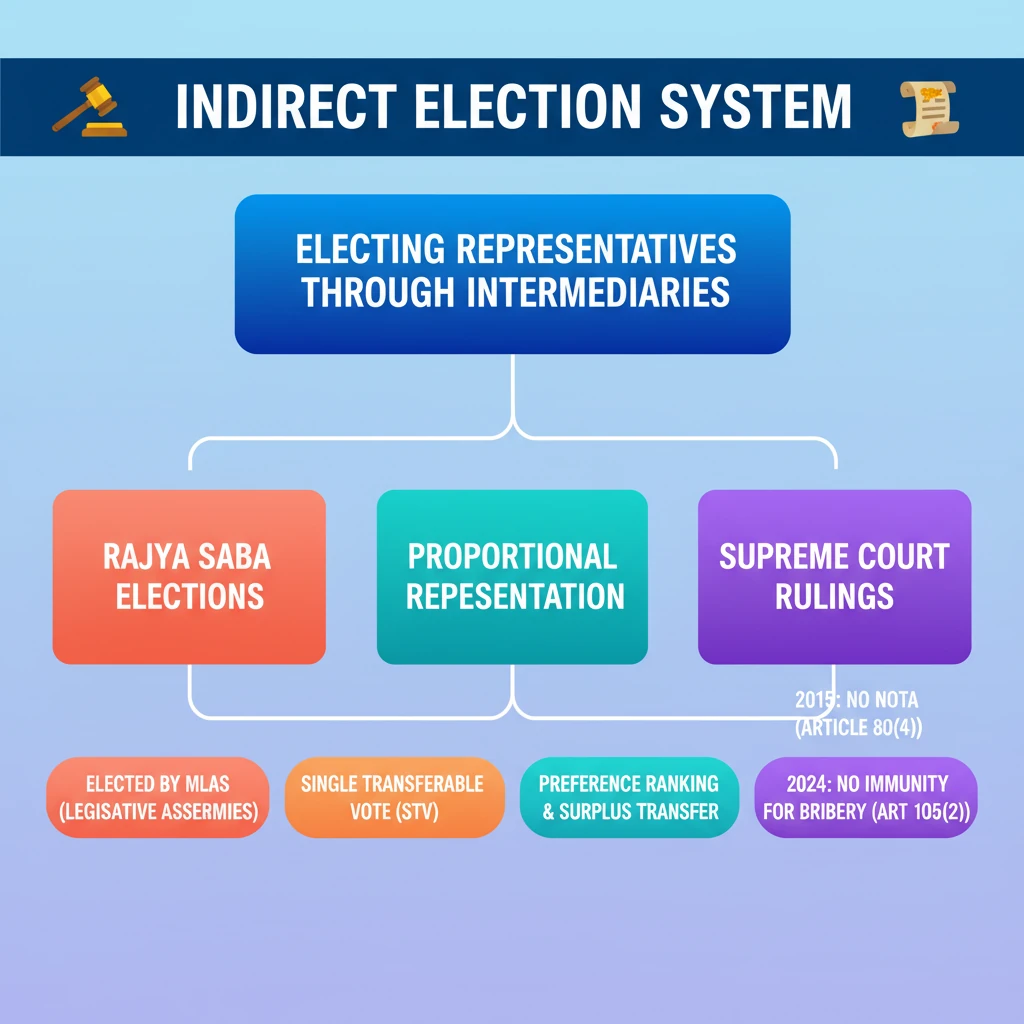
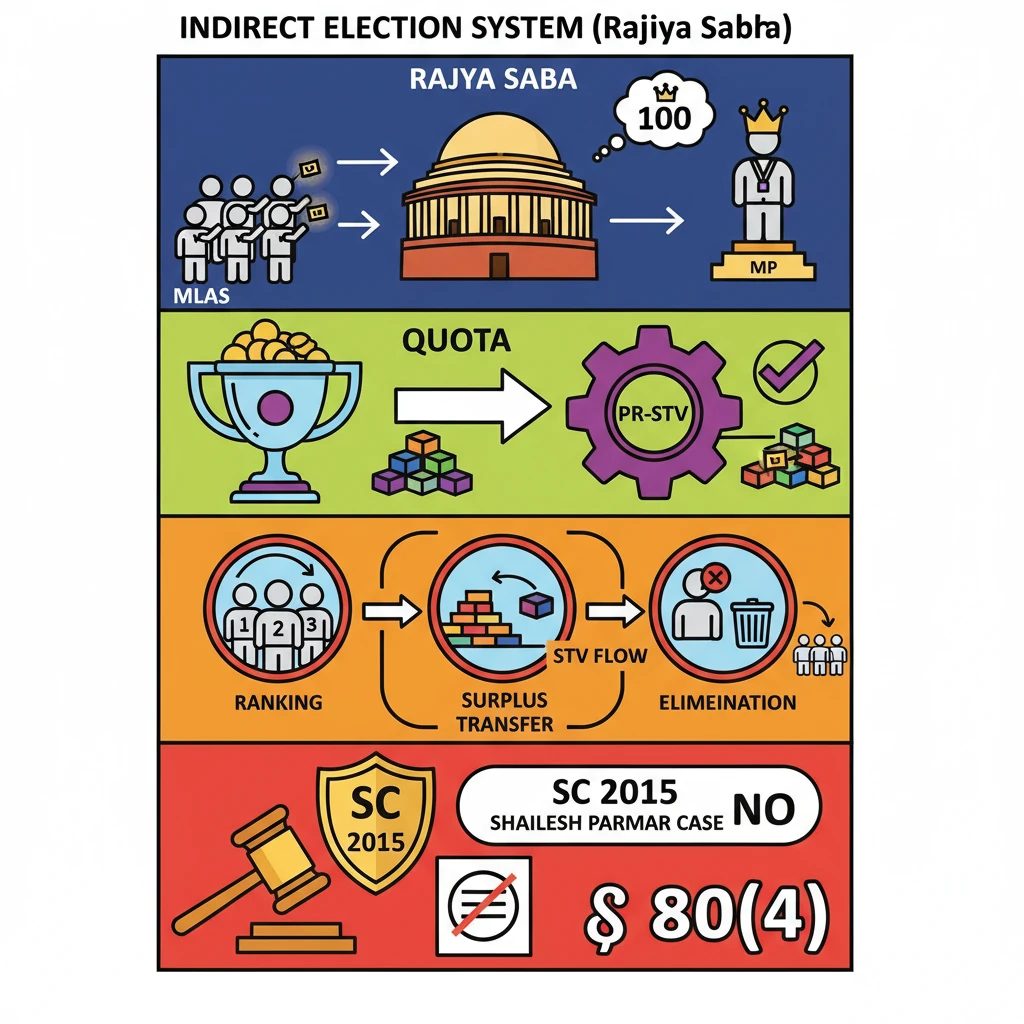
<h4>Introduction to Indirect Election System</h4><p>The <strong>Indirect Election System</strong> is a method where citizens do not directly vote for candidates. Instead, their elected representatives cast votes on their behalf.</p><p>In India, this system is primarily used for the election of members to the <strong>Rajya Sabha</strong>, the upper house of Parliament.</p><p>This ensures that the <strong>Rajya Sabha</strong> truly represents the interests of the states, as its members are chosen by the <strong>State Legislative Assemblies</strong>.</p><h4>Key Features of Rajya Sabha Elections</h4><p>Members of the <strong>Rajya Sabha</strong> are elected by the <strong>elected members of the State Legislative Assemblies</strong>.</p><p>The election follows the system of <strong>Proportional Representation by means of the Single Transferable Vote (STV)</strong>.</p><p>This system aims to ensure that various political parties secure representation in proportion to their strength in the state assembly.</p><h4>Understanding Proportional Representation and STV</h4><p><strong>Proportional Representation</strong> ensures that seats are allocated to parties in an assembly based on the percentage of votes they receive.</p><p>The <strong>Single Transferable Vote (STV)</strong> is a specific method within proportional representation. It allows voters to rank candidates in order of preference.</p><p>This system minimizes wasted votes and ensures a more accurate reflection of the electorate's will compared to a simple majority system.</p><h4>The Quota System</h4><p>To be declared elected in a <strong>Rajya Sabha</strong> election, a candidate must secure a specific number of votes, known as the <strong>quota</strong>.</p><div class='info-box'><p>The general formula for calculating the <strong>quota</strong> is: (Total valid votes / (Number of seats available + 1)) + 1.</p></div><p>In states with multiple seats, the initial value of each <strong>MLA's vote</strong> is typically fixed at <strong>100</strong>. The quota is then calculated based on this value (e.g., number of MLAs x 100).</p><h4>Preference Marking and Surplus Vote Transfer</h4><p><strong>MLAs</strong> mark their preferences on the ballot paper against the names of candidates. <strong>'1'</strong> indicates the first preference, <strong>'2'</strong> for the next, and so forth.</p><p>If a candidate receives enough <strong>first preferential votes</strong> to meet or exceed the <strong>quota</strong>, they are immediately elected.</p><div class='key-point-box'><p>If an elected candidate has <strong>surplus votes</strong> (votes beyond the quota), these votes are transferred to the voter's <strong>second choice</strong> (marked as '2'). The largest surplus is transferred first.</p></div><h4>Elimination of Candidates and Vote Redistribution</h4><p>If the required number of candidates are not elected after the transfer of <strong>surplus votes</strong>, the candidate with the <strong>fewest votes</strong> is eliminated.</p><p>Their <strong>unexhausted ballot papers</strong> are then redistributed among the remaining candidates based on the next available preference marked on them.</p><div class='info-box'><p>An <strong>"exhausted paper"</strong> refers to a ballot paper where no further preferences are recorded for any of the remaining candidates.</p></div><p>This process of <strong>surplus vote transfers</strong> and <strong>eliminations</strong> continues iteratively until all available seats are filled by candidates who reach the <strong>quota</strong>.</p>
💡 Key Takeaways
- •Rajya Sabha members are elected indirectly by MLAs using Proportional Representation by Single Transferable Vote (STV).
- •Candidates need to secure a specific 'quota' of votes to be elected, with MLAs' votes valued at 100 in multi-seat states.
- •The STV system involves ranking preferences, transferring surplus votes, and eliminating candidates with the fewest votes until all seats are filled.
- •The 2015 SC judgment in Shailesh Manubhai Parmar v ECI denied NOTA for Rajya Sabha elections, citing Article 80(4).
- •The 2024 SC judgment overruled the 1998 JMM Bribery Case, clarifying that parliamentary immunity (Article 105(2)) does not protect legislators taking bribes to vote or speak.
🧠 Memory Techniques
95% Verified Content
📚 Reference Sources
•The Constitution of India (specifically Articles 80(4), 105(2))
•Supreme Court judgments: Shailesh Manubhai Parmar v Election Commission of India (2015)
•Supreme Court judgments: JMM Bribery Case (1998) and the 2024 Seven-Judge Bench ruling overruling the 1998 judgment