PM-Surya Ghar: Muft Bijli Yojana - Polity And Governance | UPSC Learning
Topics
0 topics • 0 completed
🔍
No topics match your search
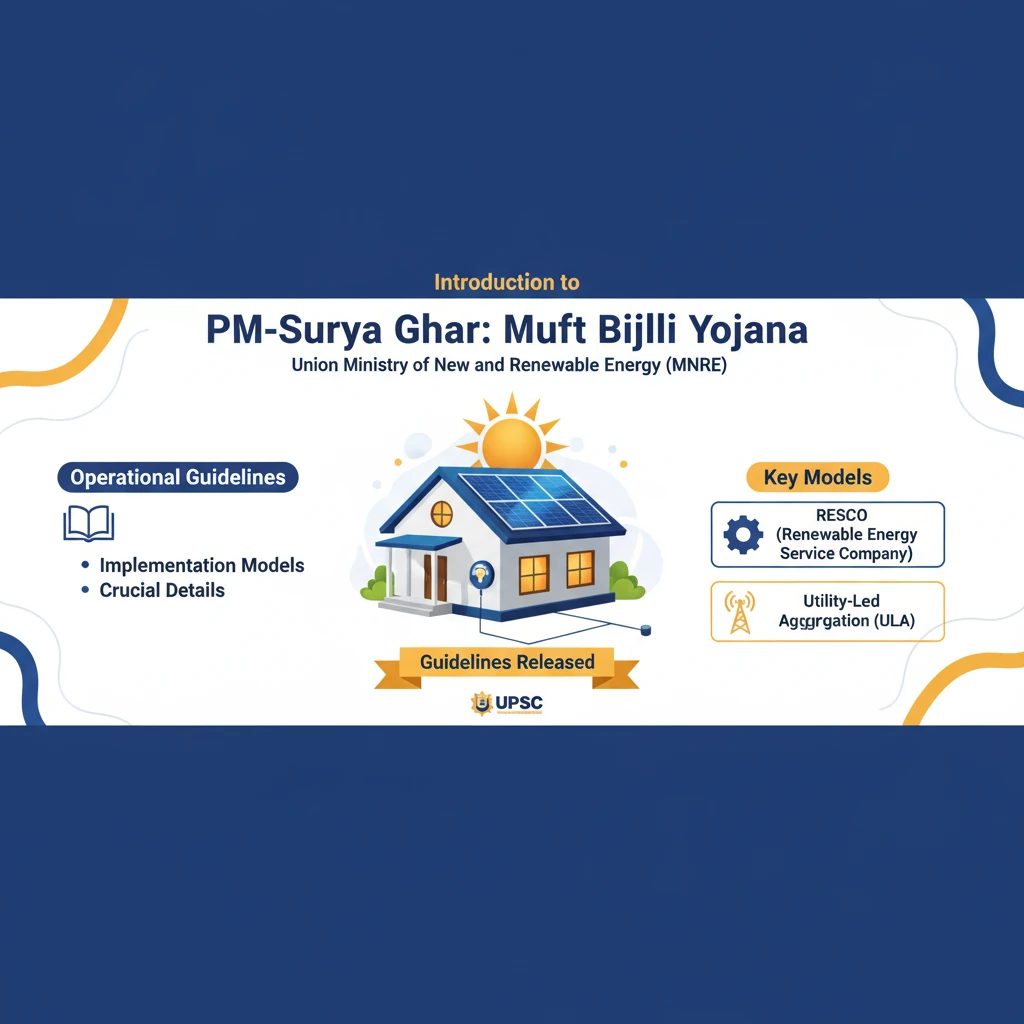
PM-Surya Ghar: Muft Bijli Yojana
Medium⏱️ 6 min read
polity and governance
📖 Introduction
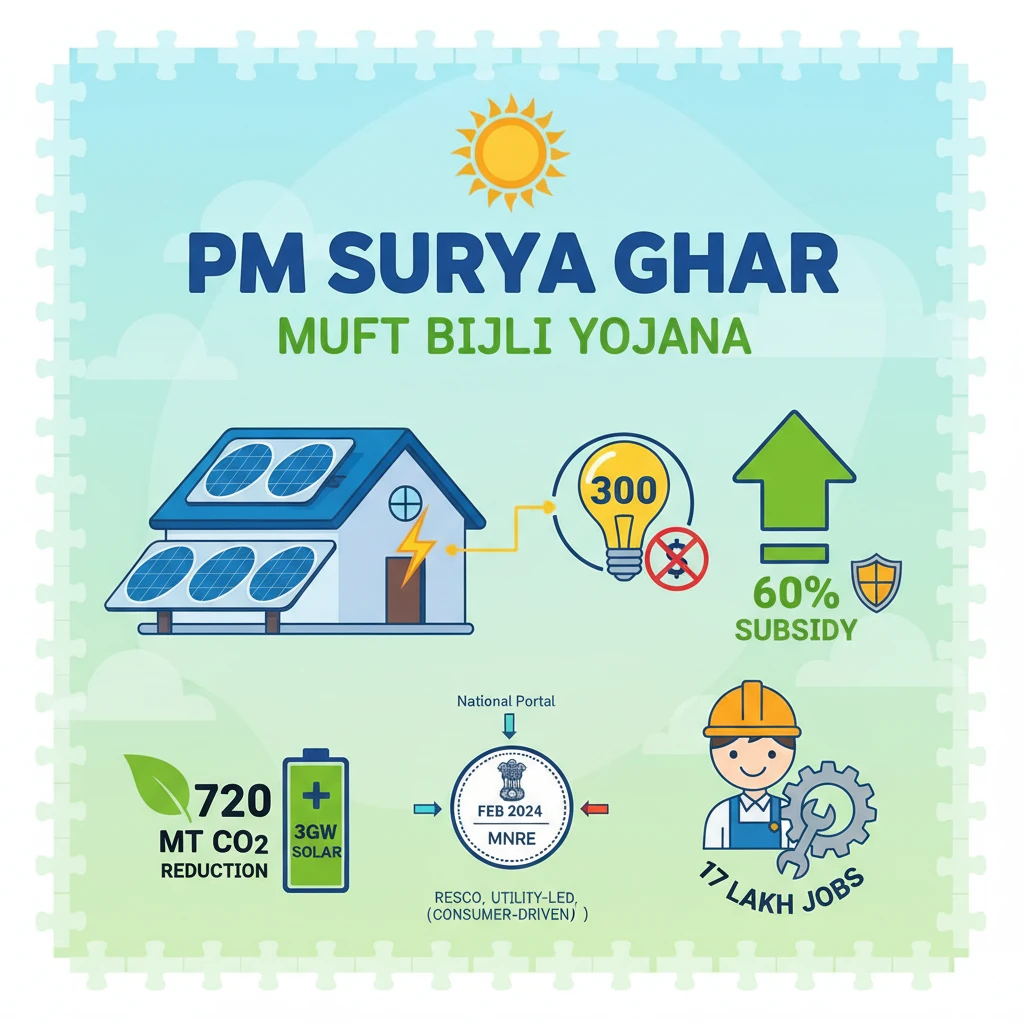
<h4>Introduction to PM-Surya Ghar: Muft Bijli Yojana</h4><p>The <strong>Union Ministry of New and Renewable Energy (MNRE)</strong> recently released the <strong>operational guidelines</strong> for the <strong>PM-Surya Ghar: Muft Bijli Yojana</strong>. These guidelines provide crucial details on the implementation models for this ambitious scheme.</p><p>Specifically, the guidelines elaborate on the <strong>RESCO (Renewable Energy Service Company)</strong> and <strong>Utility-Led Aggregation (ULA)</strong> models. These new frameworks are designed to complement the existing <strong>consumer-driven implementation</strong> of rooftop solar installations.</p><div class='exam-tip-box'><p><strong>UPSC Insight:</strong> Understanding the different implementation models (RESCO, ULA, consumer-driven) is key for Mains answers on governance and energy policy. Note the responsible ministry: <strong>MNRE</strong>.</p></div><h4>About PM-Surya Ghar: Muft Bijli Yojana</h4><p>The <strong>PM Surya Ghar: Muft Bijli Yojana</strong> was officially launched in <strong>February 2024</strong>. It is a flagship initiative by the <strong>Ministry of New and Renewable Energy (MNRE)</strong>.</p><p>The primary goal of the scheme is to provide <strong>free electricity</strong> to <strong>one crore households</strong> across India. This will be achieved through the installation of <strong>rooftop solar panels</strong> on residential buildings.</p><div class='info-box'><p><strong>Scheme Details:</strong></p><ul><li><strong>Launch Date:</strong> February 2024</li><li><strong>Responsible Ministry:</strong> MNRE</li><li><strong>Budget:</strong> <strong>Rs 75,021 crore</strong></li><li><strong>Implementation Period:</strong> Planned until <strong>FY 2026-27</strong></li><li><strong>Target:</strong> <strong>One crore households</strong></li></ul></div><p>The scheme offers significant benefits to eligible households. It provides up to <strong>300 units of free electricity per month</strong>. Additionally, it offers a substantial <strong>subsidy</strong> covering up to <strong>60% of the installation cost</strong> of the rooftop solar panels.</p><h4>Eligibility Criteria</h4><p>To qualify for the <strong>PM Surya Ghar: Muft Bijli Yojana</strong>, applicants must meet specific criteria. These ensure that the benefits reach the intended beneficiaries effectively.</p><ul><li>Applicant must be an <strong>Indian citizen</strong>.</li><li>Applicant must be a <strong>homeowner</strong>.</li><li>The household must possess a <strong>valid electricity connection</strong>.</li><li>The household should <strong>not have availed a prior solar subsidy</strong> for rooftop solar installations.</li></ul><h4>Implementation Structure</h4><p>The execution of the <strong>PM Surya Ghar: Muft Bijli Yojana</strong> is structured at both national and state levels to ensure efficient rollout and monitoring.</p><p>At the national level, the scheme will be implemented by the <strong>National Programme Implementation Agency (NPIA)</strong>. This agency is responsible for overall coordination and strategic direction.</p><p>At the state level, the implementation is carried out by <strong>State Implementation Agencies (SIA)</strong>. These agencies manage the on-ground execution and beneficiary engagement within their respective states.</p><h4>Key Components of the Scheme</h4><p>The scheme incorporates several key components designed to facilitate widespread adoption and demonstrate the benefits of solar energy.</p><ul><li><strong>Central Financial Assistance (CFA):</strong> This component provides direct <strong>financial support</strong> to residential consumers. The assistance is facilitated for installing rooftop solar panels through a dedicated <strong>National Portal</strong>.</li><li><strong>Model Solar Village:</strong> The scheme aims to establish <strong>one Model Solar Village per district</strong> across the country. These villages will serve as exemplars, actively promoting the adoption of solar energy and showcasing its benefits.</li></ul><h4>Expected Outcomes and Impact</h4><p>The <strong>PM Surya Ghar: Muft Bijli Yojana</strong> is projected to deliver substantial environmental, economic, and social benefits.</p><ul><li><strong>Carbon Emission Reduction:</strong> The scheme is expected to reduce <strong>carbon emissions by 720 million tonnes</strong> over the lifetime of the installed rooftop solar systems. This significantly contributes to India's climate goals.</li><li><strong>Job Creation:</strong> An estimated <strong>17 lakh direct jobs</strong> are projected to be generated. These jobs will span various sectors, including manufacturing, logistics, installation, and operations and maintenance of solar systems.</li><li><strong>Increased Solar Capacity:</strong> The scheme will contribute an additional <strong>30 GW</strong> to India's total solar energy capacity. This substantial increase will come specifically from residential rooftop systems.</li><li><strong>Household Income Generation:</strong> Households can earn income by selling <strong>surplus electricity</strong> generated from their solar panels back to <strong>DISCOMs (Distribution Companies)</strong>. For example, a <strong>3 kW rooftop setup</strong> can generate over <strong>300 units per month</strong>, often exceeding a household's consumption.</li></ul>
💡 Key Takeaways
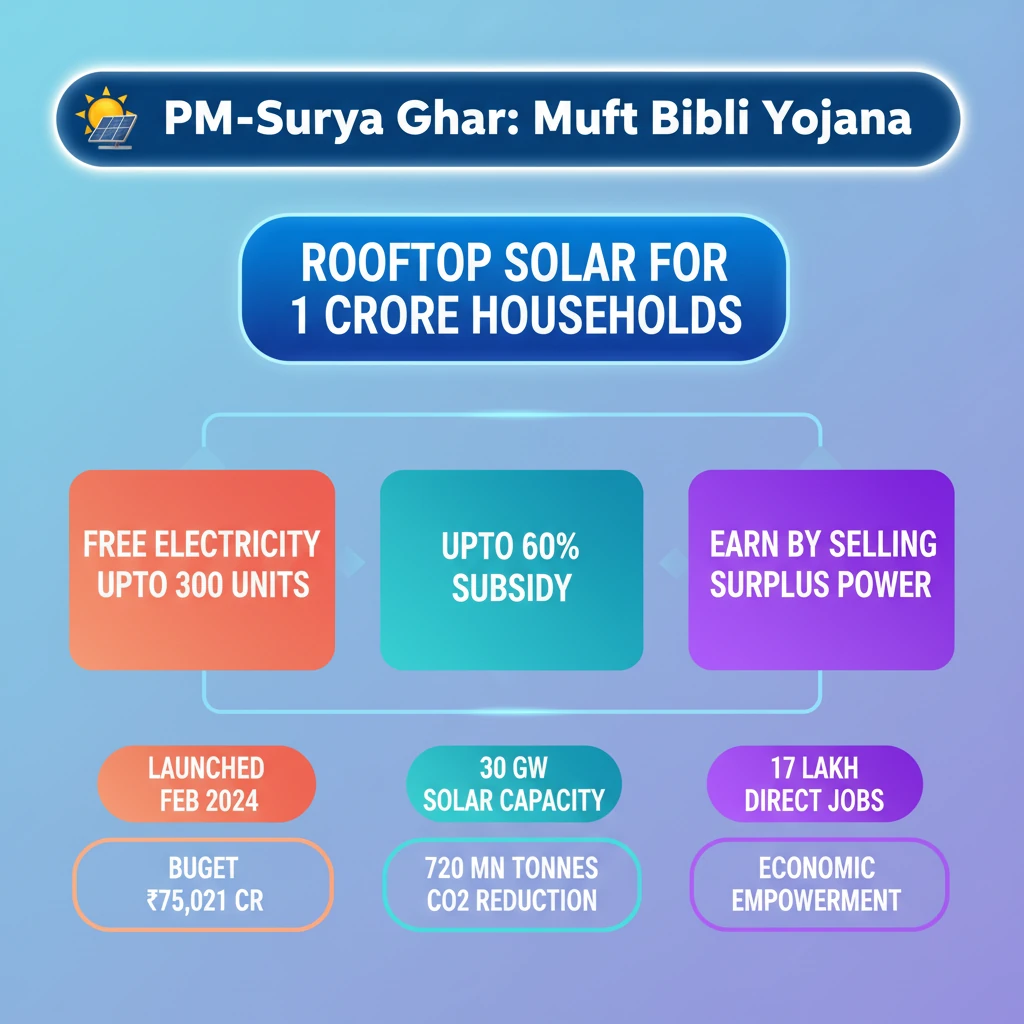
- •PM-Surya Ghar: Muft Bijli Yojana, launched Feb 2024 by MNRE, targets 1 crore households for rooftop solar.
- •Budget of Rs 75,021 crore, aims for 300 units free electricity and up to 60% subsidy.
- •Key implementation models include RESCO, Utility-Led Aggregation, and consumer-driven via National Portal.
- •Expected outcomes: 720 million tonnes carbon reduction, 17 lakh direct jobs, 30 GW additional solar capacity.
- •Households can earn income by selling surplus electricity to DISCOMs, enhancing economic empowerment.
🧠 Memory Techniques
98% Verified Content
📚 Reference Sources
•Ministry of New and Renewable Energy (MNRE) official announcements and guidelines (implied from source)