Self-Employment Scheme for Rehabilitation of Manual Scavengers (SRMS) - Polity And Governance | UPSC Learning
Topics
0 topics • 0 completed
🔍
No topics match your search
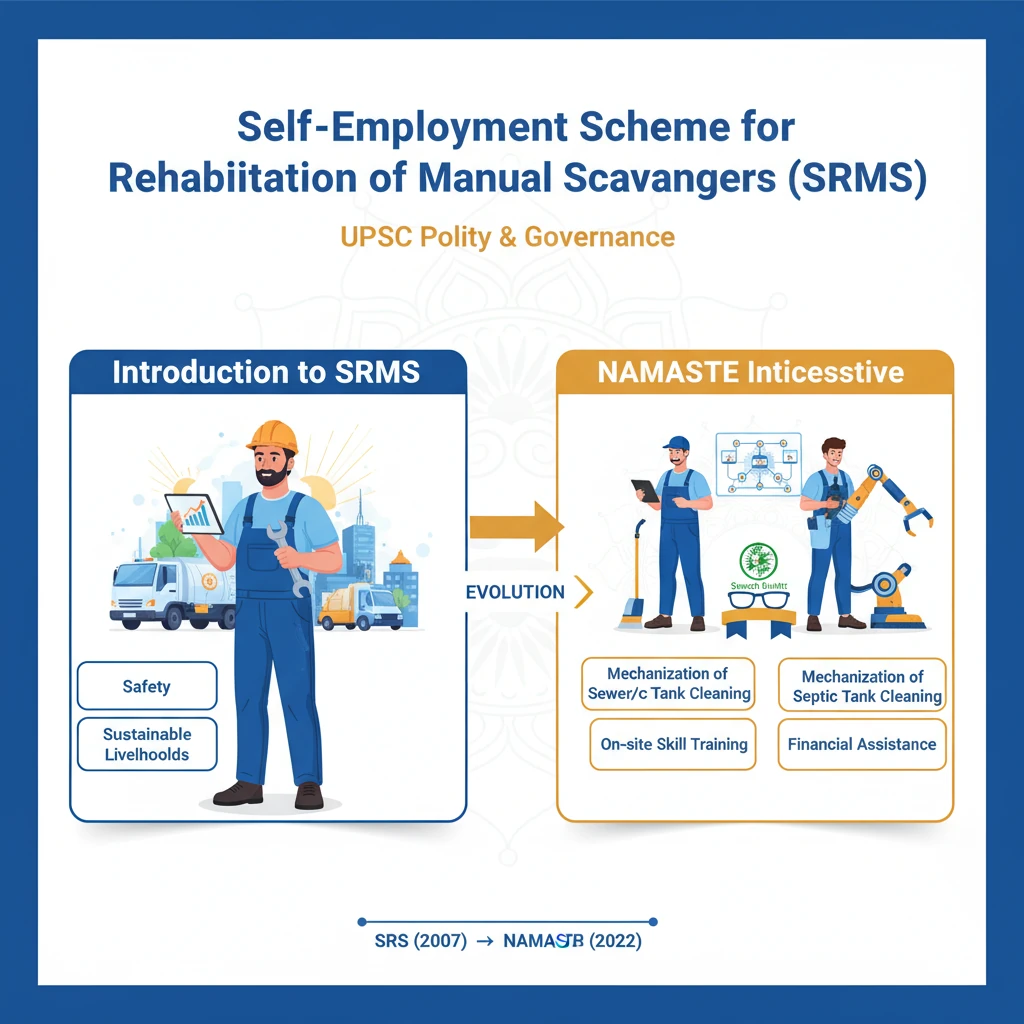
Self-Employment Scheme for Rehabilitation of Manual Scavengers (SRMS)
Easy⏱️ 5 min read
polity and governance
📖 Introduction
<h4>Introduction to SRMS and NAMASTE</h4><p>The <strong>Self-Employment Scheme for Rehabilitation of Manual Scavengers (SRMS)</strong> was a pivotal initiative launched by the Indian government. Its primary goal was to ensure the <strong>safety</strong>, <strong>dignity</strong>, and provision of <strong>sustainable livelihoods</strong> for urban sanitation workers across the country.</p><p>This scheme was designed to address the deeply rooted social issue of manual scavenging, aiming to integrate affected individuals into dignified employment opportunities.</p><div class="info-box"><p>The <strong>SRMS Scheme</strong>, originally launched in <strong>2007</strong>, has since been renamed. It is now known as the <strong>National Action for Mechanised Ecosystem Sanitation (NAMASTE)</strong> scheme.</p></div><h4>Implementation Details of NAMASTE</h4><p>The <strong>NAMASTE scheme</strong> represents an enhanced and expanded approach to the rehabilitation efforts. It is set to be implemented across a vast network of urban areas, reflecting a comprehensive national commitment.</p><p>This phased implementation ensures that a wide range of municipal bodies are covered, maximizing the scheme's reach and impact on sanitation workers.</p><div class="info-box"><p>The <strong>NAMASTE scheme</strong> is slated for implementation across <strong>4800 Urban Local Bodies (ULBs)</strong> throughout India. This extensive rollout is planned over the next three years, specifically until the fiscal year <strong>2025-26</strong>.</p><p>The primary implementing agency for the <strong>NAMASTE scheme</strong> is the <strong>National Safai Karamchari Financial Development Corporation (NSKFDC)</strong>.</p></div><h4>Core Objectives of the Scheme</h4><p>The objectives of the scheme are multi-faceted, focusing on both the direct rehabilitation of individuals and the systemic transformation of sanitation practices. These goals underscore a commitment to human rights and modern sanitation.</p><div class="key-point-box"><ul><li><strong>Rehabilitation of Manual Scavengers (MS)</strong>: A key objective is the comprehensive rehabilitation of individuals identified as <strong>Manual Scavengers (MS)</strong>. This also extends to <strong>Persons Engaged in Hazardous Cleaning of Sewer and Septic tanks (SSWs)</strong>.</li><li><strong>Promotion of Safe and Mechanised Cleaning</strong>: The scheme actively promotes the adoption of <strong>safe and mechanised cleaning</strong> methods for sewers and septic tanks. This is facilitated through the training and certification of sanitation workers, ensuring professional and risk-free operations.</li></ul></div><div class="exam-tip-box"><p>For <strong>UPSC Mains GS-I (Social Issues)</strong> and <strong>GS-II (Governance & Social Justice)</strong>, understanding the evolution from <strong>SRMS</strong> to <strong>NAMASTE</strong> and its objectives is crucial. Highlight the shift towards mechanization and dignity in your answers.</p></div>
💡 Key Takeaways
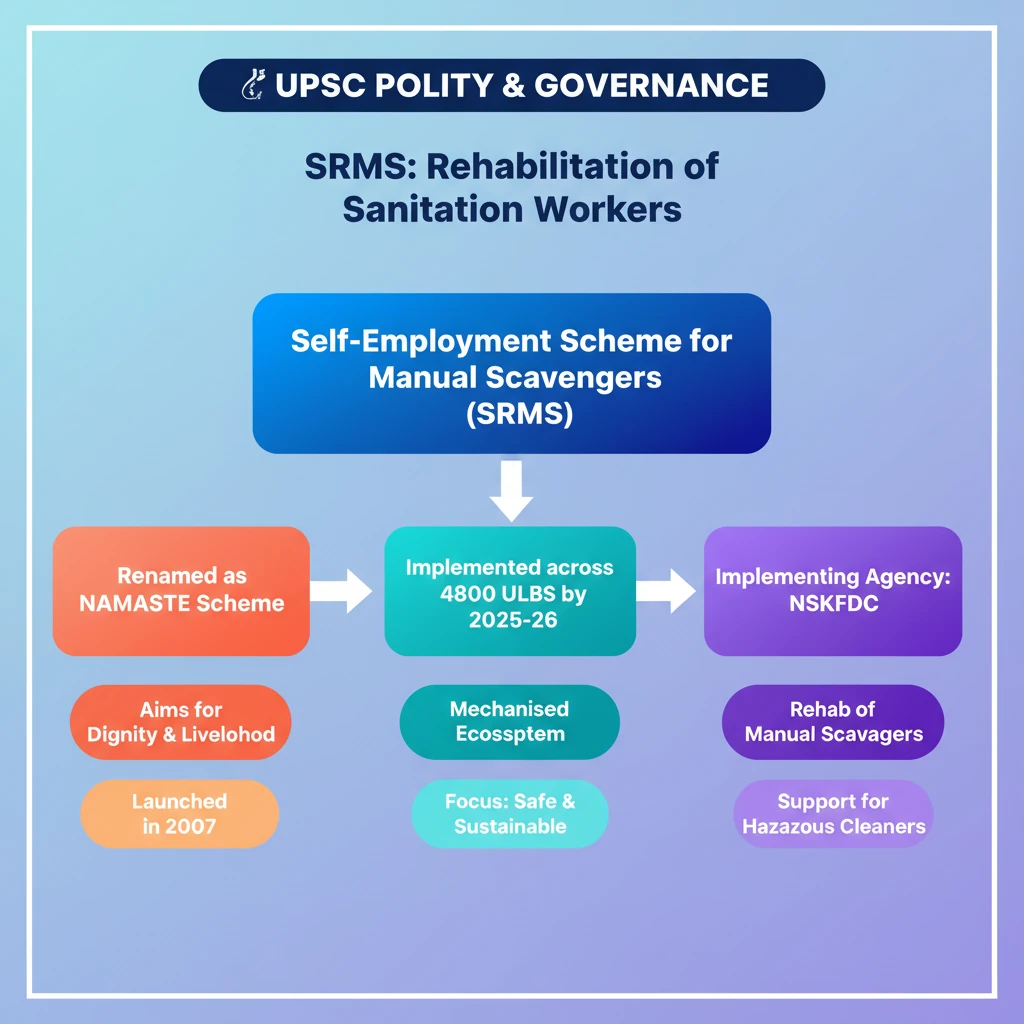
- •SRMS (Self-Employment Scheme for Rehabilitation of Manual Scavengers), launched in 2007, aims for dignity and sustainable livelihoods for sanitation workers.
- •SRMS has been renamed as NAMASTE (National Action for Mechanised Ecosystem Sanitation).
- •NAMASTE will be implemented across 4800 Urban Local Bodies (ULBs) by 2025-26.
- •The National Safai Karamchari Financial Development Corporation (NSKFDC) is the implementing agency for NAMASTE.
- •Key objectives include rehabilitation of Manual Scavengers (MS) and Persons Engaged in Hazardous Cleaning of Sewer and Septic tanks (SSWs).
- •NAMASTE also promotes safe and mechanised cleaning of sewers and septic tanks through trained and certified workers.
🧠 Memory Techniques

98% Verified Content
📚 Reference Sources
•Ministry of Social Justice and Empowerment (Government of India) reports and scheme guidelines
•Press Information Bureau (PIB) releases on NAMASTE scheme