S. R. Bommai v. Union of India Case 1994 - Polity And Governance | UPSC Learning
Topics
0 topics • 0 completed
🔍
No topics match your search
S. R. Bommai v. Union of India Case 1994
Medium⏱️ 7 min read
polity and governance
📖 Introduction
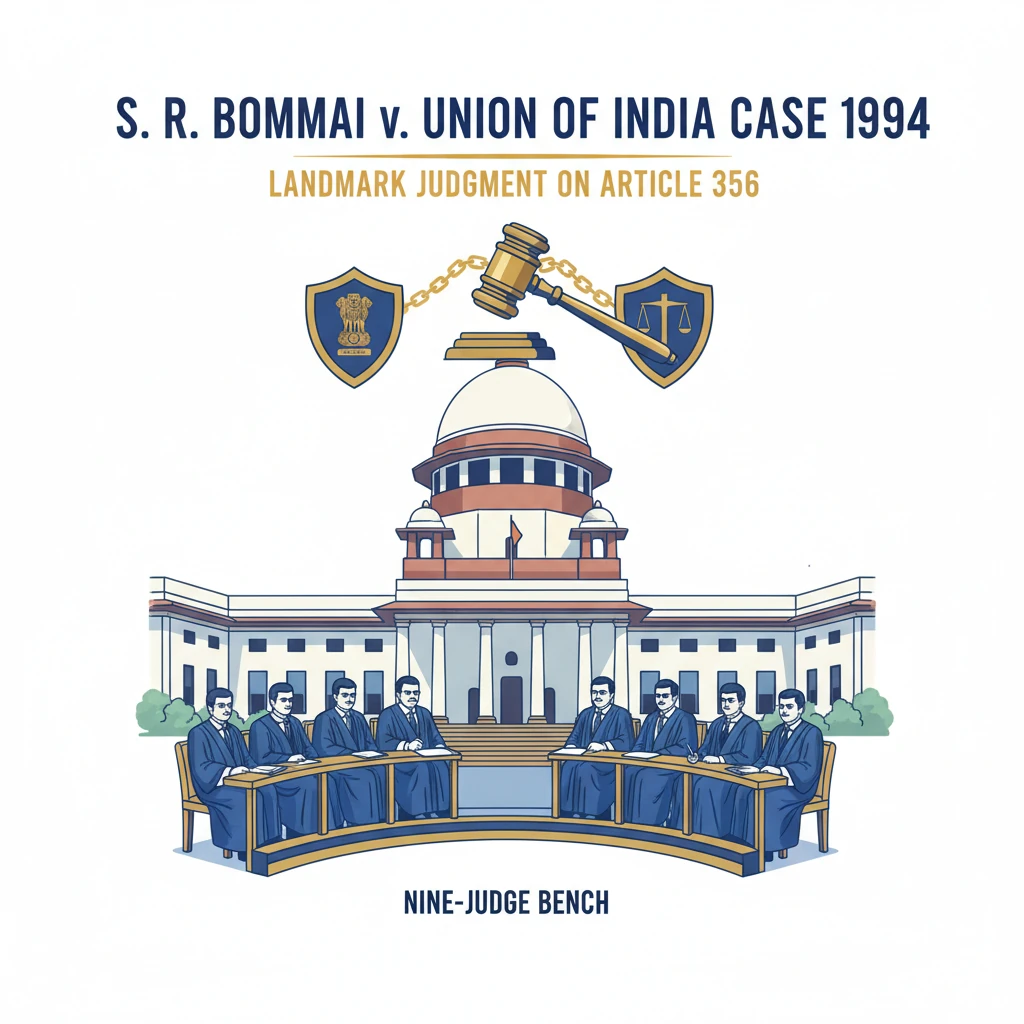
<h4>Introduction to S. R. Bommai v. Union of India Case</h4><p>The landmark judgment in <strong>S. R. Bommai v. Union of India (1994)</strong> was delivered by a <strong>nine-judge bench</strong> of the <strong>Supreme Court of India</strong>. This case significantly curtailed the arbitrary use of <strong>Article 356</strong> of the Constitution, which allows for the dismissal of state governments.</p><p>Its impact on India's <strong>constitutional framework</strong> and <strong>Centre-State relations</strong> has been profound and continues to shape governance, celebrating its <strong>30th anniversary</strong> in 2024.</p><div class='info-box'><p><strong>Case Name:</strong> S. R. Bommai v. Union of India</p><p><strong>Year:</strong> 1994</p><p><strong>Bench Strength:</strong> Nine Judges</p><p><strong>Key Article:</strong> Article 356 (President's Rule)</p></div><h4>Background of the S. R. Bommai Case</h4><p>The case originated from the dismissal of the <strong>Janata Dal government</strong> in <strong>Karnataka</strong> in 1989, led by <strong>Chief Minister S. R. Bommai</strong>. This dismissal was carried out under <strong>Article 356</strong>.</p><p>In <strong>September 1988</strong>, a legislator from the <strong>Janata Dal</strong>, along with <strong>19 other Members of the Legislative Assembly (MLAs)</strong>, defected from the party, withdrawing support from the <strong>Bommai government</strong>. This led to the Governor's recommendation for President's Rule.</p><p><strong>S. R. Bommai's</strong> request to test his government's majority on the floor of the Assembly was denied by the <strong>Governor</strong>. The state government was subsequently dismissed, prompting <strong>Bommai</strong> to seek legal recourse.</p><h4>Supreme Court Judgment: Key Principles</h4><p>The <strong>Supreme Court's</strong> judgment emphasized that the <strong>Presidential Proclamation</strong> under <strong>Article 356</strong> must be exercised with extreme <strong>caution</strong>. This aligns with the views of <strong>Dr. B.R. Ambedkar</strong> and recommendations by the <strong>Sarkaria Commission</strong>.</p><div class='key-point-box'><p><strong>Key Principle:</strong> The power to dismiss a state government under <strong>Article 356</strong> is <strong>not absolute</strong> but subject to significant limitations and safeguards.</p></div><p>The Court mandated that any proclamation under <strong>Article 356(3)</strong> must be thoroughly analyzed by <strong>both Houses of Parliament</strong>. If Parliament does not approve it within <strong>two months</strong>, the proclamation lapses, and the state assembly resumes its functions.</p><h4>Judicial Review of Article 356</h4><p>A pivotal aspect of the judgment was the clarification that the <strong>President's Proclamation</strong> under <strong>Article 356</strong> is subject to <strong>judicial review</strong>. The Supreme Court can entertain <strong>writ petitions</strong> challenging its legality if arguable questions are raised.</p><div class='exam-tip-box'><p>This aspect is crucial for <strong>UPSC Mains GS-II</strong>, demonstrating the judiciary's role in upholding <strong>constitutionalism</strong> and <strong>federal principles</strong>. Always mention <strong>judicial review</strong> in relation to <strong>Article 356</strong> post-Bommai.</p></div><p>The Court inferred the power to dissolve the legislature from <strong>Article 174(2)</strong>, which allows the <strong>Governor</strong> to dissolve the Legislative Assembly, and <strong>Article 356(1)(a)</strong>, which enables the <strong>President</strong> to assume the Governor's powers.</p><h4>Implications for Federalism</h4><p>The <strong>S. R. Bommai judgment</strong> significantly strengthened <strong>cooperative federalism</strong> by protecting states from arbitrary central intervention. It ensures that the Centre and states maintain a horizontal relationship of cooperation.</p><p>The ruling indirectly promotes <strong>competitive federalism</strong> by ensuring stable state governments, allowing them to compete for development and investment without fear of unconstitutional dismissal.</p>
💡 Key Takeaways
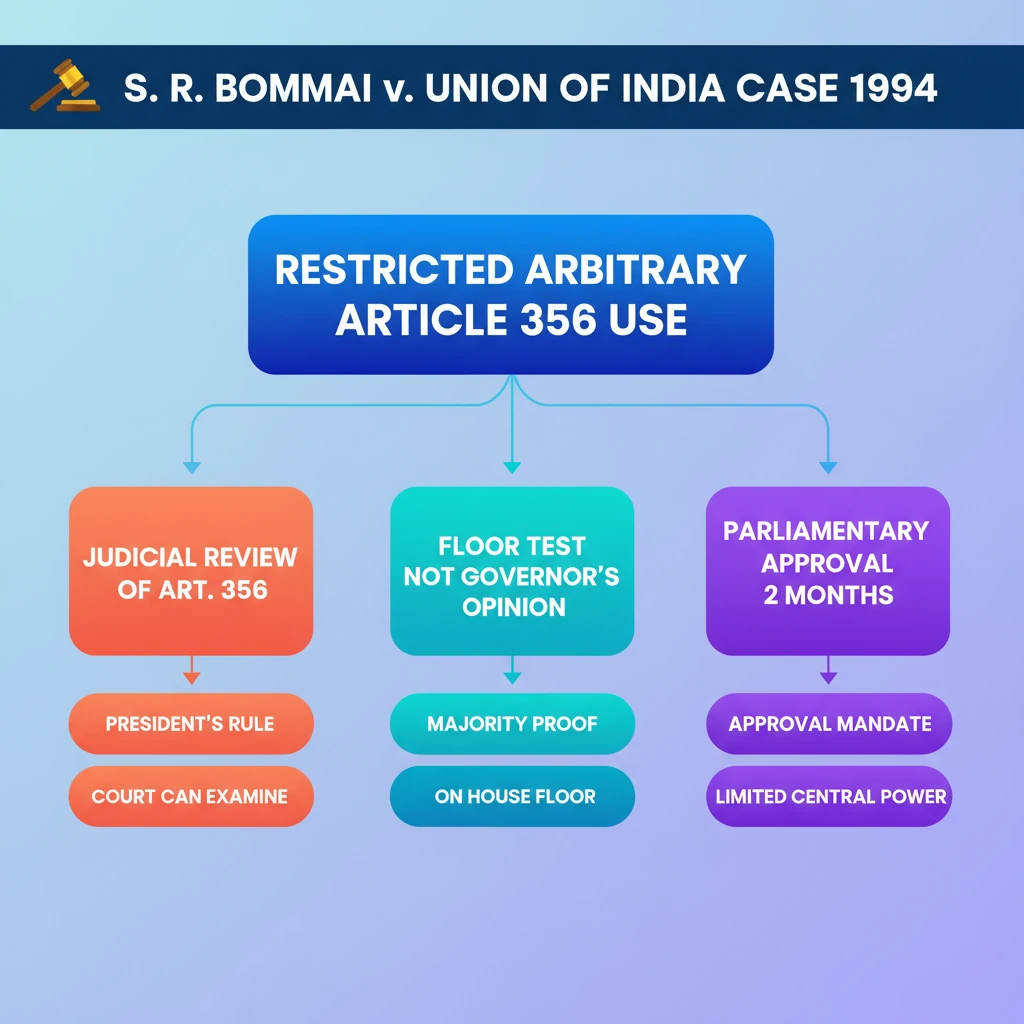
- •S. R. Bommai v. Union of India (1994) restricted arbitrary use of Article 356.
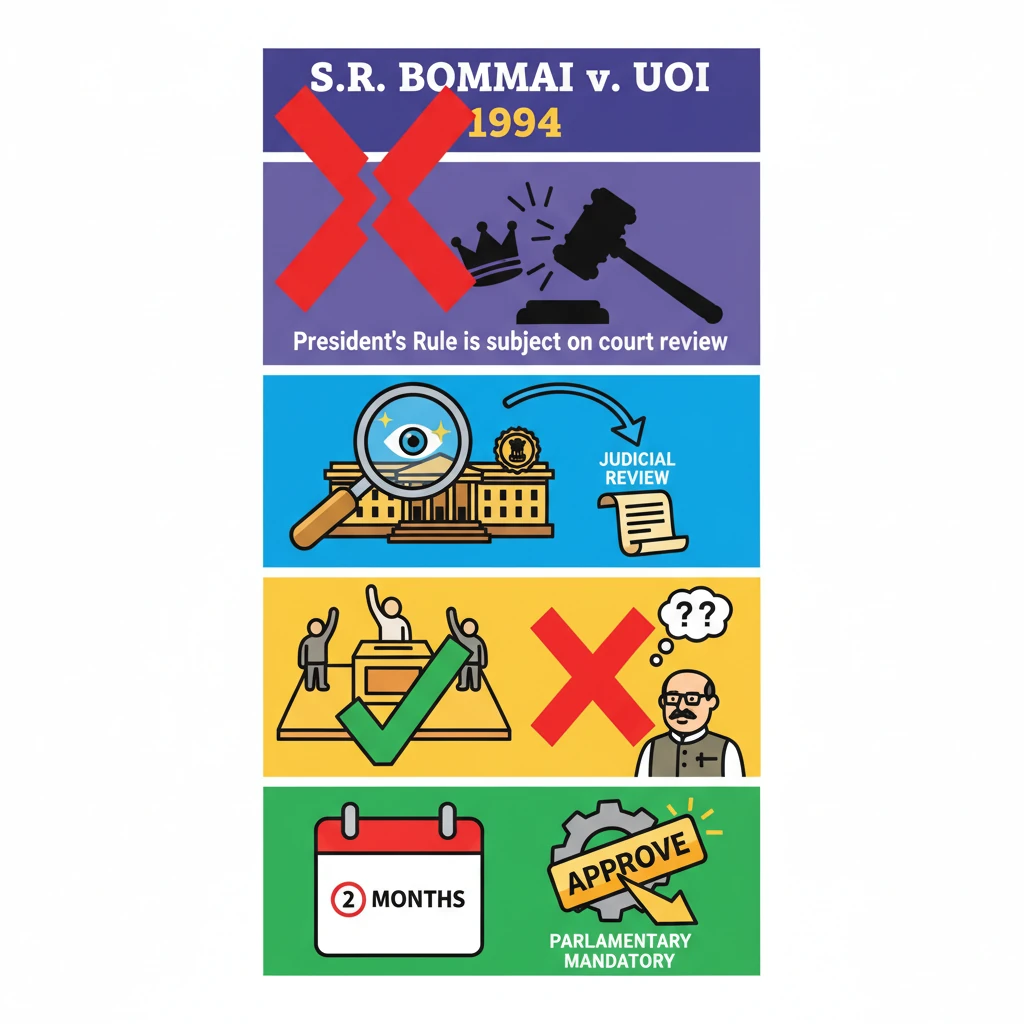
- •President's Rule under Article 356 is subject to judicial review.
- •A state government's majority must be tested on the floor of the House, not by the Governor's subjective assessment.
- •Parliamentary approval within two months is mandatory for President's Rule to continue.
- •The judgment strengthened cooperative federalism and limited central intervention in state affairs.
🧠 Memory Techniques
98% Verified Content
📚 Reference Sources
•Supreme Court of India Judgment: S. R. Bommai v. Union of India (1994)
•The Constitution of India (Article 356, Article 174(2))
•Sarkaria Commission Report on Centre-State Relations (1987)