Inquiry Wing of Lokpal - Polity And Governance | UPSC Learning
Topics
0 topics • 0 completed
🔍
No topics match your search
Inquiry Wing of Lokpal
Medium⏱️ 8 min read
polity and governance
📖 Introduction
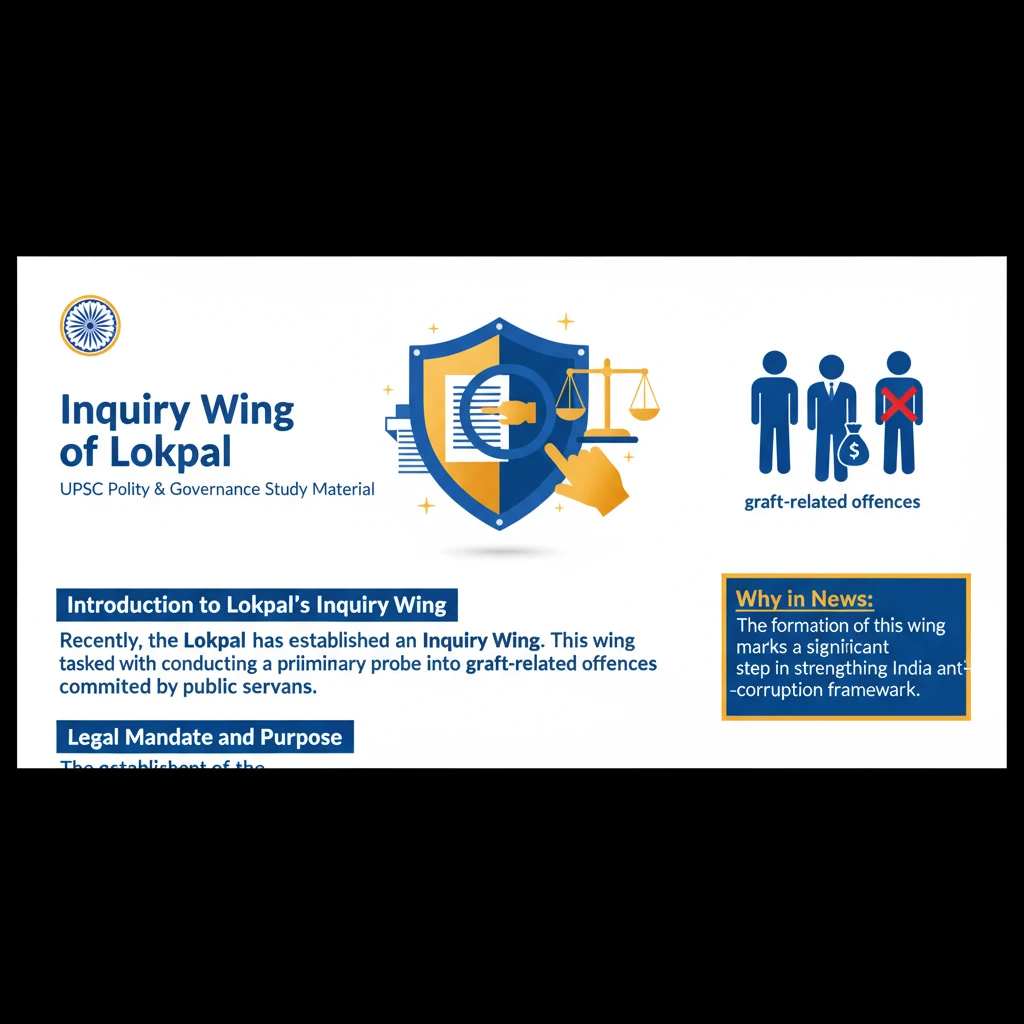
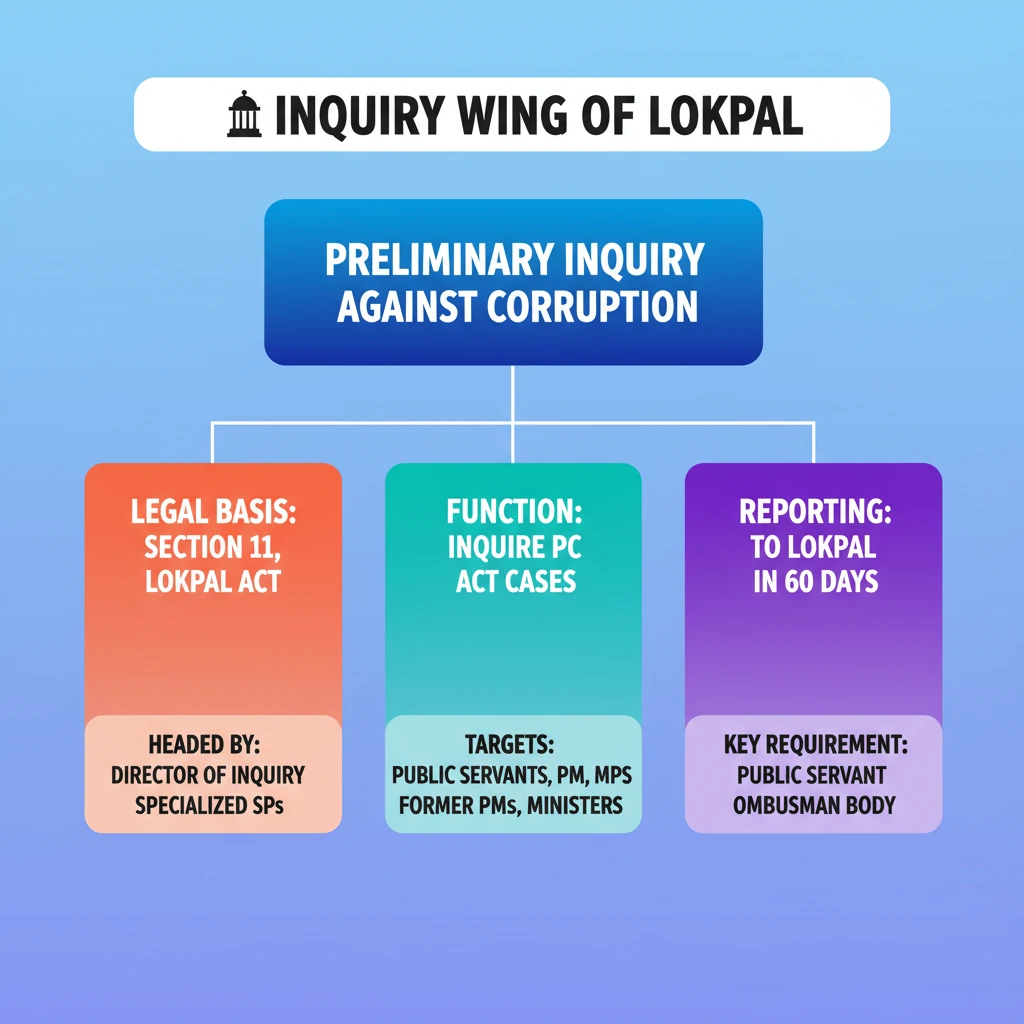
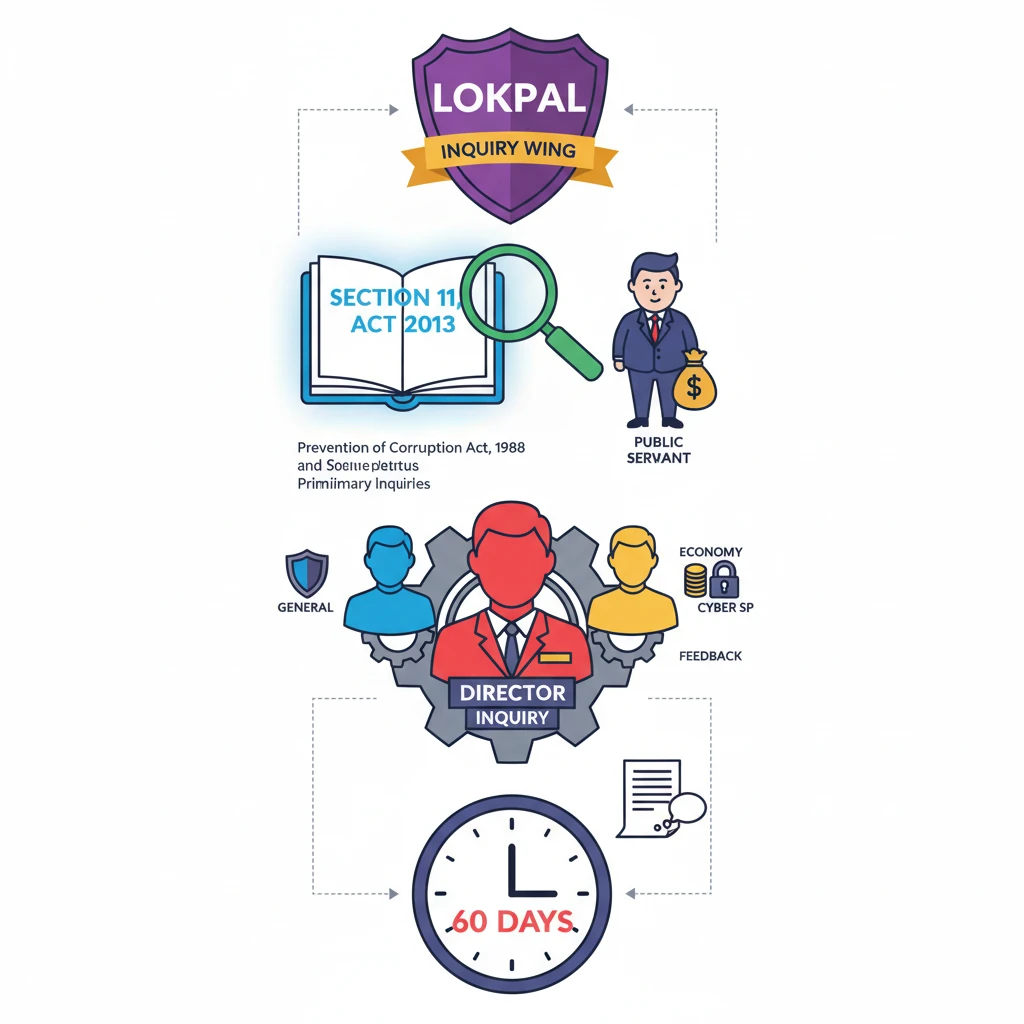
<h4>Introduction to Lokpal's Inquiry Wing</h4><p>Recently, the <strong>Lokpal</strong> has established an <strong>Inquiry Wing</strong>. This wing is tasked with conducting a preliminary probe into <strong>graft-related offences</strong> committed by public servants.</p><div class='info-box'><p><strong>Why in News:</strong> The formation of this wing marks a significant step in strengthening India's anti-corruption framework.</p></div><h4>Legal Mandate and Purpose</h4><p>The establishment of the <strong>Inquiry Wing</strong> is mandated by <strong>Section 11 of the Lokpal and Lokayuktas Act, 2013</strong>. This legal backing ensures its operational legitimacy and authority.</p><p>Its primary responsibility is to conduct <strong>preliminary inquiries</strong> into offences falling under the <strong>Prevention of Corruption Act, 1988</strong>. These allegations are specifically against specified public servants and functionaries.</p><div class='key-point-box'><p>The wing focuses on initial investigations, laying the groundwork for potential further action by the <strong>Lokpal</strong>.</p></div><h4>Organizational Structure of the Inquiry Wing</h4><p>The <strong>Inquiry Wing</strong> is headed by a <strong>Director of Inquiry</strong>, who reports directly to the <strong>Lokpal Chairperson</strong>. This ensures direct oversight and accountability.</p><p>The Director is supported by three <strong>Superintendents of Police (SPs)</strong>, each specializing in different areas:</p><ul><li><strong>SP (general)</strong>: Handles a broad range of corruption cases.</li><li><strong>SP (economic and banking)</strong>: Focuses on financial and banking-related irregularities.</li><li><strong>SP (cyber)</strong>: Deals with cyber-related corruption and digital fraud.</li></ul><p>Each <strong>SP</strong> is further assisted by dedicated <strong>inquiry officers</strong> and other essential staff, forming a comprehensive investigative team.</p><h4>Preliminary Inquiry Timeline and Reporting</h4><p>The <strong>Inquiry Wing</strong> operates under a strict deadline. It must finalize its <strong>preliminary inquiry</strong> and submit a detailed report to the <strong>Lokpal</strong> within <strong>60 days</strong> of receiving a complaint.</p><p>This report is crucial and must incorporate feedback from both the <strong>public servant</strong> against whom the allegations are made and the designated <strong>competent authority</strong> for that category of public servant.</p><div class='exam-tip-box'><p>The <strong>60-day timeline</strong> highlights the emphasis on swift and time-bound investigations, a key aspect of good governance often tested in <strong>UPSC Mains (GS-II)</strong>.</p></div><h4>Key Facts about Lokpal: An Overview</h4><p>The <strong>Lokpal</strong> is a landmark institution in independent India, specifically created to combat corruption among public functionaries. It represents a significant step towards greater accountability.</p><div class='info-box'><p><strong>Establishment:</strong> The <strong>Lokpal</strong> was established under the <strong>Lokpal and Lokayuktas Act, 2013</strong>. Its mandate is to investigate corruption allegations against individuals within its specified scope.</p></div><h4>Composition of the Lokpal</h4><p>The <strong>Lokpal</strong> body comprises a <strong>Chairperson</strong> and up to <strong>eight Members</strong>. A critical provision is that at least <strong>50%</strong> of these members must be <strong>Judicial Members</strong>.</p><p>Both the <strong>Chairperson</strong> and <strong>Members</strong> are appointed by the <strong>President of India</strong>. They serve for a term of <strong>five years</strong> or until they reach the age of <strong>70 years</strong>, whichever occurs earlier.</p><div class='info-box'><p><strong>Remuneration:</strong> The <strong>Chairperson's salary and allowances</strong> are equivalent to those of the <strong>Chief Justice of India</strong>. <strong>Members</strong> receive benefits similar to those of a <strong>Judge of the Supreme Court</strong>.</p></div><h4>Organizational Structure of Lokpal (Broader)</h4><p>Beyond the <strong>Inquiry Wing</strong>, the <strong>Lokpal</strong> operates through two primary branches to manage its extensive functions:</p><ul><li><strong>Administrative Branch:</strong> Headed by an officer of the rank of <strong>Secretary to the Government of India</strong>, managing operational and logistical aspects.</li><li><strong>Judicial Branch:</strong> Led by a <strong>Judicial Officer</strong> of an appropriate level, overseeing legal and adjudicatory processes.</li></ul><div class='key-point-box'><p><strong>Note on Prosecution Wing:</strong> The <strong>Lokpal and Lokayuktas Act, 2013</strong> also includes a provision for a <strong>Prosecution Wing</strong>, to be headed by a <strong>Director of Prosecution</strong>. This wing, intended for prosecuting public servants, is yet to be constituted.</p></div><h4>Jurisdiction of Lokpal</h4><p>The <strong>Lokpal</strong> possesses broad authority to investigate corruption allegations across various levels of public functionaries. Its reach is extensive to ensure comprehensive oversight.</p><p>Key individuals and groups under its purview include:</p><ul><li>The <strong>Prime Minister</strong></li><li><strong>Union Ministers</strong></li><li><strong>Members of Parliament (MPs)</strong></li><li>Officials in <strong>Groups A, B, C, and D</strong> of the <strong>Union Government</strong></li></ul><p>Furthermore, its jurisdiction extends to <strong>chairpersons, members, officers, and directors</strong> of any board, corporation, society, trust, or autonomous body. This includes entities established by an <strong>Act of Parliament</strong> or those significantly funded by the <strong>Union or State Government</strong>.</p><h4>Proceeding of Lokpal</h4><p>Upon receiving a complaint, the <strong>Lokpal</strong> has several avenues for action. It may directly order a <strong>preliminary inquiry</strong> through its newly constituted <strong>Inquiry Wing</strong>.</p><p>Alternatively, the <strong>Lokpal</strong> can refer the matter to other specialized agencies, such as the <strong>Central Bureau of Investigation (CBI)</strong> or the <strong>Central Vigilance Commission (CVC)</strong>, depending on the nature and scope of the allegations.</p><p>For officials in <strong>Groups A and B</strong>, the <strong>CVC</strong> sends a detailed report back to the <strong>Lokpal</strong> after its investigation. For officials in <strong>Groups C and D</strong>, the <strong>CVC</strong> takes direct action under the provisions of the <strong>CVC Act, 2003</strong>.</p><h4>Functions of Lokpal: The Ombudsman Role</h4><p>The <strong>Lokpal</strong> performs the vital function of an <strong>"ombudsman"</strong>. It inquires into allegations of corruption against specific public functionaries and addresses related matters.</p><div class='info-box'><p><strong>Definition of Ombudsman:</strong> An <strong>ombudsman</strong> is an official who investigates complaints, typically lodged by private citizens, against businesses, public entities, or officials. This role ensures an independent channel for grievance redressal.</p></div><div class='exam-tip-box'><p>Understanding the <strong>ombudsman concept</strong> is crucial for <strong>UPSC GS-II (Governance)</strong> and <strong>GS-IV (Ethics)</strong>, as it reflects principles of accountability and transparency.</p></div>
💡 Key Takeaways
- •Lokpal's Inquiry Wing is mandated by Section 11 of the Lokpal and Lokayuktas Act, 2013.
- •It conducts preliminary inquiries into corruption allegations against public servants under the Prevention of Corruption Act, 1988.
- •Headed by a Director of Inquiry, supported by specialized SPs (general, economic & banking, cyber).
- •Preliminary inquiry reports must be submitted to Lokpal within 60 days, including feedback from the public servant.
- •Lokpal acts as an ombudsman, investigating corruption against a wide range of public functionaries, including the PM, MPs, and various government officials.
🧠 Memory Techniques
95% Verified Content
📚 Reference Sources
•The Lokpal and Lokayuktas Act, 2013
•Prevention of Corruption Act, 1988