Indian Expatriate Community in Gulf Region - International Relations | UPSC Learning
Topics
0 topics • 0 completed
🔍
No topics match your search
Indian Expatriate Community in Gulf Region
Medium⏱️ 8 min read
international relations
📖 Introduction
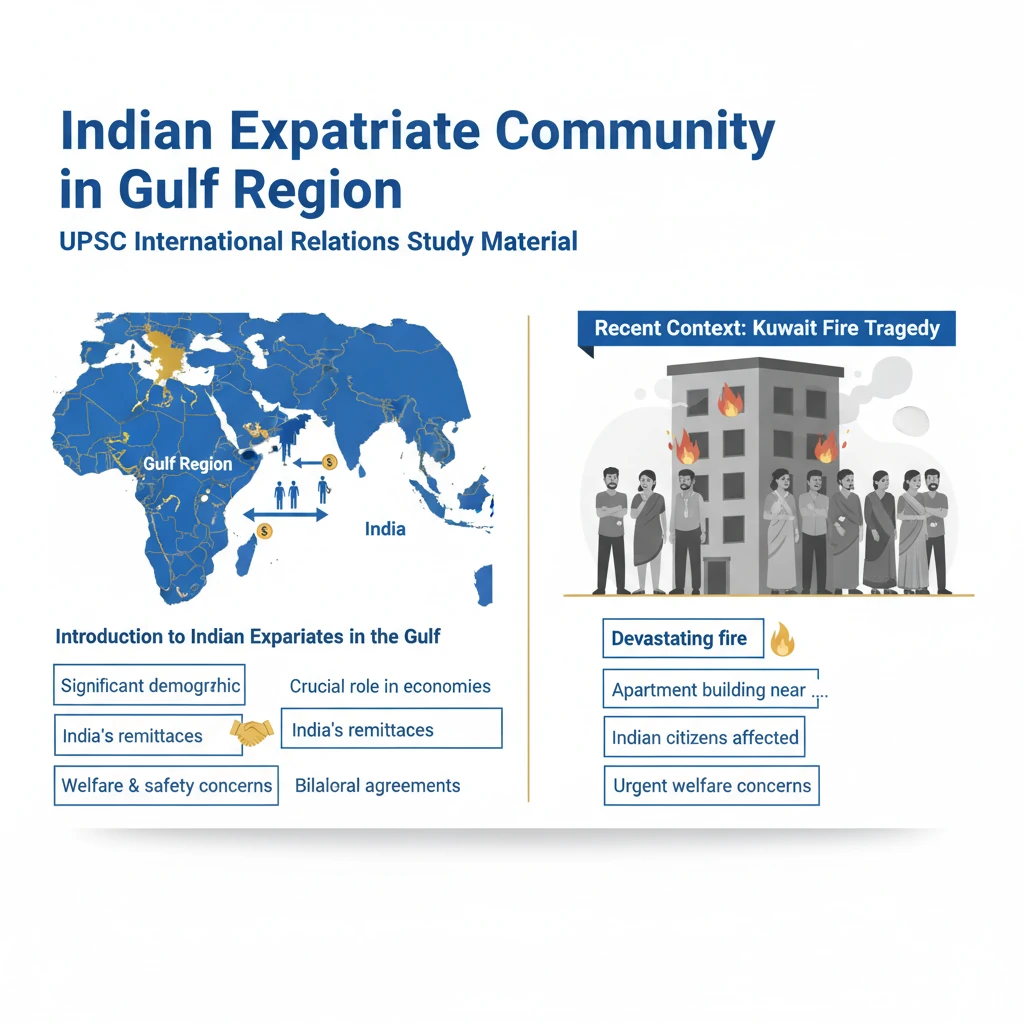
<h4>Introduction to Indian Expatriates in the Gulf</h4><p>The <strong>Indian expatriate community</strong> in the <strong>Gulf Region</strong> is a significant demographic, playing a crucial role in both the host countries' economies and India's remittances.</p><p>Their welfare and safety are paramount concerns, often highlighted by various incidents and bilateral agreements.</p><h4>Recent Context: Kuwait Fire Tragedy</h4><p>A devastating fire recently erupted in an apartment building near <strong>Kuwait City</strong>, leading to a tragic loss of life.</p><p>At least <strong>49 individuals</strong> perished in the incident, with approximately <strong>40 victims identified as Indian nationals</strong>.</p><div class='info-box'><ul><li>The apartment building housed over <strong>195 workers</strong>.</li><li>The majority of these workers were <strong>Indian nationals</strong>.</li><li>Victims hailed primarily from <strong>Kerala</strong>, <strong>Tamil Nadu</strong>, and various parts of <strong>northern India</strong>.</li></ul></div><div class='exam-tip-box'><p>This incident underscores the vulnerabilities faced by <strong>migrant workers</strong> in the Gulf and the importance of <strong>worker safety regulations</strong> and <strong>bilateral agreements</strong>.</p></div><h4>Understanding 'Expatriate'</h4><p>An <strong>expatriate</strong> is defined as an individual who lives and/or works in a country different from their country of citizenship.</p><p>This arrangement is typically <strong>temporary</strong> and often driven by <strong>work-related reasons</strong>.</p><div class='info-box'><p>An expatriate can also refer to an individual who has formally renounced citizenship in their home country to become a citizen of another nation.</p></div><h4>The Transfer of Sentenced Persons (TSP) Framework</h4><p>The <strong>Transfer of Sentenced Persons (TSP)</strong> agreement is a crucial mechanism enabling the transfer of prisoners between member states and other acceding countries.</p><p>Under this framework, sentenced individuals can seek to serve the remainder of their sentences in their home country.</p><div class='info-box'><ul><li>From <strong>2004 to January 2022</strong>, a total of <strong>86 prisoners</strong> were transferred under the TSP.</li><li>This included <strong>75 imprisoned Indian nationals</strong> who were transferred to India.</li><li>Additionally, <strong>11 foreign prisoners</strong> were transferred to their respective countries.</li></ul></div><div class='key-point-box'><p>The <strong>TSP</strong> mechanism is vital for humanitarian reasons, allowing prisoners to be closer to their families and cultural environment, facilitating rehabilitation.</p></div><h4>Current State of Indian Workers in the Gulf Region</h4><p>The <strong>Gulf Region</strong> hosts a significant number of Indian workers, who are primarily engaged in various sectors, contributing substantially to the economies of these nations.</p><p>Despite their contributions, these workers often face challenges related to working conditions, legal protections, and social integration.</p><h4>Evolution of the Indian Community in Kuwait</h4><p>The history of the <strong>Indian community in Kuwait</strong> has seen significant shifts, particularly influenced by regional conflicts.</p><p>The <strong>1990-1991 Gulf War</strong> triggered a mass exodus of Indian nationals from Kuwait.</p><div class='info-box'><p>Following Kuwait's liberation, a majority of the Indian community gradually returned, re-establishing their presence.</p><p>Subsequently, Indians became the <strong>largest expatriate community in Kuwait</strong>.</p></div><p>Prior to the liberation war, the <strong>Palestinians</strong> constituted the largest expatriate community in Kuwait.</p>
💡 Key Takeaways
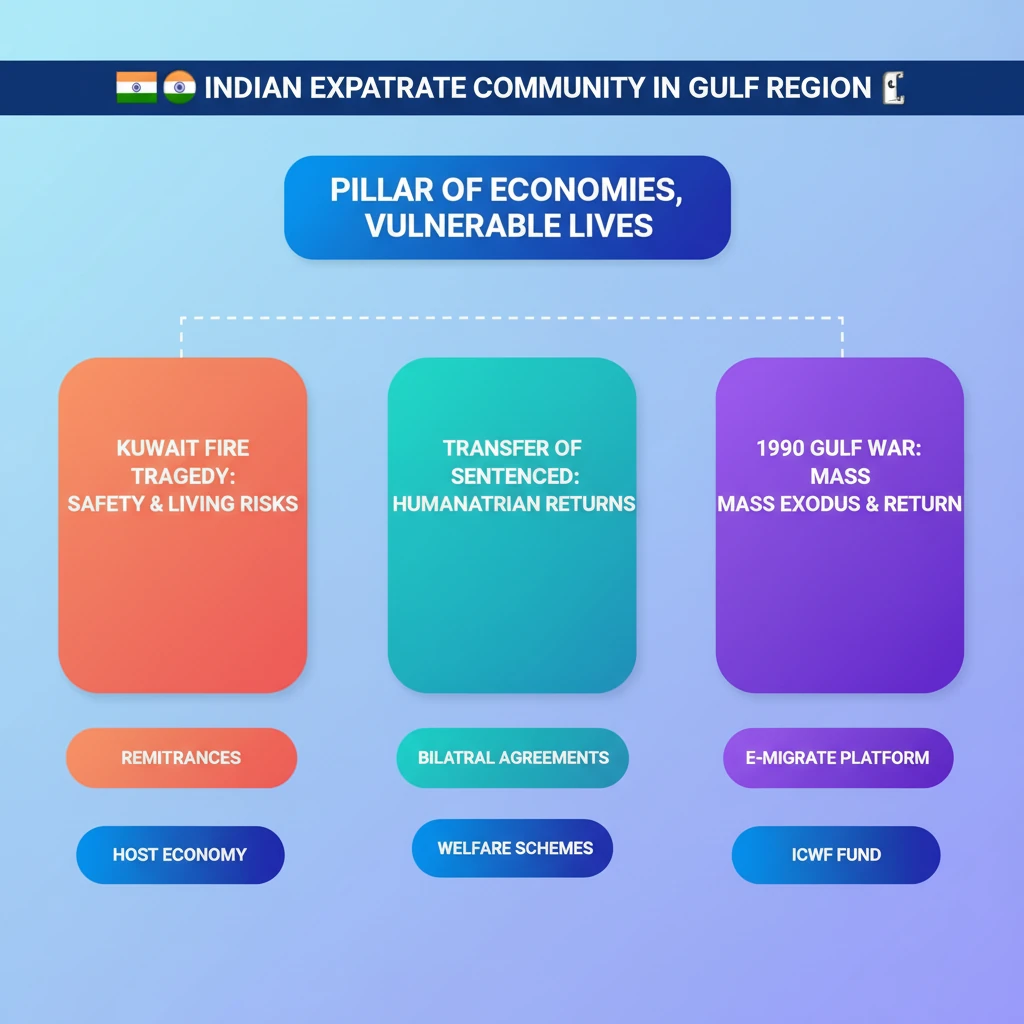
- •The Indian expatriate community in the Gulf is substantial, contributing significantly to both host economies and India's remittances.
- •Tragic incidents like the Kuwait fire highlight critical vulnerabilities faced by Indian migrant workers, including safety and living conditions.
- •The Transfer of Sentenced Persons (TSP) agreement is a key humanitarian mechanism for repatriating Indian prisoners.
- •The 1990-91 Gulf War significantly impacted the Indian community in Kuwait, leading to a mass exodus and subsequent return as the largest expatriate group.
- •India actively pursues bilateral agreements and welfare schemes (e.g., e-Migrate, ICWF) to protect its diaspora in the Gulf.
🧠 Memory Techniques

95% Verified Content