Why are Germany and India Important for Each Other? - International Relations | UPSC Learning
Topics
0 topics • 0 completed
🔍
No topics match your search
Why are Germany and India Important for Each Other?
Medium⏱️ 7 min read
international relations
📖 Introduction
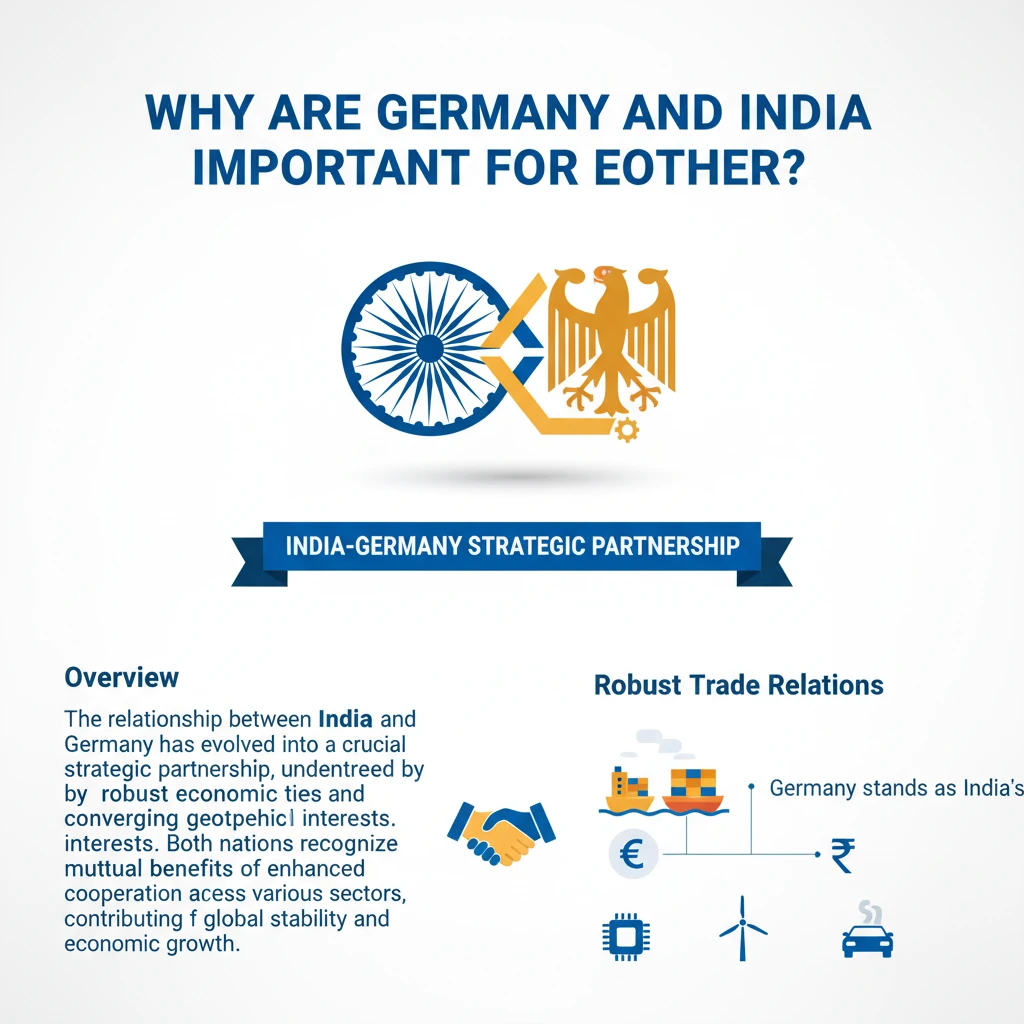
<h4>Overview of India-Germany Strategic Partnership</h4><p>The relationship between <strong>India</strong> and <strong>Germany</strong> has evolved into a crucial strategic partnership, underpinned by robust economic ties and converging geopolitical interests.</p><p>Both nations recognize the mutual benefits of enhanced cooperation across various sectors, contributing to global stability and economic growth.</p><h4>Robust Trade Relations</h4><p><strong>Germany</strong> stands as <strong>India’s largest trading partner</strong> within <strong>Europe</strong>, highlighting the significant volume and value of bilateral commerce between the two countries.</p><div class='info-box'><p>In <strong>Financial Year 2020-21</strong>, the total <strong>bilateral trade</strong> between <strong>India</strong> and <strong>Germany</strong> reached approximately <strong>USD 21.76 billion</strong>, underscoring a strong and consistent economic exchange.</p></div><p>This substantial trade volume encompasses a wide array of goods and services, ranging from machinery and automotive components to pharmaceuticals and IT services.</p><h4>Significant Foreign Direct Investment (FDI)</h4><p>Beyond trade, <strong>Germany</strong> is a crucial source of <strong>Foreign Direct Investment (FDI)</strong> for <strong>India</strong>, contributing significantly to India's economic development and industrial growth.</p><div class='info-box'><p>From <strong>April 2000</strong> to <strong>September 2021</strong>, <strong>Germany</strong> invested over <strong>USD 13 billion</strong> in <strong>India</strong>, making it the <strong>seventh-largest source of FDI</strong> for the country.</p></div><p>This investment flows into diverse sectors, including manufacturing, infrastructure, and technology, fostering job creation and technological advancement in India.</p><h4>Strategic Diversification and Geopolitical Alignment</h4><p>A key driver for strengthening ties is <strong>Germany’s strategic imperative</strong> to reduce its economic over-reliance on <strong>China</strong>.</p><div class='key-point-box'><p>In this context, <strong>India</strong> emerges as a <strong>key partner</strong> for <strong>Germany</strong>, offering a stable and growing market for diversifying its trade and investment relations, particularly within the <strong>Asian region</strong>.</p></div><p>This alignment reflects a broader geopolitical shift towards resilient supply chains and diversified partnerships in the Indo-Pacific.</p><div class='exam-tip-box'><p>For <strong>UPSC Mains GS Paper 2</strong> (International Relations), understanding this strategic diversification is crucial for analyzing India's role in global economic rebalancing.</p></div>
💡 Key Takeaways
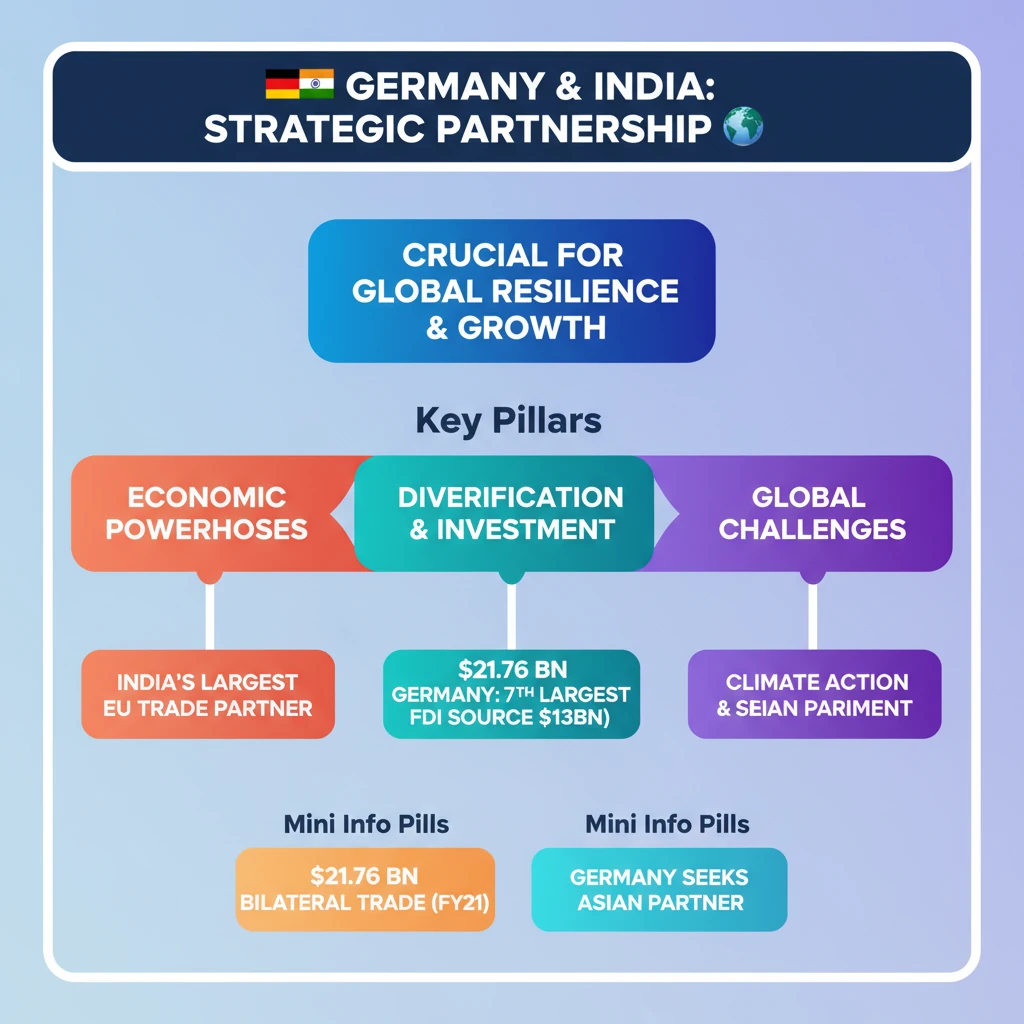
- •Germany is India's largest European trading partner.
- •Germany is the 7th largest FDI source for India, with over $13 billion invested (Apr 2000-Sep 2021).
- •Germany seeks to diversify its economic dependency from China, viewing India as a key Asian partner.
- •Bilateral trade between India and Germany amounted to $21.76 billion in FY 2020-21.
- •The partnership is crucial for economic resilience, strategic alignment, and addressing global challenges.
🧠 Memory Techniques

95% Verified Content
📚 Reference Sources
•Ministry of External Affairs (MEA) India reports on bilateral relations
•Department for Promotion of Industry and Internal Trade (DPIIT) FDI statistics
•General knowledge of international economic relations