High Seas Treaty - International Relations | UPSC Learning
Topics
0 topics • 0 completed
🔍
No topics match your search
High Seas Treaty
Medium⏱️ 10 min read
international relations
📖 Introduction
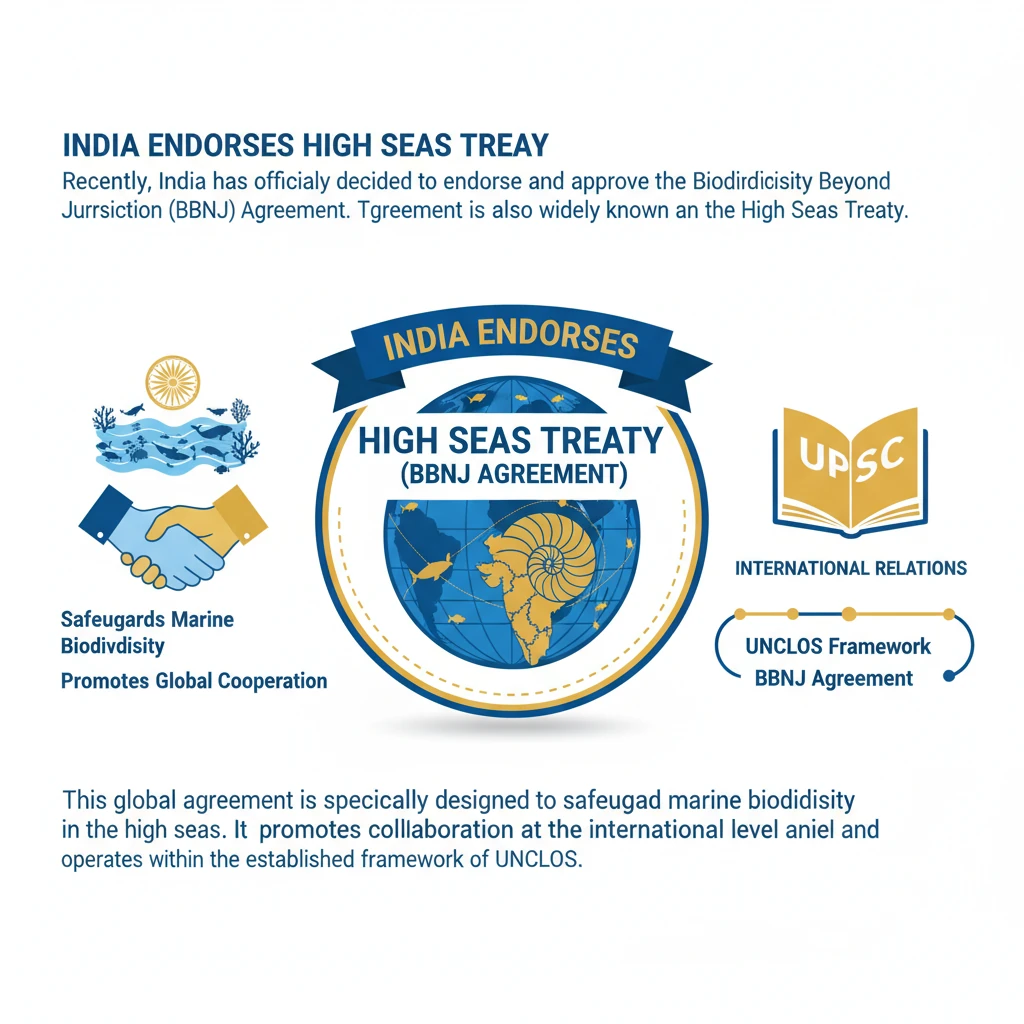
<h4>India Endorses High Seas Treaty</h4><p>Recently, <strong>India</strong> has officially decided to endorse and approve the <strong>Biodiversity Beyond National Jurisdiction (BBNJ) Agreement</strong>. This agreement is also widely known as the <strong>High Seas Treaty</strong>.</p><p>This global agreement is specifically designed to safeguard <strong>marine biodiversity</strong> in the high seas. It promotes collaboration at an international level and operates within the established framework of the <strong>United Nations Convention on the Law of the Sea (UNCLOS)</strong>.</p><div class='exam-tip-box'>📍 <strong>UPSC Prelims/Mains:</strong> India's endorsement is a significant development, highlighting its commitment to international environmental governance. This can be asked in GS-II (International Relations) and GS-III (Environment & Ecology).</div><h4>Understanding the High Seas</h4><p>The term <strong>'High Seas'</strong> refers to parts of the sea that are not included in the <strong>territorial waters</strong> or the <strong>internal waters</strong> of any country. This definition was established by the <strong>1958 Geneva Convention on the High Seas</strong>.</p><div class='info-box'><p><strong>Definition of High Seas:</strong></p><ul><li>Area beyond a country’s <strong>Exclusive Economic Zone (EEZ)</strong>.</li><li>The <strong>EEZ</strong> typically extends up to <strong>200 nautical miles</strong> from the coastline.</li><li>In this zone, no single country has exclusive jurisdiction over living and non-living resources.</li><li>No country is solely responsible for the management and protection of resources in these areas.</li></ul></div><h4>Significance of High Seas</h4><p>The high seas are immensely vital for global marine life and ecological balance. They represent a vast portion of our planet's oceans.</p><ul><li>The high seas cover over <strong>64%</strong> of the world’s oceans.</li><li>They constitute approximately <strong>50%</strong> of the Earth’s total surface.</li><li>These areas are home to around <strong>270,000 known species</strong>, with many more yet to be discovered.</li></ul><h4>Threats to High Seas Biodiversity</h4><p>Despite their critical importance, the high seas face numerous threats, both natural and anthropogenic, endangering their rich biodiversity.</p><ul><li><strong>Climate Change Impacts:</strong> High seas absorb significant heat from the atmosphere, making them vulnerable to phenomena like <strong>El Niño</strong> and <strong>ocean acidification</strong>.</li><li><strong>Species Extinction Risk:</strong> Current warming and acidification trends could lead to the extinction of several thousand marine species by <strong>2100</strong>.</li><li><strong>Anthropogenic Pressures:</strong></li><ul><li><strong>Seabed mining</strong> and <strong>noise pollution</strong>.</li><li><strong>Chemical and oil spills</strong> and fires.</li><li>Disposal of <strong>untreated waste</strong>, including antibiotics.</li><li><strong>Overfishing</strong> and unsustainable harvesting practices.</li><li>Introduction of <strong>invasive species</strong>.</li><li>Pollution originating from coastal areas.</li></ul></ul><p>Alarmingly, despite these severe threats, only about <strong>1%</strong> of the high seas are currently under formal protection.</p><h4>The High Seas Treaty (BBNJ Agreement)</h4><p>Formally known as the <strong>Agreement on Conservation and Sustainable Use of Marine Biological Diversity of Areas Beyond National Jurisdiction</strong>, this treaty is commonly referred to as <strong>BBNJ</strong> or the <strong>High Seas Treaty</strong>.</p><div class='info-box'><p><strong>Key Facts about the Treaty:</strong></p><ul><li>It is a new <strong>international legal framework</strong> operating under <strong>UNCLOS</strong>.</li><li>Aims to maintain the <strong>ecological health</strong> of the oceans.</li><li>Negotiated in <strong>2023</strong>.</li><li>Designed to reduce pollution, promote conservation, and ensure sustainable use of biodiversity and marine resources in areas beyond national jurisdiction.</li></ul></div><h4>Key Objectives of the High Seas Treaty</h4><p>The treaty outlines several crucial objectives to achieve its overarching goal of ocean protection and sustainable use.</p><ul><li><strong>Conservation and Protection of Marine Ecology:</strong> This includes the establishment of <strong>Marine Protected Areas (MPAs)</strong>. Activities within these MPAs would be regulated to conserve the marine ecosystem effectively.</li><li><strong>Fair and Equitable Sharing of Benefits of Marine Resources:</strong> The treaty aims to ensure that benefits derived from commercially valuable ocean organisms, whether through scientific research or commercial exploitation, are shared equally among all countries.</li><li><strong>Mandatory Environmental Impact Assessments (EIA):</strong> It makes it mandatory to conduct prior <strong>EIA</strong> for any activity that could potentially pollute or damage the marine ecosystem. This applies even if the activity is within a country’s national jurisdiction but its impact is expected in the high seas.</li><li><strong>Capacity Building and Transfer of Marine Technologies:</strong> This objective focuses on helping developing countries fully utilize the benefits of the oceans while simultaneously contributing to their conservation efforts.</li></ul><h4>Signing and Ratification Process</h4><p>The treaty requires widespread international acceptance to become legally binding and effective.</p><div class='info-box'><p><strong>Status of Treaty:</strong></p><ul><li>As of <strong>June 2023</strong>, <strong>81 countries</strong> had signed the treaty.</li><li>Out of these, <strong>8 countries</strong> had ratified it.</li><li>The treaty will become legally binding <strong>120 days</strong> after <strong>60 countries</strong> ratify it.</li></ul><p><strong>Distinction between Signing and Ratification:</strong></p><ul><li><strong>Signing:</strong> Indicates a country's agreement with the treaty's provisions but does not create a legal obligation.</li><li><strong>Ratification:</strong> The formal process by which a country agrees to be legally bound to the provisions of an international law. The specific process for ratification varies by country.</li></ul></div>
💡 Key Takeaways
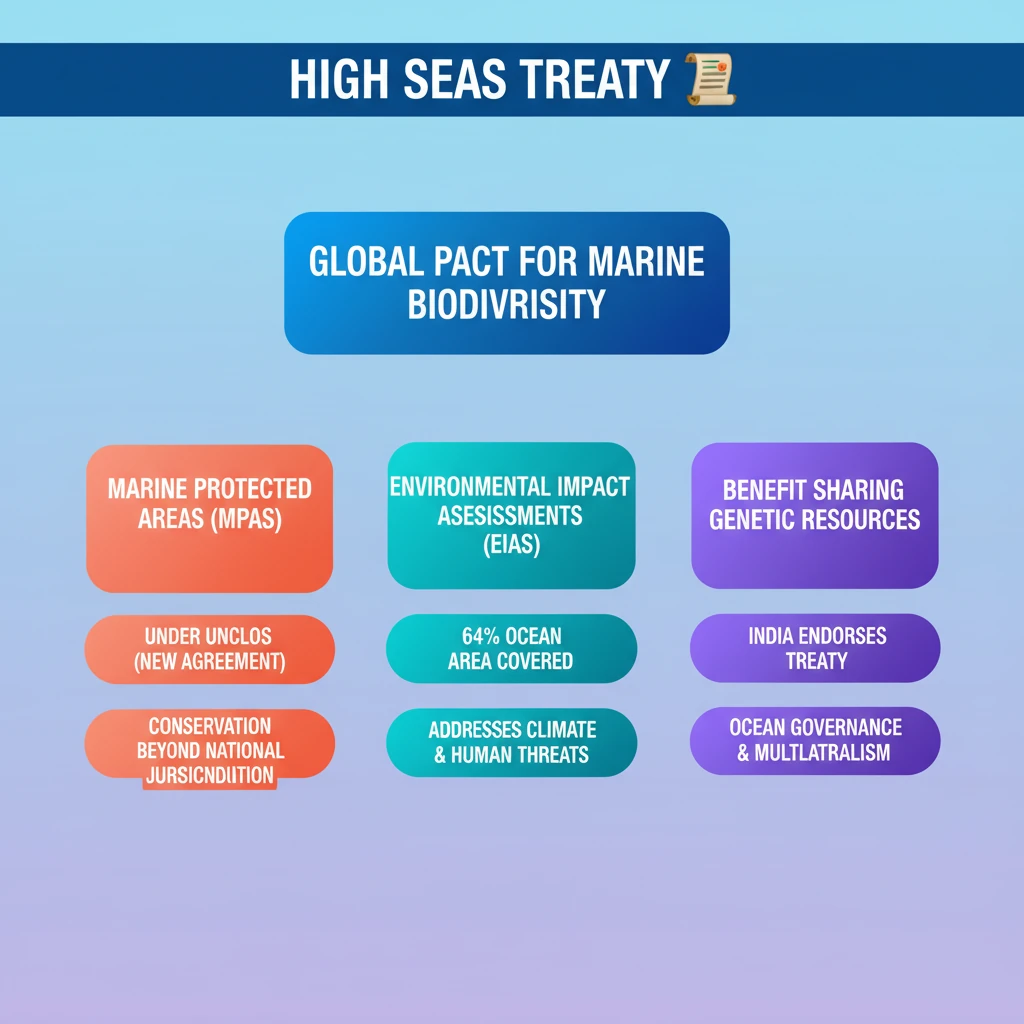
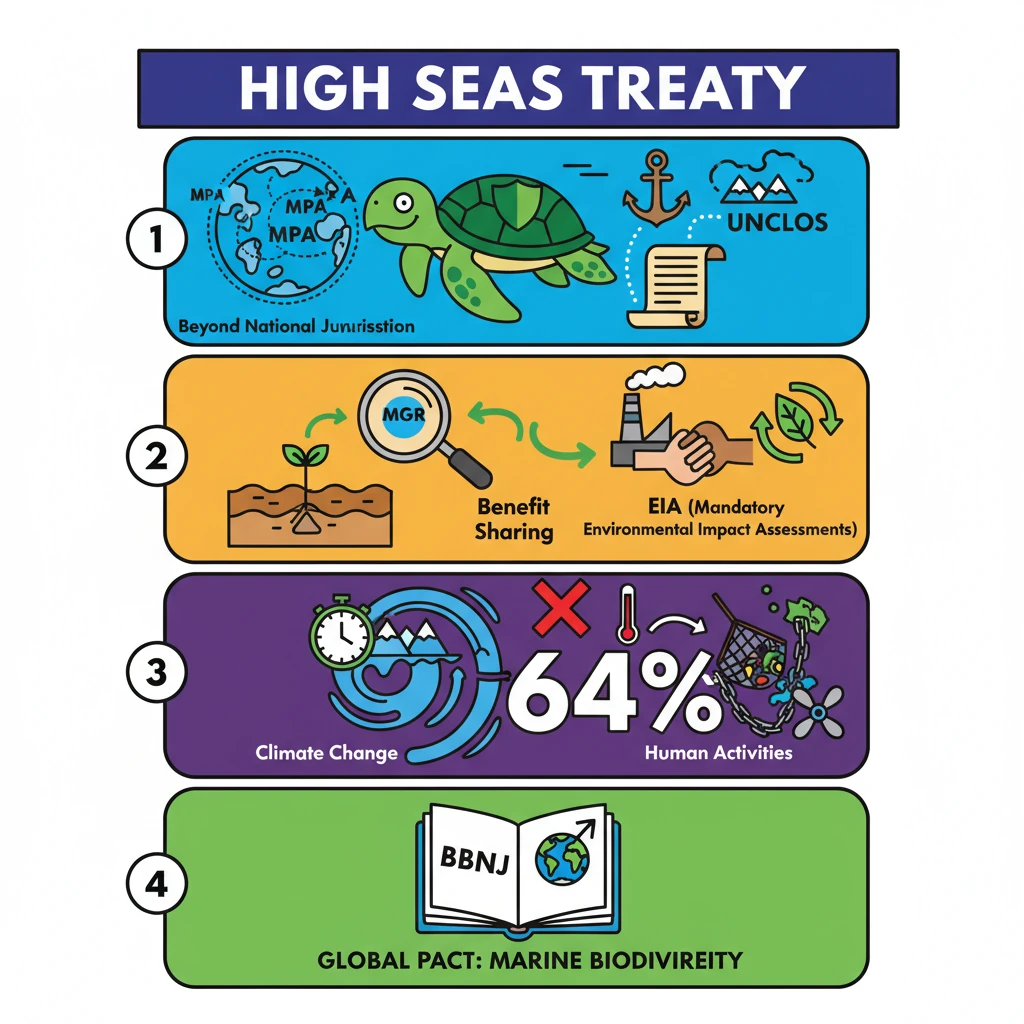
- •The High Seas Treaty (BBNJ Agreement) is a new global pact for conserving marine biodiversity beyond national jurisdiction.
- •It operates under UNCLOS, filling gaps in high seas governance.
- •Key objectives include establishing Marine Protected Areas (MPAs), mandatory EIAs, and equitable benefit sharing from marine genetic resources.
- •High seas cover over 64% of oceans and face severe threats from climate change and human activities.
- •India has endorsed the treaty, highlighting its commitment to ocean conservation and multilateralism.
- •The treaty becomes legally binding 120 days after 60 countries ratify it.
🧠 Memory Techniques
95% Verified Content
📚 Reference Sources
•United Nations Convention on the Law of the Sea (UNCLOS) official texts
•United Nations (UN) Ocean Conference reports and resolutions
•International Union for Conservation of Nature (IUCN) publications on high seas biodiversity
•Official statements from the Indian Ministry of External Affairs regarding treaty endorsement