BRICS: Evolution, Expansion, and Significance for Emerging Economies - International Relations | UPSC Learning
Topics
0 topics • 0 completed
🔍
No topics match your search

BRICS: Evolution, Expansion, and Significance for Emerging Economies
Medium⏱️ 5 min read
international relations
📖 Introduction
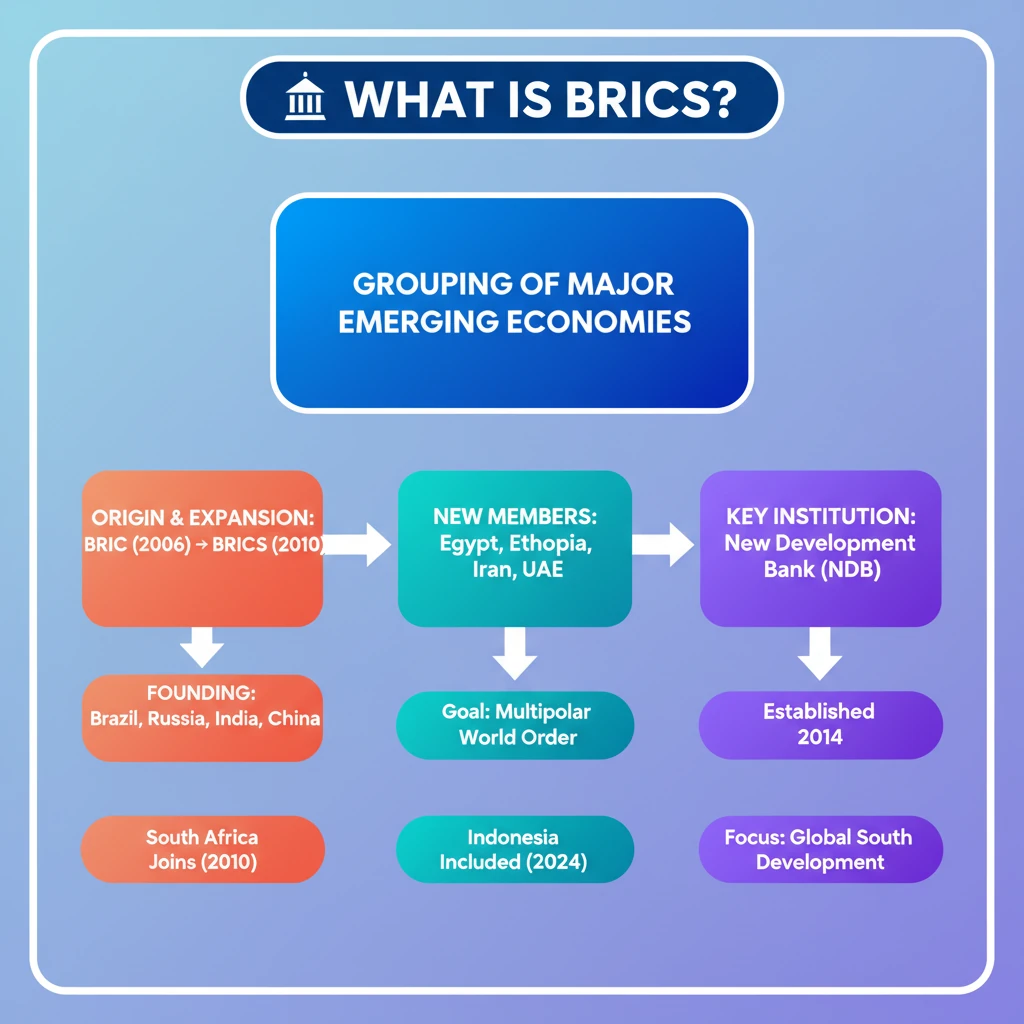
<h4>Formation of BRIC: The Genesis</h4><p>The concept of <strong>BRIC</strong> (<strong>Brazil</strong>, <strong>Russia</strong>, <strong>India</strong>, and <strong>China</strong>) was first formally recognized in <strong>2006</strong>.</p><p>Leaders of these four nations met informally on the sidelines of the <strong>G8 Outreach Summit</strong>, laying the groundwork for this significant grouping.</p><div class='info-box'><p><strong>Initial Members:</strong> <strong>Brazil</strong>, <strong>Russia</strong>, <strong>India</strong>, <strong>China</strong></p><p><strong>Year of Informal Formation:</strong> <strong>2006</strong></p><p><strong>Context:</strong> Sidelines of <strong>G8 (now G7) Outreach Summit</strong></p></div><h4>Expansion to BRICS: A Growing Influence</h4><p>The group expanded in <strong>2010</strong> with the inclusion of <strong>South Africa</strong>.</p><p>This addition transformed the acronym from <strong>BRIC</strong> to <strong>BRICS</strong>, signifying its growing geographical and economic reach.</p><div class='key-point-box'><p><strong>Key Expansion:</strong> <strong>South Africa</strong> joined in <strong>2010</strong>, forming <strong>BRICS</strong>.</p></div><h4>BRICS: A Bloc of Emerging Economies</h4><p><strong>BRICS</strong> represents a crucial grouping of the world’s leading <strong>emerging economies</strong>.</p><p>Its primary objective is to foster cooperation and address global challenges from the perspective of developing nations.</p><h4>Current Membership: A Global Footprint</h4><p>As of recent developments, the <strong>BRICS</strong> group has further expanded its membership.</p><p>It now comprises <strong>10 countries</strong>, enhancing its collective influence on the global stage.</p><div class='info-box'><p><strong>Current Members:</strong></p><ul><li><strong>Brazil</strong></li><li><strong>China</strong></li><li><strong>Egypt</strong></li><li><strong>Ethiopia</strong></li><li><strong>India</strong></li><li><strong>Iran</strong></li><li><strong>Russian Federation</strong></li><li><strong>South Africa</strong></li><li><strong>UAE</strong></li><li><strong>Indonesia</strong></li></ul></div><h4>Inaugural Summit and Key Milestones</h4><p>The first official <strong>BRIC summit</strong> was held in <strong>Yekaterinburg, Russia</strong>, in <strong>2009</strong>.</p><p>This event marked a significant step in formalizing the group's collaborative efforts and agenda.</p><p>A major achievement was the establishment of the <strong>New Development Bank (NDB)</strong>.</p><p>The agreement for the <strong>NDB</strong> was signed during the <strong>6th BRICS Summit</strong> in <strong>Fortaleza</strong> in <strong>2014</strong>.</p><div class='info-box'><p><strong>First BRIC Summit:</strong> <strong>Yekaterinburg, Russia</strong> (<strong>2009</strong>)</p><p><strong>New Development Bank (NDB) Establishment:</strong> Signed at <strong>6th BRICS Summit</strong> in <strong>Fortaleza</strong> (<strong>2014</strong>)</p></div><h4>Broader Objectives and Collaboration</h4><p>Beyond economic and political cooperation, <strong>BRICS</strong> countries are encouraged to collaborate on specific global issues.</p><p>This includes efforts towards <strong>conservation</strong> of <strong>vulnerable species</strong>, highlighting a commitment to environmental concerns.</p><div class='exam-tip-box'><p><strong>UPSC Insight:</strong> Understanding the <strong>evolution</strong> of <strong>BRICS</strong> from <strong>BRIC</strong>, its <strong>membership changes</strong>, and key institutions like the <strong>NDB</strong> is crucial for <strong>International Relations (GS-II)</strong>. Pay attention to the <strong>dates</strong> and <strong>locations</strong> of major summits.</p></div>
💡 Key Takeaways
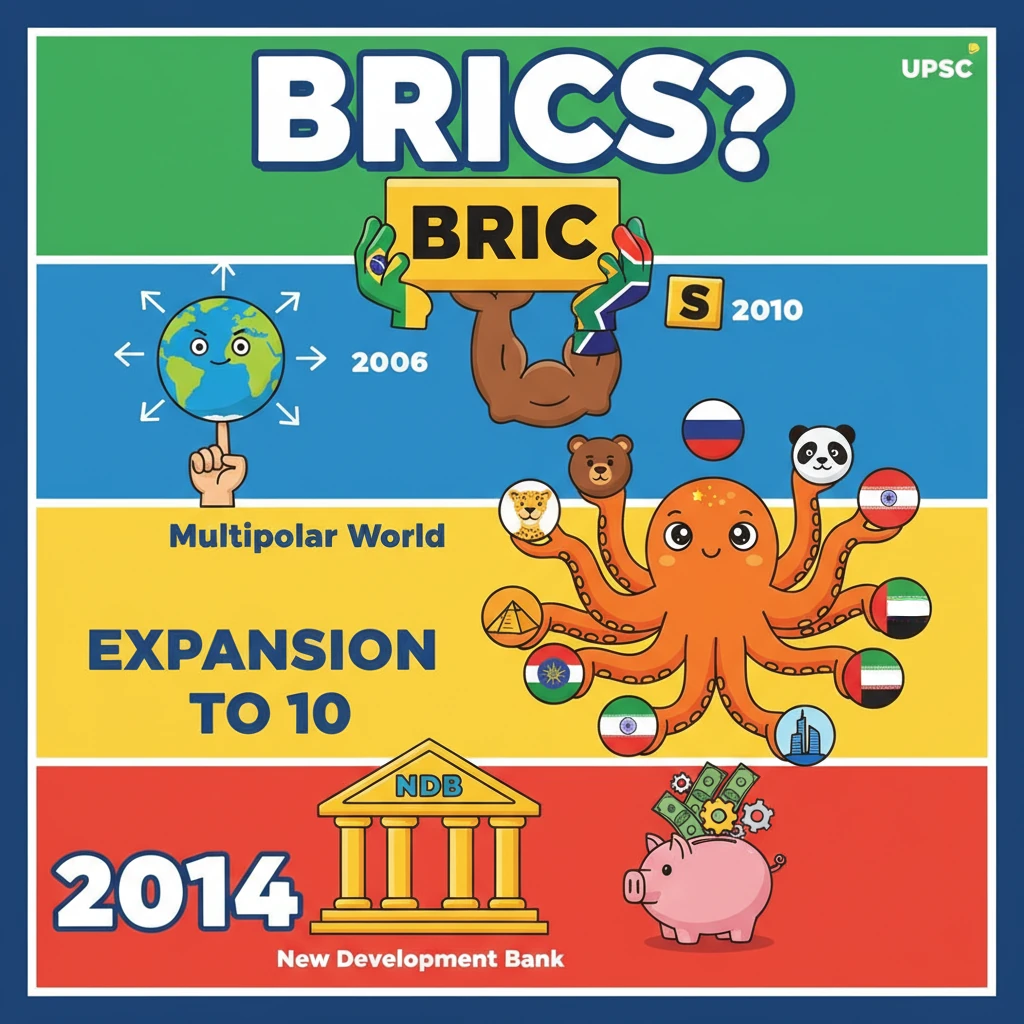
- •BRICS started as BRIC (Brazil, Russia, India, China) in 2006, with South Africa joining in 2010.
- •It represents a grouping of leading emerging economies, advocating for a multipolar world.
- •The group expanded to 10 members, including Egypt, Ethiopia, Iran, UAE, and Indonesia.
- •The New Development Bank (NDB), established in 2014, is a key institutional achievement.
- •BRICS aims to foster economic cooperation, sustainable development, and a stronger voice for the Global South.
🧠 Memory Techniques
98% Verified Content
📚 Reference Sources
•Official BRICS website (general knowledge)
•New Development Bank (NDB) official website (general knowledge)