Indus Water Treaty - International Relations | UPSC Learning
Topics
0 topics • 0 completed
🔍
No topics match your search
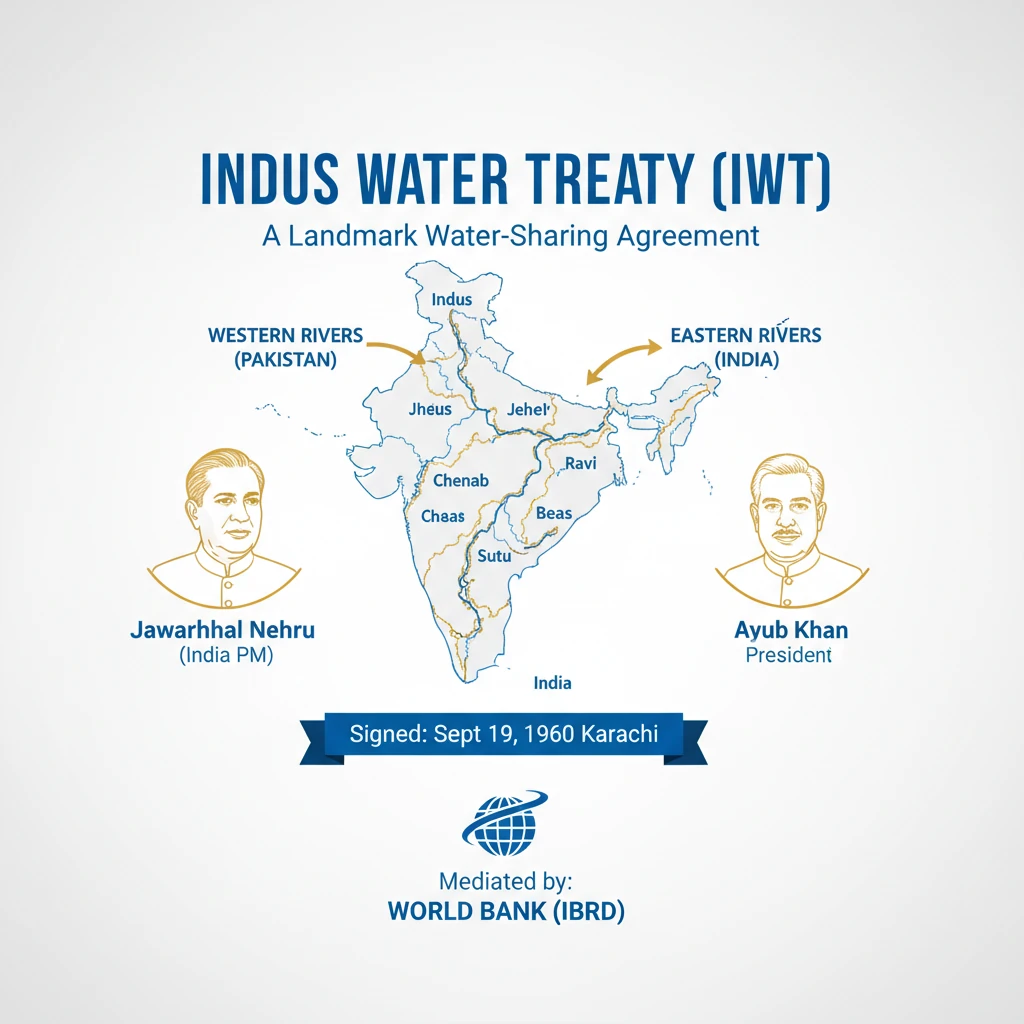
Indus Water Treaty
Medium⏱️ 7 min read
international relations
📖 Introduction
<h4>Introduction to the Indus Water Treaty (IWT)</h4><p>The <strong>Indus Water Treaty (IWT)</strong> is a landmark water-sharing agreement between <strong>India</strong> and <strong>Pakistan</strong>. It was signed on <strong>September 19, 1960</strong>, in <strong>Karachi</strong> by then-Indian Prime Minister <strong>Jawaharlal Nehru</strong> and Pakistani President <strong>Ayub Khan</strong>.</p><p>The <strong>World Bank (International Bank for Reconstruction and Development - IBRD)</strong> played a crucial role as a mediator in facilitating this treaty. It is considered one of the most successful water-sharing agreements globally, having survived multiple conflicts between the two nations.</p><div class='info-box'><p><strong>Key Fact:</strong> The <strong>IWT</strong> allocates the waters of the <strong>Indus River System</strong>, which comprises six rivers, between <strong>India</strong> and <strong>Pakistan</strong>.</p></div><h4>Division of Rivers under IWT</h4><p>The treaty meticulously divides the six rivers of the <strong>Indus Basin</strong> into two groups: <strong>Eastern Rivers</strong> and <strong>Western Rivers</strong>. This division ensures a clear framework for water utilization by both countries.</p><ul><li><strong>Eastern Rivers:</strong> <strong>Ravi</strong>, <strong>Beas</strong>, and <strong>Sutlej</strong>. These rivers are allocated for unrestricted use by <strong>India</strong>.</li><li><strong>Western Rivers:</strong> <strong>Indus</strong>, <strong>Jhelum</strong>, and <strong>Chenab</strong>. These rivers are primarily for the use of <strong>Pakistan</strong>, but <strong>India</strong> is permitted to construct run-of-the-river hydroelectric projects, irrigation, and storage facilities on them, subject to specific design criteria.</li></ul><div class='key-point-box'><p><strong>Core Principle:</strong> The <strong>IWT</strong> established the <strong>Permanent Indus Commission (PIC)</strong>, a bilateral commission, to implement and manage the treaty. It meets regularly to resolve disputes and exchange data.</p></div><h4>Recent Developments and Inspections</h4><p>Recently, a <strong>five-member Pakistani delegation</strong> visited <strong>Jammu’s Kishtwar</strong> to inspect various <strong>power projects</strong>. This inspection was conducted on rivers covered under the <strong>Indus Water Treaty (IWT) of 1960</strong>.</p><p>Such visits are part of the treaty's provisions, allowing either country to inspect projects on the rivers allocated to the other. This ensures transparency and adherence to the treaty's design specifications for projects.</p><div class='exam-tip-box'><p><strong>UPSC Insight:</strong> The <strong>IWT</strong> is frequently in the news due to its geopolitical significance. Questions often focus on its provisions, challenges, and its role in <strong>India-Pakistan relations</strong> (<strong>GS Paper 2</strong>).</p></div>
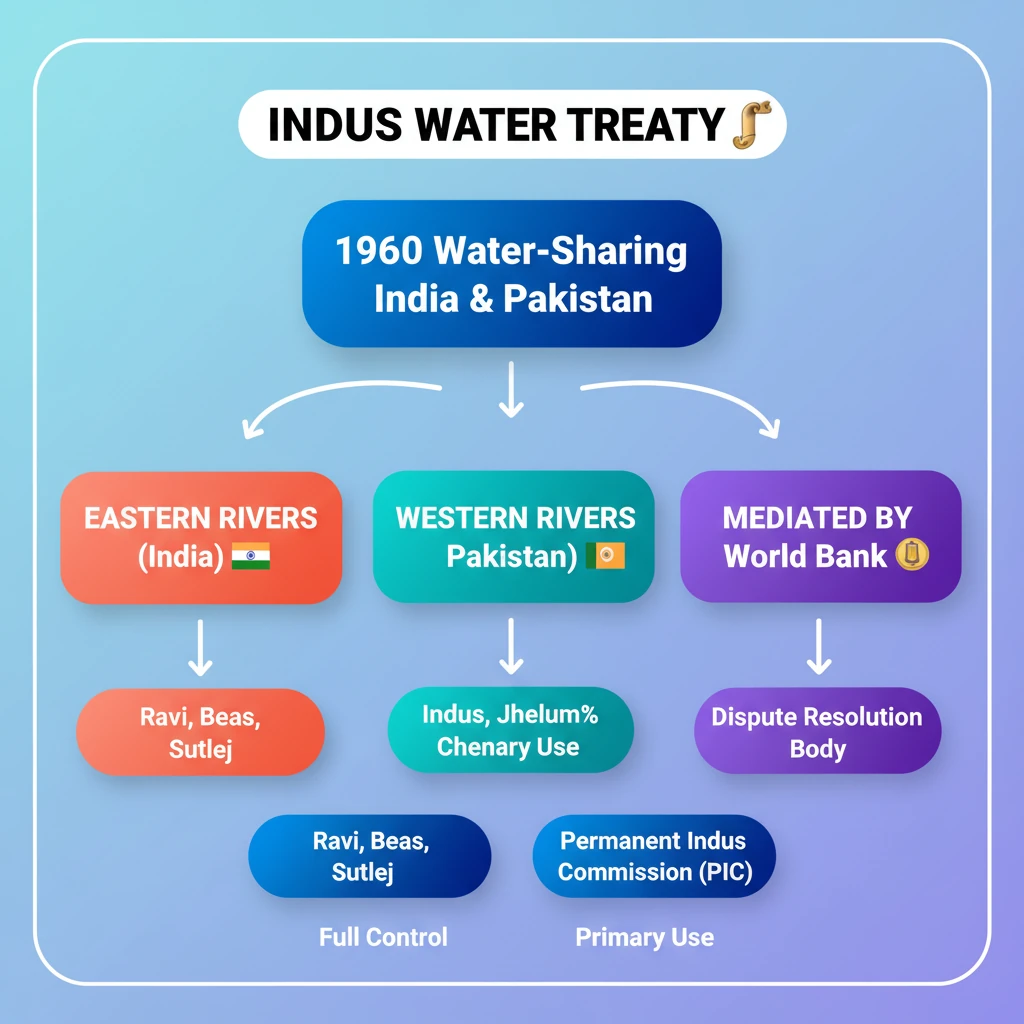
💡 Key Takeaways
- •The Indus Water Treaty (IWT) is a 1960 water-sharing agreement between India and Pakistan, mediated by the World Bank.
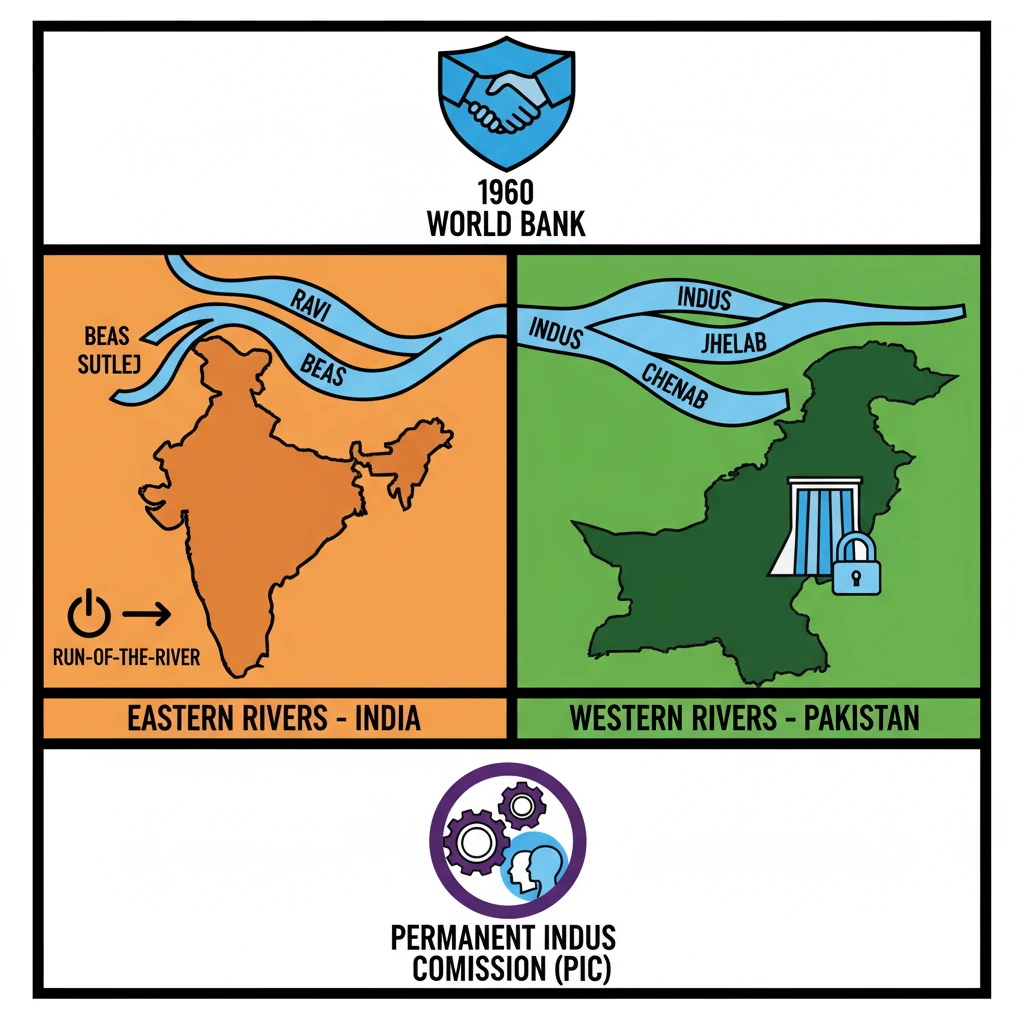
- •It divides six Indus Basin rivers: Eastern Rivers (Ravi, Beas, Sutlej) for India, Western Rivers (Indus, Jhelum, Chenab) primarily for Pakistan.
- •India can build run-of-the-river projects on Western Rivers, subject to design criteria.
- •The Permanent Indus Commission (PIC) is a bilateral body for treaty implementation and dispute resolution.
- •The treaty has survived multiple conflicts, demonstrating its resilience and importance for regional stability.
- •Recent inspections, like the Pakistani delegation's visit to Kishtwar, are part of the treaty's transparency mechanisms.
- •Challenges include climate change impacts and India's efforts to fully utilize its permitted share of Western River waters.
🧠 Memory Techniques
98% Verified Content
📚 Reference Sources
•World Bank publications on the IWT
•Ministry of External Affairs, Government of India official statements
•Drishti IAS current affairs analysis
•The Hindu and Indian Express news archives on IWT