International Criminal Court: Jurisdiction and Working - International Relations | UPSC Learning
Topics
0 topics • 0 completed
🔍
No topics match your search
International Criminal Court: Jurisdiction and Working
Medium⏱️ 7 min read
international relations
📖 Introduction
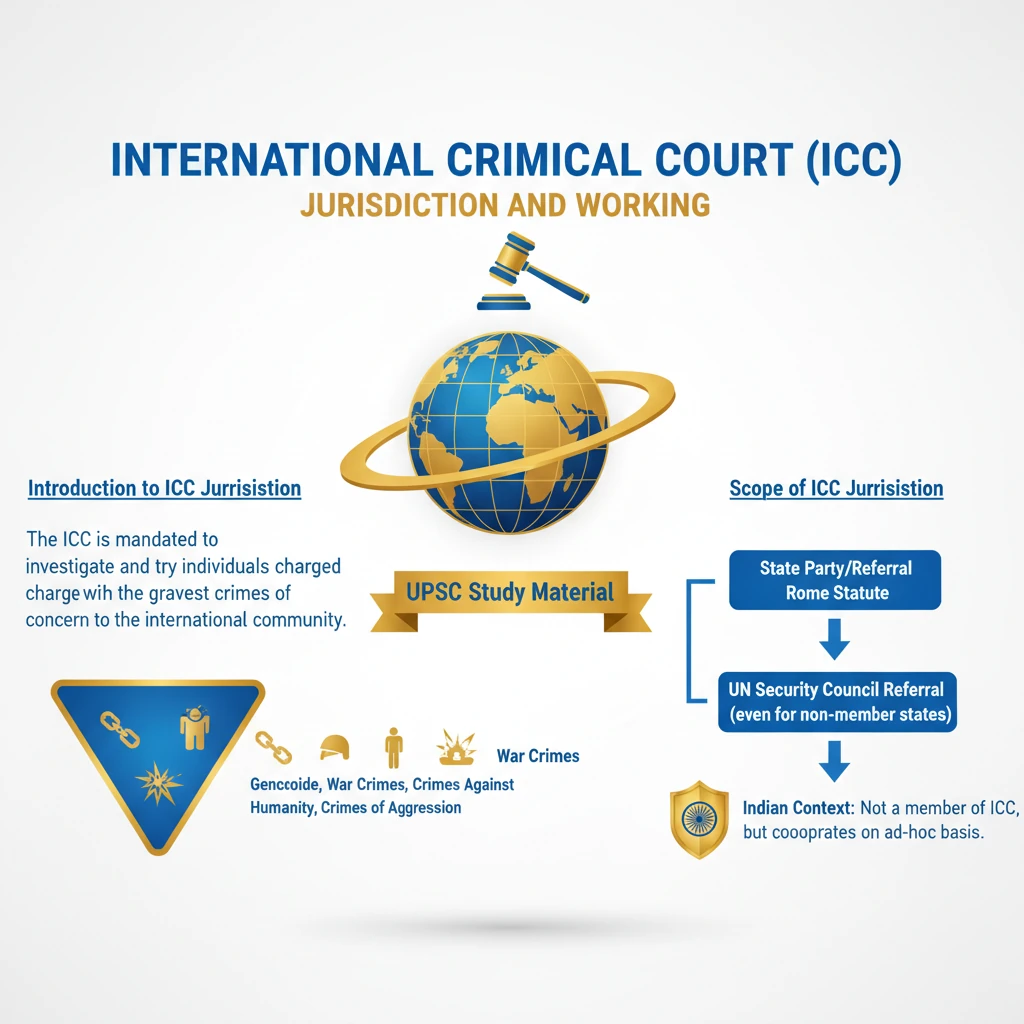
<h4>Introduction to ICC Jurisdiction</h4><p>The <strong>International Criminal Court (ICC)</strong> is mandated to investigate and, where warranted, try individuals charged with the gravest crimes of concern to the international community.</p><div class='info-box'><p>These severe crimes include <strong>genocide</strong>, <strong>war crimes</strong>, <strong>crimes against humanity</strong>, and <strong>crimes of aggression</strong>.</p></div><h4>Scope of ICC Jurisdiction</h4><p>The ICC's jurisdiction is activated under specific conditions, ensuring its focus on crimes that transcend national boundaries or national capabilities.</p><div class='key-point-box'><p>The Court can exercise jurisdiction if the crimes are committed by a <strong>State Party national</strong>, or in the <strong>territory of a State Party</strong>.</p></div><p>Furthermore, jurisdiction extends to situations where crimes occur in a <strong>State that has explicitly accepted the jurisdiction of the court</strong>.</p><h4>Role of the UN Security Council (UNSC)</h4><p>The <strong>United Nations Security Council (UNSC)</strong> plays a crucial role in referring cases to the ICC Prosecutor.</p><p>Such referrals are made pursuant to a resolution adopted under <strong>Chapter VII of the UN Charter</strong>, which deals with actions with respect to threats to the peace, breaches of the peace, and acts of aggression.</p><div class='exam-tip-box'><p>Understanding the <strong>UNSC's referral power</strong> is vital, as it can grant jurisdiction even when a situation might otherwise fall outside the Court's initial scope.</p></div><h4>Principle of Complementarity</h4><p>A fundamental principle guiding the ICC's operations is <strong>complementarity</strong>.</p><div class='info-box'><p>This means the ICC is intended to <strong>complement</strong>, not replace, national criminal justice systems.</p></div><p>The Court intervenes only when national authorities are genuinely <strong>unwilling or unable</strong> to prosecute such crimes effectively.</p><h4>ICC's Relationship with the United Nations</h4><p>It is important to note that the <strong>International Criminal Court (ICC) is not a United Nations organization</strong>.</p><p>However, it maintains a close working relationship with the <strong>UN</strong> through a dedicated <strong>cooperation agreement</strong>, facilitating coordination on international justice matters.</p><h4>States Not Accepting Jurisdiction</h4><p>Despite its global mandate, several prominent countries do not accept the ICC's jurisdiction over war crimes, genocide, and other grave crimes.</p><div class='highlight-box'><p>Key nations that do not recognize the Court's jurisdiction include <strong>Israel</strong>, the <strong>United States (US)</strong>, <strong>Russia</strong>, and <strong>China</strong>.</p></div><p>This non-acceptance often stems from concerns over sovereignty and potential political motivations behind prosecutions.</p>
💡 Key Takeaways
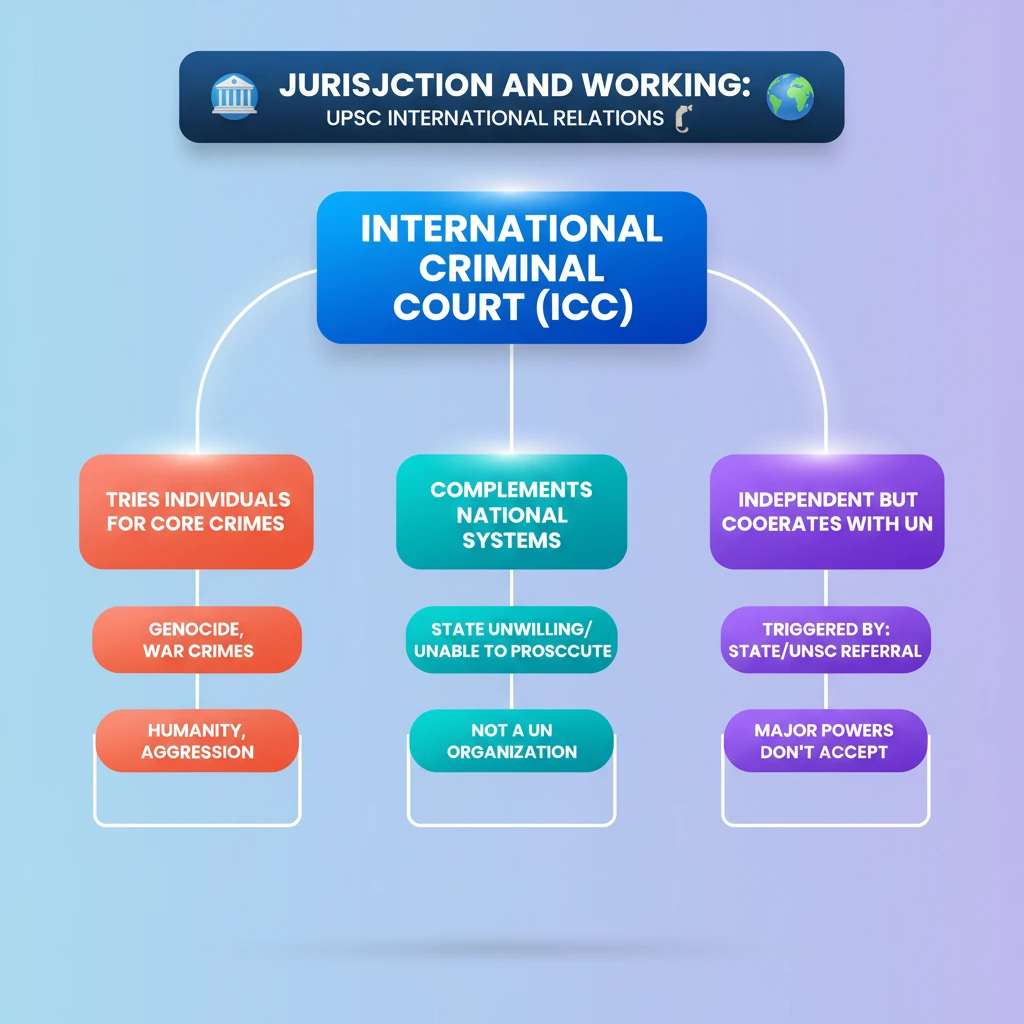
- •ICC investigates and tries individuals for genocide, war crimes, crimes against humanity, and crimes of aggression.
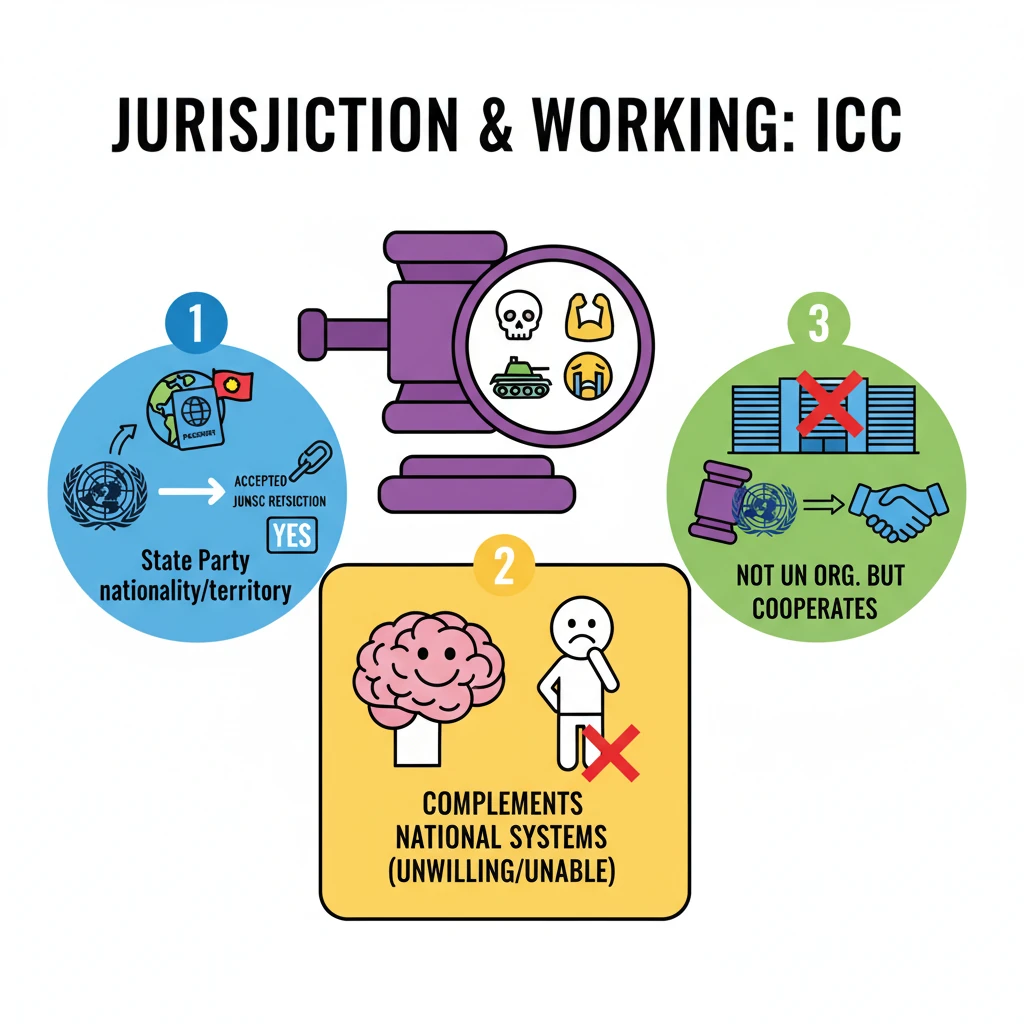
- •Jurisdiction is triggered by State Party nationality/territory, accepted jurisdiction, or UNSC referral.
- •ICC complements national systems, acting only when states are unwilling/unable to prosecute.
- •It is not a UN organization but cooperates with the UN.
- •Major powers like the US, Russia, China, and Israel do not accept its jurisdiction.
🧠 Memory Techniques
95% Verified Content
📚 Reference Sources
•Rome Statute of the International Criminal Court (Official Text)
•Official Website of the International Criminal Court (ICC.org)
•United Nations Charter (Chapter VII)