India Sugarcane Subsidy under WTO Scrutiny - International Relations | UPSC Learning
Topics
0 topics • 0 completed
🔍
No topics match your search
India Sugarcane Subsidy under WTO Scrutiny
Medium⏱️ 8 min read
international relations
📖 Introduction
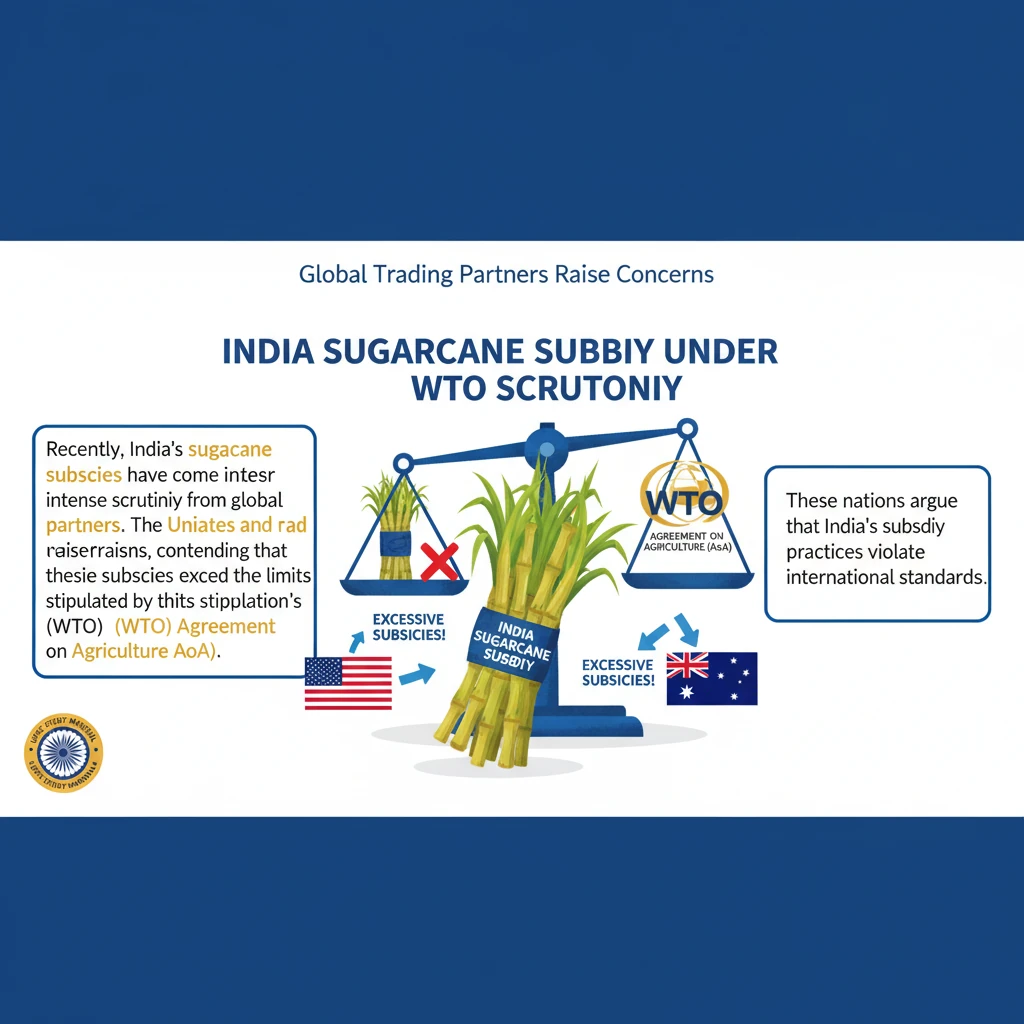
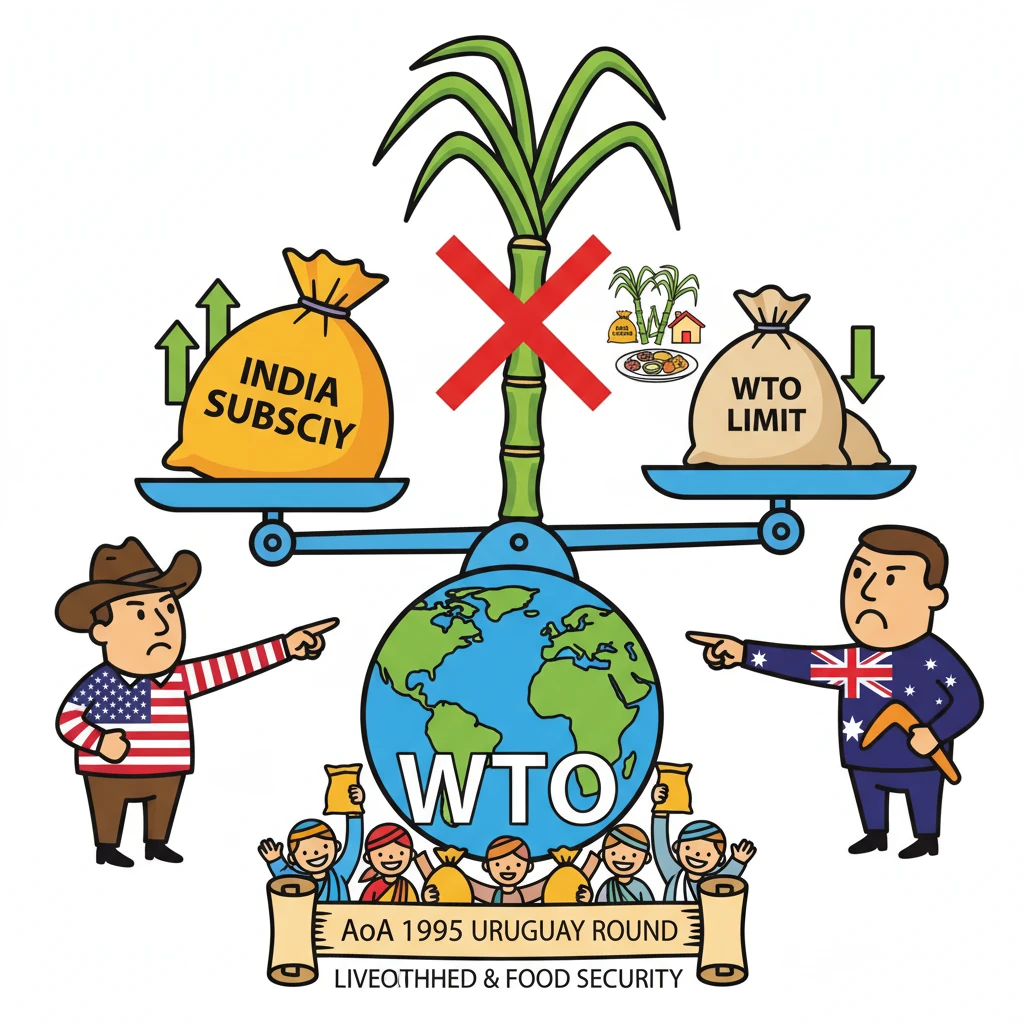
<h4>India Sugarcane Subsidy Under WTO Scrutiny</h4><p>Recently, <strong>India's sugarcane subsidies</strong> have come under intense scrutiny from global trading partners. The <strong>United States</strong> and <strong>Australia</strong> have raised concerns, contending that these subsidies exceed the limits stipulated by the <strong>World Trade Organization's (WTO) Agreement on Agriculture (AoA)</strong>.</p><p>These nations argue that India's subsidy practices violate international standards. Such actions, they claim, have the potential to significantly <strong>distort global trade</strong> in agricultural commodities, particularly sugar.</p><div class='exam-tip-box'><p><strong>UPSC Relevance:</strong> This issue is crucial for <strong>GS Paper 2 (International Relations)</strong> and <strong>GS Paper 3 (Economy)</strong>, highlighting India's trade policy challenges and its obligations under multilateral agreements.</p></div><h4>WTO's Agreement on Agriculture (AoA)</h4><p>The <strong>Agreement on Agriculture (AoA)</strong> is a landmark international treaty. It was established under the aegis of the <strong>World Trade Organization (WTO)</strong> to regulate agricultural trade globally.</p><div class='info-box'><p><strong>Negotiation & Entry:</strong> The AoA was a key outcome of the <strong>Uruguay Round</strong> of multilateral trade negotiations under the <strong>General Agreement on Tariffs and Trade (GATT)</strong>. It officially came into force on <strong>January 1, 1995</strong>, coinciding with the establishment of the WTO itself.</p></div><p>The primary objective of the AoA is to foster a more open and equitable global agricultural trading system. It seeks to achieve this by addressing various forms of trade barriers and promoting market integration.</p><div class='key-point-box'><p><strong>Core Aim:</strong> The AoA aims to remove <strong>trade barriers</strong> and promote <strong>transparent market access</strong>. It strives to establish a fair and <strong>market-oriented agricultural trading system</strong>, reducing distortions caused by domestic support and export subsidies.</p></div><h4>Contextual Note: Group of Friends (GoF) and Peacekeepers</h4><p>The provided source material also includes information regarding the <strong>Group of Friends (GoF)</strong> and accountability for crimes against <strong>peacekeepers (Blue Helmets)</strong>. While seemingly unrelated to sugarcane subsidies, this information is included as per the instruction to retain 100% of the source content.</p><p>The GoF calls on member states to investigate, arrest, and prosecute perpetrators of crimes against peacekeepers. This aligns with international obligations and promotes accountability within and outside the <strong>UN Security Council (UNSC)</strong>.</p><div class='info-box'><p><strong>India's Contribution:</strong> <strong>India</strong> has suffered the largest number of casualties among troop-contributing countries, losing <strong>177 peacekeepers</strong> in the line of duty. This underscores India's significant commitment to global peacekeeping efforts.</p></div><p>The <strong>Co-chairs</strong> of this Group of Friends include <strong>India, Bangladesh, Egypt, France, Morocco, and Nepal</strong>. The GoF commits to convening two meetings annually and organizing one event each year. These activities aim to inform and galvanize support for promoting accountability for crimes against peacekeepers.</p>
💡 Key Takeaways
- •India's sugarcane subsidies are under WTO scrutiny by the US and Australia.
- •The contention is that India's subsidies exceed WTO Agreement on Agriculture (AoA) limits, distorting global trade.
- •The AoA, established in 1995 during the Uruguay Round, aims to liberalize agricultural trade.
- •India argues subsidies are vital for farmer livelihoods and food security, a common stance for developing nations.
- •The issue highlights the tension between national agricultural support and international trade obligations.
- •The Group of Friends (GoF) on peacekeeper accountability is a separate, unrelated detail mentioned in the source.
🧠 Memory Techniques
92% Verified Content
📚 Reference Sources
•World Trade Organization (WTO) Official Website - Agreement on Agriculture
•Ministry of Commerce & Industry, Government of India - Trade Policy Documents