How India-Indonesia Ties Evolved Overtime? - International Relations | UPSC Learning
Topics
0 topics • 0 completed
🔍
No topics match your search
How India-Indonesia Ties Evolved Overtime?
Medium⏱️ 6 min read
international relations
📖 Introduction
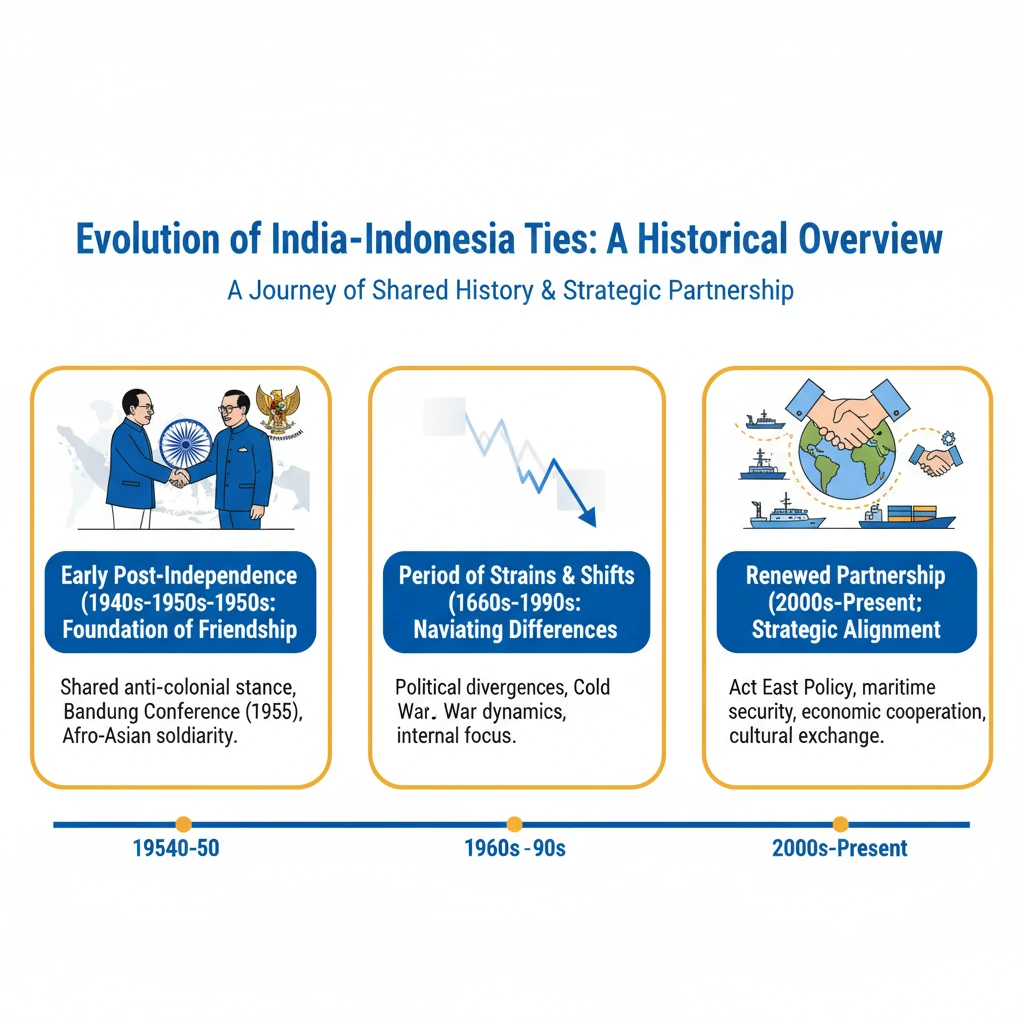
<h4>Evolution of India-Indonesia Ties: A Historical Overview</h4><p>The relationship between <strong>India</strong> and <strong>Indonesia</strong> has traversed through various phases, marked by periods of strong camaraderie and occasional strains. Understanding this evolution is crucial for grasping their current strategic partnership.</p><h4>Early Post-Independence Period (1940s-1950s): Foundation of Friendship</h4><p>During the immediate post-independence era, <strong>India</strong>, under Prime Minister <strong>Jawaharlal Nehru</strong>, extended unequivocal support to <strong>Indonesia's</strong> struggle for independence from <strong>Dutch colonial rule</strong>.</p><div class='info-box'><p>A significant milestone was the signing of a <strong>Treaty of Friendship</strong> in <strong>1951</strong>, formalizing their burgeoning bilateral relations.</p></div><p>This period witnessed flourishing cooperation across various sectors, including <strong>trade</strong>, <strong>culture</strong>, and <strong>military matters</strong>.</p><div class='key-point-box'><p>Both nations shared common ideological ground, aligning strongly on principles such as <strong>non-alignment</strong>, <strong>anti-colonialism</strong>, and <strong>peaceful coexistence</strong>.</p></div><p>Their shared vision led to active participation in the landmark <strong>1955 Bandung Conference</strong> and subsequently, the formation of the <strong>Non-Aligned Movement (NAM)</strong> in <strong>1961</strong>.</p><h4>Detente Ties (1960s): Period of Strain</h4><p>The <strong>1960s</strong> marked a period of strain in <strong>India-Indonesia</strong> relations. This was primarily due to shifts in geopolitical alignments and regional conflicts.</p><p><strong>India's</strong> ties with <strong>China</strong> deteriorated significantly following the <strong>1959 Tibetan uprising</strong> and the devastating <strong>Sino-Indian War of 1962</strong>.</p><p>Concurrently, <strong>Indonesia</strong> maintained cordial relations with <strong>China</strong>, creating a divergence in foreign policy priorities between Delhi and Jakarta.</p><div class='info-box'><p>A notable point of friction occurred during the <strong>1965 India-Pakistan conflict</strong>, when <strong>Indonesia</strong> sided with <strong>Pakistan</strong>, offering solidarity and military aid.</p></div><h4>Cold War Era (1966-1980s): Rebuilding Bridges</h4><p>Following the tumultuous 1960s, a period of rapprochement began. Under President <strong>Suharto</strong>, <strong>Indonesia</strong> strategically moved away from its earlier alignment with <strong>China</strong>.</p><p>This shift paved the way for efforts to rebuild and strengthen ties with <strong>India</strong>.</p><div class='info-box'><p>Key agreements facilitated this improvement, including the signing of a <strong>maritime boundary pact</strong> in <strong>1977</strong>.</p></div><p>The visit of President <strong>Suharto</strong> to <strong>India</strong> in <strong>1980</strong> further cemented the renewed diplomatic efforts and signaled a positive trajectory for bilateral relations.</p>
💡 Key Takeaways
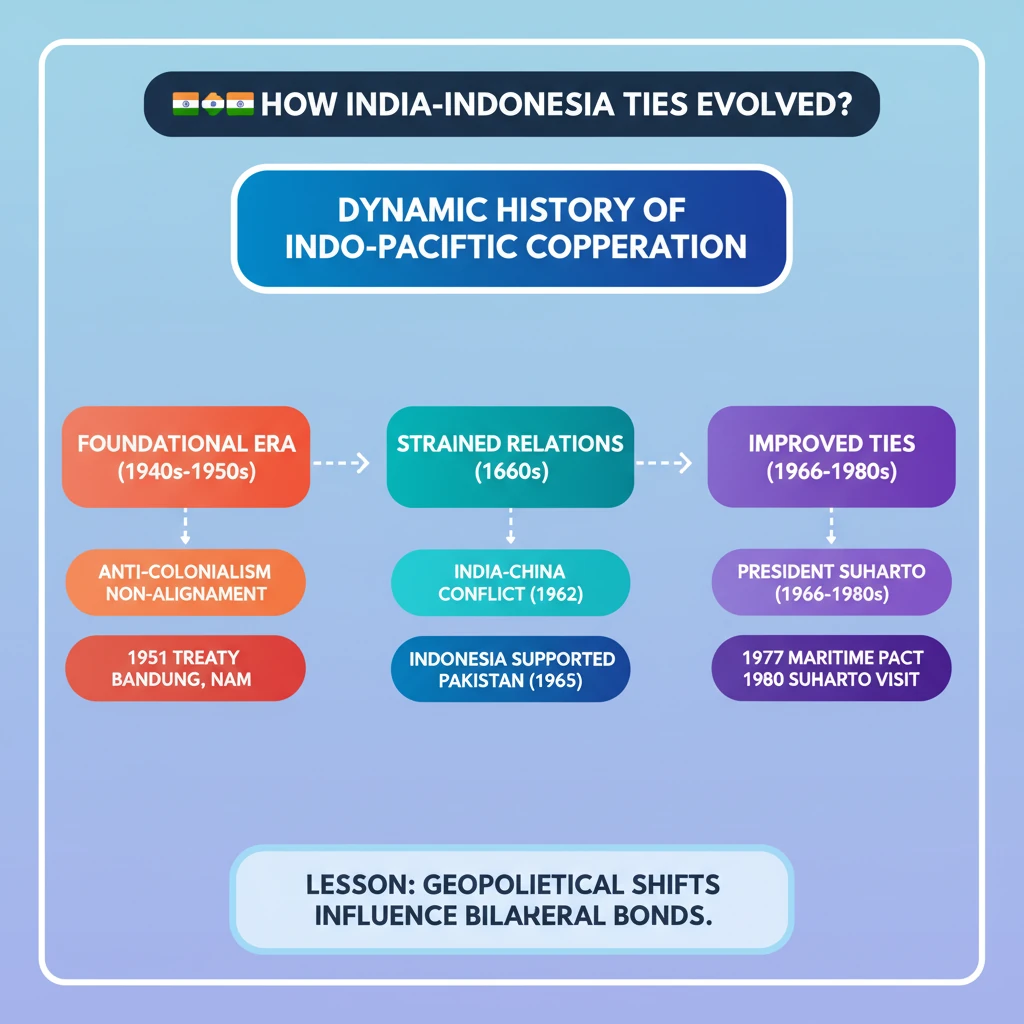
- •Early ties (1940s-50s) were strong, built on anti-colonialism, non-alignment, and resulted in the 1951 Treaty of Friendship, Bandung Conference, and NAM.
- •The 1960s saw strained relations due to India-China conflict and Indonesia's support for Pakistan in 1965.
- •Under President Suharto (1966-1980s), ties improved, marked by the 1977 maritime pact and Suharto's 1980 visit.
- •Historical evolution highlights the dynamic nature of international relations and the influence of geopolitical shifts.
- •Understanding this past is crucial for comprehending current Indo-Pacific cooperation.
🧠 Memory Techniques
95% Verified Content