International Treaties for Nuclear Programs - International Relations | UPSC Learning
Topics
0 topics • 0 completed
🔍
No topics match your search
International Treaties for Nuclear Programs
Medium⏱️ 6 min read
international relations
📖 Introduction
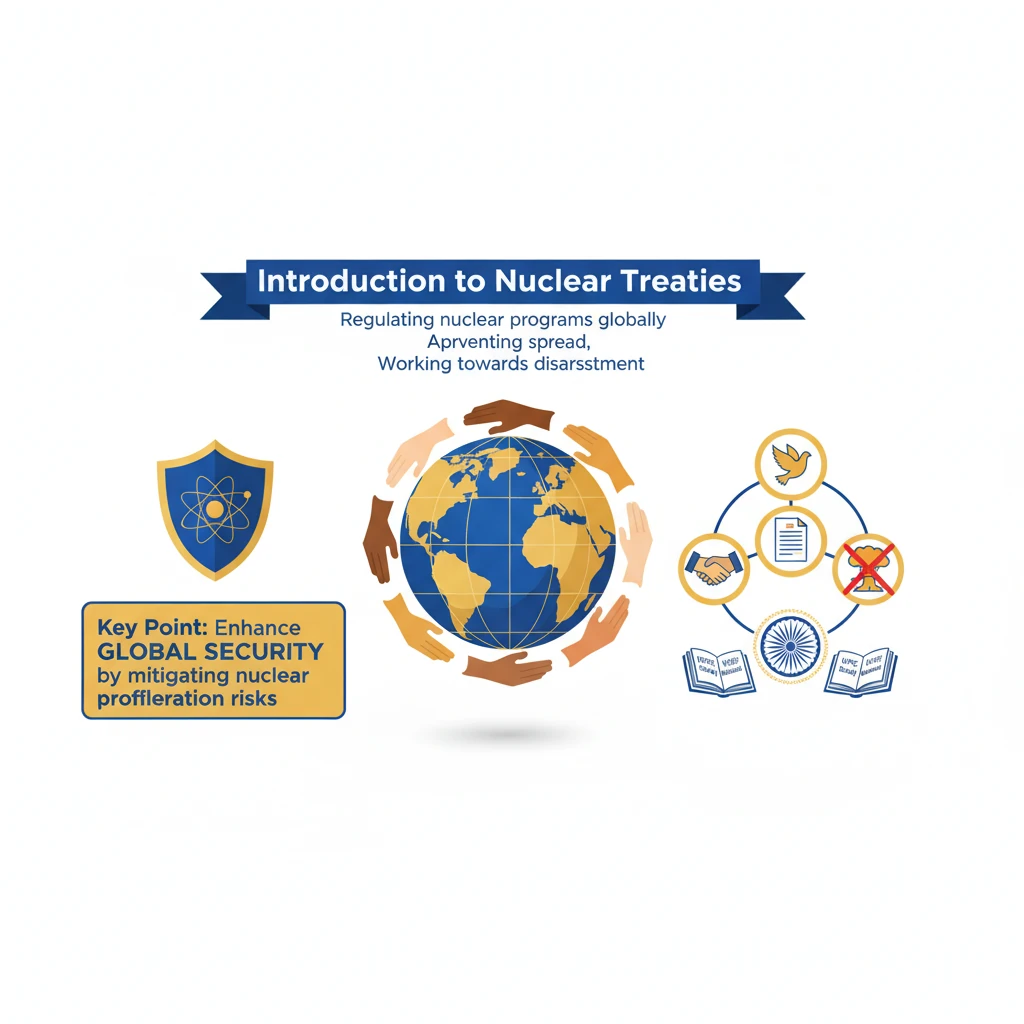
<h4>Introduction to Nuclear Treaties</h4><p>International treaties play a crucial role in regulating <strong>nuclear programs</strong> globally. These agreements aim to prevent the spread of <strong>nuclear weapons</strong>, control their testing, and ultimately work towards disarmament.</p><div class='key-point-box'><p>The primary goal of these treaties is to enhance <strong>global security</strong> by mitigating the risks associated with <strong>nuclear proliferation</strong> and <strong>nuclear weapons testing</strong>.</p></div><h4>The Treaty on the Non-Proliferation of Nuclear Weapons (NPT)</h4><p>The <strong>NPT</strong> is a landmark international treaty whose objective is to prevent the spread of <strong>nuclear weapons</strong> and <strong>weapons technology</strong>, to promote cooperation in the peaceful uses of nuclear energy, and to further the goal of achieving <strong>nuclear disarmament</strong>.</p><div class='info-box'><p>It was opened for signature in <strong>1968</strong> and entered into force in <strong>1970</strong>. It divides states into <strong>Nuclear-Weapon States (NWS)</strong> and <strong>Non-Nuclear-Weapon States (NNWS)</strong> based on whether they had tested a nuclear weapon before <strong>1967</strong>.</p></div><div class='exam-tip-box'><p>UPSC often asks about India's stance on the <strong>NPT</strong>, as India is one of the few countries that has not signed it, citing its discriminatory nature.</p></div><h4>Partial Test Ban Treaty (PTBT)</h4><p>The <strong>Partial Test Ban Treaty (PTBT)</strong> was an early effort to limit nuclear testing. It specifically prohibited nuclear weapon tests in certain environments to reduce radioactive fallout.</p><div class='info-box'><p>Signed in <strong>1963</strong>, the <strong>PTBT</strong> bans nuclear weapon tests in the <strong>atmosphere</strong>, <strong>outer space</strong>, and <strong>under water</strong>. Underground tests were still permitted under this treaty.</p></div><h4>Comprehensive Nuclear Test Ban Treaty (CTBT)</h4><p>Building upon the <strong>PTBT</strong>, the <strong>Comprehensive Nuclear Test Ban Treaty (CTBT)</strong> aims for a complete prohibition of all nuclear weapon test explosions. This includes tests conducted underground, which were allowed under the PTBT.</p><div class='info-box'><p>The <strong>CTBT</strong> was signed in <strong>1996</strong>. However, it has not yet entered into force due to non-ratification by several key states, including <strong>India</strong>, <strong>Pakistan</strong>, <strong>North Korea</strong>, and others whose ratification is required for its entry into force.</p></div><div class='exam-tip-box'><p>Understanding the difference between <strong>PTBT</strong> and <strong>CTBT</strong> is crucial for Mains. Note the shift from partial to comprehensive bans.</p></div><h4>Treaty on the Prohibition of Nuclear Weapons (TPNW)</h4><p>The <strong>Treaty on the Prohibition of Nuclear Weapons (TPNW)</strong> represents a more recent and absolute approach to nuclear disarmament. It seeks to completely outlaw nuclear weapons, similar to how chemical and biological weapons are prohibited.</p><div class='info-box'><p>The <strong>TPNW</strong> was adopted in <strong>2017</strong> and entered into force on <strong>January 22nd, 2021</strong>. It prohibits states parties from developing, testing, producing, manufacturing, otherwise acquiring, possessing, or stockpiling nuclear weapons or other nuclear explosive devices.</p></div><div class='key-point-box'><p>Unlike the <strong>NPT</strong>, which aims to prevent proliferation, the <strong>TPNW</strong> directly seeks the total elimination of nuclear weapons. However, no nuclear-weapon states have signed the <strong>TPNW</strong>.</p></div>
💡 Key Takeaways
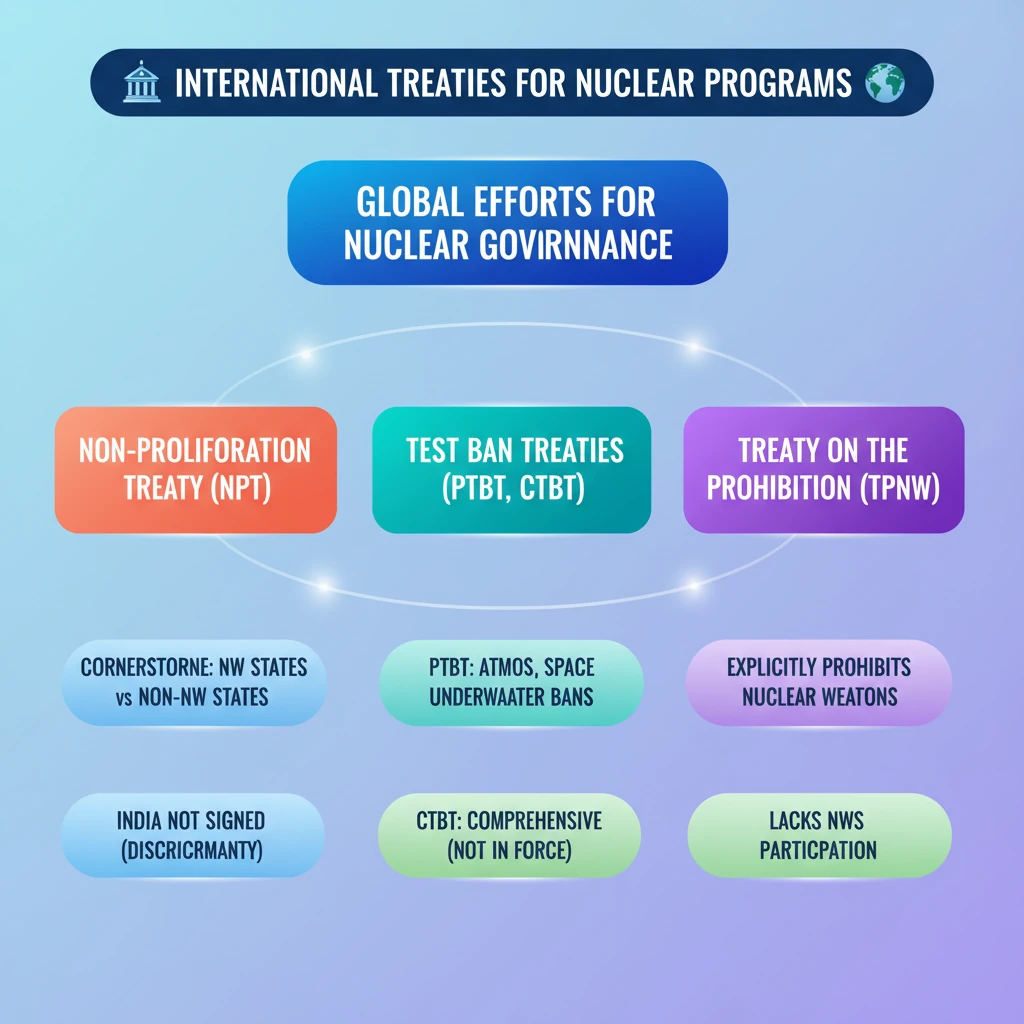
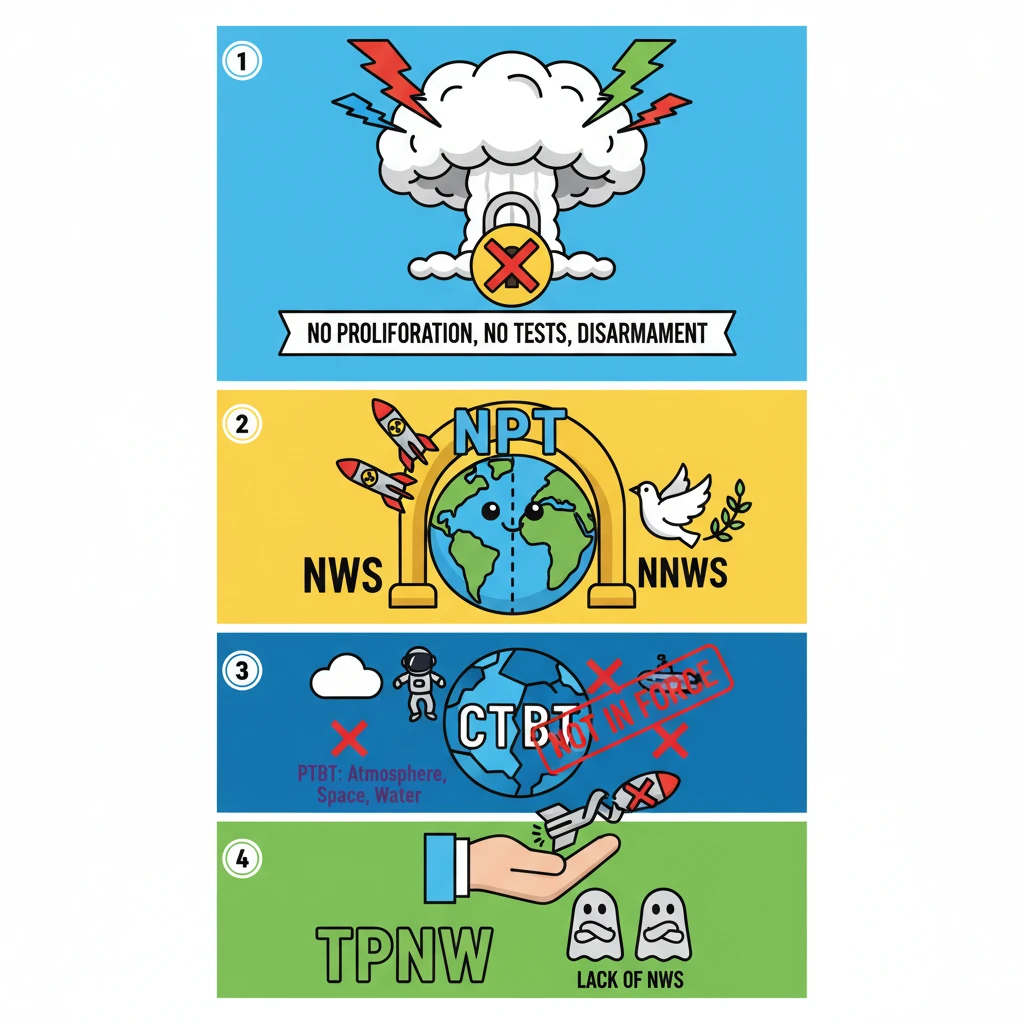
- •Nuclear treaties aim to prevent proliferation, ban testing, and promote disarmament.
- •NPT is the cornerstone, distinguishing between Nuclear-Weapon States and Non-Nuclear-Weapon States.
- •PTBT banned tests in atmosphere, outer space, and underwater; CTBT aims for a comprehensive ban but is not in force.
- •TPNW is a newer treaty explicitly prohibiting nuclear weapons, but lacks NWS participation.
- •India has not signed NPT or CTBT, citing their discriminatory nature, while advocating for universal disarmament.
🧠 Memory Techniques
95% Verified Content