Colombo Security Conclave - International Relations | UPSC Learning
Topics
0 topics • 0 completed
🔍
No topics match your search
Colombo Security Conclave
Medium⏱️ 10 min read
international relations
📖 Introduction
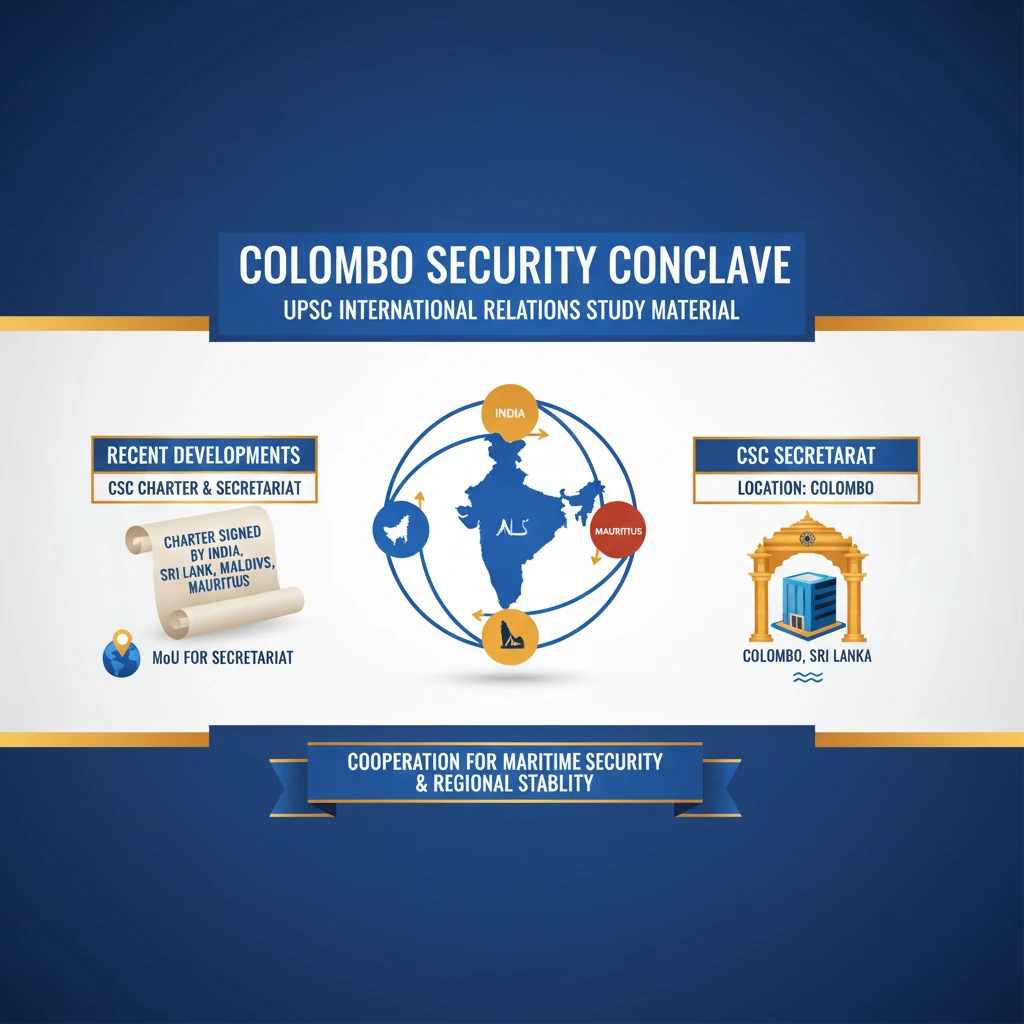
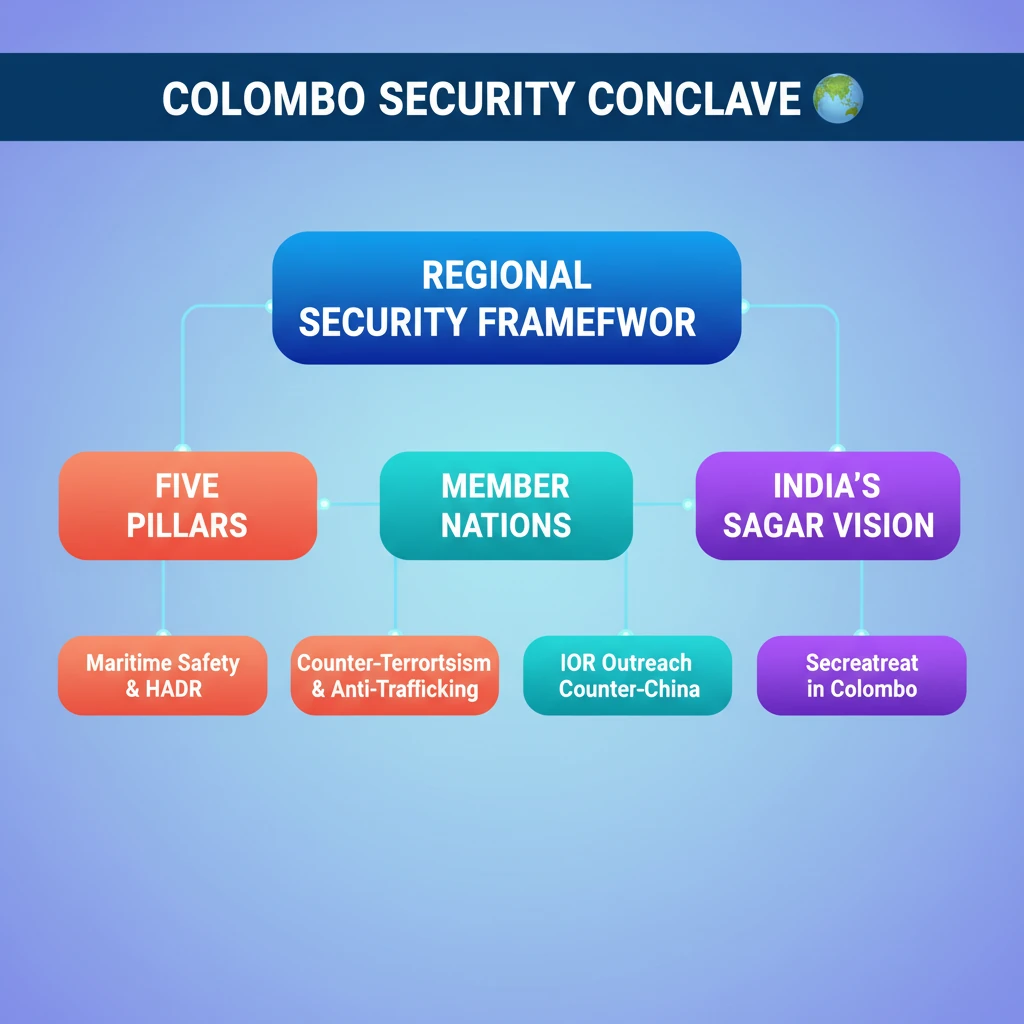
<h4>Recent Developments: CSC Charter and Secretariat</h4><p>Recently, the member states of the <strong>Colombo Security Conclave (CSC)</strong> – <strong>India</strong>, <strong>Sri Lanka</strong>, the <strong>Maldives</strong>, and <strong>Mauritius</strong> – signed a crucial <strong>Charter</strong>. This significant event was accompanied by a <strong>Memorandum of Understanding (MoU)</strong> for the establishment of the <strong>CSC Secretariat</strong>, which will be located in <strong>Colombo</strong>.</p><div class='info-box'><p>During the signing, <strong>Bangladesh</strong> was notably absent, while <strong>Seychelles</strong> participated in the proceedings as an <strong>observer state</strong>.</p></div><h4>Origins and Evolution of CSC</h4><p>The <strong>Colombo Security Conclave</strong> has its roots in an earlier initiative known as the <strong>NSA Trilateral on Maritime Security</strong>. This trilateral framework was initially established in <strong>2011</strong> between <strong>India</strong>, <strong>Sri Lanka</strong>, and the <strong>Maldives</strong>.</p><p>The primary objective behind its formation was to enhance <strong>maritime security</strong> and cooperation within the strategically vital <strong>Indian Ocean Region (IOR)</strong>. It was originally an initiative spearheaded by <strong>Sri Lanka</strong>.</p><h4>Member States and Observers</h4><p>The <strong>founding members</strong> of the conclave were <strong>India</strong>, <strong>Sri Lanka</strong>, and the <strong>Maldives</strong>. Over time, its membership has expanded to include other key regional players.</p><ul><li><strong>Mauritius</strong> officially joined the conclave in <strong>2022</strong>.</li><li><strong>Bangladesh</strong> became a member in <strong>2024</strong>, further broadening the conclave's reach.</li><li><strong>Seychelles</strong> currently holds the status of an <strong>observer state</strong>, participating in discussions and activities.</li></ul><h4>Pillars of Cooperation</h4><p>Cooperation within the <strong>Colombo Security Conclave</strong> is structured around <strong>five core pillars</strong>, addressing a comprehensive range of security challenges in the region.</p><div class='key-point-box'><ul><li><strong>Maritime Safety and Security:</strong> Focusing on safeguarding sea lanes and preventing illicit activities.</li><li><strong>Countering Terrorism and Radicalisation:</strong> Joint efforts to combat extremist threats.</li><li><strong>Combatting Trafficking and Transnational Organised Crime:</strong> Addressing issues like drug and human trafficking.</li><li><strong>Cyber Security and Protection of Critical Infrastructure and Technology:</strong> Enhancing digital resilience.</li><li><strong>Humanitarian Assistance and Disaster Relief (HADR):</strong> Coordinated responses to natural calamities and crises.</li></ul></div><h4>Joint Defence Exercises</h4><p>The member states actively engage in joint exercises to enhance interoperability and readiness in addressing shared security concerns. These exercises are crucial for practical cooperation.</p><ul><li>In <strong>November 2021</strong>, <strong>India</strong>, <strong>Sri Lanka</strong>, and the <strong>Maldives</strong> conducted <strong>Exercise Dosti XV</strong> in the <strong>Maldives</strong>, focusing on maritime security.</li><li>Subsequently, these three nations also carried out their <strong>first joint exercise in the Arabian Sea</strong>, operating under the broader aegis of the <strong>CSC</strong>.</li></ul><h4>Timeline of Meetings and Revival</h4><p>The initial dialogues among the original three countries commenced in <strong>2011</strong> in the <strong>Maldives</strong>. Subsequent meetings were held in <strong>Sri Lanka (2013)</strong> and <strong>India (2014)</strong>.</p><p>However, the dialogue experienced a period of stagnation after <strong>2014</strong>. This pause was primarily attributed to rising tensions between <strong>India</strong> and the <strong>Maldives</strong>, coupled with the increasing geopolitical influence of <strong>China</strong> in the <strong>Indian Ocean</strong>.</p><p>The initiative was successfully revived and subsequently <strong>re-branded</strong> as the <strong>Colombo Security Conclave</strong> in <strong>2020</strong>, signaling renewed commitment to regional security cooperation.</p><h4>Strategic Importance for India and the Region</h4><p>The <strong>Colombo Security Conclave</strong> holds immense significance for <strong>India's Indian Ocean outreach</strong> and its broader strategic objectives in the region.</p><div class='exam-tip-box'><p>The CSC significantly strengthens <strong>India's position</strong> as a net security provider in the <strong>IOR</strong>. It serves as a crucial mechanism to <strong>counter China's growing influence</strong> in the region, particularly in the maritime domain.</p><p>It aligns seamlessly with <strong>India's SAGAR vision</strong> (Security and Growth for All in the Region), fostering sub-regionalism and collective security among <strong>Indian Ocean nations</strong> on a shared platform.</p></div><h4>Related Regional Energy Infrastructure Projects</h4><p>Beyond maritime security, regional dynamics also involve significant energy infrastructure projects that have geopolitical implications, though distinct from the direct mandate of CSC.</p><h5>Turkmenistan-Afghanistan-Pakistan-India (TAPI) Pipeline</h5><p>The <strong>TAPI pipeline</strong> is a major energy project envisioned to transport natural gas from <strong>Turkmenistan</strong> to <strong>Afghanistan</strong>, <strong>Pakistan</strong>, and <strong>India</strong>. It has several strategic and economic dimensions.</p><div class='info-box'><ul><li><strong>Environmental Benefits:</strong> Potential to alleviate <strong>air pollution</strong> in major cities like <strong>Delhi</strong>, <strong>Mumbai</strong>, <strong>Karachi</strong>, and <strong>Islamabad</strong> by providing a cleaner energy alternative.</li><li><strong>Economic Growth:</strong> Offers opportunities for economic development in <strong>Afghanistan</strong> and <strong>Pakistan</strong> through transit fees and job creation. It could also stimulate investment in renewable energy.</li><li><strong>Strategic Influence:</strong> Seen as a key element in geopolitical competition for influence in <strong>Central Asia</strong>. The <strong>US</strong> views it as a counter to the <strong>Iran-Pakistan-India (IPI) pipeline</strong>, supported by <strong>Iran</strong> and <strong>Russia</strong>.</li><li><strong>Diversification for Turkmenistan:</strong> Provides <strong>Turkmenistan</strong> a chance to diversify its export markets and reduce dependency on existing routes to <strong>China</strong> and <strong>Russia</strong>.</li><li><strong>Counterweight to Chinese Influence:</strong> Could serve as a counterweight to <strong>Chinese influence</strong>, particularly in <strong>Pakistan</strong>, given <strong>China's investment in CPEC</strong>.</li><li><strong>Regional Cooperation:</strong> Enhances cooperation among <strong>Central</strong> and <strong>South Asian countries</strong>, potentially fostering collaborations in energy, communication, and transportation.</li><li><strong>India's Role:</strong> Positions <strong>Turkmenistan</strong> as a crucial energy partner for <strong>India</strong>, enhancing <strong>India’s connectivity with Central Asia</strong> and aligning with <strong>India’s broader strategy of regional connectivity and energy security</strong>.</li></ul></div><h5>India's Other Bilateral/Multilateral Energy Projects</h5><p>India is involved in several other energy infrastructure projects to bolster its energy security and regional connectivity.</p><ul><li><strong>India-Bangladesh Friendship Pipeline:</strong> Enhancing energy ties with <strong>Bangladesh</strong>.</li><li><strong>Mothari-Amlekhgunj Pipeline (India-Nepal):</strong> Strengthening energy cooperation with <strong>Nepal</strong>.</li><li><strong>Bay of Bengal Initiative for Multi-Sectoral Technical and Economic Cooperation (BIMSTEC):</strong> A platform for regional cooperation, including energy.</li><li><strong>International North-South Transport Corridor (INSTC):</strong> A multimodal network for freight transport, crucial for trade and energy routes.</li></ul>
💡 Key Takeaways
- •CSC evolved from the 2011 NSA Trilateral, re-branded in 2020.
- •Current members: India, Sri Lanka, Maldives, Mauritius, Bangladesh; Seychelles is an observer.
- •Five pillars of cooperation: Maritime safety, counter-terrorism, anti-trafficking, cyber security, HADR.
- •Recent milestone: Signing of CSC Charter and establishment of Secretariat in Colombo.
- •Significance for India: Strengthens IOR outreach, counters China, aligns with SAGAR vision.
- •Joint exercises like 'Dosti XV' enhance interoperability among member states.
🧠 Memory Techniques
95% Verified Content
📚 Reference Sources
•Ministry of External Affairs (MEA), Government of India
•Official websites of Colombo Security Conclave member states