Indian Diaspora - International Relations | UPSC Learning
Topics
0 topics • 0 completed
🔍
No topics match your search
Indian Diaspora
Medium⏱️ 8 min read
international relations
📖 Introduction
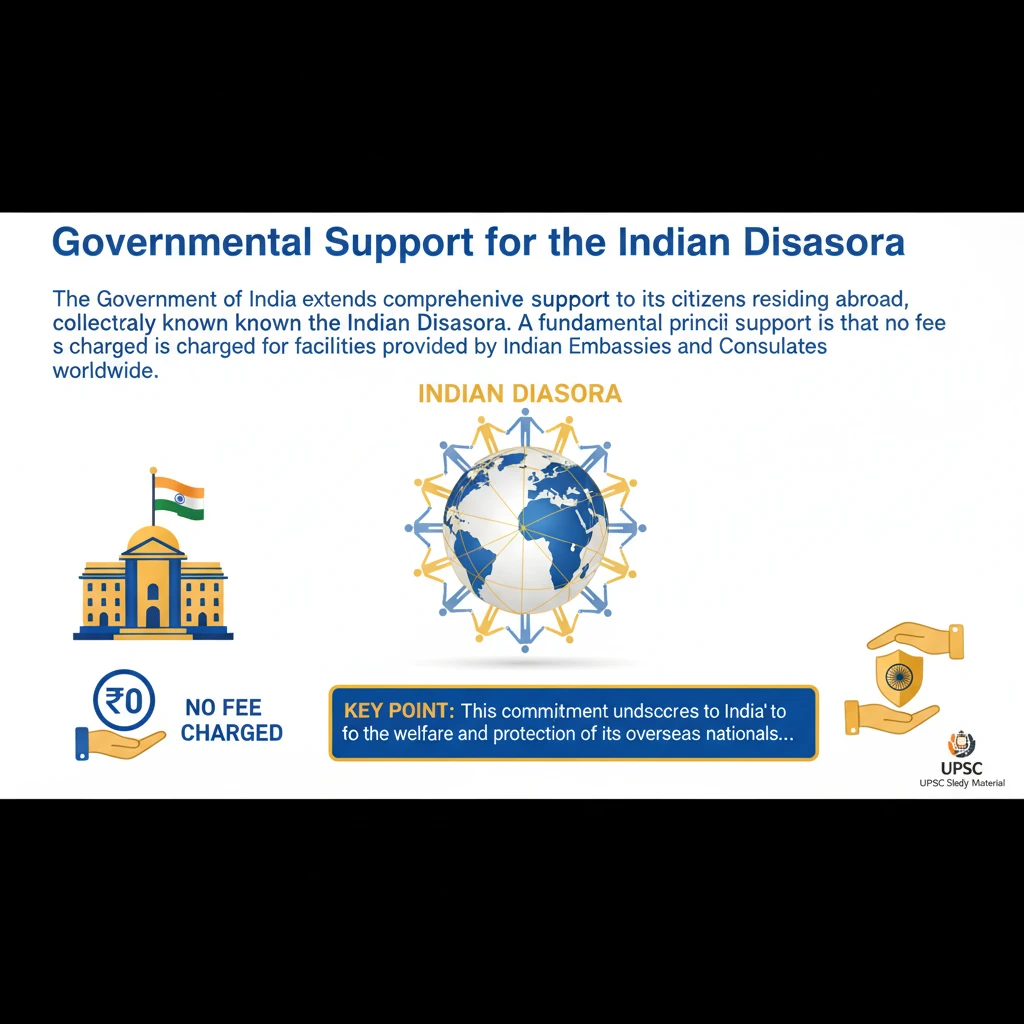
<h4>Governmental Support for the Indian Diaspora</h4><p>The Government of India extends comprehensive support to its citizens residing abroad, collectively known as the <strong>Indian Diaspora</strong>. A fundamental principle of this support is that <strong>no fee is charged</strong> for facilities provided by Indian Embassies and Consulates worldwide.</p><div class='key-point-box'><p>This commitment underscores India's dedication to the welfare and protection of its overseas nationals, reflecting a citizen-centric approach in its foreign policy.</p></div><h4>Indian Community Welfare Fund (ICWF)</h4><p>The <strong>Indian Community Welfare Fund (ICWF)</strong> is a vital mechanism established at Indian Missions and Posts abroad. Its primary objective is to provide assistance to <strong>overseas Indian nationals in distress situations</strong>.</p><div class='info-box'><p>The <strong>ICWF</strong> offers various forms of support, including:</p><ul><li><strong>Financial assistance</strong> for legal aid.</li><li>Provision of <strong>travel documents</strong>.</li><li>Arrangement of <strong>air tickets during repatriation</strong>.</li><li>Support in other deserving cases of hardship.</li></ul></div><h4>Repatriation of Indian Nationals</h4><p>The Indian government actively pursues the issue of <strong>release and repatriation</strong> of Indian nationals incarcerated in foreign prisons. This is a continuous process conducted through <strong>consular and other consultations</strong> with the concerned foreign governments.</p><p>These efforts aim to ensure due process and humanitarian treatment for Indian citizens detained abroad, facilitating their safe return home.</p><h4>Pardon and Reduction in Prison Sentences</h4><p>India consistently engages with foreign governments to seek <strong>pardon or reduction of sentences</strong> for Indian inmates. While some countries grant such relief to various nationalities, they often do not share specific data with the concerned countries.</p><div class='info-box'><p>Significant progress has been made: Since <strong>2014</strong>, a total of <strong>4,597 Indian nationals</strong> have received pardon or reduction of their sentences by foreign governments. This achievement is a direct result of sustained efforts by the Indian Government through multiple diplomatic channels.</p></div><h4>Agreement(s) on Transfer of Sentenced Persons (TSP)</h4><p>India has established a robust framework for the <strong>Transfer of Sentenced Persons (TSP)</strong>. These agreements allow Indian prisoners lodged in foreign countries to be transferred to India to serve the remainder of their sentences, and vice-versa for foreign nationals in Indian prisons.</p><div class='key-point-box'><p>The <strong>TSP agreements</strong> are crucial for humanitarian reasons, enabling prisoners to be closer to their families and cultural environment during their incarceration.</p></div><p>India has signed <strong>bilateral TSP agreements</strong> with <strong>31 countries</strong>. These include:</p><ul><li><strong>Australia</strong>, <strong>Bahrain</strong>, <strong>Bangladesh</strong>, <strong>Bosnia & Herzegovina</strong>, <strong>Brazil</strong>, <strong>Bulgaria</strong>, <strong>Cambodia</strong>, <strong>Egypt</strong>, <strong>Estonia</strong>, <strong>France</strong>, <strong>Hong Kong</strong>, <strong>Iran</strong>, <strong>Israel</strong>, <strong>Italy</strong>, <strong>Kazakhstan</strong>, <strong>Korea</strong>, <strong>Kuwait</strong>, <strong>Maldives</strong>, <strong>Mauritius</strong>, <strong>Mongolia</strong>, <strong>Qatar</strong>, <strong>Russia</strong>, <strong>Saudi Arabia</strong>, <strong>Somalia</strong>, <strong>Spain</strong>, <strong>Sri Lanka</strong>, <strong>Thailand</strong>, <strong>Turkey</strong>, <strong>United Arab Emirates (UAE)</strong>, <strong>United Kingdom</strong>, and <strong>Vietnam</strong>.</li></ul><p>Beyond bilateral pacts, India is also a signatory to <strong>two multilateral conventions</strong> on the transfer of sentenced persons:</p><ol><li>The <strong>Inter-American Convention on Serving Criminal Sentences Abroad</strong>.</li><li>The <strong>Council of Europe Convention on the Transfer of Sentenced Persons</strong>.
💡 Key Takeaways
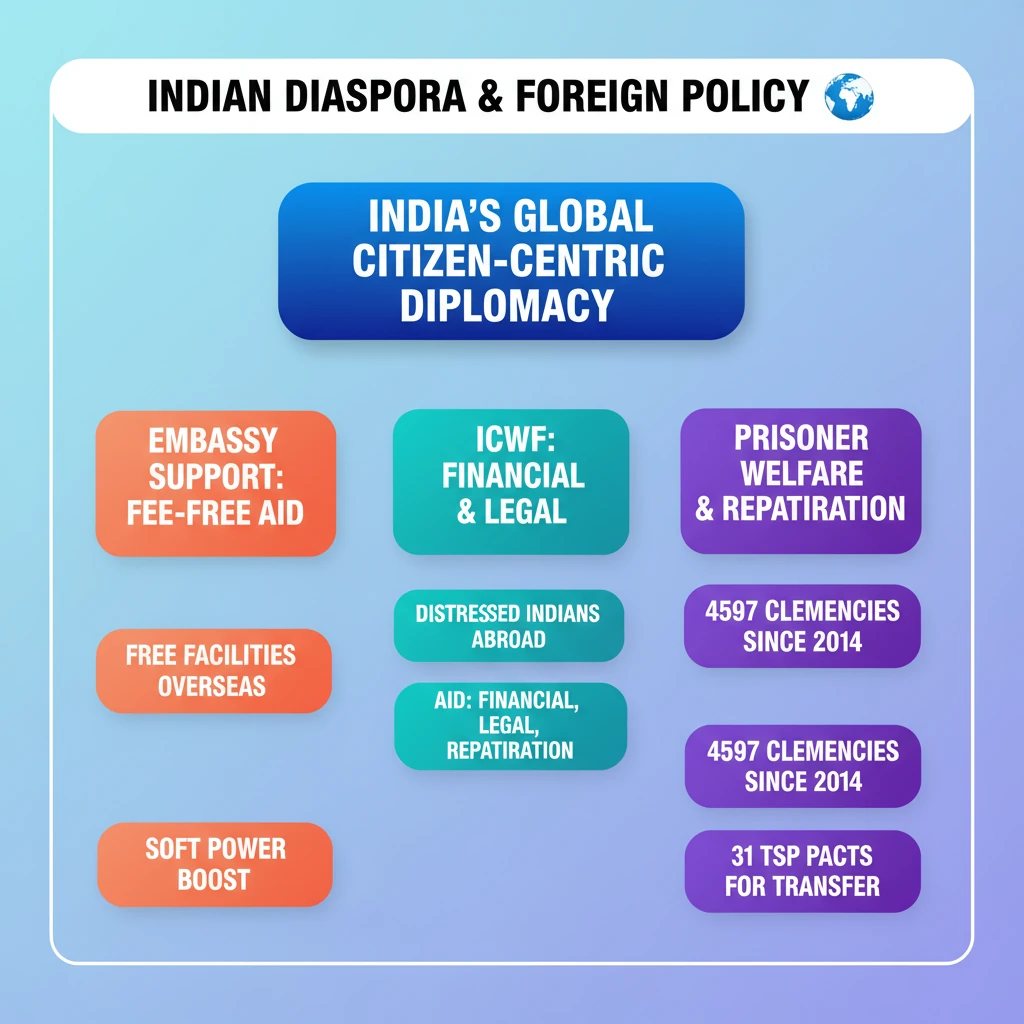
- •Indian Embassies provide fee-free facilities to overseas nationals.
- •ICWF offers financial, legal, and repatriation aid to distressed Indians abroad.
- •Government actively pursues repatriation and sentence reduction for Indian prisoners, achieving 4,597 clemencies since 2014.
- •India has signed TSP agreements with 31 countries and two multilateral conventions for prisoner transfer.
- •These mechanisms are crucial for India's citizen-centric foreign policy and soft power.
🧠 Memory Techniques

95% Verified Content