Support and Promotion to India-Middle East-Europe Economic Corridor (IMEC) - International Relations | UPSC Learning
Topics
0 topics • 0 completed
🔍
No topics match your search
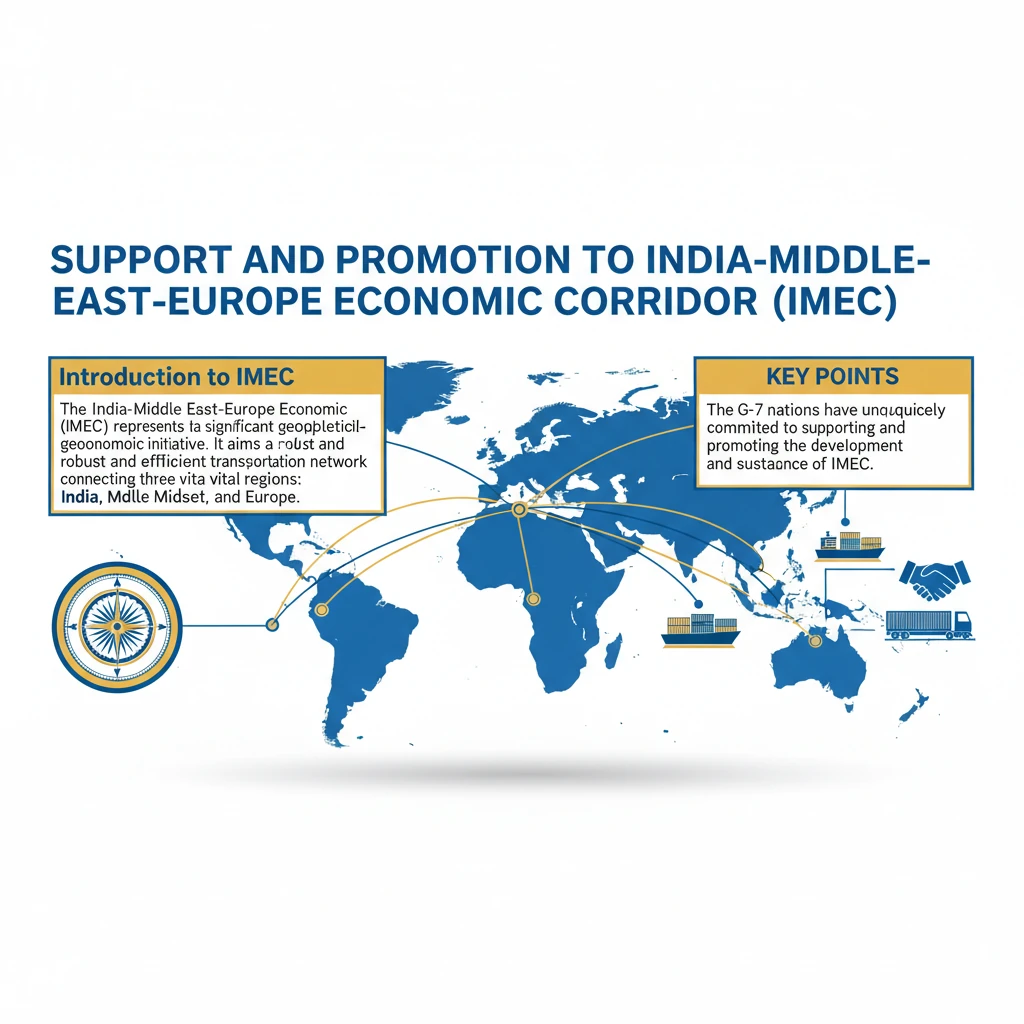
Support and Promotion to India-Middle East-Europe Economic Corridor (IMEC)
Medium⏱️ 8 min read
international relations
📖 Introduction
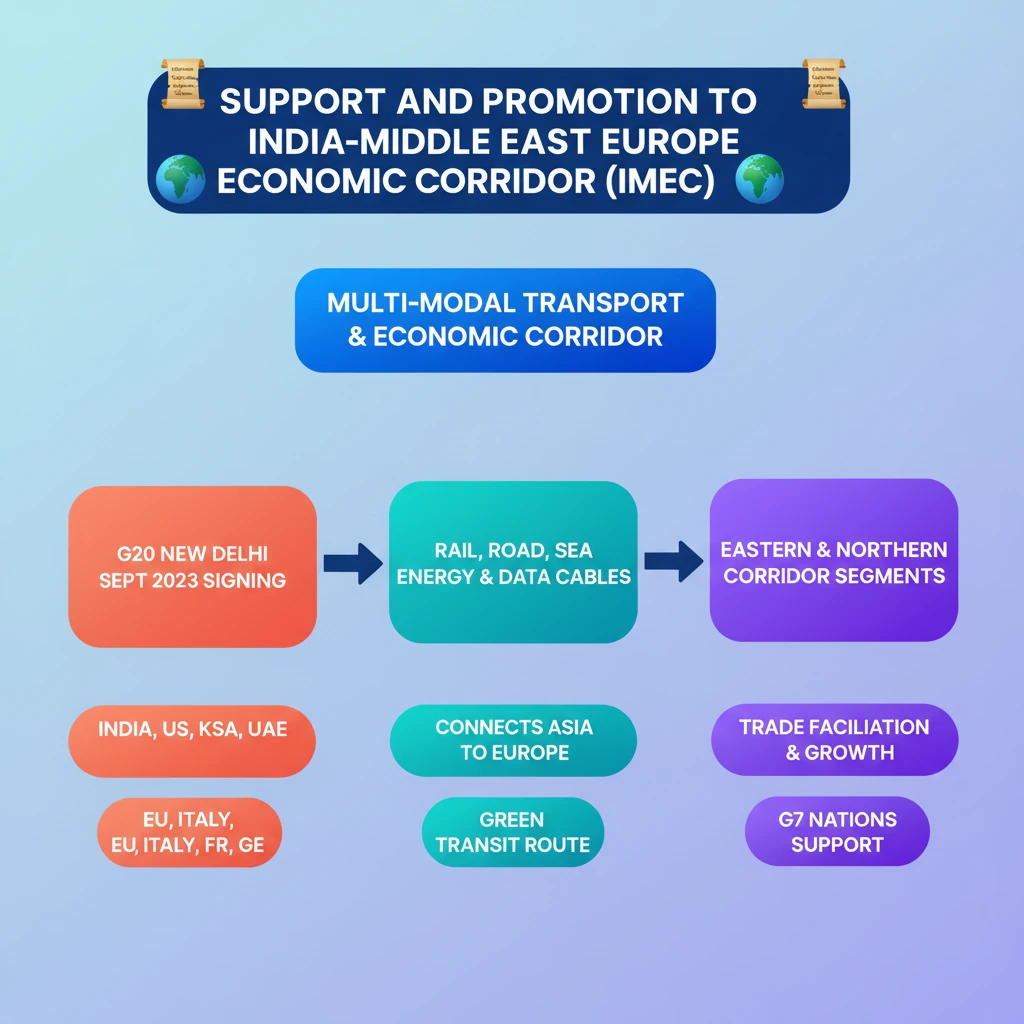
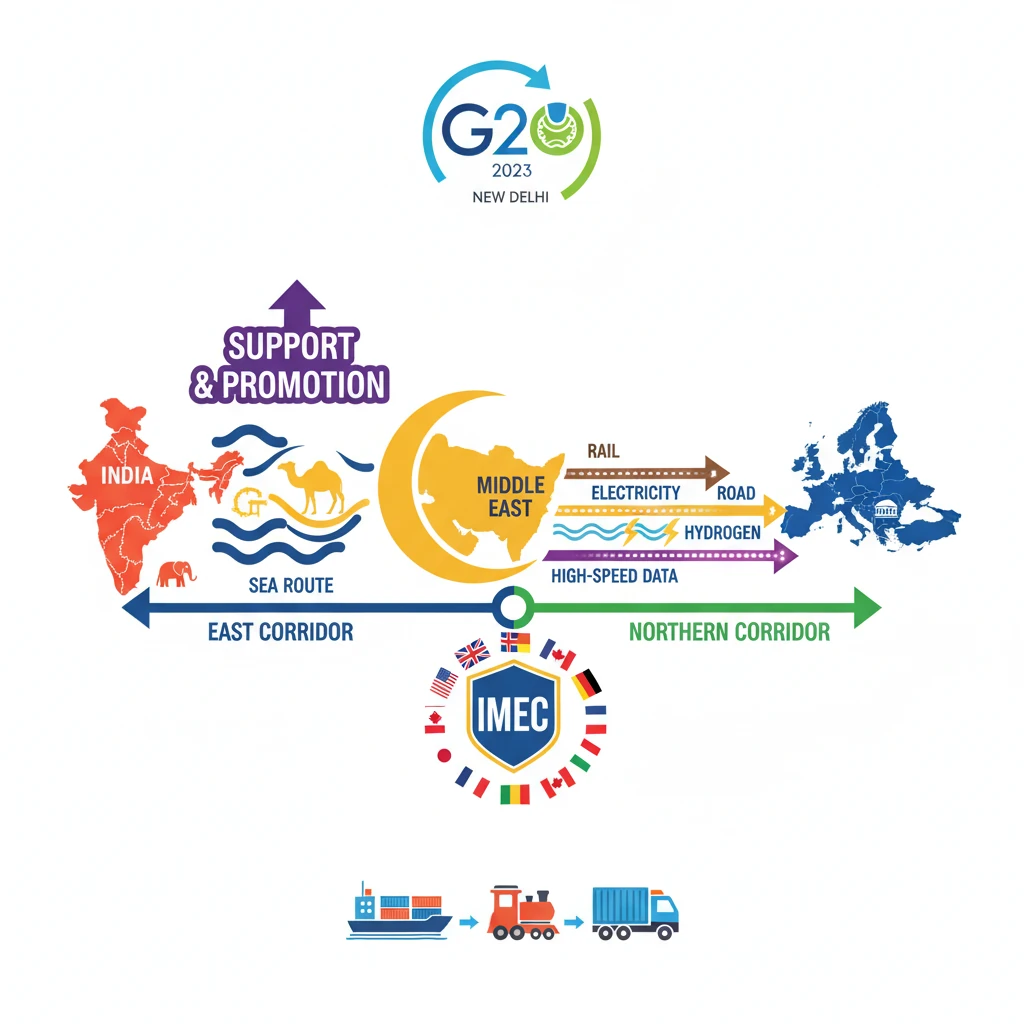
<h4>Introduction to IMEC</h4><p>The <strong>India-Middle East-Europe Economic Corridor (IMEC)</strong> represents a significant geopolitical and geoeconomic initiative. It aims to establish a robust and efficient transportation network connecting three vital regions: <strong>India</strong>, the <strong>Middle East</strong>, and <strong>Europe</strong>.</p><div class='key-point-box'><p>The <strong>G-7 nations</strong> have unequivocally committed to supporting and promoting the development and successful implementation of the <strong>IMEC</strong>, underscoring its global strategic importance.</p></div><h4>Core Objective and Components</h4><p>The primary objective of <strong>IMEC</strong> is to create a comprehensive multi-modal transportation network. This network is designed to enhance connectivity, facilitate trade, and foster economic integration across the participating regions.</p><p>The corridor will integrate various modes of transport, including <strong>rail, road, and sea routes</strong>. Beyond traditional transport, it will also feature advanced infrastructure elements.</p><div class='info-box'><p><strong>Key Infrastructure Components:</strong><ul><li><strong>Electricity cable:</strong> For energy transmission.</li><li><strong>Hydrogen pipeline:</strong> To support green energy initiatives.</li><li><strong>High-speed data cable:</strong> For digital connectivity and communication.</li></ul></p></div><h4>Corridor Structure</h4><p>The proposed <strong>IMEC</strong> is structured into two distinct corridors, each serving a crucial segment of the overall route. These corridors are designed to optimize connectivity and logistics.</p><div class='info-box'><p><strong>IMEC Corridors:</strong><ul><li><strong>East Corridor:</strong> This segment will connect <strong>India</strong> directly to the <strong>Arabian Gulf</strong>, establishing a vital maritime and land link.</li><li><strong>Northern Corridor:</strong> Extending from the <strong>Arabian Gulf</strong>, this corridor will provide a direct connection to <strong>Europe</strong>, completing the intercontinental route.</li></ul></p></div><h4>Signing and Participants</h4><p>The formal agreement for the <strong>IMEC</strong> was a landmark event, signed during the <strong>G20 Summit in New Delhi</strong> in <strong>September 2023</strong>. This signing highlighted global consensus on the project's importance.</p><p>A diverse group of nations and entities are signatories to the <strong>IMEC</strong> agreement, reflecting its broad international support and collaborative nature.</p><div class='info-box'><p><strong>Signatories of IMEC:</strong><ul><li><strong>India</strong></li><li><strong>United States (US)</strong></li><li><strong>Saudi Arabia</strong></li><li><strong>United Arab Emirates (UAE)</strong></li><li><strong>European Union (EU)</strong></li><li><strong>Italy</strong></li><li><strong>France</strong></li><li><strong>Germany</strong></li></ul></p></div><h4>Broader Context and Related Initiatives</h4><p>The <strong>IMEC</strong> project is an integral part of the larger <strong>Partnership for Global Infrastructure and Investment (PGII)</strong> initiative. <strong>PGII</strong> is a G7-led effort to fund infrastructure projects globally, often seen as a counter to China's Belt and Road Initiative (BRI).</p><p>In addition to <strong>IMEC</strong>, the <strong>G7</strong> has also extended its support to other significant infrastructure projects worldwide. This demonstrates a broader commitment to global connectivity and development.</p><div class='exam-tip-box'><p><strong>UPSC Insight:</strong> Understanding <strong>IMEC's</strong> connection to <strong>PGII</strong> is crucial for analyzing global infrastructure competition and cooperation. Questions often link specific projects to broader strategic initiatives.</p></div><p>Other corridors receiving <strong>G7</strong> support include the <strong>Lobito Corridor</strong> in Central Africa, the <strong>Luzon Corridor</strong>, and the <strong>Middle Corridor</strong>. These projects collectively aim to enhance regional and intercontinental trade routes.</p>
💡 Key Takeaways
- •IMEC is a multi-modal transport and economic corridor connecting India, the Middle East, and Europe.
- •It was signed at the G20 Summit in New Delhi in September 2023, with G7 nations committed to its promotion.
- •The corridor comprises rail, road, and sea routes, along with electricity, hydrogen, and high-speed data cables.
- •It consists of two main segments: an East Corridor (India to Arabian Gulf) and a Northern Corridor (Arabian Gulf to Europe).
- •Key signatories include India, US, Saudi Arabia, UAE, EU, Italy, France, and Germany.
- •IMEC is part of the G7's Partnership for Global Infrastructure and Investment (PGII), offering an alternative to China's BRI.
🧠 Memory Techniques
95% Verified Content
📚 Reference Sources
•G20 New Delhi Leaders' Declaration, September 2023
•White House Fact Sheet: Partnership for Global Infrastructure and Investment (PGII) and India-Middle East-Europe Economic Corridor (IMEC)
•European Commission statements on IMEC
•Official statements from the Ministry of External Affairs, Government of India