Prime Minister’s Visits to Singapore and Brunei Darussalam - International Relations | UPSC Learning
Topics
0 topics • 0 completed
🔍
No topics match your search
Prime Minister’s Visits to Singapore and Brunei Darussalam
Medium⏱️ 7 min read
international relations
📖 Introduction
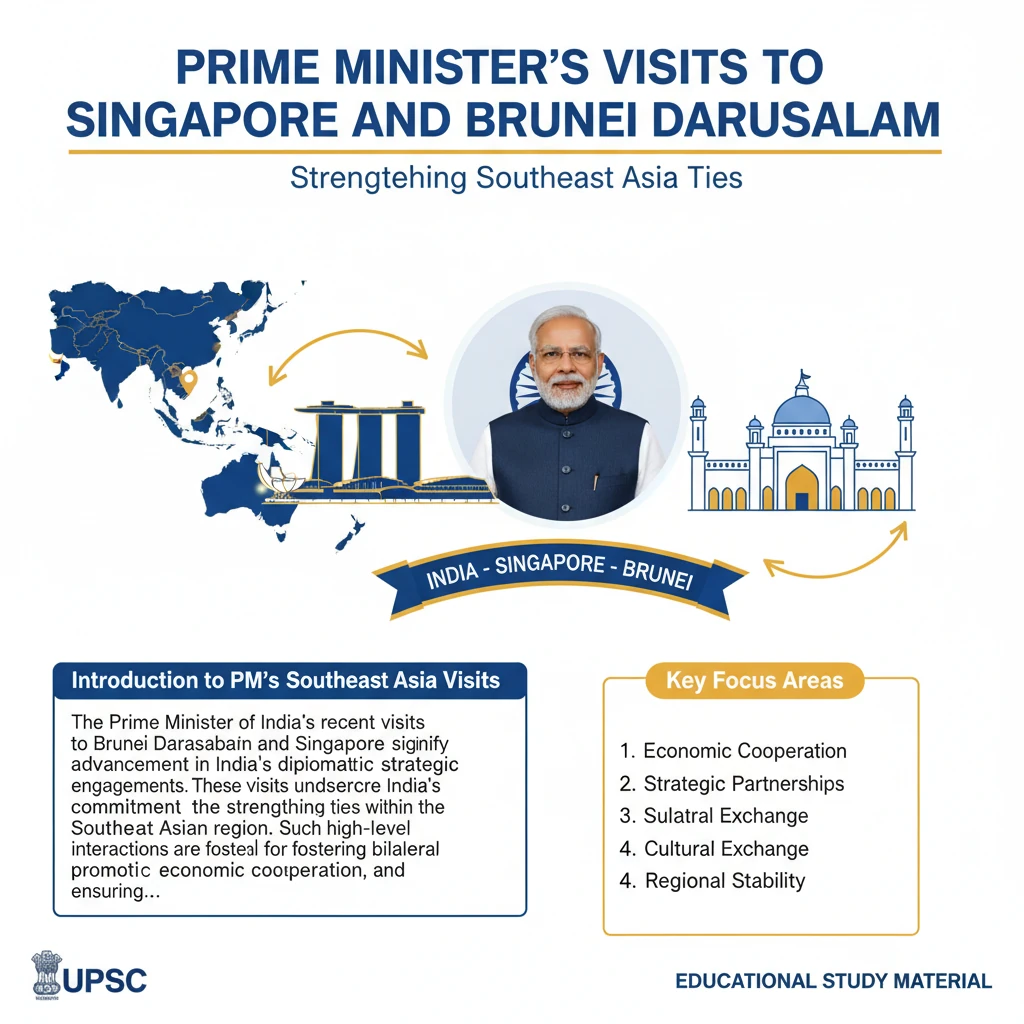
<h4>Introduction to PM's Southeast Asia Visits</h4><p>The <strong>Prime Minister of India's recent visits</strong> to <strong>Brunei Darussalam</strong> and <strong>Singapore</strong> signify crucial advancements in India's diplomatic and strategic engagements. These visits underscore India's commitment to strengthening ties within the <strong>Southeast Asian region</strong>.</p><p>Such high-level interactions are vital for fostering bilateral relations, promoting economic cooperation, and ensuring regional stability.</p><div class='exam-tip-box'><p><strong>UPSC Insight:</strong> These visits are directly linked to India's <strong>'Act East Policy'</strong>, emphasizing economic cooperation, cultural ties, and strategic partnerships with countries in the Asia-Pacific region. Understanding the specifics of engagements with individual nations like Singapore and Brunei is key for <strong>GS Paper 2 (International Relations)</strong>.</p></div><h4>Brunei Darussalam: Key Facts and Significance</h4><p><strong>Brunei Darussalam</strong> is a small, resource-rich nation strategically located in Southeast Asia. Its economy is predominantly driven by its vast hydrocarbon reserves.</p><div class='info-box'><p><strong>Location:</strong> Situated on the <strong>north-west of the island of Borneo</strong>. It has a coastline of about <strong>161-km</strong> along the <strong>South China Sea</strong>. It is bounded by the South China Sea to the north and by <strong>Malaysia</strong> on all other sides.</p><p><strong>Economy:</strong> Revenue primarily generated from <strong>crude oil</strong> and <strong>natural gas</strong>. Efforts are underway for economic diversification to reduce reliance on hydrocarbons.</p><p><strong>Energy Production:</strong> Brunei is the <strong>third-largest oil producer</strong> in Southeast Asia and the <strong>fourth-largest liquefied natural gas (LNG) producer globally</strong>.</p><p><strong>Main Exports:</strong> Consist of <strong>crude oil</strong>, <strong>petroleum products</strong>, and <strong>liquefied natural gas</strong>. These are largely sold to key markets such as <strong>Japan</strong>, the <strong>US</strong>, and various <strong>ASEAN countries</strong>.</p></div><h4>Singapore: Key Facts and Strategic Importance</h4><p><strong>Singapore</strong> is a highly developed island nation, renowned as a global financial hub and a critical maritime gateway. Its strategic location and robust economy make it a pivotal partner for India.</p><div class='info-box'><p><strong>Geography:</strong> An <strong>island nation</strong> comprising one main island, <strong>Pulau Ujong</strong>, and <strong>62 smaller islands</strong>. Its neighbors include <strong>Malaysia</strong> to the north and <strong>Indonesia</strong> to the south.</p><p><strong>Government and Economy:</strong> Operates as a <strong>Parliamentary Republic</strong>. It possesses one of the <strong>strongest economies in Southeast Asia</strong>, with significant sectors in <strong>banking</strong>, <strong>finance</strong>, and <strong>manufacturing</strong>.</p></div>
💡 Key Takeaways
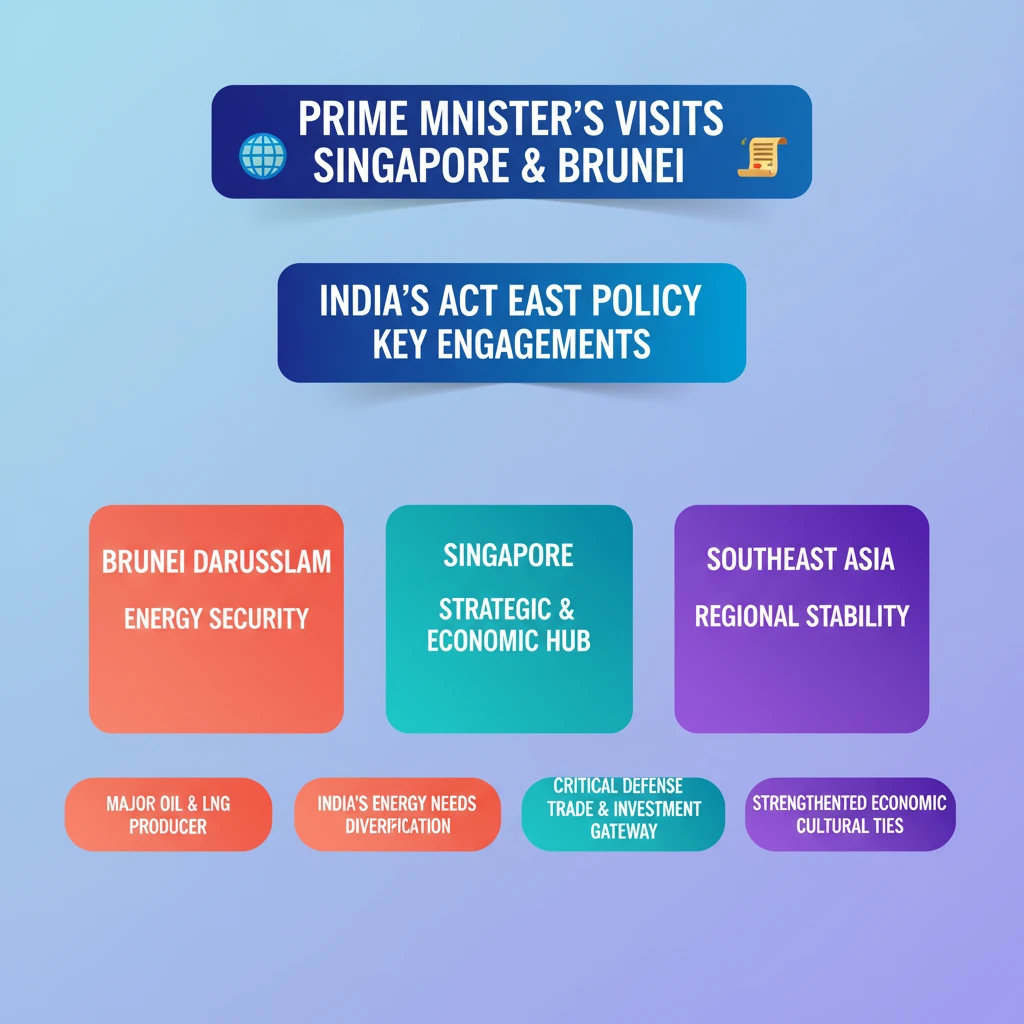
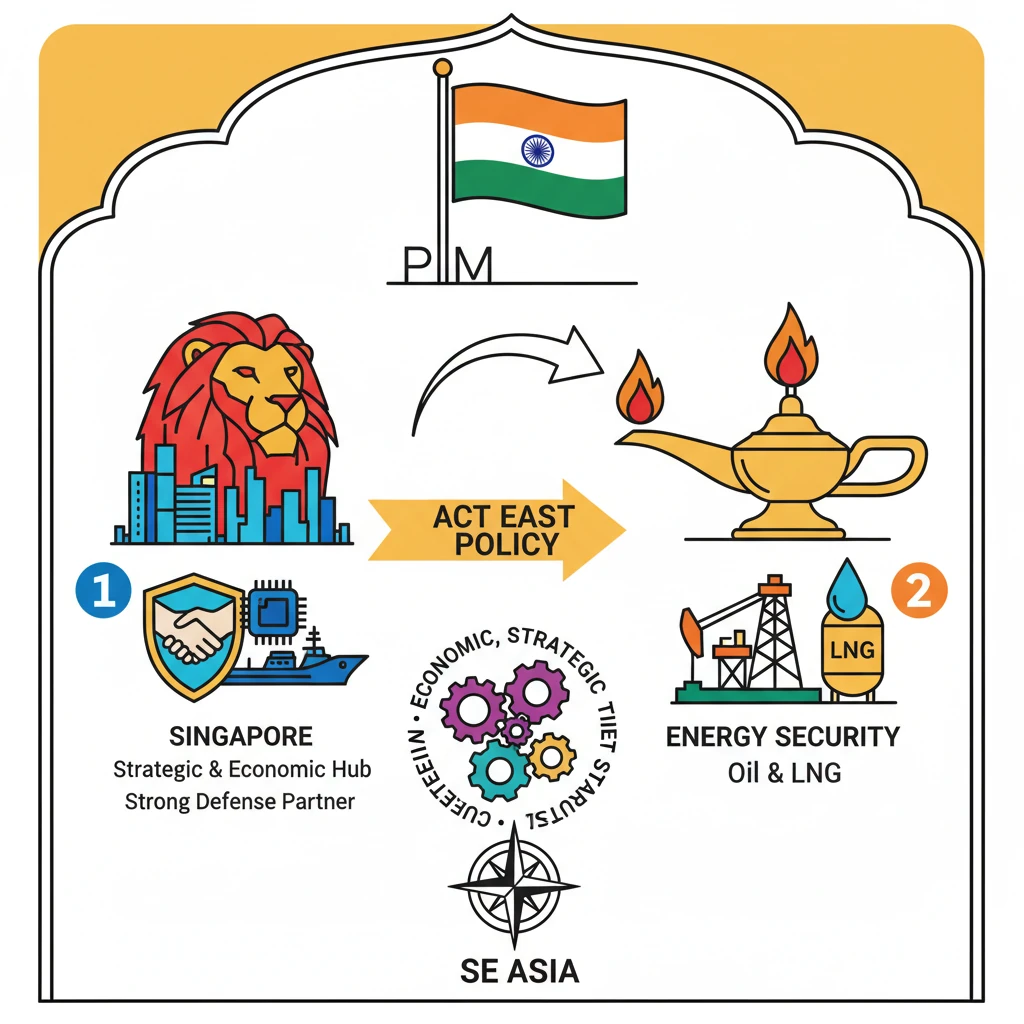
- •PM's visits to Singapore and Brunei are key to India's Act East Policy.
- •Brunei is vital for India's energy security as a major oil and LNG producer.
- •Singapore is a critical strategic and economic hub, and a strong defense partner.
- •These visits enhance India's economic, strategic, and cultural ties in Southeast Asia.
- •The engagements underscore India's commitment to regional stability and ASEAN centrality.
🧠 Memory Techniques
95% Verified Content