What are the Key Facts About India and Bhutan? - International Relations | UPSC Learning
Topics
0 topics • 0 completed
🔍
No topics match your search
What are the Key Facts About India and Bhutan?
Medium⏱️ 8 min read
international relations
📖 Introduction
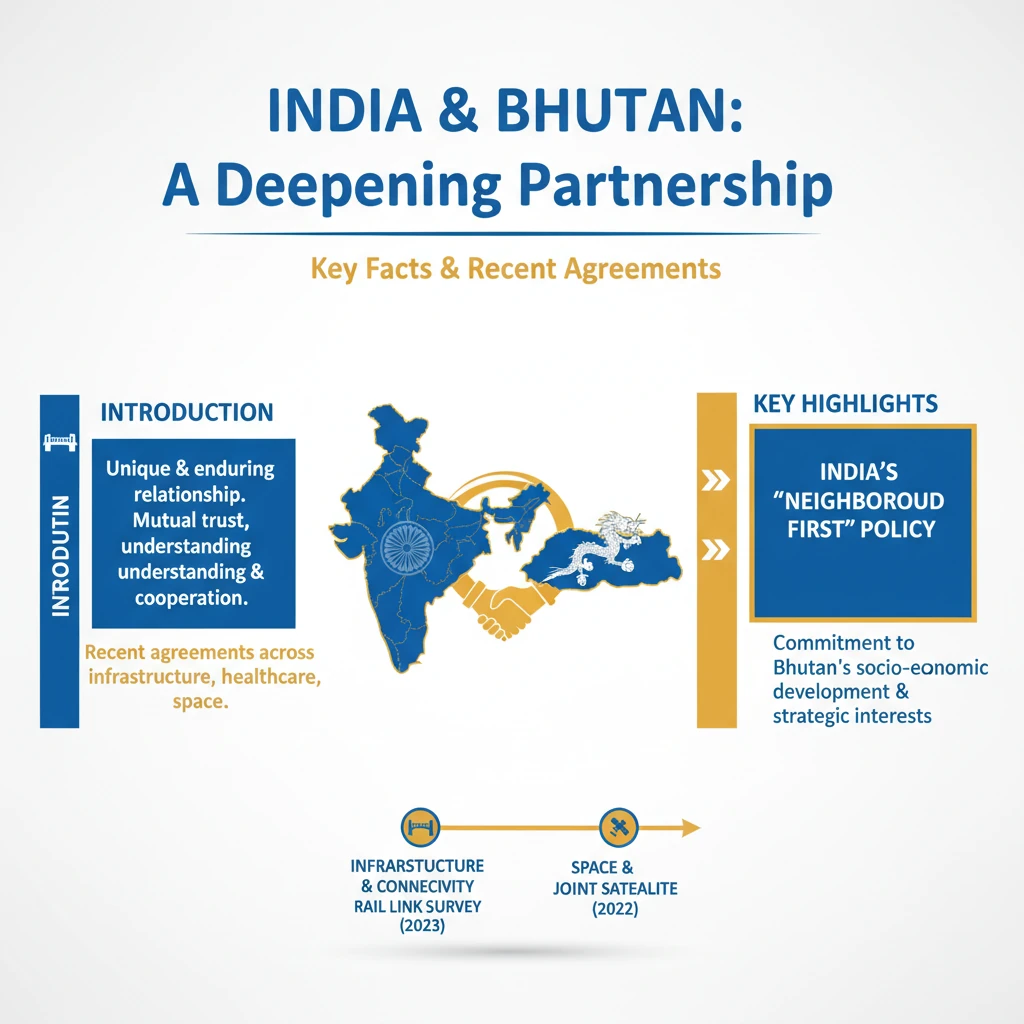
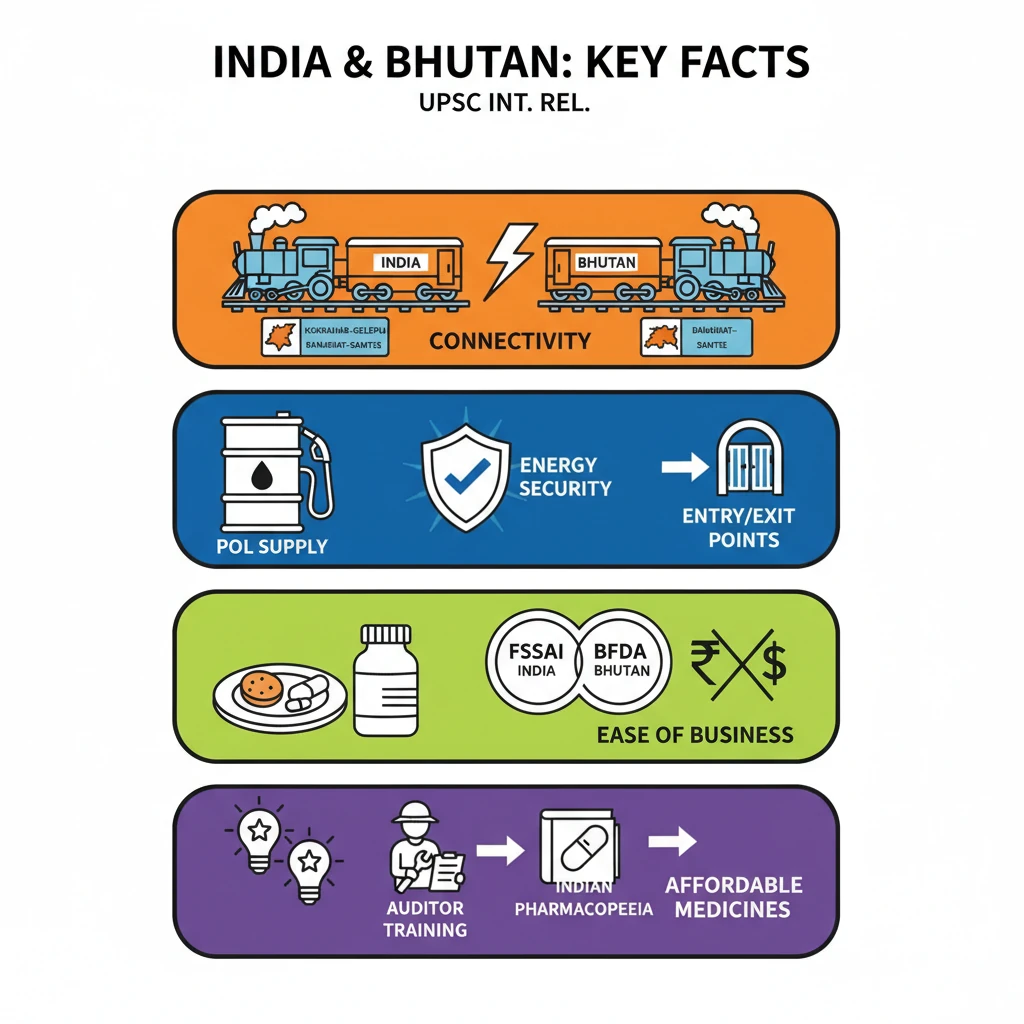
<h4>Introduction to India-Bhutan Relations</h4><p>India and Bhutan share a unique and enduring relationship, characterized by mutual trust, understanding, and cooperation. Recent agreements highlight the deepening of this bilateral partnership across various sectors, from infrastructure to healthcare and space.</p><div class='key-point-box'><p>The agreements underscore India's <strong>'Neighbourhood First' policy</strong> and its commitment to Bhutan's socio-economic development and strategic interests.</p></div><h4>Establishment of Rail Links</h4><p>A significant development is the finalization of a <strong>Memorandum of Understanding (MoU)</strong> for establishing crucial rail links between India and Bhutan. This initiative aims to enhance connectivity and facilitate trade and people-to-people contact.</p><div class='info-box'><p>Key rail links include the <strong>Kokrajhar-Gelephu rail link</strong> and the <strong>Banarhat-Samtse rail link</strong>. These projects are expected to boost economic activities in border regions.</p></div><h4>Petroleum, Oil, and Lubricants (POL) Supply</h4><p>An agreement has been reached for the general supply of <strong>Petroleum, Oil, and Lubricants (POL)</strong> and related products from India to Bhutan. This ensures a stable and reliable energy supply for Bhutan.</p><div class='info-box'><p>The agreement facilitates supply through mutually agreed <strong>entry/exit points</strong>, streamlining logistics and ensuring energy security for Bhutan.</p></div><h4>Recognition of Bhutan Food and Drug Authority (BFDA)</h4><p>A landmark agreement involves the recognition of official controls exercised by the <strong>Bhutan Food and Drug Authority (BFDA)</strong> by the <strong>Food Safety and Standards Authority Of India (FSSAI)</strong>. This promotes smoother trade in food and pharmaceutical products.</p><div class='info-box'><p>This recognition aims to promote <strong>ease of doing business</strong> and significantly reduce compliance costs for traders and manufacturers in both countries.</p></div><h4>Cooperation in Energy Efficiency and Energy Conservation</h4><p>An MoU has been finalized to assist Bhutan in enhancing <strong>energy efficiency</strong>, particularly within its household sector. This aligns with global efforts towards sustainable development.</p><div class='info-box'><p>Measures under this MoU include promoting a <strong>star labelling program</strong> for appliances and institutionalizing the training of <strong>energy auditors</strong> in Bhutan.</p></div><h4>Pharmacopoeia, Vigilance, and Testing of Medicinal Products</h4><p>This MoU focuses on enhancing cooperation and information exchange in the regulation of medicines. It is crucial for ensuring the quality and affordability of pharmaceutical products.</p><div class='info-box'><p>The agreement allows for the acceptance of <strong>Indian Pharmacopoeia</strong> by Bhutan and facilitates the supply of <strong>generic medicines</strong> at affordable prices, benefiting public health.</p></div><h4>Joint Plan of Action (JPOA) on Space Cooperation</h4><p>A concrete roadmap has been established for further developing <strong>space cooperation</strong> between India and Bhutan. This opens new avenues for technological advancement and research.</p><div class='info-box'><p>The JPOA includes provisions for exchange programs and training, fostering scientific collaboration and capacity building in the space sector.</p></div><div class='exam-tip-box'><p>These agreements are crucial for understanding India's evolving <strong>bilateral diplomacy</strong> and its role as a regional partner. They can be cited in answers related to <strong>GS Paper 2: International Relations</strong>, particularly on India's neighbourhood policy and economic diplomacy.</p></div>
💡 Key Takeaways
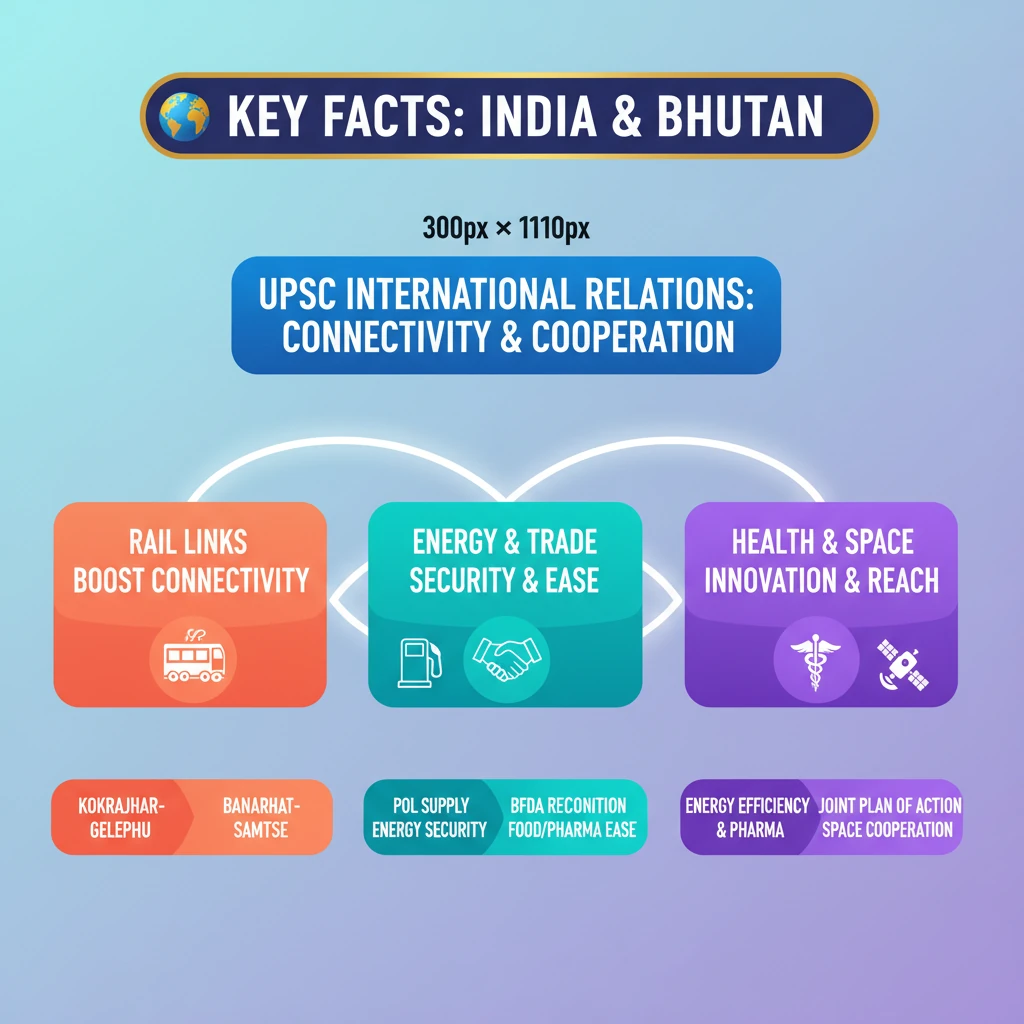
- •India and Bhutan have finalized agreements on rail links (Kokrajhar-Gelephu, Banarhat-Samtse) to boost connectivity.
- •A POL supply agreement ensures Bhutan's energy security through agreed entry/exit points.
- •BFDA recognition by FSSAI aims to ease business and reduce compliance costs in food/pharma trade.
- •MoUs cover energy efficiency (star labelling, auditor training) and acceptance of Indian Pharmacopoeia for affordable generic medicines.
- •A Joint Plan of Action (JPOA) strengthens space cooperation through exchange programs and training.
- •These agreements exemplify India's 'Neighbourhood First' policy and commitment to Bhutan's development and strategic interests.
🧠 Memory Techniques
98% Verified Content
📚 Reference Sources
•General knowledge of India-Bhutan bilateral relations